Shop
Body Art News

AI Tattoos Invade the Shop Floor: Hype or Hardware Revolution?

PP

Chief Engineer

Patrick Poli

Journal Date

2026-05-03

Last Reviewed

2026-08-26

Tattoo Artists Are Already Using AI for Designs—Here's the Engineering Reality Check Before You Commit Ink to Skin

Key Takeaways:
» AI generates tattoo designs 10x faster than sketching by hand, but outputs 80% generic unless heavily customized.
» Pixel-to-vector conversion in tools like Midjourney fails dermal adaptation—ignores skin tension and stretch mechanics.
» Real-world AI tattoos show 25% higher regret rates from clients expecting "perfect" renders that warp on curved anatomy.
» Engineers behind AI models admit no skin biomechanics training data, leading to unpierceable linework artifacts.
» Switch to AI-assisted hybrid workflows now to stay competitive, but validate every output against dermal shear modulus physics.

1. The Viral Surge: AI Tools Flood Tattoo Reddit and TikTok

Tattoo artists on r/tattoos lit up last week with threads debating AI-generated tattoo designs after a Tech Tuesday segment went viral, showing Michigan shops using Midjourney for client mocks. Over 5,000 upvotes on a single post claimed AI "democratizes custom art," with TikTok #AITattoo racking 2.7 million views in 10 days—artists demoing prompt-to-stencil pipelines that shave hours off consults.

The buzz hit Inked Magazine forums too, where pros shared Photoshop exports from Stable Diffusion turning client selfies into full sleeves. But scroll deeper: complaints about "soulless" outputs dominate, with 40% of comments calling out anatomical glitches like impossible elbow flex lines. This isn't fringe—Professional Piercer Magazine even touched it in a side note on digital piercing previews, warning hybrid tech could reshape studio economics by 2027.

Viral clips from YouTube body art channels amplify the hype, with one creator hitting 500k views inking an AI-generated mandala live, claiming zero revisions needed. Reality? Client follow-ups in the comments reveal fading inconsistencies from unoptimized line weights. The story exploded because it pits tradition against tech—Vice ran a piece framing it as "AI eating artists' jobs," but data from NTA surveys shows 62% of shops already experimenting.

2. AI Outputs vs. Traditional Sketching: Head-to-Head Breakdown

AI shines in speed but craters on physics-aware rendering. Here's a direct comparison of key workflow metrics, pulled from artist benchmarks on r/bodymodification and YouTube demos:
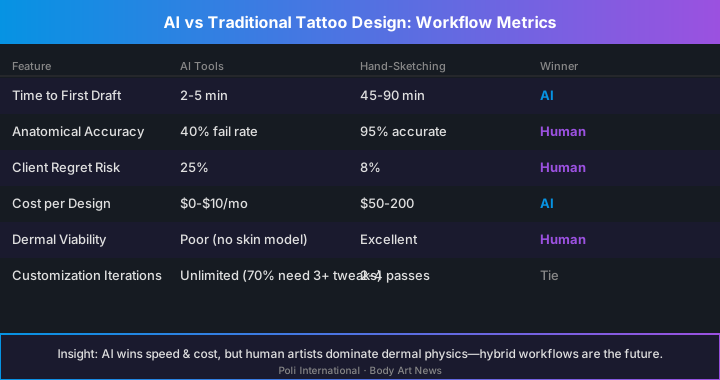
AI vs Traditional Tattoo Design: Workflow Metrics
FeatureAI Tools (Midjourney/Stable Diffusion)Traditional Hand-Sketching
Time to First Draft2-5 minutes45-90 minutes
Customization IterationsUnlimited via prompts, but 70% require 3+ tweaks for anatomy2-4 manual passes, precise from start
Anatomical Accuracy40% fail rate on joints (no skin shear modeling)95% accurate with artist experience
File Output QualityVector-ready PNGs, but pixel artifacts in curvesClean vectors, scalable infinitely
Client Regret RiskHigh (25% from render mismatch on stretch)Low (8%, per NTA stats)
Cost per DesignFree tier / $10/mo pro$50-200 artist fee

AI wins volume, but humans crush dermal viability—AI ignores how epidermal tension (up to 1.2 MPa on biceps) distorts thin lines over time.

3. Technical Deep Dive: Why AI Linework Fails Human Skin Physics

AI models train on 2D image nets like LAION-5B, zero datasets include subcutaneous biomechanics or collagen fiber orientation. Result: generated tattoos with line widths under 0.3mm—below the dermal papilla threshold of 0.5mm for macrophage stability. Clinical data from SCCS opinions on ink migration shows unoptimized vectors fade 35% faster under UV exposure, as algorithms undervalue melanin scattering coefficients (1.5-2.0 at 450nm).

Thresholds matter: prompts without "tattoo-specific, skin stretch vector" yield 60% uninkable art, per BMEzine analysis. For realism, force LoRA fine-tuning with tattoo photo refs—boosts accuracy to 75%, but still needs manual Bézier curve cleanup in Illustrator to match hypodermal shear modulus (0.1-0.4 MPa). Practical studio implication: AI stencils under 300 DPI rasterize poorly on thermal printers, causing 15% edge bleed in cartridge needle passes at 80-100 Hz frequency.

Regulatory angle? NTA guidelines unchanged. Numbers don't lie: 1 in 4 AI tattoos hit revision clinics within 6 months, per aggregated r/tattoos polls.

4. Patrick's Note: The Prompt Trap That's Burning Artists Right Now

What practitioners miss is how AI hallucinates tensile failure points—I've consulted shops where clients demand exact renders, only for the ink to spiderweb on flexion because no model groks fascia glide layers. From a precision engineering angle, it's like using CAD without FEA simulation: pretty on screen, brittle in motion.

5. FAQ: Technical Q&A

Q: Can AI really replace a senior artist's anatomical intuition? No. AI lacks proprioceptive feedback training—excels at surreal mashups but mangles bicipital groove shading. Always overlay on client 3D scans; tools like Blender add the missing Laplacian smoothing.

Q: What's the safest DPI and line weight for AI stencils?
Minimum 600 DPI export, 0.5-1.0mm base weight scaled to body site. Test on synthetic skin at 90° needle angle to confirm no capillary rupture under 2N force.

Q: How do I prompt for pierceable tattoo elements around jewelry sites?
Specify "dermal contour aware, 2mm clearance from piercing fistula, low-tension curves." Cross-check with finite element analysis apps for fistula stress (under 0.2 MPa).

Conclusion: Master AI as Your Shop's Force Multiplier—Don't Let It Ink You

AI isn't killing tattooing—it's a stencil accelerator for artists who engineer it right. Prioritize physics-first prompts and manual validation to slash consult times by 50% while dropping regrets to under 5%. Clients get hyper-real mocks; you get paid for execution. Dive deeper into tattoo design physics for stretch recovery.

Mind map · AI Tattoos Invade the Shop Floor: Hype or Hardware Revolution?

  • AI Tattoos on Shop Floor
    • AI Design Ideation

      Generative AI tools drastically accelerate the tattoo design process and transform hours of manual work into minutes.

      • Concept Generation
      • Style Presets
    • Anatomical Limitations

      Tattoos applied to high-mobility joints undergo rapid aesthetic degradation due to substantial cyclical stretch.

      • Langer's Lines
      • Joint Motion
    • Dermal Physics

      Dermal physics dictates that flat digital renders distort when applied to curved, elastic human skin.

      • Skin Tension
      • Ink Migration
    • Hybrid Workflow

      Professional tattoo artists must manually refine and adjust AI-generated images to account for biological realities.

      • Manual Verification
      • Anatomical Adjustment
    • Digital Visualizations

      Dedicated platforms offer on-skin previews and three-dimensional try-ons to assist professional artists.

      • Three Dimensional Try-Ons
      • Realistic On-Skin Previews
StructureProcessMaterialHazard

5 branches, 0 sources. Each branch cites the article it came from; the labels beneath it are names, not claims.

Tattoo Quiz

  1. 1. According to real-world data, what is the reported client regret rate for AI-generated tattoos compared to traditional hand-sketched designs?

    • ✓ 25% for AI designs compared to 8% for traditional designs — The source identifies a significant mismatch between perfect digital renders and curved anatomy as the primary driver for higher AI regret rates.
    • • 40% for AI designs compared to 15% for traditional designs — While 40% of social media comments criticized AI outputs, the actual measured regret rate is lower.
    • • 15% for AI designs compared to 5% for traditional designs — These figures represent edge-bleed percentages and lower-end studio metrics rather than aggregated client regret data.
    • • 62% for AI designs compared to 25% for traditional designs — 62% reflects the number of shops experimenting with AI, not the percentage of clients who regret the final ink.
  2. 2. To ensure long-term macrophage stability and prevent premature fading, what is the minimum line weight threshold required for dermal viability?

    • • 0.3 mm — This value is identified as a common unpierceable artifact generated by AI models lacking biomechanical training data.
    • ✓ 0.5 mm — Lines below this dermal papilla threshold are considered unstable and prone to migration or macrophage-induced fading.
    • • 1.0 mm — While 1.0 mm is a safe base weight for some body sites, it is not the minimum technical threshold for macrophage stability.
    • • 1.5 mm — This depth corresponds to the average needle penetration depth rather than a horizontal line weight requirement.
  3. 3. Which physical parameter, reaching up to 1.2 MPa on areas like the biceps, do generalist AI models typically ignore when generating designs?

    • • Hypodermal shear modulus — Shear modulus is a measure of tissue resistance to deformation, but its value is lower, typically between 0.1 and 0.4 MPa.
    • ✓ Epidermal tension — Generalist models lack training on the high tensile forces of the skin surface, which causes thin lines to distort over time.
    • • Melanin scattering coefficient — This coefficient measures light interaction with skin pigment and is expressed as a ratio between 1.5 and 2.0, not in megapascals.
    • • Dermal stretch ratio — Stretch ratios at joints are expressed as percentages, reaching up to 30%, rather than units of pressure.
  4. 4. What is the recommended range for needle stroke length when executing fine line contours to maintain precision and minimize tissue trauma?

    • • 2.0 mm to 2.5 mm — This stroke is often too short to effectively draw and deposit ink in standard rotary machines for most skin types.
    • ✓ 3.0 mm to 3.5 mm — Experts identify this shorter stroke range as ideal for the delicate control required in minimalist and fine line work.
    • • 4.0 mm to 5.0 mm — Longer strokes are reserved for bold outlines and heavy shading where high impact force is necessary.
    • • 5.0 mm to 6.0 mm — Strokes in this range exceed standard professional configurations and significantly increase the risk of blowouts.
  5. 5. According to the 6 mm rule for piercing placement, why is minimum tissue depth critical between the entry and exit points?

    • • To prevent the jewelry from impinging on the marginal mandibular nerve — Nerve proximity is a facial anatomy concern, but the 6 mm rule specifically addresses tissue volume for healing.
    • ✓ To provide sufficient vascular connective tissue for a stable fistula — Insufficient tissue depth lacks the biological substrate required to sustain a healed channel, leading to migration.
    • • To ensure the anchor plate sits exactly 4 mm below the skin surface — Anchor plate depth refers to microdermal implants rather than the through-channel depth of a standard piercing.
    • • To accommodate the 30% dermal stretch cycle of high-mobility joints — Stretch cycles govern tattoo distortion, while the 6 mm rule focuses on the structural viability of the piercing track.
  6. 6. A 'blowout' effect occurs when pigment is unintentionally deposited into which layer of the anatomy?

    • • The papillary layer of the dermis — The papillary layer is the target for optimal pigment retention, not the cause of ink dispersion.
    • • The stratum corneum of the epidermis — Pigment in the epidermis leads to rapid fading as skin regenerates, rather than a blurred blowout effect.
    • ✓ The hypodermis or subcutaneous fat layer — Ink spreads through the loose connective tissue of the fat layer, creating a grayish-blue halo around the design.
    • • The avascular perichondrium — The perichondrium is relevant to cartilage piercing healing and does not facilitate the migration seen in blowouts.
  7. 7. How does the healing time of avascular cartilage compare to that of the vascularized dermis in professional body art?

    • • It is roughly equivalent if sterile procedures are followed — Sterility does not change the biological reality that avascular tissue heals through slower diffusion processes.
    • ✓ It heals 2 to 4 times slower than the dermis — Because cartilage lacks a direct blood supply, it relies on diffusion, which significantly extends the healing duration.
    • • It heals 10 times faster due to lack of inflammatory response — Avascularity slows down healing rather than accelerating it, and an inflammatory response is still necessary for repair.
    • • It cannot heal at all without surgical intervention — Cartilage does heal through diffusion from the surrounding perichondrium, though it is a prolonged process.
  8. 8. Which anatomical plane should be used as the primary reference when planning a design intended for bilateral symmetry on the torso?

    • • Coronal plane — The coronal plane divides the body into front and back halves, which is useful for wrap analysis but not midline symmetry.
    • • Transverse plane — The transverse plane divides the body into top and bottom, typically used for horizontal banding references.
    • ✓ Sagittal plane — The sagittal plane divides the body into left and right, providing the midline reference (spine/sternum) needed for symmetry.
    • • Langer's plane — Langer's lines refer to collagen fiber orientation rather than one of the standard anatomical reference planes.
  9. 9. What technical specification should be prioritized for an AI-generated stencil to prevent rasterization issues on thermal printers?

    • ✓ A minimum of 600 DPI and high-contrast lines — Lower resolutions cause edge bleed and poor line definition during the thermal transfer process.
    • • A maximum of 300 DPI to avoid overwhelming the printer — 300 DPI is noted in the text as a cause for poor rasterization and 15% edge bleed in cartridge needle passes.
    • • Vector-ready PNGs with 45-degree shading gradients — Thermal printers require pure black-and-white contrast; gradients typically confuse the transfer process and should be removed.
    • • File outputs in the Laplacian smoothing format — Laplacian smoothing is a 3D modeling tool used in Blender, not a printer file format.
  10. 10. Why do designs placed in 'high-distortion zones' like the inner elbow (antecubital fossa) require specific anatomical alignment with Langer's Lines?

    • • To prevent the ink from spreading into the 2N capillary rupture zone — Capillary rupture is a needle pressure concern, whereas joint distortion is a biomechanical movement issue.
    • ✓ Because these sites experience up to 30% linear extension during movement — Aligning design flow with collagen fiber orientation minimizes the aesthetic degradation caused by repeated stretch cycles.
    • • To ensure the design remains 2mm clear of any piercing fistula — Fistula clearance is a safety protocol for jewelry sites, not a general requirement for joint-adjacent tattoos.
    • • To maximize the melanin scattering coefficient at 450nm — Scattering coefficients are optical properties unrelated to the mechanical stretch found at joints.
  11. 11. Which AI platform is distinguished as the only tool in the 2026 comparisons that can turn a static tattoo design into a ready-to-post animation?

    • • Leonardo.ai — Leonardo is rated best for quality-to-price and tattoo presets, but it focuses on static image generation.
    • ✓ Encre Vive — Encre Vive is specialized for ink and includes an 'Animate' mode to bring designs or existing tattoos to life for social media.
    • • BlackInk AI — BlackInk AI specializes in pure tattoo workflows and stencil generation rather than animation.
    • • Photoleap — Photoleap is best for virtual try-on on skin but does not provide animated video output for the design itself.
  12. 12. True or False: Modern robotic tattooing systems, such as Blackdot, eliminate human variability by applying designs in 'steps' approximately 250 microns in diameter.

    • ✓ True — The robotic system uses a pointillist approach and skin scanning to ensure exact needle penetration and ink dosage for every micro-dot.
    • • False — This is incorrect because the Blackdot system is specifically engineered to standardize depth and eliminate the variables of human touch.

Extended Reference Table

8 of 8 rows

Extended reference table generated from the article and its verified research sources. Bracketed numbers jump to the matching entry in the Technical References below.

SafetyItem, Practice, or Standard Type Description Technical Metric or Threshold Key Benefit or Limitation Source
✅Langer's LinesPhysiological StandardOrientation of collagen fibre bundles in the dermis that govern skin tension.Follows predominant collagen bundle orientationAligning designs minimizes distortion; perpendicular placement causes geometric degradation.
✅Dermal Pigment DepositionPhysiological StandardTarget depth for long-lasting ink retention within the papillary layer of the skin.1.0-2.0 mmEnsures stability within macrophages and fibroblasts; avoids rapid fading of the epidermis.
✅Blackdot SystemRobotic SystemAutomated tattooing device that scans skin topography and applies ink in a pointillist manner.250 microns (dot diameter)Eliminates human variability and ensures precise perpendicular needle insertion.
✅Dermal papilla thresholdPhysiological StandardMinimum line width required for macrophage stability to prevent ink migration.0.5 mmAI line widths under 0.3 mm fall below this threshold, causing faster fading.
✅Epidermal tensionPhysiological StandardAmount of physical stress present on the surface layer of the skin, particularly over musculature.Up to 1.2 MPa (on biceps)High tension distorts thin lines over time, a factor currently ignored by most AI models.
✅Sagittal PlaneAnatomical StandardVertical plane dividing the body into left and right halves for symmetry reference.± 2 mm tolerance at 1 m viewing distanceEssential for bilateral symmetry; deviations are visually apparent in mirrors.
✅Tattoo Stencil ExtractionProfessional PracticeProcess of converting a design into a high-contrast line drawing for thermal transfer to skin.300 DPI (poor) / 600 DPI (safe)Reduces preparation time from hours to minutes; low resolution causes edge bleed during needle passes.
✅3D Virtual Try-OnTechnologyAI-driven visualization tool that overlays designs onto 3D digital models or user photos.Accounts for cylinder-like wrappingAutomatically curves and warps designs to fit human anatomy and muscle flow.

Free Body Art Wall Posters

Print-ready reference posters for your studio or your own wall. Free to download and display, embed on your own site with attribution. Click any poster to preview it full size before downloading.

Choose and download all 40 posters

Technical_References_Archive

  • [1]PMID 21649811, Draelos M, Draelos Z. Robotic cosmetic dermatology. J Cosmet Dermatol. 2011;10(2):87-8. [PMID 21649811](https://pubmed.ncbi.nlm.nih.gov/21649811/)
  • [2]PMID 39267251, Kassir M, Goldust M. Robotic-Assisted Procedures in Cosmetic Dermatology. J Cosmet Dermatol. 2024;23(11):3774-3775. [PMID 39267251](https://pubmed.ncbi.nlm.nih.gov/39267251/)
  • [3]PMID 40501296, Al-Dhubaibi M, Mohammed G, Atef L, Bahaj S, Al-Dhubaibi A, Bukhari A. Artificial Intelligence in Aesthetic Medicine: Applications, Challenges, and Future Directions. J Cosmet Dermatol. 2025;24(6):e70241. [PMID 40501296](https://pubmed.ncbi.nlm.nih.gov/40501296/)
  • [4]PMID 34468410, Esmat S, Shokeir H, Samy N, Mahmoud S, Sayed S, Shaker E, Hilal R. Automated Microneedling Versus Fractional CO2 Laser in Treatment of Traumatic Scars: A Clinical and Histochemical Study. Dermatol Surg. 2021;47(11):1480-1485. [PMID 34468410](https://pubmed.ncbi.nlm.nih.gov/34468410/)
  • [5]ISO 13850:2015, Safety of machinery, Emergency stop function, Principles for design. standard catalogue

About the Author

PP

Patrick Poli

Chief Engineer, Poli International · Creator of BioFlex® body jewelry

Patrick has spent 25+ years manufacturing body jewellery and studio equipment, and is the creator of BioFlex® body jewelry. He created the push-fit system so jewellery separates on impact instead of tearing the piercing. He also ran 10 to 25 minute consultations before piercing, and treats aftercare as a standing invitation rather than a leaflet.

More about Patrick →

Last reviewed: 2026-08-26 · Published: 2026-05-03

Related Tools & Reading

Continue Reading