Shop
Gear Watch

Touchscreen and AI Come to the Tattoo Stencil Printer

PP

Chief Engineer

Patrick Poli

Journal Date

2026-08-17

Last Reviewed

2026-10-10

The stencil is the last piece of the tattoo studio that still smells like a high school chemistry lab. Machines, grips, and inks have gone through rigorous engineering cycles, but the stencil printer has stayed a clunky box running on spirit duplicator fluid, heat, and a prayer that the line art does not smear mid-transfer. That is changing. Phomemo's new L85, TA81, and M08F Plus move the category from portable gadget to professional tool, and the shift brings caveats that studio owners need to scrutinize before retiring their thermal copier.

The hardware gets serious

The flagship L85 is the first device in this lineup designed by someone who has run a busy appointment book. The 5-inch touchscreen is not a gimmick; it puts print mileage, battery level, and sensor calibration data on the device, so you are not digging through a phone app mid-session [1]. The 3500mAh battery claims 200 pages per charge, with 24-hour standby that is realistic for a studio where the printer sits idle between clients [1]. At 60 percent smaller than traditional units, it frees up counter space, but the real engineering win is the anti-wrinkle mode and sensor calibration, which address the two most common failure points in thermal printing: paper misalignment and creases. The TA81 is the wild card here, offering continuous-roll printing at $199, which is a direct answer to artists who print long, wrap-around stencils for sleeves or full-back pieces without dealing with page breaks [2]. The M08F Plus is essentially a refinement of the 2024 original, adding a touchscreen and a smart paper check system that confirms the stencil paper is seated correctly before you waste a sheet [3]. None of these are revolutionary technologies, but they are the first time the hardware has been engineered to reduce the friction of the actual printing process rather than just shrinking the device.
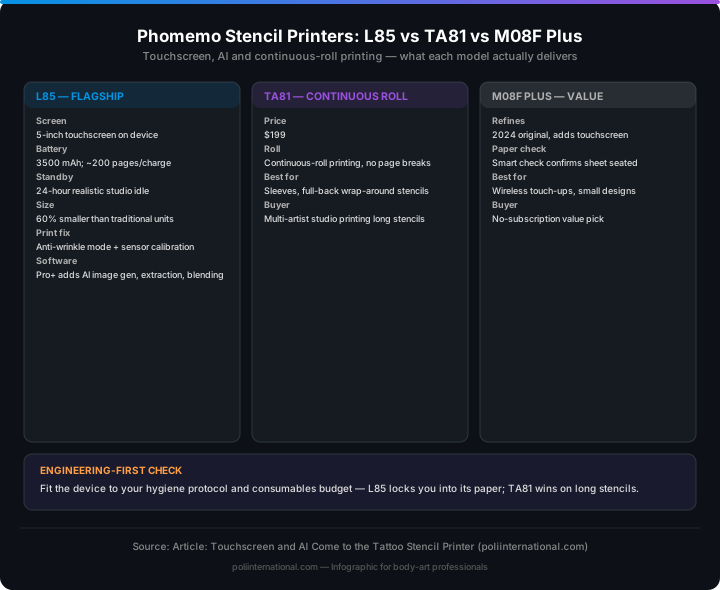
Touchscreen and AI Come to the Tattoo Stencil Printer
Infographic: Touchscreen and AI Come to the Tattoo Stencil Printer

What the software actually does

The AI angle is where marketing gets loud, so be precise about what Pro+ actually delivers. The L85 app includes line-art conversion, large-design splitting, and tattoo preview, which turn a complex digital drawing into a printable stencil without manually adjusting contrast and threshold in a separate editor [1]. The Pro+ tier adds AI image generation, image extraction, and image blending, which modify source art, not print output [1]. For a custom artist who draws everything by hand, those are irrelevant. For an artist who works from reference photos or vague client references, image extraction and blending produce a usable line-art base in seconds. The one software feature that directly affects print quality is anti-wrinkle mode, and it sits on the standard app, not behind the paywall. Do not buy the L85 for the AI; buy it for print reliability and the touchscreen workflow. The AI might save you twenty minutes a week, not $299.

The lock-in problem

Here is the part that should make any studio owner pause: the L85 is compatible exclusively with Phomemo-brand tattoo stencil paper [1]. That is a deliberate supply chain decision that changes your consumables economics permanently. Traditional thermal stencil printers are format-agnostic; you can buy any brand of transfer paper that fits the tray. With the L85, you are locked into Phomemo's paper for the life of the device. This matters for two reasons. First, price volatility. If Phomemo raises paper prices, you have no alternative supplier. Second, and more importantly for a safety-focused studio, you cannot fall back on a paper brand that you have already validated for skin contact and transfer reliability. The M08F Plus and TA81 do not appear to have the same exclusive paper restriction, so they remain viable options for artists who want to maintain flexibility [2][3]. Before you buy the L85, calculate your monthly paper usage and compare Phomemo's per-sheet cost against your current brand. If the delta is significant, the $299 price tag starts to look like an entry fee for a subscription you did not sign up for.

Studio and hygiene implications

From a Poli International perspective, the stencil printer is not a creative tool; it is a piece of infection control equipment. A stencil that smears, fades, or misprints forces you to redo the transfer, which increases client skin contact time and the risk of cross-contamination. The smart paper check on the M08F Plus is a genuine safety feature because it prevents you from printing on a misaligned sheet and then having to handle a partially printed stencil that is no longer sterile [3]. The wireless connectivity is also a hygiene win; you can print from a tablet without touching a shared computer keyboard in the studio. However, the touchscreens on the L85 and M08F Plus introduce a new fomite risk. If your artists are handling the printer between clients, the screen needs the same disinfection protocol as your machines and clip cords. Check the manufacturer's guidance on cleaning the screen with your preferred surface disinfectant; not all touchscreens tolerate quaternary ammonium compounds. For a busy shop, the L85's larger battery and faster workflow will pay for itself in reduced downtime, but only if you treat the device as part of your contaminated equipment rotation, not as a permanent fixture on the clean side of the room.

Who should buy what

Buying advice is straightforward. A single artist doing custom work gets the best print quality from the L85, but only if you accept the paper lock-in [1]. A multi-artist studio printing long, continuous stencils for sleeves and full backs gets more practical value from the TA81 [2]. For reliable wireless touch-ups and small designs without subscription pressure, the M08F Plus is the sensible value pick [3]. Market data shows wireless thermal printers gaining adoption across the US and EU, and that trend is not slowing [5]. The stencil workflow is finally digital, but the engineering-first question is not whether the screen is pretty; it is whether the device fits your hygiene protocol and your consumables budget.

6. FAQ: Phomemo stencil printers and the digital stencil workflow

Q: Can I use my existing stencil paper with the Phomemo L85?
No. The L85 is engineered to work exclusively with Phomemo-brand tattoo stencil paper. Other brands will not feed or print correctly, and attempting to force them can damage the thermal print head. If you have a preferred paper brand, the M08F Plus or TA81 are better options because they do not have the same exclusive restriction.

Q: Is the Pro+ AI subscription necessary for basic stencil printing?
No. The core printing functions, including line-art conversion, large-design splitting, and anti-wrinkle mode, work without the subscription. The Pro+ tier adds AI image generation, text generation, and image blending, which are design tools for creating or modifying source art, not for improving print output. Start with the free tier and upgrade only if you find yourself regularly using the design features.

Q: How do I disinfect the touchscreen on these printers between clients?
Use a soft, lint-free cloth lightly dampened with a disinfectant that is safe for electronics. Avoid spraying liquid directly onto the screen, as it can seep into the bezel and damage the internals. Check the device manual for specific compatibility, but isopropyl alcohol wipes at 70 percent concentration are generally safe for the glass surface. Treat the printer as a contaminated item if it is handled during a procedure and allow the disinfectant to dry completely before the next use.

7. References

1. Phomemo L85 Smart Touchscreen Professional Tattoo Stencil Printer product page, phomemo.com. phomemo.com/products/phomemo-l85-touchscreen-prof...
2. Phomemo TA81 Continuous Tattoo Stencil Printer product page, phomemo.com. phomemo.com/products/phomemo-ta81-continuous-tatt...
3. Phomemo M08F Plus Wireless Tattoo Stencil Printer with Touch Screen product page, phomemo.com. phomemo.com/products/phomemo-m08f-plus-direct-tou...
4. "Phomemo Expands Tattoo Stencil Printer Solutions to Support Professional Artists Evolving Workflows," press release, August 13, 2026.
5. "Global Tattoo Stencil Printer Market Size, Growth, Trends," openPR, August 12, 2026.

Mind map · Touchscreen and AI Come to the Tattoo Stencil Printer

  • Touchscreen and AI Tattoo Printers
    • Hardware Performance and Reliability

      Phomemo hardware like the L85 and TA81 integrates touchscreen controls and continuous-roll printing to improve stencil print reliability.

      • Phomemo L85 Flagship
        • Touchscreen Controls
      • Phomemo TA81 Printer
        • Continuous-roll Printing
    • Software and AI Features

      The Phomemo app features line-art conversion and design tools, with a paid tier adding AI design generation and image blending.

      • Standard ePrinter App
        • Line-art Contrast Conversion
      • Paid Pro+ Subscription
        • AI Image Generation
    • Supply Chain Lock-in Warning

      The flagship Phomemo L85 requires proprietary Phomemo-brand stencil paper, locking studios into a single-supplier ecosystem.

      • Proprietary Consumables Lock-in
        • Exclusive Paper Requirement
      • Format-agnostic Alternative Models
        • TA81 Continuous Paper
    • Studio Hygiene and Infection Control

      Tattoo stencil touchscreens introduce new fomite cross-contamination risks, requiring strict studio cleaning protocols with electronics-safe disinfectants.

      • Fomite Cross-contamination Risk
        • Shared Screen Handling
      • Disinfection Standards
        • Isopropyl Alcohol Seventy Percent
StructureProcessMaterialHazard

4 branches, 0 sources. Each branch cites the article it came from; the labels beneath it are names, not claims.

Stencil Printer

  1. 1. Which specific hardware feature on the Phomemo L85 allows artists to monitor print mileage, battery levels, and sensor calibration directly on the device?

    • ✓ 5-inch built-in touchscreen — The integrated screen directly displays operational statistics such as mileage, battery status, and sensor calibration on the printer itself.
    • • Smart paper check system — This hardware mechanism confirms proper paper alignment prior to printing rather than displaying operational calibration metrics.
    • • Pro+ AI mobile dashboard — Sensor metrics and print mileage are monitored natively on the physical hardware display rather than being restricted to a mobile application interface.
    • • Wireless tablet application — The physical screen integration prevents artists from needing to navigate phone or tablet apps during active tattooing sessions.
  2. 2. What primary operational advantage does the Phomemo TA81 offer to tattoo artists working on large projects like full sleeves or back pieces?

    • ✓ Continuous-roll printing capability to eliminate page breaks — The continuous-roll functionality allows artists to output long uninterrupted stencils without forcing arbitrary page splits.
    • • Exclusive integration with high-contrast thermal transfer paper — The TA81 model maintains open paper compatibility rather than enforcing exclusive proprietary paper restrictions.
    • • An upgraded 3500mAh battery for all-day cord-free printing — A 3500mAh battery specification is attributed to the L85 flagship model rather than the TA81 continuous printer.
    • • Built-in AI image extraction and blending tools — Image extraction and blending belong to the optional Pro+ software tier rather than being a hardware feature of the TA81.
  3. 3. How does the smart paper check feature on the M08F Plus serve as a hygiene and infection control benefit in a studio?

    • ✓ It prevents misprints that force artists to handle unsterile, partially printed paper — Verifying proper sheet alignment before thermal execution keeps artists from coming into contact with compromised or improperly fed stencils.
    • • It automatically sanitizes paper surfaces using ultraviolet sensors before printing — The smart paper check system senses physical paper alignment rather than performing chemical or radiative sterilization.
    • • It eliminates the requirement to wipe down the device touchscreen between clients — Touchscreen surfaces still require physical disinfection regardless of automated paper alignment checks.
    • • It restricts paper usage strictly to single-use autoclavable thermal sheets — The feature evaluates structural paper positioning rather than dictating autoclavable material standards.
  4. 4. What distinguishes the software features in the paid Pro+ tier from those in the standard Phomemo application?

    • ✓ Pro+ offers AI source art tools like image extraction and blending, whereas standard app features manage print conversion and execution — The Pro+ tier focuses on generating and modifying source reference art, while standard software handles printing reliability and line-art conversions.
    • • Pro+ unlocks the anti-wrinkle print setting, whereas the standard app only provides basic contrast adjustments — Anti-wrinkle controls are included in the base application without requiring any paid subscription upgrade.
    • • Pro+ removes the paper brand restriction on the L85, whereas the standard app enforces exclusive paper lock-in — Paper compatibility is governed by hardware and supply chain design rather than software subscription tiers.
    • • Pro+ enables wireless Bluetooth connectivity, whereas the standard app requires a wired computer connection — Wireless printing capability is built into the hardware and standard app ecosystem rather than locked behind Pro+.
  5. 5. What is a major financial and supply chain drawback specifically associated with adopting the Phomemo L85 in a tattoo studio?

    • ✓ Exclusive compatibility with Phomemo-brand paper, creating supplier lock-in — The L85 hardware restricts printing to proprietary paper, exposing studios to price volatility and limiting choices.
    • • Mandatory monthly fees required to operate basic line-art conversion — Core printing controls and basic line-art conversions function fully on the standard free application.
    • • Inability to clean the hardware using any studio-grade surface disinfectants — The device can be disinfected safely using appropriate techniques like dampened alcohol wipes on the glass interface.
    • • High risk of thermal print head failure when printing large sleeve stencils — Thermal head damage is linked to forcing non-compatible paper into the unit, not normal sleeve stencil printing.
  6. 6. Why do touchscreens on modern stencil printers present a specific infection control challenge in a tattoo studio setting?

    • ✓ They act as potential fomites that require strict surface disinfection protocols between clients — Physical contact with printer controls between client sessions creates a vector for cross-contamination that demands routine sanitization.
    • • Their high operating temperatures prevent the effective use of liquid sanitizers — Heat from thermal printing does not prevent standard surface cleaning routines when applied correctly.
    • • They require continuous touch contact during the entire printing process to maintain calibration — Calibration data is displayed on screen but does not require continuous manual touching while printing.
    • • Their screen glass degrades permanently when exposed to any form of wireless radiation — Device screens undergo standard physical wear and chemical interactions rather than degradation from wireless signals.
  7. 7. What is recommended when cleaning and disinfecting the glass touchscreen on these thermal printers?

    • ✓ Wiping the glass surface gently with a cloth lightly dampened with 70% isopropyl alcohol — Lightly dampening a lint-free cloth with 70% isopropyl alcohol effectively cleans screen glass without risking liquid ingress into internal electronics.
    • • Spraying quaternary ammonium disinfectants directly onto the screen bezel — Direct spraying can allow liquid to seep into device bezels and harm electronics, while some screen glass may not tolerate quaternary ammonium.
    • • Submerging the front panel in enzymatic cleaning solutions between appointments — Electronic hardware components cannot survive liquid immersion procedures.
    • • Running an internal heat-cycle routine to thermally sterilize the touch display — Touchscreens require manual surface wipe-downs rather than automated thermal self-sterilization.
  8. 8. What battery performance specifications are reported for the Phomemo L85 flagship printer?

    • ✓ A 3500mAh battery delivering up to 200 pages per charge with 24-hour standby — This combination of capacity, page output, and standby duration reflects the documented specifications of the flagship printer.
    • • A 5000mAh battery delivering up to 500 pages per charge with 48-hour standby — These figures overestimate both the battery capacity and page yield documented in the text.
    • • A 2000mAh battery delivering up to 100 pages per charge with 12-hour standby — The stated battery rating is higher, providing 200 pages and 24 hours of idle standby.
    • • A 3500mAh battery requiring continuous plugged-in operation for large thermal prints — The battery allows cordless operation suitable for sitting idle or printing standard sessions without continuous wall power.
  9. 9. An artist doing custom work who wants touchscreen features and paper flexibility without subscription pressure should select which model?

    • ✓ Phomemo M08F Plus — This model provides touchscreen utility, smart paper check, and open paper flexibility without enforcing proprietary brand lock-in.
    • • Phomemo L85 — While offering strong print quality, this model forces exclusive use of Phomemo-brand paper, restricting consumable choices.
    • • Thermal Copier Pro+ — This term represents a generalized category or software tier rather than the specific flexible printer model recommended.
    • • Phomemo TA81 — The TA81 is designed specifically for continuous-roll sleeve work rather than being identified as the primary value pick for small designs and touch-ups.
  10. 10. The anti-wrinkle print feature on the L85 requires a paid subscription to the Pro+ software tier.

    • ✓ False — Anti-wrinkle mode is located within the standard free application and does not require paying for the Pro+ subscription tier.
    • • True — The Pro+ tier focuses on AI generation and blending tools, whereas anti-wrinkle functionality is part of the standard app features.

Extended Reference Table

8 of 8 rows

Extended reference table generated from the article and its verified research sources. Bracketed numbers jump to the matching entry in the Technical References below.

SafetyItem Material Technical Specification Resolution (DPI) Battery Capacity Regulatory Compliance or Safety Standard
✅M831 A4 Thermal PrinterIndividual, folded, and rolled thermal paperBuilt-in paper bin, wireless Bluetooth300 DPI2600mAhFCC, CCC, CE, Rohs, IC
✅M08ESD Touchscreen Tattoo Stencil PrinterTattoo paperDirect thermal print, 15mm/s speed, 216mm valid printing width203 DPI1200mAhFCC, CCC, CE, Rohs, IC
✅M08F PRO Tattoo PrinterTransfer paperWireless Bluetooth, upgraded thermal imaging technologyHigher than 203 DPI (Upgraded)-FCC, CCC, CE, Rohs, IC
✅P832 A4 Thermal transfer PrinterThermal transfer consumablesMonochrome printing, Bluetooth/USB interface--FCC, CCC, CE, ROHS
✅Phomemo M08F Tattoo EditionDirect ThermalWireless Bluetooth/USB, optimized firmware for tattoo line clarity-Built-in RechargeableCarbonfree Certified
✅Phomemo M08F PlusDirect ThermalLCD Touchscreen interface, Bluetooth/USB connectivity, smart paper check system203 DPI1200mAhCarbonfree Certified
✅INKSOUL T08FS Wireless Tattoo Stencil PrinterCarbon-backed A4 thermal paperSpecialized thermal algorithm for shadow and gradient mapping; weight 0.75 kg203 DPI1200mAh-
✅INKSOUL T08FD Tattoo Transfer PrinterCarbon-backed thermal tattoo transfer paper2-inch smart touchscreen; 216mm print width; 10-15mm/s speed; standalone mirroring and scaling203 DPI1200mAh-

Free Body Art Wall Posters

Print-ready reference posters for your studio or your own wall. Free to download and display, embed on your own site with attribution. Click any poster to preview it full size before downloading.

Choose and download all 40 posters

Technical_References_Archive

About the Author

PP

Patrick Poli

Chief Engineer, Poli International · Creator of BioFlex® body jewelry

Patrick has spent 25+ years manufacturing body jewellery and studio equipment, and is the creator of BioFlex® body jewelry. He built bi-material RCA and machine cables, overmoulded so the connector stops being the part that fails first. He also developed sterilised disposable grips and over-grips, including a dual-material version built around how a machine actually sits in the hand.

More about Patrick →

Last reviewed: 2026-10-10 · Published: 2026-08-17

Related Tools & Reading

Continue Reading