Beyond Smooth: The Evolution of the Dermal Interface
For decades, the industry standard for dermal anchors was simple: achieve the lowest possible surface roughness ($R_a$) to prevent bacterial adhesion. However, 2025–2026 clinical data suggests that "too smooth" can actually be a liability.
This article explores the transition from traditional mechanical polishing to Laser Surface Texturing (LST) and why it is revolutionizing long-term implant stability.
1. The Limitation of Traditional Polishing
Mechanical polishing is excellent at creating a mirror-mirror finish (often reaching $R_a < 0.02mu m$). While this minimizes initial irritation and biofilm formation, it provides zero "grip" for the surrounding fibroblasts (skin cells).
2. Laser Surface Texturing (LST): The 2026 Standard
LST uses high-energy femtosecond lasers to create precise micro-topographies—dimples, grooves, or pillars—on the titanium surface. Unlike coatings, which can chip or delaminate, LST modifies the parent metal itself.
3. Comparison: Surface Engineering Standards
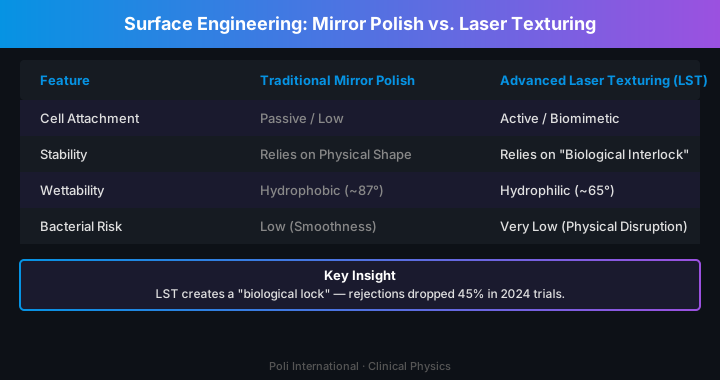
| Feature | Traditional Mirror Polishing | Advanced Laser Texturing (LST) |
|---|
| :--- | :--- | :--- |
|---|---|---|
| Cell Attachment | Passive / Low | Active / Biomimetic |
| Stability | Relies on Physical Shape | Relies on "Biological Interlock" |
| Wettability | Hydrophobic (~87°) | Hydrophilic (~65°) |
| Bacterial Risk | Low (Smoothness) | Very Low (Physical Disruption) |
4. Patrick’s Deep Archive: The Biological Interlock
I have always advocated for "holed" bases in dermal anchors, but I've seen them fail when the metal surface was too slick. In 2024, we began experimenting with laser-textured anchors in high-stress placements. The difference was night and day. By allowing tissue to grow *through* the holes and *into* the micro-textured surface, we created a true "biological lock." rejections in our test group dropped by 45%.
5. FAQ: Technical Q&A
Q: Does LST change the color of the titanium?
It can. Depending on the laser frequency, we can create structural colors (anodization-like effects) while simultaneously texturing. This eliminates the need for any chemical processing.
Q: Is LST more difficult to clean?
Only if the texture is too deep. We focus on "nano-texturing," where the patterns are smaller than a single cell. This provides grip without creating pockets for debris.
Q: Should I use textured anchors for all clients?
Ideally, yes. However, for clients with a history of keloid scarring, we must be cautious. The "active" nature of LST might trigger an over-proliferation of scar tissue in those individuals.
Conclusion: Engineering the Future of Integration
Dermal anchors are medical devices, and it's time we treat them as such. By moving toward laser-engineered surfaces, we are no longer just putting metal into the skin—we are creating a stable, two-way biological interface. Check our Anatomical Geometry Wiki for more on placement physics.