
Can Cheap Body Jewellery Cause an Infection? What the Evidence Says
Key Takeaways:
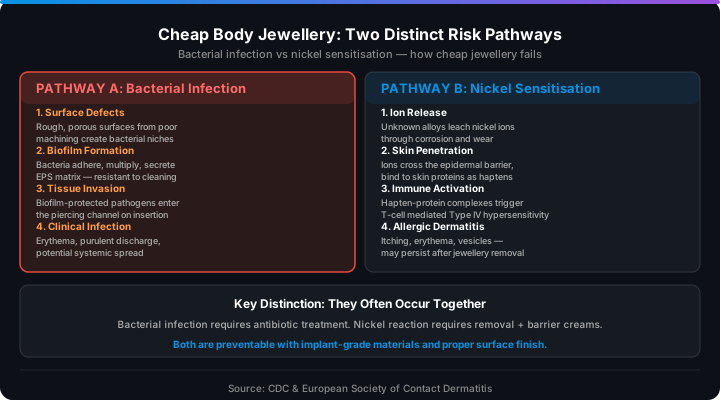
>> Cheap body jewellery carries two separate risks: bacterial infection from poor surface finish, and nickel sensitisation from unknown alloys, and they often occur together
>> A true infection is microbiological: rough, porous surfaces give bacteria a place to adhere, multiply, and form biofilm that resists cleaning
>> A nickel reaction is immunological: the immune system identifies nickel ions as a threat and mounts an inflammatory response, with lifelong sensitisation consequences
>> Surface roughness above 0.5 micrometres Ra provides anchoring sites for Staphylococcus aureus biofilm; cheap cast jewellery often exceeds 1.0 micrometres
>> The jewellery enters an open wound: whatever is in contact with that wound for weeks, its surface texture, its chemical composition, its manufacturing residue, becomes part of the healing biology
1. Two Ways Cheap Jewellery Causes Problems
When someone says their piercing "got infected from cheap jewellery," they are usually describing one of two things. Only one of them is a true infection. The other is an allergic reaction to the metal, most commonly nickel. Knowing which is which matters because the treatment is different, and because the nickel reaction has lifelong consequences beyond the current piercing.
A true infection is microbiological: bacteria or fungi colonise the wound. Cheap jewellery increases infection risk through poor surface finish. A rough, porous, or scratched surface gives bacteria a place to adhere, multiply, and resist cleaning. This is a mechanical problem, not a chemical one.
A nickel reaction is immunological: the immune system identifies nickel ions as a threat and mounts an inflammatory response. This is a materials problem. The cheaper the alloy, the more nickel it typically contains, the more ions it releases into the wound, and the more aggressively the body reacts. Both problems often occur together, which is why clients describe "infection" when they may be experiencing sensitisation, infection, or both.
| Problem | Mechanism | Cause | Key Symptom | Long-Term Risk |
|---|---|---|---|---|
| Bacterial infection | Microorganisms colonise wound | Rough surface finish; biofilm formation | Redness, heat, pus, escalating pain | Localised infection; sepsis if untreated |
| Nickel sensitisation | Immune response to metal ions | Unknown alloy; nickel release | Itching, redness, blistering, no pus | Lifelong nickel allergy; cross-reactivity |
| Combined | Both simultaneously | Poor surface plus high-nickel alloy | Mixed symptoms; difficult to diagnose | Both infection and sensitisation risks |
2. The Surface-Finish Problem: How Rough Jewellery Harbours Bacteria
Implant-grade body jewellery is machined to a mirror finish. Under magnification, the surface is smooth enough that bacteria cannot easily adhere. The Association of Professional Piercers specifies that initial piercing jewellery should have a surface roughness (Ra) below 0.1 micrometres. At that level, a typical disinfectant wipe removes nearly all surface bacteria.
Cheap jewellery does not meet this standard. Cast rather than machined, often from recycled alloys with unknown composition, the surface contains micropores, pits, and crevices at the micron scale. These features are invisible to the naked eye. They are large enough for Staphylococcus aureus, the most common wound pathogen, to lodge and form a biofilm.
Biofilm bacteria are hundreds of times more resistant to antiseptics than free-floating bacteria. Once established in a surface defect inside a piercing channel, they can sustain a low-grade infection for months. The client reports persistent redness, intermittent discharge, and a piercing that "never quite heals." The jewellery looks fine to casual inspection. The surface defect is invisible. The infection is real.
3. The Nickel Problem: Sensitisation Is Permanent
Nickel is the most common contact allergen in the world, affecting an estimated 10 to 15 percent of the adult population. Nickel sensitisation develops through repeated or prolonged exposure. A piercing with nickel-containing jewellery provides exactly that: 24-hour contact with an open wound for weeks.
Cheap alloys, particularly those labelled generically as "surgical steel" with no grade specification, can contain 8 to 15 percent nickel. Implant-grade ASTM F136 titanium contains zero nickel. ASTM F138 316LVM implant-grade steel contains 12 to 14 percent nickel but in a tightly controlled, low-release form bound within the alloy matrix. The distinction between "contains nickel" and "releases nickel" is critical: implant-grade steel keeps its nickel locked in the crystal structure; cheap steel releases it into the wound.
Once nickel sensitisation develops, it is permanent. The immune system now recognises nickel as an enemy, and every subsequent exposure triggers a faster, stronger reaction. This has consequences far beyond body jewellery: nickel is present in coins, zippers, eyeglass frames, mobile phones, and foods (chocolate, legumes, whole grains). A single cheap piercing can create a lifelong sensitivity to everyday objects.

