
Flexible vs Rigid Body Jewelry anthropometric measurement principles: The Biomechanics That Actually Decide Healing
Key Takeaways:
» 316L steel registers approximately 193 GPa elastic modulus; PTFE sits at roughly 0.5 GPa, a nearly 400× stiffness gap that governs the mechanical load a fistula experiences during every jaw movement, swallow, and sleep position shift.
» Bending stiffness scales with the fourth power of bar radius, so the diameter difference between a 1.2 mm and 1.6 mm bar matters more for tissue stress than many practitioners realise, and the material modulus gap can outweigh the gauge decision entirely.
» Rigid metal bars create point-contact pressure against the wound margin during cyclic loading (talking, chewing, sleeping); compliant polymer bars distribute that load across a broader contact area, reducing peak stress at the tissue interface.
» The clinical decision is not a material loyalty test, it is matching flexural compliance to the anatomical load environment: high-movement sites and initial healing call for polymer compliance; settled, low-movement piercings benefit from the positional stability of rigid metal.
» A 1.6 mm BioFlex PP-R bar can be more compliant in bending than a 1.2 mm 316L bar because the modulus gap between a low-GPa polymer and 193 GPa steel is larger than the gauge multiplier, making material selection the dominant variable in the stiffness envelope.
1. The Stiffness Question Nobody Asks Before Insertion
When a piercer selects a barbell for a fresh oral piercing, the material conversation almost always runs to biocompatibility, nickel content, implant-grade certifications, ISO 10993 compliance. Those conversations matter, and we have covered them in detail in our guide to initial piercings and BioFlex healing. But they skip an equally determinative physical question: how stiff is this bar, and what does that stiffness do to the tissue I am asking to heal around it?
The engineering quantity that answers this is Young's modulus (elastic modulus), expressed in gigapascals (GPa). It measures how much a material resists elastic deformation under load. A high-modulus material stays rigid under stress; a low-modulus material deforms and returns elastically. The range across body jewellery materials is extreme, and it directly controls the mechanical environment of the healing fistula:
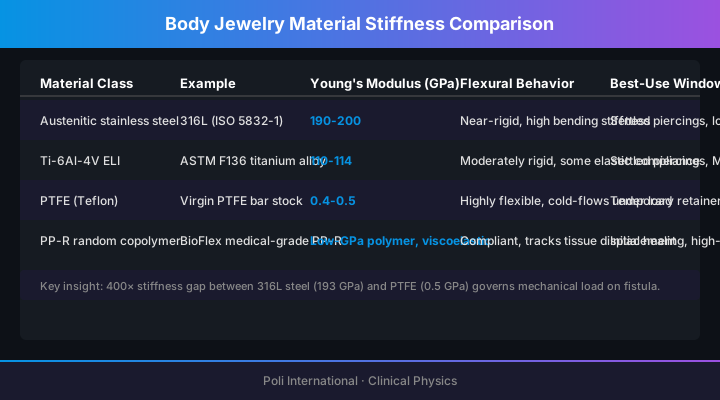
| Material Class | Example Material | Young's Modulus (~GPa) | Flexural Behaviour | Best-Use Window |
|---|---|---|---|---|
| Austenitic stainless steel | 316L (ISO 5832-1) | 190-200 | Near-rigid, high bending stiffness | Settled piercings, low-movement anatomical sites |
| Ti-6Al-4V ELI | ASTM F136 titanium alloy | 110-114 | Moderately rigid, some elastic compliance | Settled piercings, MRI-safe requirement, nickel-allergic clients |
| PTFE (Teflon) | Virgin PTFE bar stock | 0.4-0.5 | Highly flexible, but cold-flows under sustained compressive load | Temporary retainers, short-duration use only |
| PP-R random copolymer | BioFlex medical-grade PP-R | Low-GPa polymer, viscoelastic | Compliant, tracks tissue displacement without permanent set | Initial healing, high-movement sites, pregnancy and swelling |
The 400× gap between 316L steel and PTFE is not a clinical footnote. When a patient talks, chews, or shifts position in sleep, a rigid steel bar transfers near-100% of that displacement load to the fistula wall as a concentrated stress. A PP-R bar absorbs a substantial fraction of the displacement through elastic compliance, distributing the load along the fistula length rather than pinning it at the entry and exit points. The wound margin experiences two fundamentally different mechanical environments, and the healing trajectory reflects which one was chosen at insertion.
We have previously compared the chemistry case for BioFlex PP-R against PTFE in detail (BioFlex vs PTFE: Why PP-R Wins). The biomechanical dimension covered here is the physical complement to that chemical argument: even if both materials were identically biocompatible, their elastic moduli would still produce different clinical outcomes.
2. Why Bar Diameter Matters More Than You Think: the Fourth-Power Rule
Practitioners frequently treat gauge selection as an aesthetic or fistula-sizing decision. Biomechanically, it is a stiffness multiplier of the most aggressive kind.
Flexural rigidity of a cylindrical bar is proportional to EI, where E is the elastic modulus and I is the second moment of area. For a circular cross-section, I = πr⁴/4. That r⁴ term means bending stiffness scales with the fourth power of the radius. The practical consequence is stark:
| Bar Diameter | Relative Bending Stiffness (same material) | Implication |
|---|---|---|
| 1.2 mm (16g) | 1.0× (reference) | Baseline stiffness for a given material |
| 1.6 mm (14g) | ~3.16× stiffer | More than triple the bending resistance from a 0.4 mm diameter increase |
| 2.0 mm (12g) | ~7.7× stiffer | Nearly eight times the bending load on the fistula wall |
This fourth-power relationship explains why "just use titanium instead of steel" is an incomplete answer. Switching from 316L to Ti-6Al-4V drops the elastic modulus by roughly 42%, which is a meaningful reduction. But dropping from a 1.6 mm bar to a 1.2 mm bar drops bending stiffness by roughly 68%, the gauge decision can outweigh the material decision, and if the piercer sizes up for perceived stability while inserting into a fresh high-movement site, the net mechanical load on the fistula actually increases.
Now layer material flexibility onto this: a BioFlex PP-R bar at 1.6 mm can still be more compliant in bending than a 1.2 mm 316L bar, because the modulus gap between a low-GPa polymer and 193 GPa steel is larger than the r⁴ multiplier that gauge provides. Material choice dominates the stiffness envelope long before gauge becomes the deciding variable. This is the quantitative reason that a pregnancy piercing with a rigid metal bar is biomechanically wrong: the swelling tissue is generating displacement that the bar cannot accommodate, and the fourth-power stiffness of even a thin metal bar concentrates that load at the wound margin.
3. Cyclic Loading, Lever-Arm Torque, and Contact Pressure: the Live Biomechanics
The mechanical load on a piercing fistula is not static. It is cyclic, dynamic, and driven by three interacting mechanisms that operate simultaneously during normal daily activity.
Lever-arm torque at the tissue interface. Every external bead or decorative end acts as a mass on a lever arm. When the wearer talks, chews, or catches the jewellery on clothing, that mass generates a torque about the tissue entry point. A rigid bar transmits the full torque to the wound margin as a concentrated stress; a flexible bar absorbs some of it through material compliance, distributing the load along the fistula length rather than concentrating it at the entry and exit points. The internal vs. external threading comparison addresses the attachment geometry, but the underlying torque transmission mechanics are governed by bar stiffness regardless of the thread system.
Cyclic fatigue loading. Oral piercings experience roughly 1,500-2,000 loading cycles per day from speech and mastication alone. A rigid bar concentrates each cycle at the same tissue interface point, creating a repetitive stress injury pattern that retards epithelialisation and can produce persistent irritation bumps. A compliant polymer bar spreads those cycles across a broader contact zone and damps the peak force, reducing the accumulated microtrauma that drives hypertrophic scarring.
Contact pressure: point load versus distributed load. At the wound margin, the bar-to-tissue contact can be modelled as Hertzian contact mechanics: a rigid cylinder pressing against a soft tissue half-space produces a narrow, high-pressure contact band. A compliant polymer conforms to the tissue contour under load, broadening the contact area and reducing peak pressure by a factor approximately proportional to the modulus ratio. This is why piercing sites with a rigid metal bar often show a localised pressure halo at the entry margin, while the same site with a BioFlex bar shows even, diffuse tissue adaptation. The physics is straightforward: same applied force, larger contact area, lower peak stress.
4. Patrick's Deep Archive: What Building BioFlex Taught Me About Stiffness and Healing
I did not start with Young's modulus tables. I started with a studio bench and a recurring observation: clients came back with swollen, angry piercings, and the common variable was not infection or aftercare, it was a rigid metal bar sitting inside tissue that needed room to move.
The first polymer bars I prototyped were PTFE, because PTFE was the obvious choice for chemical inertness. But PTFE has a biomechanical flaw that the datasheets do not advertise: cold flow. Under sustained compressive load, exactly what a fistula applies to an inserted bar, PTFE permanently deforms. The bar thins at the pressure point, the fistula tightens around the thinned section, and the mechanical mismatch worsens over time. That failure mode is why BioFlex moved to a PP-R random copolymer: the viscoelastic response gives you compliance without cold-flow creep, and the modulus stays stable across the 35-40°C range of body temperature. The polymer science is covered in our BioFlex vs PTFE comparison; what I want to add here is the clinical observation that drove the switch.
The clinical pattern that crystalised this for me was oral piercings. Tongue and labret piercings sit inside a dynamic load environment: the tongue generates 40-60 N of force during swallowing, and the perioral musculature cycles continuously during speech. A rigid metal bar in that environment is a stress concentrator. A BioFlex bar is a stress distributor. Same insertion site, same aftercare, same client, different healing trajectory, every time.
I am not saying metal bars are wrong. I am saying the decision should be biomechanical, not habitual. When I see a piercer default to 316L for a fresh tongue piercing because "that is what we always use," I see someone who has not been shown the load path that fistula is actually experiencing. Twenty-five years on this bench has taught me that material selection is a mechanical engineering problem. The sooner the industry treats it as one, the fewer hypertrophic scars we will all be looking at.
5. FAQ: The Biomechanical Decision in Practice
Q: When is a rigid metal bar the right choice, biomechanically?
A: When the piercing is fully healed, the site is low-movement (helix, conch, some nostril placements), and the mechanical priority shifts from tissue accommodation to positional stability. A rigid bar holds its geometry under intermittent external loads, snagging, clothing contact, without deflecting into the fistula, which is itself a protective function. The load environment determines the answer, not material loyalty.
Q: Does a thicker flexible bar cause more insertion trauma than a thinner rigid one?
A: Insertion trauma is driven by the needle gauge, not the jewellery diameter. The jewellery follows the needle track. Once inserted, the bar diameter does matter for steady-state tissue stress, but as Section 2 explains, the modulus gap dominates. A 1.6 mm BioFlex bar produces lower steady-state contact pressure on the healing fistula than a 1.2 mm 316L bar, because the polymer compliance reduces the peak stress more than the diameter increase adds to it.
Q: Do threadless and internally threaded systems change the biomechanics described here?
A: They change the insertion hygiene profile, see our threading comparison for that discussion, but not the bulk flexural mechanics covered in this article. The thread design does not materially alter the bar's bending stiffness or the contact pressure distribution at the wound margin. The biomechanical questions in this article apply regardless of which attachment system the piercer prefers.
Q: Can I use a flexible polymer bar in every piercing from day one?
A: No. Some placements genuinely benefit from rigid initial jewellery, certain industrial scaffold configurations, surface anchors that depend on bar rigidity for retention geometry, and piercings where the fistula path needs the bar to act as a positional splint during the first weeks of healing. The framework in this article is about matching the material to the load environment, not about declaring one material universally superior. The question is not "which material is best", it is "which material is best for this specific fistula, in this specific anatomical site, at this specific stage of healing."
Conclusion: Material Selection Is a Biomechanical Calculation
The material selection decision for body jewellery is a biomechanical calculation, whether the piercer performs it explicitly or not. Young's modulus, the fourth-power relationship between bar radius and bending stiffness, cyclical loading patterns, and contact pressure distribution are the real physics deciding whether a fistula heals cleanly or fights its jewellery.
The practical clinical takeaway is straightforward: for high-movement sites, initial healing, and anatomical situations involving swelling or tissue displacement, the compliance of a low-modulus polymer reduces the mechanical barrier to epithelialisation. For settled, low-movement piercings, the positional stability of a rigid metal bar is an asset. The mistake is applying one answer to every load environment, and that mistake is still being made in studios every day.


