Recent material news has not changed the core rule: BioFlex® is PP-R, not TPU, and that distinction still matters for fresh-piercing safety, sterilization behavior, and migration risk.
Key Takeaways:
- BioFlex® is a polypropylene random copolymer (PP-R), while TPU-based soft jewelry is a chemically different material family; they should not be treated as interchangeable. BioFlex chemistry correction
- PP random copolymers have distinct diffusion and migration behavior compared with other polypropylene types, which is relevant when a studio is choosing material for fresh wounds and implant-adjacent wear. PP additive diffusion in random copolymer
- The most useful practitioner lens is use-case specific: swelling management, healing retention, and short-term wear in cartilage or lip areas are not the same decision problem as long-term decorative wear. BioFlex chemistry correction
- When suppliers blur PP-R and TPU under “soft jewelry” language, piercers should correct the chemistry on the invoice, in staff training, and in customer-facing recommendations. Polypropylene random copolymer basics
- The best current guidance is to stock chemistry-verified PP-R and chemistry-verified TPU as separate product categories, not as equivalent alternatives. PP copolymer vs other polypropylene types
1. BioFlex®, TPU, and why the naming confusion still causes real-world errors
The key correction is straightforward: BioFlex® is PP-R random copolymer polypropylene, not TPU or any urethane-based material. That is not a branding preference; it is a chemistry distinction that changes how the material behaves under heat, sterilization, and long-term skin contact. The same correction applies to similar naming confusion around Bioplast/BioPlast, which is also a PP-R family product, while TPU-based jewelry lines such as Kaos Softwear belong to a different polymer class entirely. BioFlex chemistry correction
For practitioners, the practical consequence is that “soft” does not mean “same.” Random copolymer polypropylene is described by resin suppliers as a material with improved clarity, transparency, and stiffness balance relative to homopolymer polypropylene, while TPU is typically selected for a different elastic profile and tactile feel. That means a studio should choose based on whether the job is short-term healing retention, high-flex comfort, or specific anatomical clearance, not on a generic promise of softness. Polypropylene random copolymer resin description PP copolymer selection differences
This distinction matters because polymer family affects additive mobility. In a PubMed study on polypropylene, the authors found that diffusion coefficients in random copolymer PP (r-PP) are at least one order of magnitude higher than in homopolymer PP, which confirms that PP subtypes cannot be treated as identical from a migration standpoint. For body jewelry buyers, that is a reminder to ask vendors for exact resin identity, not just a product nickname. Diffusion behaviour of additives in polypropylene
When you map this onto studio use, the most defensible interpretation is simple: PP-R soft retainers are best viewed as a chemically specific, semi-flexible healing category, while TPU retainers should be evaluated separately on their own formulation and certification claims. If you want a broader framework for choosing between polymer families and more rigid options, the 2026 piercer's guide to flexible jewelry materials remains the right companion reference, but the present article stays focused on the soft-material divide.
2. What the material data suggests for stocking decisions
The most useful comparison for studios is not “which one is better,” but “which one is chemically what the label says, and which application does that chemistry support?”
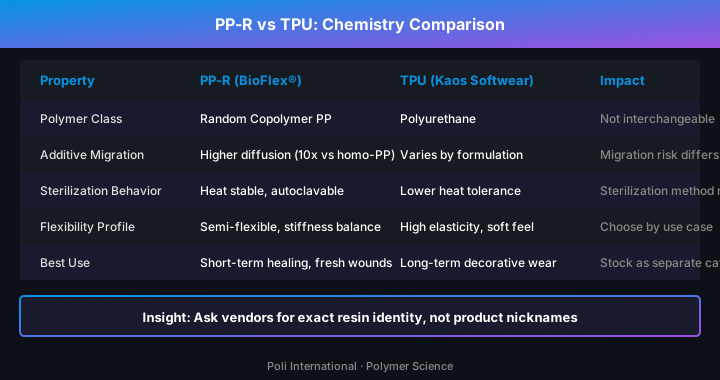
| Feature | PP-R random copolymer (BioFlex®, Bioplast/BioPlast) | TPU / urethane-based soft jewelry |
|---|---|---|
| Polymer family | Polypropylene random copolymer | Thermoplastic polyurethane or related urethane chemistry |
| Chemistry identity | Same base family as other PP-R products | Different material class |
| Migration profile | PP subtype-dependent; r-PP shows measurable diffusion behavior differences from h-PP | Formulation-dependent; not interchangeable with PP-R |
| Typical studio use | Healing retainers, short-term soft wear, swelling accommodation | Flexible jewelry, comfort wear, application-specific soft components |
| Stocking rule | Verify as PP-R, not just “bio-safe soft plastic” | Verify as TPU, not assumed equivalent to PP-R |
The best procurement rule is to stop using “soft plastic” as a purchasing category. A vendor should be able to state whether the item is PP-R or TPU, and that disclosure should be as routine as gauge, length, and closure type. The chemistry matters because PP-R and TPU may feel similar in the hand while behaving differently in heat, deformation recovery, and extraction risk. Polypropylene random copolymer properties PP copolymer chemistry basics
For body-art use, the consequence is practical: if a client needs a soft retainer for labret swelling, helix recovery, or nostril stability during inflammation, the studio should prioritize a known PP-R or a known alternative with equivalent documentation, rather than assuming all flexible clear materials are the same. If you want the most clinically relevant side of this topic, the practitioner framework for choosing polymer retainers by anatomy and healing stage is the complementary article, but the core message here is still chemistry verification.
3. Technical details that matter in a studio setting
PP-R is made by incorporating a small amount of comonomer, usually ethylene, randomly along the polypropylene chain, which lowers crystallinity and changes clarity, flexibility, and processing behavior. Supplier literature describes random copolymers as having lower melting point, better transparency, and improved flexibility relative to homopolymer PP, all of which are consistent with why PP-R has a place in body jewelry and medical-adjacent products. PP-R chemistry and properties Random copolymer property profile
The migration issue is more nuanced. A PubMed study on additive diffusion in polypropylene found that r-PP diffusion coefficients were higher than those of homopolymer PP and comparable to heterophasic copolymers, which means additive mobility depends on the polymer architecture, not just the umbrella label “polypropylene.” For piercing use, that does not automatically make PP-R unsafe, but it does mean the material’s purity, additive package, and processing history should be disclosed by the supplier. Diffusion behaviour of additives in polypropylene
The actionable studio implication is to reserve PP-R soft jewelry for situations where flexibility is needed without switching into a totally different chemistry. That includes fresh lobes, swelling-prone oral sites, and some cartilage healing cases where a less rigid retainer can help manage early trauma, provided the client is appropriate and the jewelry dimensions are correct. For a deeper comparison with non-PP flexible choices, the relationship between flexible implant-grade polymers and fresh-piercing outcomes is the relevant internal reference.
4. Patrick's Note: what I tell studios when they ask for “the soft clear one”
What I’ve seen in the field is that confusion usually starts when people treat feel as a substitute for chemistry. If a supplier says a piece is “like BioFlex,” that is not enough; I want to know whether it is PP-R or TPU, because the decision affects sterilization compatibility, deformation behavior, and how confidently I can recommend it for a healing client. You can see the same chemistry-first logic carried through in my internal note on BioFlex versus TPU and why the polymer family matters.
From a sourcing perspective, the mistake I still see is retailers putting every flexible clear item into one shelf tag. That creates avoidable errors in labret fittings, nostril recovery, and conch swelling management, especially when a client later asks what the piece is made of. If the answer is not a clean polymer family name, the product is not ready for serious studio use.
5. FAQ: Technical Q&A
Q: Is BioFlex® actually TPU?
No. BioFlex® is PP-R random copolymer polypropylene, not TPU or any urethane-based material. That distinction matters because polymer family affects flexibility, migration behavior, and how the product should be described to clients and staff. BioFlex chemistry correction
Q: Can I treat Bioplast and BioFlex as the same thing?
Yes in the sense that both are PP-R materials, but not as identical branded products. They are chemically aligned at the base-polymer level, yet they remain separate brands with their own manufacturing, certification, and sourcing histories. PP-R product family overview
Q: When does a soft polymer retainer make more sense than metal?
It makes the most sense during early swelling, in clients who repeatedly irritate a site with hard jewelry, or where low-profile flexibility helps maintain wear during healing. It does not replace proper sizing, and it should never be chosen just because it feels softer in-hand. Flexible jewelry material guidance
Conclusion: Stock by chemistry, not by nickname
The safest business rule is to separate PP-R, TPU, and other flexible polymers into distinct inventory categories and to train staff to say the chemistry out loud. That avoids the most common misrepresentation in the market: treating all soft clear jewelry as if it were the same material.
For studios serving healing clients, the decision should be based on exact polymer identity, documented formulation, and the specific anatomical site being fitted. For the broader sourcing framework behind that approach, the most relevant companion reading is medical elastomers and the chemistry divide in body jewelry.