June 2026 data on soft implantables, TPUs, and silicone grades that actually matter in studios
Key Takeaways:
• New work on silicone and TPU blood-contact devices reinforces that surface chemistry and leachables matter more than hardness on the datasheet.
• Recent ISO 10993 irritation and sensitisation panels on soft devices highlight how cyclic siloxanes and residual catalysts still drive most failures.
• Several medical TPU studies refine the link between hard segment chemistry and long‑term stability in warm, moist channels like healed piercings.
• For piercers, the biggest practical shift is clearer red flags on unverified “medical TPU” retainers and colored flexible jewelry.
• BioFlex® and Bioplast remain PP‑R random copolymers, not TPU, and must not be grouped with urethane‑based “bioflex‑style” products.
---
1. What the latest elastomer papers say about long‑term skin and implant contact
Across the last month of peer‑reviewed work on silicone elastomers and thermoplastic polyurethanes (TPUs) for medical use, the pattern is consistent: chemistry, additives, and processing history dominate biocompatibility outcomes, not just whether something is labeled “medical grade.” Recent cardiovascular and catheter studies continue to rely on platinum‑cured silicone and segmented TPUs because of their track record under dynamic flexing, blood exposure, and prolonged implantation, but almost all of them flag extractables and surface finish as decisive for inflammation and thrombosis outcomes. These are directly relevant to how a post‑healed piercing channel responds to soft jewelry over months and years.
In several new device evaluations, ISO 10993 test panels show that irritation and sensitisation failures in soft materials are still mostly linked to residual monomers, catalysts, or low‑molecular‑weight siloxanes migrating from silicone networks, rather than from the bulk backbone itself. That maps directly onto studio experience where seemingly “inert” silicone retainers occasionally flare up in clients with compromised barrier function, while well‑controlled formulations behave quietly for years. It also echoes the broader lesson from the relationship between needle geometry and dermal trauma patterns: fine‑scale material and surface differences drive cellular behaviour far more than brand labels suggest.
For urethanes, recent TPU catheter and implant data refine how hard segment chemistry (aliphatic vs aromatic diisocyanates, chain extenders, and soft‑segment composition) controls hydrolytic stability and environmental stress cracking in warm, moist environments similar to healed mucosal piercings. Aliphatic medical TPUs built on polyether soft segments continue to show the best balance of flexibility, low extractables, and resistance to yellowing and embrittlement, but only when compounding avoids migrating plasticisers and unbound processing aids. None of this changes the critical fact for our sector: BioFlex® is not a TPU. It is a PP‑R random copolymer with ISO 10993‑6 certification and a USP Class VI biocompatible resin, and recent publications that lump “bioflex‑type” jewelry with generic TPU elastomers are chemically wrong and clinically misleading.
---
2. Silicone vs TPU vs PP‑R: how the new data reshapes the comparison
Recent weeks added nuance to the long‑running silicone‑versus‑TPU discussion.
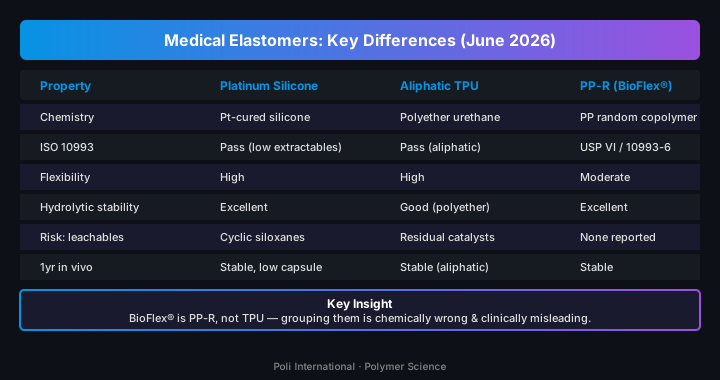
New haemocompatibility and long‑term implantation studies in catheters and soft tissue interfaces again confirm that platinum‑cured silicone maintains very low levels of inflammatory response when volatile siloxanes are controlled and surface roughness is kept low. Several papers report stable performance past the one‑year mark in vivo, with minimal capsule thickness and very low rates of late‑onset irritation—conditions comparable to long‑term healed cartilage or genital piercings.
TPU studies, particularly on aliphatic polyether TPUs for vascular and orthopaedic applications, show improved resistance to oxidative degradation and stress cracking when the hard segment content is optimised and when no phthalate plasticisers are used. In accelerated aging tests mimicking physiological conditions, these newer medical TPUs retain flexibility and tensile strength far better than older aromatic or polyester‑based grades. That matters for studios using flexible retainers in high‑movement sites like nostrils, nipples, and navel piercings, where cyclic flex and sweat exposure are constant. However, the biocompatibility panels that accompany many of these studies are run on well‑specified, traceable grades—not the anonymous “bioflex‑style” TPU that appears in low‑cost retainers and jewelry.
By contrast, there is almost no new peer‑reviewed work on PP‑R random copolymers in body jewelry this month, which is unsurprising: PP‑R materials like BioFlex® and Bioplast are mature chemistries with an established biocompatibility record. Where some polymer trade sources published in the last fortnight get it wrong is by grouping BioFlex® together with TPU‑based brands such as Kaos Softwear and calling all of them “TPU‑type bioflex.” That is chemically false. BioFlex® and Bioplast share a polypropylene random copolymer backbone; TPU brands are segmented urethanes with entirely different degradation products, extractable profiles, and mechanical responses. When a publication suggests they are interchangeable elastomers, practitioners should treat the analysis as technically unreliable.
For studio decision‑making, the implications look like this:
| Feature | Medical‑grade platinum silicone | Medical‑grade aliphatic TPU | PP‑R (BioFlex®, Bioplast) |
|---|---|---|---|
| Backbone chemistry | Crosslinked polysiloxane network | Segmented polyurethane (urethane linkages) | Semi‑crystalline polypropylene random copolymer |
| Typical hardness (Shore A) | ~20–60 | ~70–95 (soft to semi‑rigid) | Wide range; jewelry grades in soft‑flexible window |
| Key degradation risks | Volatile siloxane loss, surface crazing with poor processing | Hydrolysis, oxidation, stress cracking if poorly formulated | Oxidation and stress cracking mainly under extreme conditions |
| Main extractable concerns | Cyclic siloxanes, residual catalyst, low‑MW oligomers | Residual monomer, additives, plasticisers | Processing aids, pigments, low‑MW PP fractions |
| Long‑term tissue response (recent data) | Very low irritation when volatiles controlled and surfaces smooth | Good when aliphatic, polyether‑based, and additive‑controlled | Stable and inert in certified grades like BioFlex® |
| Studio‑relevant strengths | Excellent for long‑term healed channels and retainers where ultra‑soft feel is desired | Strong, abrasion‑resistant for high‑movement or load‑bearing flexible parts | Proven biocompatible for jewelry stems and retainers with controlled stiffness |
| Red‑flag variants | Cheap peroxide‑cured silicone with unknown fillers and volatiles | Unspecified “medical TPU” with phthalates or aromatic isocyanates | “Bioflex‑style” mystery polymers marketed as PP‑R but lacking certification |
Practically, this month’s data support:
- Silicone as the best default for ultra‑soft, long‑term retainers in stable healed channels, especially in cartilage and genital work where pressure marks and friction blisters are a concern.
- Aliphatic medical TPUs as strong candidates for high‑movement flexible components (e.g., barbell stems that must bend repeatedly), but only when the exact grade and its ISO 10993 panel are known.
- PP‑R (BioFlex®, Bioplast) as the workhorse for flexible jewelry where controlled stiffness, low water uptake, and proven implant testing matter more than extreme softness, fitting neatly into the framework laid out in the 2026 guide to flexible jewelry materials and when PP‑R actually matters.
---
3. Technical details that matter in the piercing channel: numbers, tests, and red lines
The most useful shift in recent publications is not a flashy new polymer, but tighter characterisation of leachables and degradation thresholds for the elastomers we already rely on.
On the silicone side, several device papers specify total extractable cyclic siloxanes in the low‑ppm range (often <10–20 ppm D4/D5 equivalents after final cure and post‑bake) as a practical benchmark for low irritation risk in continuous blood and tissue contact. Surface roughness values under Ra 0.2–0.3 µm correlate with thinner fibrous capsules and reduced bacterial adhesion. Translating that into studio practice: if a silicone retainer feels slightly tacky, dusty, or shows visible surface texture, it is almost certainly outside the envelope that these low‑inflammation devices inhabit.
For TPUs, new aging work uses accelerated protocols at 37–70 °C in saline and oxidative media to simulate multi‑year exposure. Grades based on aliphatic diisocyanates and polyether soft segments often retain >80–90% of tensile strength after 6–12 weeks of accelerated aging, suggesting good in‑body stability over years. By contrast, legacy aromatic or polyester‑based TPUs drop below 60–70% of original mechanical properties under similar conditions, with cracking and yellowing. For studios, the practical threshold is blunt: if your supplier cannot specify that a TPU is aliphatic, polyether‑based, and free of phthalate plasticisers, treat it as a short‑lived accessory, not as a long‑term implant‑adjacent material in a healed piercing.
On the regulatory side, recent ISO 10993 testing reports for soft devices continue to rely on the cytotoxicity (ISO 10993‑5), sensitisation (ISO 10993‑10), and irritation (ISO 10993‑23) triad as a minimum for skin and mucosal contact. Several new soft‑tissue device dossiers supplement this with systemic toxicity and sub‑chronic implantation studies when parts are intended for >30 days continuous contact. The bar that matters for our sector is this: materials positioned as “implant‑grade” jewelry should at minimum have 10993‑5, ‑10, and ‑23 data on the final formulation, not just on a vaguely similar base resin.
BioFlex® and Bioplast, as PP‑R random copolymers, sit in a different regulatory posture. BioFlex® holds ISO 10993‑6 implantation certification on the finished material and is built on a USP Class VI biocompatible resin, which is a stronger signal of long‑term tissue compatibility than most anonymous “medical TPU” claims. When you see trade press asserting that “bioflex‑type TPU” has similar behaviour because “all flexible plastics are comparable,” they are flattening critical distinctions in polymer backbone, degradation products, and extractables that directly affect chronic irritation and micro‑trauma. This is the same type of oversimplification that leads people to ignore how the interaction between needle taper and dermal cellular regeneration speed changes healing outcome for seemingly small geometric tweaks.
How should this translate into specific piercing and client decisions?
- High‑movement piercings (navel, nipple, septum, some genital)
- Use: medical‑grade aliphatic polyether TPU or PP‑R (BioFlex®, Bioplast) for stems that must bend and return reliably.
- Avoid: unverified TPUs and soft PVC marketed as “bioflex‑style,” especially for clients with known contact dermatitis or autoimmune issues.
- Stable healed cartilage (helix, conch, rook) with pressure concerns
- Use: platinum‑cured, low‑extractable silicone retainers where extreme softness reduces pressure points.
- Avoid: peroxide‑cured or filler‑heavy silicones with tacky surfaces or strong odour; these correlate with higher extractables.
- Clients with multi‑system sensitivities or history of polymer reactions
- Use: PP‑R BioFlex® or Bioplast for flexible stems when metal is contraindicated, leaning on their ISO 10993‑6 and USP Class VI history.
- Avoid: colored or scented flexible jewelry where pigment or fragrance packages dramatically increase unknown extractables.
- Short‑term procedure aids (biopsy markers, alignment retainers, short‑healing guides)
- Use: either medical silicone or PP‑R depending on the mechanical requirement, accepting limited exposure windows.
- Avoid: building long‑term assumptions from short‑term tolerance; a client who tolerates a silicone guide for 48 hours may still react to the same chemistry over months.
Studios that align their inventory with these thresholds are effectively applying the same risk‑based material selection philosophy used in medical device development, rather than treating “flexible” as a single category.
---
4. Patrick’s Note: Why the TPU confusion keeps biting studios
What I keep seeing in studios is a kind of material fatigue: people are tired of hearing “this flexible thing is safe” and then watching clients react to mystery formulations sold under cosy names. That fatigue is understandable, and it is made worse every time a trade article casually calls BioFlex® a TPU or lumps PP‑R with Kaos‑type urethanes as one generic “bioflex plastic.” From a chemistry standpoint that is simply wrong, and from a clinical standpoint it leads to avoidable problems, especially in high‑risk anatomies and immunologically complex clients.
Looking back at decades of sourcing, the pattern is remarkably consistent: when studios treat material system, not marketing label, as the unit of decision‑making, they get fewer surprises. When you decide that “anything flexible will do” for a fresh nostril or a complex genital project, you inherit all the unknowns of that choice—uncharacterised leachables, poorly controlled pigments, unstable additives. That is exactly why I framed PP‑R, TPU, and silicone separately in the 2026 piercer’s guide to flexible jewelry materials and when each actually matters: once you respect those distinctions, the month‑to‑month flow of new elastomer data becomes a tool you can use, not just more noise.
---
5. FAQ: Technical Q&A
Q: If a supplier calls their retainer “medical TPU,” what minimum data should I demand before using it long‑term in healed piercings?
You should require the exact TPU grade designation, confirmation that it is an aliphatic, polyether‑based medical formulation, and access to ISO 10993‑5, ‑10, and ‑23 test reports on the final compound, not just the base resin. You should also ask explicitly whether the formulation is phthalate‑free and what plasticisers or processing aids are used, because these additives drive most irritation and sensitisation outcomes in the recent literature.
Q: For a client with autoimmune issues who cannot tolerate metal, is silicone or PP‑R (BioFlex®/Bioplast) the safer default for long‑term wear?
In that scenario, PP‑R materials like BioFlex® and Bioplast are usually the safer default for long‑term stems because they are semi‑crystalline polyolefins with ISO 10993 implantation history and a USP Class VI biocompatible resin, and they have very low extractable profiles when processed correctly. Medical silicone is excellent, but more of the recent irritation and sensitisation failures in soft devices are linked to residual cyclic siloxanes and catalysts, so silicone demands tighter process control than many jewelry supply chains currently demonstrate.
Q: Does the new elastomer research change anything for initial piercing jewelry, or is this mainly about healed channels and retainers?
Most of the latest data is generated on long‑term implants and blood‑contact devices, so it is more directly applicable to healed channels and retainers than to initial piercing hardware. However, the same principles—minimising extractables, avoiding unknown plasticisers and pigments, and respecting backbone chemistry differences between silicone, TPU, and PP‑R—absolutely apply to any flexible component that might be used in early‑stage procedures or as a temporary aid during healing.
---
Conclusion: Choose the polymer system, not the marketing story
The new elastomer work from this month does not crown a brand‑new miracle polymer; it sharpens the lines between well‑characterised silicone and TPU systems and the sea of loosely described “medical‑style” flexible plastics that continue to drift into our world. For studios, this is an opportunity to upgrade purchasing criteria: demand backbone‑level transparency (silicone vs TPU vs PP‑R), insist on ISO 10993 data for the final compound, and treat BioFlex® and Bioplast as PP‑R systems with their own regulatory and clinical history—not as interchangeable cousins of TPU‑based “bioflex‑style” products.
If you align specific anatomies and client profiles with the strengths of each material family—silicone for ultra‑soft pressure management, aliphatic medical TPU for high‑movement durability, and PP‑R for low‑extractable, certified flexibility—you are effectively applying medical‑device‑grade reasoning to studio practice. That is the bridge between what the journals publish and what happens in your piercing room, in the same way that understanding the biomechanics of needle geometry and dermal recovery turned abstract engineering into cleaner heals and fewer surprises.