
The State of Studio Safety: What the Data Says (Mid-2026)
Key Takeaways:
» Sterilisation requires validation, not trust: weekly spore testing with biological indicators is the minimum standard, on a Class B vacuum autoclave with separated clean and dirty zones.
» Bloodborne-pathogen (BBP) training is an annual requirement under OSHA, not a one-time onboarding checkbox.
» 11.4% of the population is nickel-sensitised, and 82% of nickel-allergy cases trace back to piercing jewellery; implant-grade titanium (ASTM F136) eliminates the risk.
» 24.7% of European earrings still exceed the EN 1811 nickel-release limit, so batch-specific certification is the only reliable defence.
» The REACH SVHC candidate list now exceeds 240 entries and grows each ECHA cycle, so compliance requires active quarterly checking.
Studio safety is the foundation everything else sits on. A studio can have the best artists, the strongest Instagram presence, and a six-month waiting list, but if the autoclave is not validated, the BBP training is stale, or the jewellery cannot be traced to a mill certificate, none of the rest matters. This is the mid-2026 data round-up on how studios are actually performing.
1. Sterilisation: The Numbers Behind the Autoclave
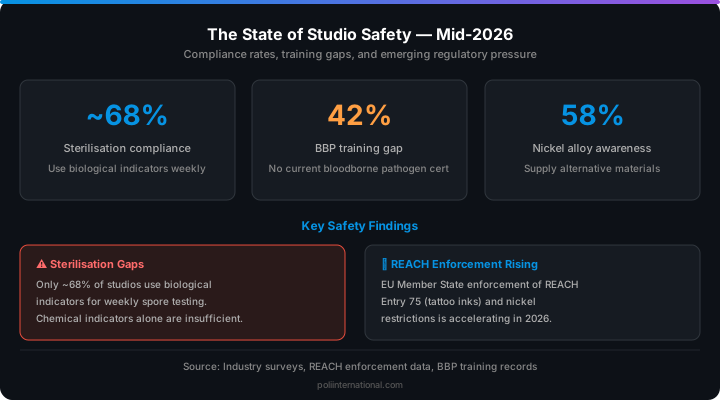
The autoclave is the single most important piece of equipment in any studio. Weekly spore testing using *Geobacillus stearothermophilus* biological indicators is the gold standard for validation. Studios that run spore tests weekly and log results catch failures before they reach a client; studios that test monthly, or only when the inspector is due, are operating on trust. A single undetected failed spore test means every instrument in that cycle was not sterile.
A Class B vacuum autoclave is the recommended standard for wrapped and hollow instruments. Class N gravity-displacement units cannot sterilise wrapped packs or lumened instruments and should not be used for piercing equipment. The Autoclave Calculator sizes sterilisation capacity correctly, because undersized autoclaves create pressure to rush cycles, and rushed cycles create incomplete sterilisation. Physical workflow matters too: clean instruments must never cross back through the dirty zone, cleaning and handwashing sinks must be separate, and ultrasonic pre-cleaning removes the bioburden that would otherwise shield microorganisms from steam. The Studio Compliance Checklist maps every one of these into an auditable sequence.
2. Bloodborne Pathogens: Training, Compliance, and the Gap
Every studio in a regulated jurisdiction must maintain BBP training for all staff who handle needles, contaminated instruments, or biological waste. The OSHA Bloodborne Pathogens Standard (29 CFR 1910.1030) sets the US federal baseline and requires annual refresher training, a certificate from 2023 is not current in 2026. The gap between who should be trained and who is trained is where liability lives. The BBP Training Tracker tracks certification dates and flags expiries; the Sharps Disposal Tracker logs container change dates and fill levels, since sharps disposal is the BBP item most likely to fail an inspection.
3. Material Safety: Nickel, Certification, and What Clients Do Not Know
| Metric | Figure | Meaning |
|---|---|---|
| Nickel allergy prevalence | 11.4% | Most common contact allergen |
| Odds ratio, allergy with piercings | 5.9 | General population (von Spreckelsen 2025) |
| Etiological fraction of piercings | 82% | Share of cases attributable to piercing |
| European earrings over EN 1811 limit | 24.7% | Nearly one in four posts non-compliant |
A piercer who stocks implant-grade titanium (ASTM F136, zero nickel) knows exactly what they are inserting into a healing wound. A piercer who stocks unspecified "surgical steel" with no batch ICP-MS certificate does not, and neither does their client. The Material Certification Checker walks through the verification: which standard the material meets, whether a mill certificate exists, and whether nickel release has been tested to EN 1811. The EU Nickel Directive (now within REACH Annex XVII) restricted release to 0.2 micrograms per square centimetre per week, and prevalence in young women fell from roughly 19.8% to 11.4% as a result. Regulation works when it is enforced.
4. REACH and Regulation: Enforcement Is the Real Story
REACH Annex XVII restricts nickel, lead, cadmium, and other substances in skin-contact articles, and the EU Tattoo Ink Regulation (2020/2081) added roughly 4,000 substance restrictions to inks from January 2022. But regulation without enforcement is paper. The REACH SVHC Checker cross-references Safety Data Sheets against the current Substances of Very High Concern list, which now exceeds 240 entries and grows each ECHA cycle. The Legal Compliance Standards wiki maps which substances are restricted under which instrument, essential reading for any studio importing ink or jewellery.
5. Patrick's Deep Archive: Client Safety Starts Before the Needle
Safety does not begin when the needle touches skin, it begins with the health screening. A form that asks "any health conditions?" and leaves a blank line is not screening, it is hoping. The Client Health Screening tool flags real contraindications: isotretinoin requires a minimum six-month wait before elective procedures, anticoagulants increase bleeding risk, and keloid predisposition changes the risk calculation for certain placements. After the procedure, the Aftercare Schedule Generator produces a day-by-day protocol and the Reaction Triage Wizard helps clients tell normal healing from early infection. Studios that track their own complication rates improve; those that do not cannot, because they do not know where they stand.
6. FAQ: Technical Q&A
Q: How often should a studio run spore tests?
Weekly at minimum. Some health departments require every cycle. A monthly test means you could process hundreds of clients with a failing autoclave before detecting it.
Q: Is "surgical steel" safe for initial piercings?
"Surgical steel" has no regulatory definition. Only ASTM F138 316LVM, verified by a batch ICP-MS certificate showing EN 1811 release below 0.2 micrograms per square centimetre per week, meets the implant-grade standard. For initial piercings, implant-grade titanium (ASTM F136) is the safer default.
Q: What does REACH actually require from a studio?
Know what substances are in your inks and jewellery, verify restricted substances are below thresholds, keep SDS documentation, and respond to SVHC information requests within 45 days. Importers from outside the EU carry additional obligations under REACH Title II.
Conclusion: Validate, Certify, Check
 style="width:100%;max-width:720px;height:auto;border-radius:12px;border:1px solid var(--border-color);margin:2rem auto;display:block" />
Studio safety in 2026 is a documentation problem as much as a technical one. Validate your sterilisation, certify your materials, and check your compliance on a schedule. Start with the Studio Compliance Checklist and work outward.


