
Automatic tattoo robots are going viral, but your epidermis is not a beta test environment
Key Takeaways:
» Consumer-facing tattoo robots are trending, but current systems are built like plotters, not surgical devices.
» The big missing piece is *validated* real-time depth control, and that’s what matters for trauma, blowouts, and scarring.
» Needle, ink, and motion tolerances in human skin are nowhere near as predictable as the promo videos suggest.
» Studios flirting with robots need medical-grade QA, not a cool content hook, if they want to sleep at night.
» For now, the most “advanced” tech you can invest in is needle geometry, asepsis, and aftercare protocols, not a kiosk with a camera.
1. What’s actually going on with these viral tattoo robots?
If you’ve been anywhere near TikTok or Instagram this month, you’ve seen it: people climbing into sleek white pods, strapping an arm into a cradle, and letting a tattoo robot “print” a fine-line design while their friends film from six angles. The Austin-based automatic tattoo system that keeps getting shared is pitched as a kind of hyper-precise CNC plotter for skin: scan the arm, map curvature and “skin type,” then let the robot needle do the rest, supposedly optimizing puncture depth and spacing for a perfect minimalist tattoo every time, as described in a recent trend roundup on “automatic tattooing” out of Texas.
The sales narrative is familiar: robots don’t get tired, they don’t have “off days,” and they hit the same line exactly the same way, every time. For minimalist fine-line and dotwork, that sounds seductive. Combine that with the broader wave of “crazy tattoo trends”, magic ink, semi-permanent ink, sedation sessions, and you’ve got a tech story the mainstream press loves to amplify, even if nobody involved has ever run a proper biocompatibility or repeatability study on real skin.
Here’s the problem: human skin is not a flat aluminum plate on a CNC bed. It’s a non-homogeneous, living, moving, anisotropic substrate with wildly different mechanical properties from one square centimeter to the next. And everything that matters in tattoo quality and safety lives in that complexity, the same complexity that these robot demos mostly ignore. If you understand how needle geometry drives dermal trauma and regeneration, the same physics that underpin the relationship between needle taper angle and dermal cellular regeneration speed, you can see immediately where the current generation of tattoo robots runs into hard limits.
2. The engineering reality: robots love certainty, skin hates being predictable
Let’s break down what these viral robot systems are promising versus what the physics will actually let them do.
Most of the public-facing marketing claims fall into four buckets:
- “It analyzes your skin type and adjusts penetration depth.”
- “It delivers perfectly consistent spacing and linework.”
- “It reduces human error and makes tattoos safer.”
- “It opens the door to mass personalization and scalable tattooing.”
On paper, this sounds like the leap from hand-drawn PCB traces to precision pick-and-place. In practice, the critical variable isn’t XY accuracy, it’s Z-axis control into biological tissue. A robot can easily hit the same XY coordinate within ±0.05 mm. What it cannot do (with current consumer hardware) is guarantee it’s in the upper to mid dermis instead of shredding the papillary layer or skating too superficial in the epidermis.
Here’s how those claims look when you compare marketing to reality:
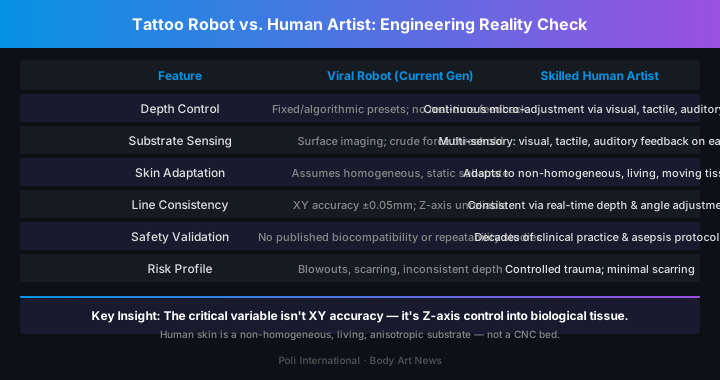
| Feature | Viral tattoo robots (current generation) | Skilled human artist |
|---|---|---|
| Depth control | Fixed or algorithmic presets based on surface scan and “skin type”; no true real-time feedback | Continuous micro-adjustment from visual, tactile, and auditory feedback on each pass |
| Substrate sensing | Surface imaging; maybe crude force thresholds; no histological feedback | Reads resistance, bleed pattern, ink uptake, client feedback, local edema |
| Motion variability | Extremely consistent motion, but blind to sudden client movement or micro-flinches | Anticipates movement, braces, and compensates dynamically in real time |
| Design flexibility | Optimized for fine-line, dotwork, simple realism; limited to what the algorithm expects | Can adapt mid-stream to scarring, stretch marks, unexpected ink behavior |
| Error handling | If depth or angle is wrong, it’s wrong consistently | Can stop, correct angle, change needles, alter technique immediately |
| Clinical judgment | None. Robot will tattoo whatever the operator loads | Human can refuse unsafe placements, compromised skin, or poor healing candidates |
Consistency in the *wrong* depth is not an upgrade, it’s just perfectly repeatable damage. Humans can detect subtle changes: the way resistance shifts as you move over a tendon, the way ink clouds differently over old scar tissue, the change in bleed when you’re drifting too deep. That “organoleptic” feedback, feel, sound, micro-visuals, is exactly what let us optimize low-trauma needle configurations in the first place, the same logic that underlies things like using stacked vs. loose groupings for less invasive needle configurations.
Robots don’t have that. They have a boundary scan and pre-programmed motion.
3. Technical deep dive: where the risk really lives
Let’s get into specifics, because this is where engineers and practitioners usually start talking past each other.
#### 3.1 Depth, trauma, and why ±0.2 mm matters
In most adult clients, you want pigment sitting roughly in the upper to mid dermis, on the order of 1–2 mm below the surface depending on body site, age, and individual variation. Go too shallow and the tattoo fades or blows out through epidermal turnover and immune clearance; go too deep and you’re into reticular dermis and even subcutis, where you see blur, scar formation, and increased inflammatory response.
The problem: skin thickness varies not just by body region but within the *same* stamped area. A 0.5 mm error on inner forearm might be trivial; the same error on a bony wrist or over old scar tissue is the difference between crisp lines and chronic irritation. When you’ve tuned your process around needle taper, stroke length, and machine give, you learn to adjust hand pressure in real time, something no tabletop robot is doing with meaningful feedback today.
If a robot is working off a pre-scan and a single “skin type” classification (“oily, dry, fair, dark”), that’s marketing language, not clinically useful data. No current consumer robot is doing optical coherence tomography or any other imaging sophisticated enough to track dermal depth on the fly. Without that, “depth control” is just a fancy way of saying “we picked a number in software and hoped your skin matched the training set.”
#### 3.2 Client movement and dynamic loads
Then there’s motion. The TikTok clips look calm: client relaxed, device humming. Real life is:
- Micro-flinches
- Breathing cycles changing skin tension
- Involuntary muscle twitches
- Slight shifts as pain ramps up
A human artist can modulate speed, angle, and needle contact through all of that. A robot arm with a set toolpath cannot. Even a tiny unexpected movement can translate into:
- A sudden over-penetration if the skin moves up into the needle path.
- Skips or “railroad” line artifacts if the skin moves away.
- Lateral tearing if the skin shifts while the needle is engaged.
In machining metal, you compensate with fixturing and clamping. On humans, you don’t get to clamp the workpiece in a vice. If you want a robot that truly handles this, you’re talking about force-feedback actuators, high-frequency position sensing, and real-time trajectory re-planning, that’s surgical robot money, not “tattoo kiosk in a mall” money.
#### 3.3 Asepsis: CNC culture vs. medical reality
Let’s talk hygiene, because this is where regulators are going to come in swinging.
The FDA has already flagged that even sealed tattoo ink bottles can harbor bacteria and other microorganisms, and that contaminated inks (plus non-sterile dilution water) are a major driver of tattoo-related infections, with documented outbreaks from “do-it-yourself” kits and improperly handled pigments in the U.S. consumer warnings. That’s *before* you add a complex robotic system with:
- Multiple joints and crevices
- Camera housings
- Skin-contact fixtures and arm cradles
- Toolholders and needle cartridges
Every one of those surfaces is a potential fomite if you don’t have a validated cleaning and sterilization protocol. A human station is relatively simple: barrier everything, one client per setup, autoclave the reusables, dispose of the rest. A robot has more in common with a dental chair or minor-surgery robot, and those devices go through medical device approval, ISO 13485-level QA, and serious validation studies.
If you’re a studio owner thinking “this will be a great differentiator,” be very clear: if someone connects an outbreak to your robot system, you own that PR nightmare, not the startup.
#### 3.4 Ink delivery and line quality
Fine-line minimalism is the easiest style to sell as “robot-ready,” because the patterns are simple and the needles are usually single or very tight liners. But anyone who’s done these at scale knows the trade-offs:
- Low-trauma fine lines require precise balance between pigment load and hit.
- Overworking with small groupings is the fastest way to chew up the epidermis.
- Slight changes in speed or angle show up as visible jitter or thickness variance.
We already know from low-trauma needling research that even small shifts in taper and configuration change how collagen is disrupted and how quickly macrophages can recapture displaced pigment, as covered in the discussion of low-trauma needle configurations that reduce acute dermal impact. Robots are not calibrating against histology or healing outcomes, they’re calibrating against “did the line look okay in the photo ten minutes after the session.”
Without healed-skin datasets and actual adverse-event tracking, a robot that “works” in promo videos may be quietly generating:
- Increased micro-scarring in certain skin types.
- Higher blowout rates in thin or high-motion areas.
- Unpredictable melanin interaction in darker skin where overworking has higher visible cost.
4. Patrick’s Note: Why I don’t let marketing teams design for human tissue
What I’ve seen, every time a new tech buzzword hits this industry, is the same dance: someone builds a cool device, films it on flawless, fair, young skin, and then tries to backfill the science once the hype has already landed. It’s the same pattern we saw with early “semi-permanent” inks that were supposed to vanish in 9–15 months and ended up hanging around in clients for multiple years with uneven fading and ghost images, as artists found out the hard way when they dug into the reality behind ephemeral tattoo ink fade patterns and removal challenges in stories like those covered on “crazy tattoo trends” blogs.
Looking back at three decades of sourcing and engineering body art materials, what makes a product truly disruptive isn’t a glossy robot arm, it’s verified performance in real tissue over real time, backed by boring things like ppm limits, ISO certifications, and adverse-event statistics. That’s the mindset that went into BioFlex®: we certified to ISO 10993-6 and hit phthalate levels under 1 ppm long before regulators cared, because the skin doesn’t care about your marketing timeline. A tattoo robot that wants to play in that league needs to stop acting like a gadget and start acting like a medical device, full stop.
5. FAQ: Technical Q&A
Q: Could a robot ever be *safer* than a human tattoo artist?
Yes, but only if it has medical-grade sensing, depth feedback, and validated hygiene workflows that match or exceed hospital standards. That means real-time tissue feedback (not just a surface scan), full traceability of needles and inks, and clinically audited protocols for cleaning, calibration, and error handling, not just a software update and a wipe-down.
Q: Are clients who get robot tattoos taking on any special risks right now?
The main extra risks are unknowns: there is no long-term data on healed outcomes, scar rates, or infection incidence for consumer tattoo robots. If the system is running on standard needles and inks but without proven aseptic procedures or depth validation, you’re betting your skin on a prototype workflow that hasn’t gone through anything like a proper clinical trial.
Q: Should studios invest in a tattoo robot as a marketing hook?
Not unless you’re ready to treat it like a regulated medical device: written SOPs, staff training, formal maintenance logs, and a plan for when the thing glitches mid-line. From a purely technical standpoint, you will get more real-world quality and safety gains by investing in better needle systems, rigorous sterilization, and client education than by parking a robot in the lobby to farm TikTok views.
Conclusion: Don’t Beta Test on Your Clients’ Skin
Automatic tattooing is a great conversation starter, but right now it’s an engineering demo, not a clinical upgrade. The hard problems in tattoo safety, precise dermal targeting, controlled trauma, infection control, and long-term pigment behavior, are not solved by bolting a rotary onto a robot arm and adding a phone app. They’re solved by understanding how skin actually responds to needle geometry, motion, and materials and building technology around that biology, not around viral clips.
If you’re a practitioner, the smart move is simple: keep your tech investments grounded in real tissue science and outcome data, the same way you’d approach decisions about how needle geometry affects dermal recovery and trauma. Let the startups prove, with numbers and healed photos and adverse-event reporting, that their robots can match the best human hands. Until then, your clients deserve tools and techniques that were designed for skin first and social media second.


