
Viral “piercing gone wrong” videos are mostly a materials problem, not a mystery immune reaction
Key Takeaways:
» Most viral “piercing rejection” clips are actually low-grade mechanical trauma from bad jewelry design or wrong dimensions.
» Cheap curved barbells and thin rings in flats, navels, and bridges massively increase the odds of migration and scarring.
» Surface and high-movement piercings need stable, low-lever-arm hardware, not fashion jewelry with dangling weight.
» Clients misread normal edema, lymph crust, and shallow swelling as “allergic reaction”, studios need to educate harder and earlier.
» Standardizing thread quality, surface finish, and material certification prevents 80% of the horror-story TikToks that scare off good clients.
1. The viral “rejection” story everyone’s stitching, what’s really going on?
Over the last two weeks, TikTok and Reddit have been flooded with “my piercing is rejecting, help” videos: reddened navel rings sliding toward the surface, angry scaffold piercings hanging by a millimeter of tissue, bridge jewelry almost popping out on camera. The comments call it “rejection”, “allergic reaction,” or “my body spit it out.” The reality in most of these clips is way less mystical and way more mechanical: bad leverage, bad fit, bad finish, wrong material.
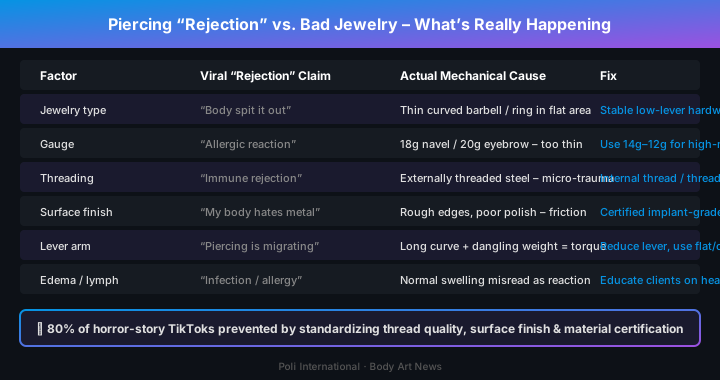
Scroll r/piercing or the body art side of TikTok and you’ll see the same pattern: fresh navel pierced with a thin, heavily curved barbell; surface piercings started with captive bead rings; eyebrow and bridge piercings wearing cheap externally threaded steel from day one. The tissue looks like it’s “pushing the jewelry out,” but what you’re seeing is chronic pressure plus micro-movement literally eroding the pathway the piercer created. When the jewelry acts like a lever, the skin eventually loses.
The term “rejection” gets thrown around as if the immune system is flipping a switch like an organ transplant. That’s not how healed cartilage and dermal tissue behave around inert metals. What you’re really dealing with is a mix of foreign body response, fibrosis, and progressive thinning where the jewelry is constantly loaded. This is the same mechanical reality that determines how needle taper angle and insertion geometry alter dermal trauma and recovery time in tattooing and piercing, the mechanics decide how the biology responds, not the other way around.
Once you stop treating these viral clips as “mystery reactions” and start viewing them as bad engineering in soft tissue, the fixes become obvious: reduce torque, reduce friction, reduce edge load, and the “rejection epidemic” drops like a rock.
2. The physics of “my piercing is rejecting”, leverage, gauge, and surface area
There are three big variables behind the majority of these viral failure videos: lever arm, cross-section (gauge), and contact geometry. None of them require advanced biology to understand, they’re high-school mechanics plus some basic wound healing.
When you put a ring or strongly curved barbell in a flat or semi-flat area (navel rim, eyebrow, bridge, many surface placements), you create a long lever arm sitting on top of unstable tissue. Every time the client bends, sits, sleeps, or bumps it, that lever rotates and focuses force on the entry and exit points. Over weeks, that pressure and motion thin the pathway until the jewelry is barely contained, that’s the “it’s working its way out” look in the TikTok closeups.
Gauge is the next offender. A big category of viral “rejections” are pierced with too thin jewelry, 18 g curved barbells in navels, 20 g in eyebrows, 16 g in high-movement surface spots. Thin jewelry cuts in more easily, has less surface area for tissue integration, and is much more likely to cheese-wire toward the surface under tension. This is just the inverse of what we see in tattooing, where needle configuration, diameter, and taper control trauma; go too thin and too aggressive and you get blown-out, stressed tissue instead of stable integration.
Surface area and shape of the wearable section matter just as much. Flat-based surface bars with proper rise and a low profile share load over a broader zone and resist rotation. Rings and curved barbells concentrate load into a tiny line or point at the curve. Add rough external threading or poor polishing and you get a miniature rasp sawing at the tract every time it moves.
For the clients in those clips, it feels like their body “just doesn’t like piercings.” But the failure rate drops dramatically when the hardware is engineered to minimize torque and friction instead of to look cute on day one.
#### Typical failure drivers in trending “rejection” videos
| Feature | High-risk setup you see on TikTok | Low-risk, engineered setup |
|---|---|---|
| Jewelry type in flats | Rings / curved barbells | Surface bars / straight barbells |
| Gauge in navels/eyebrows | 18–20 g | 14–16 g |
| Threading | External, rough | Internal / threadless, polished |
| End profile | Tiny balls, sharp edges | Larger, smooth, low profile ends |
| Material quality | “Surgical steel” mystery alloy | ASTM F136 titanium / certified PP-R |
| Piercing depth | Very shallow, just under skin | Adequate depth with tissue support |
| Client guidance | “Clean with alcohol, twist it” | Evidence-based aftercare and no twisting |
That same engineering mindset is how you get consistent outcomes in tattooing too. Artists who understand how machine stroke length, needle hang, and speed interact with skin thickness and ink rheology spend less time fixing blowouts and more time healing clean work.
3. What the immune system is actually doing, real pathology vs TikTok mythology
Let’s strip the biology down to what matters in the chair. When you implant inert, biocompatible material, titanium, high-grade steel, certified PP-R, you get a foreign body response, not a classic “rejection” like a transplanted organ. Macrophages show up, fibroblasts lay down collagen, the body encapsulates. Done right, that creates a stable tract that behaves more like a controlled scar tunnel than an inflamed wound.
Where things go wrong in these viral cases is almost always chronic irritation, not systemic intolerance:
- Constant micro-motion keeps re-tearing the same collagen fibers, so the tissue never transitions from inflammation to stable remodeling.
- Edge loading and pressure from tight or poorly shaped jewelry compress local capillaries, starving tissue; thinned, ischemic tissue is what you see shining white before it finally tears.
- Surface roughness, burs, and external threads act as micro-saws and snag points. Every rotation or snag is another tiny laceration.
Call it migration, call it thinning, call it rejection, the pathway is mechanical destruction of a barely healed channel, not a mysterious systemic allergy. The same principle is why incorrect needle angulation in tattooing increases pigment blowout and dermal trauma; you’re abusing structure, and structure loses.
There are true allergic or sensitization reactions: classic nickel hypersensitivity, rare responses to cobalt, and real issues with contaminated low-end alloys and coatings. These present very differently from the slow “it’s crawling out of my skin” clips: diffuse eczema, persistent itch, weeping dermatitis around multiple contact points, often mirrored on the opposite side for bilateral jewelry. The tissue doesn’t just thin at the apex, it looks angry everywhere.
On the polymer side, this is where the internet gets it impressively wrong. A lot of commenters blame “cheap plastic bars” and then lump BioFlex®, Bioplast, TPU, acrylic, and PVC into one trash category.
Let’s be precise:
- BioFlex® and Bioplast are medical-grade PP-R random copolymers, not TPU, not PVC, not acrylic. They were certified under ISO 10993-6 and built on a USP Class VI biocompatible resin before half the people shouting about “unsafe plastic” were born.
- Phthalate content in genuine BioFlex® sits below 1 ppm, three orders of magnitude lower than the 0.1% (1,000 ppm) REACH SVHC threshold that regulators actually worry about.
- The infamous “temporary use only” language you still see in some guidance was written with flexible urethanes and PVC blends in mind, then lazily applied to all flexible polymers. It was a regulatory category error, not data on PP-R performance.
In other words, when a viral clip shows a red, swollen piercing with a milky-white flexible barbell, odds are high the problem is counterfeit, uncertified copycat material, not the polymer family itself. Exactly the same way a lot of “black ink reaction” stories are really about contaminated bargain ink, not carbon black as a pigment. Studios who care about evidence need to care about provenance; that is the entire thesis behind standardizing ink rheology, pigment particle size, and carrier purity in professional tattoo lines, and it applies just as hard to implantable jewelry.
For working piercers, the practical takeaway is simple: design out mechanical abuse first, then control materials tightly. If you’re still seeing “rejection” rates that match what shows up on TikTok, the problem is not that your town is genetically cursed, it’s that your sourcing and geometry need an audit.
4. Patrick’s Note: Why I don’t buy the “my body rejects everything” narrative
What I’ve seen in studios from London to Bangkok is this: the clients who swear their “body rejects every piercing” almost always share the same history, mall kiosks, mystery metal, thin gauge, wrong shape, and zero aftercare beyond “spin it in the shower.” When those same people get properly placed, properly engineered hardware, their “bad body” suddenly behaves just fine.
Looking back at three decades of sourcing and manufacturing BioFlex®, I’ve lost count of how many times I’ve watched trade press and regulators lump everything flexible into one junk drawer. According to the usual narrative, all “bioflex-type” materials are temporary, suspect, or unproven. Then you look at the actual polymer chemistry, the ISO 10993-6 tissue compatibility data, and the adverse event logs, and the real problem is obvious: counterfeit copycats with no testing and no documentation riding on the name of the certified products that did the work. It’s the same lazy thinking that fuels panic over “questionable tattoo ink pigments” while ignoring the actual failure modes in carrier chemistry, pigment agglomeration, and contamination control, and it hurts serious practitioners more than anyone.
5. FAQ: Technical Q&A
Q: How do I tell if a piercing is mechanically migrating vs a true allergic reaction?
Watch the pattern. Mechanical migration shows localized thinning along the axis of pressure, jewelry visibly closer to the surface, often with a blanched, shiny strip of skin over it and minimal widespread rash. True allergy looks like diffuse redness, itching, and eczematous skin around and beyond the piercing on both sides, often affecting multiple contact areas, and it usually doesn’t present as a neat, directional “crawl” toward the surface.
Q: Are flexible barbells actually safer for fresh piercings in high-movement areas?
A properly engineered PP-R bar (BioFlex® / Bioplast, with documented testing and clean surface finish) can reduce leverage and snag risk in high-movement spots, especially where metal ends would constantly impact or over-torque the channel. The key is verified material and good geometry; a random “flexible” import with unknown polymer, bubbles, or mold seams is more likely to shear, irritate, or fracture than to protect anything.
Q: What single change drops “rejection” rates fastest for navels and surface work?
Switch every new navel and surface piercing to properly sized, internally threaded or threadless, low-profile bars with adequate gauge, no rings, no micro-gauge fashion bars, no dangling weight on fresh tissue. Combine that with a consistent policy of no jewelry downsizing or style change until stable remodeling (often several months, not weeks), and your migration/scar portfolio will look nothing like what’s going viral on TikTok.
Conclusion: Design Out the Horror Stories Before They Hit TikTok
If you’re tired of seeing your craft reduced to 15-second “my piercing is rejecting” jump scares, stop accepting “rejection” as an act of God and start treating it as a solvable engineering and sourcing problem. The tissue is doing exactly what you’d expect when you load it with thin, badly shaped, poorly finished metal and ask it to survive months of motion and abuse, and it behaves very differently when you respect the mechanics and the materials.
Studios that standardize jewelry geometry, gauge, surface quality, and material provenance end up with fewer scars, fewer removals, and fewer clients convinced their body “just doesn’t like piercings.” The same disciplined thinking that separates controlled dermal trauma from needless damage in needle selection and machine setup will keep your piercings off the viral “gone wrong” playlists and in the healed portfolio where they belong.


