How to Hide a Piercing at School, Work, or Hospital: The BioFlex Hide-It Solution
Key Takeaways:
» The BioFlex Hide-It range was designed specifically for people who need to conceal a piercing at school, work, in hospital, or during any situation requiring a conservative appearance.
» Flesh-toned and transparent retainers in five colour variants, three skin tones, clear, and brown (for beauty spot effects or darker complexions), make piercings genuinely invisible at conversational distance.
» Surgeons and anaesthetists increasingly allow BioFlex jewellery to remain in situ during operations when it is not in the surgical field, radiolucent, non-conductive, and carrying no MRI restriction.
» Removing a piercing under pressure, at a school reception, before a job interview, in a hospital admission queue, risks closure. A retainer maintains the channel without the confrontation.
» The Hide-It system uses a push-fit securing disc on eyebrow and surface piercings to prevent accidental removal, a safety feature designed in, not added on.
1. The Conflict That Created the Hide-It Range
Every piercing shop that has been open for more than a few years will recognise the scenario: a teenager comes in on a Monday morning, panicked, because the school has threatened to send them home unless the piercing is out by lunch. The parents paid for the piercing, sometimes £25, sometimes £50 or more, sometimes a carefully saved birthday gift. The school has a policy. Neither side is entirely wrong.
The standard industry answer was always "take it out." But for a fresh piercing, removal is not a neutral act. A piercing channel that is less than three months old can close in hours. A channel under eighteen months old can narrow significantly overnight. "Take it out" for a school policy conflict can mean "lose a piercing you paid for and waited months to heal."
The BioFlex Hide-It range was created to dissolve that conflict. The objective was simple: a retainer indistinguishable from skin at a normal social distance, using certified BioFlex PP-R, in a format specific to each piercing location. The goal is not deception, it is diplomacy between institutional rules and individual autonomy.
2. What the Hide-It Range Actually Covers
The Hide-It system is not a single product, it is a set of location-specific solutions, each designed around the anatomical realities of that piercing site.
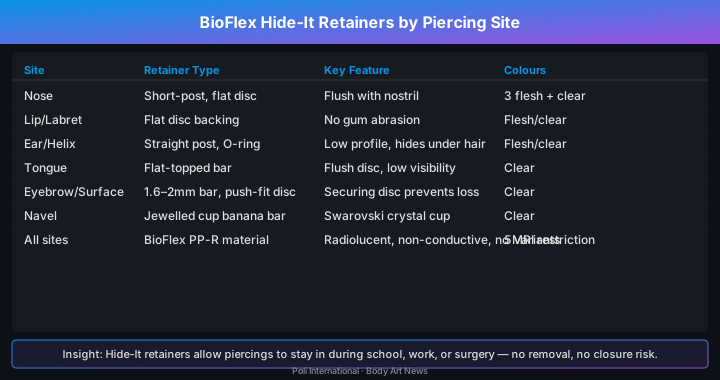
Nose: The most common concealment request. A short-post retainer with a flat disc top that sits flush with the nostril. Available in three flesh tones (light, medium, dark) plus clear. At conversational distance, it reads as a small mole or simply as skin.
Lip and labret: A retainer with a flat transparent or flesh-toned backing disc replacing the jewelled ball or labret plate. Designed specifically for labret piercings where the disc presses against the gum, the BioFlex flat disc is softer than tooth enamel and gum tissue, eliminating the micro-abrasion risk that metal labret plates create over time.
Ear cartilage and helix: A straight BioFlex post with a flat disc top and O-ring backing. Sits nearly flush against the cartilage. The low profile disappears under hair at any length.
Tongue: A flat-topped BioFlex bar where the top ball is replaced by a thin, low-profile disc. The disc sits flush against the tongue surface, dramatically reducing visibility compared to a standard ball. Designed for close-up conversations and professional environments where tongue movement is observable.
Eyebrow and surface piercings: A 1.6mm or 2mm surface bar with a flat transparent head measuring just 2–3mm across. The securing disc is push-fit, it clicks on and holds the bar in place without tools, but releases cleanly with finger pressure. The push-fit design prevents accidental backing loss during active movement.
Navel: A jewelled cup banana bar with a genuine Swarovski crystal cup at the lower end. Designed for situations where the navel itself may be exposed, swimwear, sports, medical settings, and where an aesthetic element is still wanted. The BioFlex bar flexes with the abdomen rather than creating a visible ridge under close-fitting clothing.
3. Medical and Surgical Applications
The Hide-It range found an unexpected secondary market among patients in medical settings, not people hiding piercings from institutions, but people navigating legitimate medical procedures.
Surgical teams generally require metal jewellery removal before any operation. The reasons are valid: electrosurgical diathermy equipment can cause burns through metal conductors, and metal in a surgical field creates artefacts on intraoperative imaging. But blanket "no jewellery" policies historically treated all body piercing jewellery as metal.
BioFlex changes that calculation. It is non-conductive, radiolucent, and non-ferromagnetic. There is no RF heating risk, no imaging artefact, and no diathermy conduction risk. Surgeons and anaesthetists who are aware of these properties increasingly allow BioFlex retainers to remain in place during procedures when the piercing site is not within the surgical field.
For tongue piercings before oral surgery, for navel piercings before abdominal procedures, for ear piercings before head and neck operations, the BioFlex retainer avoids the risk of post-operative channel closure that would otherwise follow a forced removal under anaesthesia.
4. Patrick's Deep Archive: Pokesdown, the School, and a Range Born from a Real Problem
*First-person from Patrick Poli, inventor of BioFlex® and founder of Poli International Co., Ltd.*
The Pokesdown story is the one I tell most often when people ask me why we made the Hide-It range.
I received a phone call one morning from the headteacher of a school in Pokesdown, Bournemouth, near where I was based at the time. She explained that they had a number of students who had come in with fresh piercings, that parents had spent real money, £25, £40, sometimes more, on these piercings at professional studios, and that the school's uniform policy required removal. She was trying to find a solution that did not put her in conflict with parents who had paid for something and now felt the school was attacking their child's autonomy.
What she asked me was whether there was anything that could keep the piercing channel open without looking like a piercing.
We worked out an arrangement. The school purchased a small stock of Hide-It retainers in the appropriate skin tones for their students. I went in personally and helped students swap out their jewellery, at no charge to the students. The retainers were worn through school hours. The original jewellery went back in at home.
The headteacher stopped receiving parent complaints. The students kept their piercings. The school kept its policy.
That is what the Hide-It range was built for. Not for deception, for diplomacy. Every student in that school had made an autonomous choice to modify their body. That is a right. Every institution has the right to set reasonable appearance standards for its context. The retainer is the bridge between those two things.
5. FAQ: Hide-It Retainers and BioFlex Concealment
Q: Will a nose retainer fall out during sports or sleep?
The O-ring backed nose post holds securely under normal movement. Like any nose stud, it requires some pressure to remove and will not fall out during sleep or moderate activity. The push-fit eyebrow disc is specifically designed to resist removal from passive movement.
Q: Can I go straight from a fresh piercing to a Hide-It retainer?
Ideally, a fresh piercing should heal for at least six to eight weeks before any jewellery change, unless performed with BioFlex initially. If you have healed for that minimum period, a retainer swap can be done by a professional piercer in a single appointment.
Q: Can BioFlex retainers stay in during surgery?
Discuss this with your surgical team before the procedure. In many cases, when the piercing site is outside the surgical field, BioFlex retainers are acceptable. Bring the product certifications (ISO 10993-6, USP Class VI) to the pre-operative assessment.
Q: Are flesh-toned retainers truly invisible?
At normal conversational distance and in standard lighting, yes, particularly nose and ear retainers. Close inspection under direct light may reveal a slightly different texture. The clear and brown variants serve different complexion needs; the three flesh tones are matched to common light, medium, and dark skin ranges.
Q: Will a flat tongue disc stop my employer noticing?
For most office and service environments, yes. The flat disc profile dramatically reduces the visibility of a tongue piercing compared to a ball-top. In professional settings where you speak directly to people at close range, the disc sits flat and does not catch light the way a standard ball does.
*The full BioFlex® Hide-It range is detailed at poliinternational.com/bioflex/.*