If a tattoo setup cannot be licensed, inspected, and cleaned, it does not belong in public view—or on anyone’s skin
Key Takeaways:
» A viral video showing an apparent tattoo session outside a Green Bay-area Kwik Trip was staged, according to the artist; the machine was not operating and the skin was not broken.
» Brown County Public Health still issued a cease-and-desist notice because Wisconsin law and local ordinances prohibit tattooing outside a properly licensed and regulated establishment.
» A tattoo machine is not the main infection-control problem; the danger is the complete chain of contamination before, during, and after skin penetration.
» Disinfection cannot replace sterilization for reusable instruments that enter tissue, and “it looked clean” is not a safety standard.
» Studios should treat viral publicity stunts as compliance events: document what happened, preserve records, and make the actual operating boundary obvious.
1. The Video Was Fake. The Message Was Real.
The clip looked engineered for outrage: a tattoo machine, a client, and the familiar fluorescent background of a Green Bay-area Kwik Trip. It was exactly the kind of short-form content designed to make viewers ask whether someone had finally turned a petrol station into a tattoo studio.
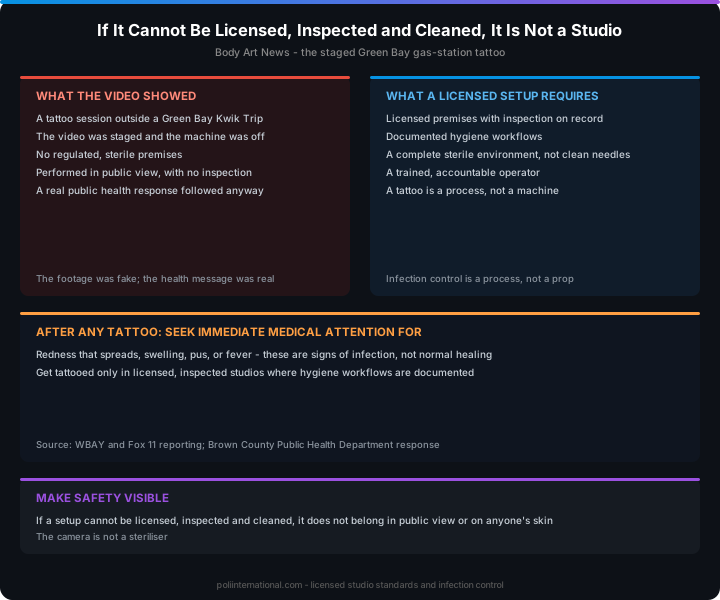
According to reporting by WBAY on the apparent Kwik Trip tattoo session, the video was staged. The machine was not turned on, the skin was not broken, and no tattooing actually took place. That distinction matters clinically. A performance with no skin penetration is not an exposure event in the same way as a real tattoo.
But it does not make the stunt harmless. Brown County Public Health responded because the setting represented something the law is designed to prevent: invasive body art being offered outside a licensed, inspectable environment. The county’s concern was not whether the camera captured a needle entering skin. It was that the public could reasonably believe the service was being performed there—and that the same arrangement could be used for real tattooing next time.
This is where the internet habit of sorting everything into “real” and “fake” becomes useless. The video was fake as a tattoo. It was real as advertising, real as a regulatory problem, and real as a lesson in how quickly a public-health message can be drowned by a publicity stunt.
2. A Tattoo Is a Process, Not a Machine
The public tends to focus on the visible object: the tattoo machine. That is the wrong centre of gravity. A modern machine can be wiped, bagged, disinfected, and stored correctly; none of those actions make an uncontrolled environment safe by themselves.
| Feature | Licensed studio | Improvised public setup |
|---|---|---|
| Premises | Registered and subject to inspection | No assured compliance boundary |
| Surface control | Work surfaces can be prepared, covered, and discarded safely | Public surfaces have unknown contamination histories |
| Hand hygiene | Dedicated sink, supplies, and workflow | Access and workflow may be improvised |
| Instrument processing | Reusable instruments can follow a documented sterilization cycle | Sterilization status may be unknown or impossible |
| Waste handling | Sharps and contaminated waste have defined disposal routes | Disposal may be improvised or delayed |
| Traceability | Client records, consent, and product details can be retained | Little or no defensible documentation |
A tattoo needle creates a controlled injury. It repeatedly penetrates the epidermis and deposits pigment into the dermis. That means the relevant question is not whether the station counter looks tidy. The question is whether every item that may contact the open skin has been controlled from packaging to disposal.
The viral tattoo story involving an outdoor setting and water exposure made a similar point from a different direction: environmental contact matters because fresh tattooed skin is not sealed, finished skin. A public setting multiplies the variables—dust, touch, splash, crowd movement, and surfaces that were never designed for invasive procedures.
The licensed studio is therefore not merely a nicer room. It is a containment system. It separates clean supplies from contaminated instruments, protects the client from the environment, and gives the practitioner a repeatable workflow rather than a collection of hopeful gestures.
3. The Infection-Control Detail the Video Concealed
A tattoo needle may be single-use, but the procedure is not single-component. Grips, tubes, machines, cords, squeeze bottles, clip cords, power supplies, armrests, trays, and work surfaces all form part of the contamination pathway.
Any item that cannot be reliably cleaned and disinfected must be protected with a suitable disposable barrier and changed between clients. Any reusable instrument that penetrates tissue must be cleaned thoroughly before sterilization. Sterilization is the process that destroys all forms of microbial life, including bacterial spores; surface disinfection is not an interchangeable substitute.
For studios, that distinction should be operational rather than rhetorical:
- Single-use needles and cartridges should remain sealed until setup and go directly into an approved sharps container after use.
- Reusable equipment must be cleaned before sterilization; organic material can shield microorganisms from the sterilization process.
- Barrier films and bags are not decorative plastic. They prevent contamination of surfaces that are difficult to clean between clients.
- Hand hygiene must happen at the correct moments, including before gloving and after removing gloves.
- Pigment handling must prevent cross-contamination. Product should not be returned to its original container, and disposable ink caps should be discarded after the procedure.
- Documentation should identify the client, practitioner, products used, and any incident requiring follow-up.
The biological risk is not limited to dramatic bloodborne infections. Improper technique can also introduce ordinary skin bacteria into damaged tissue, producing cellulitis, abscesses, delayed healing, or more serious systemic infection. The severity depends on the organism, the depth and extent of injury, the client’s health, and how quickly treatment begins.
Wisconsin’s stated concern, as reported by Fox 11’s coverage of the Brown County health response, was straightforward: unlicensed tattooing can expose people to serious infections and disease transmission. That is not bureaucratic theatre. It is the predictable result of removing the controls that make a repeatable procedure possible.
The important engineering principle is risk reduction by system design. A competent practitioner can work carefully and still be undermined by a bad room, a bad surface, missing supplies, or a workflow that forces clean and contaminated items together. Good regulation is useful when it examines the system rather than merely asking whether the artist appears talented.
4. Patrick’s Note: The Camera Is Not a Sterilizer
A machine sitting on a shop counter is not proof of a tattoo. A machine sitting outside a convenience store is not proof of a safe one.
The artist says the clip was designed to look real, and that no skin was broken. Fine. Then the stunt should have been labelled clearly before it travelled through millions of screens. “It was only content” is not a safety protocol; it is what people say after the audience has already supplied the missing context.
What bothers me is not that public health officials took the video seriously. They were right to do so. The problem is the growing belief that a viral setup can borrow the visual authority of professional tattooing without accepting the obligations that make professional tattooing safe. The difference between a mobile tattoo ban and genuine infection-control engineering matters here: fixed premises are useful only when they support controlled workflow, not when regulation stops at the address.
A studio does not need to look glamorous. It needs to be inspectable, repeatable, and boring in the best possible way. Boring is what prevents blood, pigment, and bacteria from becoming a customer-service problem.
5. FAQ: Technical Q&A
Q: If no needle touched skin, was anyone actually at risk?
No tattoo-related exposure occurred if the machine was not operating and the skin was not broken. The risk was indirect: the video could normalize or advertise invasive work in an unlicensed environment, where the necessary controls may not exist.
Q: Why can’t an artist simply disinfect a public table before tattooing?
Because wiping a surface does not create a complete sterile workflow. The artist still needs controlled hand hygiene, protected equipment, safe sharps disposal, clean storage, appropriate waste handling, and a method for processing reusable instruments.
Q: What should a client check before booking a tattoo?
Ask where the artist is licensed, whether the premises are registered or inspected, whether needles and cartridges are opened in front of you, and how reusable equipment is sterilized. A professional should answer directly and show the workflow without treating basic safety questions as an insult.
Conclusion: Make Safety Visible
The Green Bay video was staged, but the public-health response identified the real issue: tattooing is an invasive procedure whose safety depends on the entire environment, not just the needle or the artist’s confidence.
For artists, the practical rule is simple: do not use an uncontrolled public location as a tattooing backdrop, demonstration space, or marketing prop without making unmistakably clear that no procedure is taking place. For clients, choose the place where the workflow is controlled, documented, and inspectable—not the place that looks most entertaining on a phone screen.
The engineering difference between compliant tattoo practice and improvised tattooing is not visible in the first three seconds of a viral video. It is visible in everything the video leaves out.