Shop
Body Art News

Pearland’s Piercing Ban Is a Regulatory Joke—And Studios Should Pay Attention

PP

Chief Engineer

Patrick Poli

Journal Date

2026-10-25

Last Reviewed

2026-10-26

Cities Should Regulate Actual Risk, Not Invent Service Restrictions for Appearances

Key Takeaways:
» Pearland added a no-piercing condition to a tattoo-shop approval even though the applicant never planned to offer piercings.Source report
» The city acknowledged that neither its code nor policy required the restriction.Source report
» No incident reports, inspection findings, or public-health data were presented to justify the ban.
» Tattooing and piercing require different controls, but that is an argument for specific standards—not symbolic prohibition.
» Studios should document their service scope, facility controls, and compliance before a public hearing turns “community image” into regulation.

1. The Ban That Wasn’t Needed

A new tattoo shop in Pearland, Texas, received approval with an unusual condition: it could not offer body piercings. The strange part is that the business had not planned to offer piercing services in the first place.Source report

That is not public-health regulation. It is administrative theatre with a zoning stamp.

The city council approved the boutique, appointment-only studio after the owner described a controlled operation and made clear that piercing was not part of the business model. Council members nevertheless added the restriction, reportedly citing concerns about Pearland’s “image.” The city later confirmed that no existing code or policy required the condition.Local coverage

Tattooing and piercing are not interchangeable services. They have different equipment, workflows, anatomy, aftercare, and contamination controls. A competent regulator can distinguish between them. A lazy regulator simply treats both as visual evidence of a dangerous lifestyle and writes “no piercing” into the approval.

That distinction matters because regulation is supposed to control hazards, not aesthetics. A city may reasonably require a sink, cleanable surfaces, sharps disposal, hand hygiene, sterilization documentation, and proper licensing. It should be able to explain the risk each requirement addresses. “We do not like what the service represents” is not a health standard; it is a mood.

2. What Should Actually Be Regulated?

The correct comparison is not “tattoo versus piercing.” It is specific hazard versus vague anxiety.

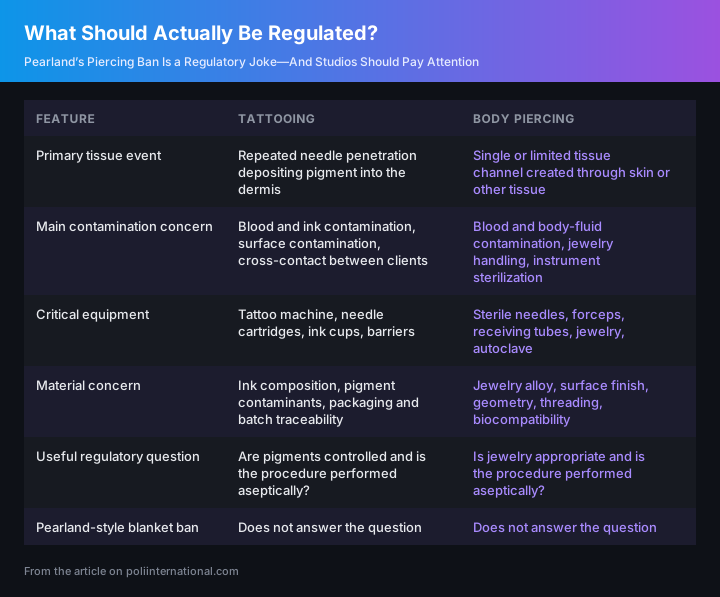
FeatureTattooingBody piercing
Primary tissue eventRepeated needle penetration depositing pigment into the dermisSingle or limited tissue channel created through skin or other tissue
Main contamination concernBlood and ink contamination, surface contamination, cross-contact between clientsBlood and body-fluid contamination, jewelry handling, instrument sterilization
Critical equipmentTattoo machine, needle cartridges, ink cups, barriersSterile needles, forceps, receiving tubes, jewelry, autoclave
Material concernInk composition, pigment contaminants, packaging and batch traceabilityJewelry alloy, surface finish, geometry, threading, biocompatibility
Useful regulatory questionAre pigments controlled and is the procedure performed aseptically?Is jewelry appropriate and is the procedure performed aseptically?
Pearland-style blanket banDoes not answer the questionDoes not answer the question
What Should Actually Be Regulated?
Infographic: What Should Actually Be Regulated?

A piercing ban attached to a tattoo-shop permit therefore proves nothing about safety. If the shop does not offer piercing, the condition changes no exposure at all. If the shop later wants to add piercing, the city should inspect the new service against piercing-specific requirements.

That is how rational regulation works: identify the activity, define the hazard, inspect the control, and enforce the rule. The alternative is a growing pile of local conditions that look official but cannot survive a basic “what problem does this solve?” test.

For studios, the practical lesson is straightforward. Keep your business plan precise. List the services you do and do not provide. If an official asks for a restriction that is unrelated to the proposed operation, ask for the written authority and the evidence behind it. The difference between a tattoo studio permit and a body-piercing compliance framework is not paperwork trivia; it determines whether a rule is aimed at a real hazard.

3. The Technical Problem With “Community Image”

“Community image” is a dangerous phrase because it has no measurable endpoint. A sterilizer can be tested. A surface can be disinfected. A jewelry material can be specified. An image cannot be calibrated, validated, or audited.

A proper piercing program should begin with single-use sterile needles, sterile or appropriately sterilized tools, an instrument-processing workflow, and a sterilizer operated according to manufacturer instructions. Critical devices should be packaged, processed, stored, and monitored with mechanical, chemical, and—where required by local rules—biological indicators. The actual details vary by jurisdiction, but the engineering principle does not: the process must demonstrate reliable microbial inactivation, not merely display a clean-looking room.

Jewelry introduces another technical layer. Fresh piercings need jewelry with a smooth, cleanable surface, suitable geometry, adequate clearance for expected swelling, and a material that does not create an avoidable biological or mechanical problem. Implant-certified titanium such as ASTM F136 is one established option; properly specified flexible polymers can also be appropriate in situations where rigid jewelry creates leverage or contact concerns. The answer is never “ban the service because the public may dislike it.”

The same applies to tattooing. Ink handling requires closed, controlled dispensing into single-use caps, prevention of bottle-tip contact, appropriate barriers, and careful management of contaminated equipment. A city that wants safer tattooing should ask about those controls. It should not pretend that a piercing prohibition improves tattoo hygiene by magic.

There is also a legal and operational issue. A condition unrelated to the requested service can create regulatory uncertainty. Suppose the owner later hires a qualified piercer, installs the necessary equipment, and applies for an amendment. Does the prior condition mean piercing is permanently barred, or merely absent from the original approval? If the answer is unclear, the city has not created safety; it has created a future dispute.

The recent debate over mobile tattoo bans and hygiene rules shows the same recurring failure: officials identify a legitimate contamination concern, then write a rule broader than the technical problem. That is how sensible health control becomes bad policy.

4. Patrick's Note: Paper Versus Practice

The client is not protected by a council member’s discomfort with the word “piercing.” The client is protected by a sterile needle, competent anatomy, suitable jewelry, a clean workflow, and an operator who can explain what happens when the body does something unexpected.

I have no objection to strict rules. I object to decorative rules pretending to be strict ones. When a city adds a piercing ban to a shop that does not offer piercing, it has spent political energy regulating an imaginary procedure while real standards remain the things that deserve inspection. The Pearland tattoo-shop approval controversy is worth watching because this is how bad regulation usually begins: not with a dangerous studio, but with a vague phrase nobody wants to define.

5. FAQ: Technical Q&A

Q: Can a city legally ban piercing at a tattoo shop?

A city may impose conditions within its lawful authority, but the condition should have a clear statutory or regulatory basis. In Pearland’s case, reporting indicates the city acknowledged that neither its code nor policy required the restriction.Source report Affected businesses should request the written authority, appeal route, and evidence supporting the condition.

Q: Are tattooing and piercing regulated the same way?

No. They share infection-control fundamentals, but their equipment, materials, tissue mechanics, and workflows differ. A piercing inspection should examine sterile needles, instrument processing, jewelry, anatomy, and aftercare; a tattoo inspection should also examine ink handling, pigment storage, machine barriers, and needle cartridges.

Q: What should a studio do before applying for approval?

Submit a narrow, accurate service description and attach a written infection-control plan. Include sterilization procedures, equipment lists, waste disposal, surface controls, staff qualifications, and the exact services that will be offered. If officials propose an unrelated restriction, ask them to identify the hazard and the rule addressing it.

Conclusion: Regulate the Risk

Pearland’s decision is not a model for safe body art. It is a warning that studios can be pulled into symbolic regulation even when no service, incident, or public-health finding justifies it.

The answer is not weaker oversight. It is better oversight: measurable requirements, service-specific controls, documented inspections, and rules tied to hazards rather than reputation. A city that wants safer studios should regulate what enters the skin, how it gets there, and how contamination is prevented—not whether the word “piercing” makes a council chamber uncomfortable.

For the broader lesson, read the engineering difference between sensible hygiene rules and overbroad tattoo bans.
Further Reading

  • The Viral Neck Piercing That Wasn’t a Piercing
  • The Tattoo Wasn’t Finished. The Problem Was.
  • The Viral Finger Piercing Story Gets One Thing Right: Hands Are a Terrible Place for Jewellery
  • Mind map · Pearland’s Piercing Ban Is a Regulatory Joke—And Studios Should Pay Attention

    • Pearland Piercing Ban Regulatory Critique
      • Unnecessary Service Restriction
        • Symbolic Zoning Condition
        • No Underlying Code Mandate
      • Community Image Over Safety
        • Vague Anxiety
        • Non-Measurable Endpoints
      • Distinct Service Hazard Controls

        Tattooing and piercing require distinct equipment, materials, anatomy, and infection controls rather than interchangeable regulatory treatment [Pearland’s Piercing Ban Is a Regulatory Joke—And Studios Should Pay Attention].

        • Tattooing Ink Controls
        • Piercing Sterilization and Jewelry
          • ASTM F136 Titanium
      • Studio Compliance Recommendations

        Studios should keep business plans precise, document controls, and request written legal authority when unrelated restrictions arise [Pearland’s Piercing Ban Is a Regulatory Joke—And Studios Should Pay Attention].

        • Narrow Service Scopes
        • Demand Written Statutory Authority
    StructureProcessMaterialHazard

    4 branches, 0 sources. Each branch cites the article it came from; the labels beneath it are names, not claims.

    Body Art Quiz

    1. 1. What made the city of Pearland's piercing restriction on the new tattoo studio unusual?

      • • The studio owner had explicitly requested approval to offer both tattooing and body piercing services. — The owner made clear during the approval process that piercing was not part of the business model.
      • ✓ The business had never planned or proposed to offer piercing services in the first place. — The studio operated on an appointment-only boutique model and never intended to include body piercing in its services.
      • • The city imposed the restriction following a series of public health violations at the facility. — No public health data, inspection findings, or incident reports were presented to justify the condition.
      • • The restriction was legally mandated by existing city code and written policy. — City officials later confirmed that no municipal code or official policy required adding the restriction.
    2. 2. According to the source, how do the primary tissue events differ between tattooing and body piercing?

      • • Tattooing involves a single tissue channel creation, while piercing involves repeated pigment deposition. — Pigment deposition through repeated penetration is characteristic of tattooing, not body piercing.
      • ✓ Tattooing deposits pigment into the dermis via repeated needle penetration, whereas piercing creates a single or limited tissue channel. — Tattooing relies on micro-penetrations to deposit ink into the dermal layer, whereas piercing creates a distinct channel through tissue.
      • • Both procedures involve identical tissue mechanics, penetrating only the outer epidermis. — The text explicitly notes that tattooing and piercing differ in equipment, anatomy, and tissue interaction.
      • • Piercing alters tissue geometry permanently, while tattooing causes no physical disruption to the skin barrier. — Both procedures disrupt tissue barriers, but piercing forms a defined channel while tattooing leaves pigment in the dermis.
    3. 3. Why does the author argue that 'community image' is an inappropriate basis for health and safety regulation?

      • • Community image standards require excessive mechanical and biological testing to enforce properly. — Biological and mechanical testing apply to sterilizers and surface controls, not abstract image standards.
      • ✓ Image lacks measurable endpoints and cannot be calibrated, validated, or audited like physical hazard controls. — Health standards rely on objective, measurable controls like surface disinfection and sterilization, whereas image cannot be measured or audited.
      • • Zoning boards lack the constitutional authority to discuss public perception during permit hearings. — The text criticizes the technical validity of image-based rules rather than disputing council authority to host discussions.
      • • Focusing on image prevents municipal councils from collecting licensing fees from local businesses. — Licensing fee collection is unaffected by whether regulation focuses on visual aesthetics or biological hazards.
    4. 4. According to the source material, which material standard is cited as an established option for fresh body piercings?

      • • Standard surgical stainless steel without surface finish specifications. — Unspecified steel lacks the documented biocompatibility and surface finish properties required for fresh piercings.
      • ✓ Implant-certified titanium such as ASTM F136. — ASTM F136 titanium is identified as a proven, biocompatible material option suitable for initial piercing jewelry.
      • • High-density rigid polymers designed to maximize tissue leverage. — Rigid polymers can create excessive leverage or contact issues, whereas flexible polymers are preferred when non-metallic options are used.
      • • Any unplated metallic alloy that passes a basic visual surface inspection. — Visual surface inspections alone cannot verify biological safety or alloy composition.
    5. 5. What fundamental engineering principle should guide a proper instrument sterilization program in a studio?

      • • Ensuring the processing room displays a clean visual appearance to clients. — Visual cleanliness is administrative theatre and does not prove that harmful microorganisms were destroyed.
      • ✓ Demonstrating reliable microbial inactivation through documented packaging and indicator monitoring. — Effective processing requires mechanical, chemical, and biological monitoring to verify that microbial inactivation actually occurred.
      • • Replacing all sterilization devices after a fixed number of operational cycles. — Sterilizers are validated through routine testing according to manufacturer instructions, not discarded after set cycles.
      • • Restricting sterilization controls strictly to surface disinfectant sprays. — Surface sprays disinfect environmental barriers but cannot replace high-level heat or steam sterilization for instruments.
    6. 6. Which ink-handling control is highlighted in the text as an essential practice for safe tattooing?

      • ✓ Dispensing ink into single-use caps while avoiding bottle-tip contact. — Controlled dispensing into single-use caps prevents cross-contamination between the main bottle and individual client setups.
      • • Decanting unused pigment back into primary bottles after each procedure. — Returning used ink to supply bottles contaminates the entire pigment inventory and poses severe infection risks.
      • • Storing ink containers open to allow ambient airflow during sessions. — Leaving ink containers open exposes pigments to airborne particles and surface contamination.
      • • Diluting pigments with tap water to ensure smooth needle flow. — Tap water introduces potential biological contaminants into sterile pigment preparations.
    7. 7. What operational problem is created when a city council adds a service prohibition that is unrelated to the applicant's proposed plan?

      • ✓ It creates regulatory uncertainty about whether the restricted service is permanently barred or merely unapproved initially. — Unrelated conditions leave it unclear whether a future amendment could allow the service or if it stands as an absolute lifetime ban.
      • • It automatically invalidates the studio's state-issued sanitation permits. — Local zoning conditions do not automatically nullify state-level operational licenses.
      • • It forces the studio to re-apply for zoning approval on an annual basis. — Adding vague conditions creates long-term legal ambiguity rather than triggering mandatory annual re-applications.
      • • It obligates health officials to inspect non-existent services during routine audits. — Inspectors audit active operations and facilities, not services that the shop does not provide.
    8. 8. What key action should a studio take prior to a permit hearing to protect against arbitrary zoning restrictions?

      • ✓ Submit a detailed written infection-control plan alongside a narrow, accurate service description. — Documenting exact services, sterilization procedures, and hygiene controls establishes a clear, hazard-based factual record.
      • • Agree to whatever conditions council members propose to ensure swift approval. — Conceding to symbolic restrictions leads to unneeded operational constraints and regulatory ambiguity.
      • • Omit specific equipment lists to keep operational details flexible. — Omitting technical details leaves room for officials to impose arbitrary visual restrictions due to lack of information.
      • • Claim compliance with general community image guidelines rather than technical standards. — Relying on image guidelines surrenders technical compliance to subjective public opinion.
    9. 9. How did Pearland city officials justify adding the no-piercing condition during the tattoo shop approval hearing?

      • • They presented recent inspection data showing high infection rates in local piercing facilities. — No incident reports, inspection findings, or health data were introduced to support the ban.
      • • They cited unaddressed contamination risks found during a pre-opening site audit. — The studio operated under controlled boutique conditions, and no facility defects were cited.
      • ✓ They voiced vague concerns regarding Pearland's overall 'image.' — Council members added the ban based on subjective perceptions of municipal image rather than public health facts.
      • • They pointed to mandatory state statutes prohibiting combined tattoo and piercing studios. — No state or local code required separating the two services or banning piercing outright.
    10. 10. What distinction does the text draw between a rational regulatory approach and administrative theatre?

      • ✓ Rational regulation identifies hazards and inspects controls, whereas administrative theatre regulates non-existent risks for appearances. — Sound policy targets specific operational hazards with measurable controls, while decorative rules address vague visual anxieties.
      • • Rational regulation relies on aesthetic preferences, whereas administrative theatre focuses on sterilization indicators. — Sterilization indicators belong to rational health control, while aesthetic preferences define administrative theatre.
      • • Rational regulation bans complex services entirely, whereas administrative theatre uses individual service inspections. — Blanket bans reflect lazy regulation, whereas targeted service inspections represent rational hazard management.
      • • Rational regulation allows businesses to self-certify, whereas administrative theatre requires written infection control plans. — Written plans and objective oversight are elements of legitimate regulation, not administrative theatre.

    Extended Reference Table

    6 of 6 rows

    Extended reference table generated from the article and its verified research sources. Bracketed numbers jump to the matching entry in the Technical References below.

    SafetyItem or Material Category Application or Use Case Standards or Compliance Key Properties or Controls
    ✅Implant-certified titaniumJewelry MaterialFresh body piercingsASTM F136Smooth cleanable surface, suitable geometry, adequate clearance for swelling, safe biocompatibility
    ✅Single-use sterile needlesTools / EquipmentBody piercing proceduresNot in sourceUsed to create single or limited tissue channels through skin or other tissue; primary hazard control
    ✅Flexible polymersJewelry MaterialBody piercings where rigid jewelry creates leverage or contact concernsNot in sourceProperly specified flexibility to prevent biological or mechanical problems
    ✅Tattoo ink and single-use capsTattooing MaterialsTattooing procedures (depositing pigment into dermis)Not in sourceClosed controlled dispensing into single-use caps, prevention of bottle-tip contact, batch traceability
    ✅Autoclave / SterilizerEquipmentInstrument processing for body piercingNot in sourceOperated according to manufacturer instructions; monitored with mechanical, chemical, and biological indicators for microbial inactivation
    ✅Service-specific local zoning conditions (Pearland ban)Regulatory PracticeTattoo studio permit approvalNot in sourceSymbolic prohibition lacking statutory/code basis, unsupported by incident reports or public-health data

    Free Body Art Wall Posters

    Print-ready reference posters for your studio or your own wall. Free to download and display, embed on your own site with attribution. Click any poster to preview it full size before downloading.

    Choose and download all 37 posters

    Technical_References_Archive

    About the Author

    PP

    Patrick Poli

    Chief Engineer, Poli International · Creator of BioFlex® body jewelry

    Patrick has spent 25+ years manufacturing body jewellery and studio equipment, and is the creator of BioFlex® body jewelry. He created the push-fit system so jewellery separates on impact instead of tearing the piercing. He also ran 10 to 25 minute consultations before piercing, and treats aftercare as a standing invitation rather than a leaflet.

    More about Patrick →

    Last reviewed: 2026-10-26 · Published: 2026-10-25

    Continue Reading