Shop
Body Art News

The Tattoo Ban That Proves Regulation Can Be Pure Theatre

PP

Chief Engineer

Patrick Poli

Journal Date

2026-10-29

Last Reviewed

2026-10-30

If a studio is licensed for tattooing, a council should need evidence—not vibes—to ban piercing

Key Takeaways:
» Pearland officials approved a tattoo studio while imposing an unexpected ban on body piercing, despite the operators saying piercing was not part of their business plan.(poliinternational.com/blog/feed.xml)
» Tattooing and piercing share important infection-control principles, but they are not interchangeable procedures.
» A service restriction should be tied to a documented risk, defined standard, or licensing failure—not a council member’s instinct.
» Studios should obtain every condition of approval in writing and challenge restrictions that lack a measurable safety basis.
» Clients should judge a studio by training, licensing, sterilization, jewelry, and aftercare—not by theatrical claims that one service is inherently suspect.

1. The Rule That Solves Nothing

A new tattoo shop in Pearland, Texas, received approval with a condition that it could not offer body piercing—even though the operators repeatedly stated that piercing was not part of their business plan.(poliinternational.com/blog/feed.xml) That is not a safety intervention. It is a hypothetical prohibition attached to a service nobody proposed.

The distinction matters because regulation is supposed to manage demonstrated risk. A tattoo procedure deposits pigment through repeated skin penetration. A piercing creates a controlled wound that must accommodate jewelry while tissue remodels around a foreign object. The hazards overlap—bloodborne pathogens, cross-contamination, poor hand hygiene, contaminated surfaces—but the technical controls are not identical.

The sensible response is to define those controls clearly: licensing, operator competency, sterilizer validation, instrument processing, sharps disposal, informed consent, jewelry standards, and inspection. The lazy response is to say “tattooing may be allowed, but piercing feels different, so no piercing.” That is how public policy turns into mood lighting.

The wider regulatory landscape shows that body-art rules can be specific without being theatrical. North Dakota’s revised code, for example, addresses initial-piercing jewelry materials, ear-piercing devices, ink dilution, single-use cups, and age restrictions in concrete terms.(ndlegis.gov/admcode/arc202610401NORTH%20DAKOTA%20...) That is regulation doing its job: identifying a process and specifying what acceptable practice looks like.

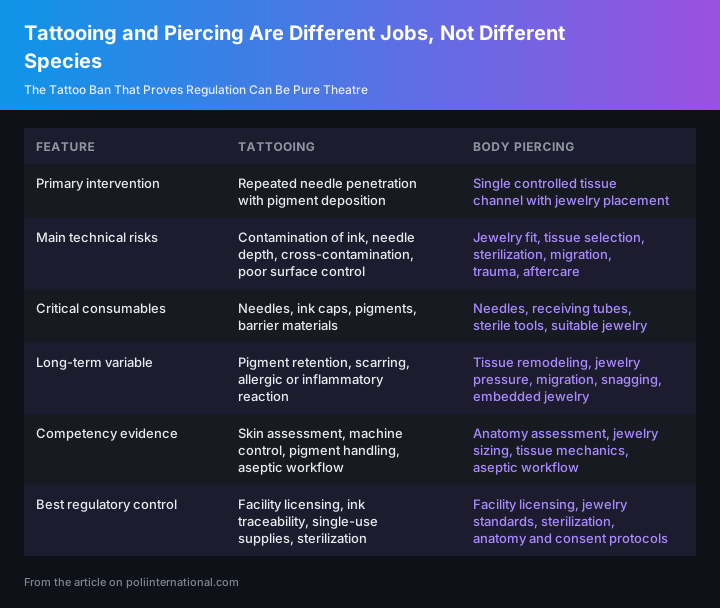
2. Tattooing and Piercing Are Different Jobs, Not Different Species

The Pearland condition appears to confuse different procedural risks with separate moral categories. Tattooing and piercing should not be treated as identical, but neither should piercing be treated as an inherently disreputable add-on.

FeatureTattooingBody piercing
Primary interventionRepeated needle penetration with pigment depositionSingle controlled tissue channel with jewelry placement
Main technical risksContamination of ink, needle depth, cross-contamination, poor surface controlJewelry fit, tissue selection, sterilization, migration, trauma, aftercare
Critical consumablesNeedles, ink caps, pigments, barrier materialsNeedles, receiving tubes, sterile tools, suitable jewelry
Long-term variablePigment retention, scarring, allergic or inflammatory reactionTissue remodeling, jewelry pressure, migration, snagging, embedded jewelry
Competency evidenceSkin assessment, machine control, pigment handling, aseptic workflowAnatomy assessment, jewelry sizing, tissue mechanics, aseptic workflow
Best regulatory controlFacility licensing, ink traceability, single-use supplies, sterilizationFacility licensing, jewelry standards, sterilization, anatomy and consent protocols
Tattooing and Piercing Are Different Jobs, Not Different Species
Infographic: Tattooing and Piercing Are Different Jobs, Not Different Species

A studio licensed for one service should not automatically be assumed competent for the other. That is obvious. The missing step is equally obvious: require separate competency and inspection criteria if both services are offered.

A piercing ban does not prove those criteria are being met. It only ensures that nobody can legally offer the service. That may satisfy a council’s appetite for visible action, but it tells the public nothing about whether the tattoo service is clean, whether the operator is trained, or whether the premises are properly inspected.

For clients, the useful questions are practical. Is the establishment licensed? Are sterile packs opened in front of the client? Are instruments processed in a validated sterilization cycle? Is the jewelry appropriately sized and made from a documented implant-grade material? Is consent specific to the procedure? A council prohibition answers none of them.

3. The Engineering Problem Is Governance, Not Needles

A professional piercing setup is a systems-engineering problem. The needle is only one component. The outcome depends on anatomy selection, insertion angle, tissue thickness, jewelry geometry, surface finish, sterilization, swelling allowance, and aftercare.

Jewelry standards matter because the body does not care what a product catalogue calls “premium.” North Dakota’s updated rules require materials used for initial piercings to meet applicable ASTM or ISO implantation standards, including requirements for polymer and titanium materials.(ndlegis.gov/admcode/arc202610401NORTH%20DAKOTA%20...) A studio should be able to identify the material, supplier, gauge, length, and relevant standard—not merely produce a colourful invoice.

Sterilization also needs more than a machine with a digital display. A steam sterilizer must be loaded correctly, operated according to its validated cycle, monitored with the appropriate physical, chemical, and biological indicators, and supported by maintenance records. A failed indicator is not paperwork inconvenience; it is evidence that the process needs investigation before instruments return to service.

Tattoo regulation has its own hard controls. The North Dakota code requires inks and pigments to be manufactured for body-art procedures, restricts dilution to distilled or sterile water, and requires diluted material to be prepared for a single client and discarded afterward.(ndlegis.gov/admcode/arc202610401NORTH%20DAKOTA%20...) Those details are not decorative. Water quality, shared dilution bottles, and reused pigment create avoidable contamination pathways.

Pearland’s restriction is weak because it skips the engineering question: what specific failure does the ban prevent? If the answer is unlicensed piercing, regulate licensing. If the answer is inadequate sterilization, inspect sterilization. If the answer is unsafe jewelry, specify material and documentation requirements. If the answer is operator incompetence, require training and competency evidence.

A blanket ban is what happens when an institution wants the appearance of risk management without the inconvenience of measuring risk.

4. Patrick's Note: The Paperwork Has Become the Product

A sign outside a shop cannot tell you whether the piercing inside would be safe. Neither can a council condition that forbids a service nobody planned to offer. What matters is whether the rules describe the actual hazards and whether somebody checks compliance.

The operators reportedly made clear that piercing was not part of their business plan, yet the restriction was added anyway.(poliinternational.com/blog/feed.xml) That is the kind of administrative performance that makes responsible studio owners nervous: not because it targets one particular practitioner, but because it replaces transparent standards with unpredictable discretion.

The industry should read every approval document as an engineering specification. If a condition is vague, ask what measurable requirement it implements. If it is permanent, ask what evidence would justify removing it. If officials cannot answer either question, the rule is not protecting the public; it is protecting the institution from having to explain itself.

A related examination of how official restrictions can miss the real technical issue appears in the analysis of North Devon’s mobile tattoo ban and its engineering blind spot. The pattern is familiar: policymakers identify a genuine hygiene concern, then write a rule that is easier to announce than to defend.

5. FAQ: Technical Q&A

Q: Does a tattoo licence mean a studio is qualified to perform piercings?

No. Tattooing and piercing require overlapping infection-control systems but different procedural skills. A studio should have documented piercing competency, appropriate equipment, jewelry knowledge, and procedures specific to piercing before offering it.

Q: Is banning piercing from a tattoo studio automatically safer?

No. It prevents that studio from performing piercings, but it does not establish that the tattoo operation is safe. Safety comes from enforceable standards, competent workers, validated sterilization, traceable materials, and inspection.

Q: What should a studio do if a council imposes an unexplained service restriction?

Request the condition in writing, ask which statute or evidence supports it, and seek review through the relevant licensing or planning process. Keep the tone professional, but insist on a measurable standard rather than accepting an indefinite prohibition.

Conclusion: Regulate the Risk You Can Name

Pearland’s decision is not a piercing-safety standard. It is a warning about how quickly regulation can become theatre when officials impose a ban without a demonstrated operational reason.

Tattooing and piercing deserve serious oversight because both breach the skin. Serious oversight means competent operators, validated processes, appropriate materials, clear consent, and inspections that test reality. It does not mean inventing a prohibition for a service the studio never intended to provide.

The takeaway is simple: ban unsafe practices, not hypothetical services. For a closer look at the difference between a genuine public-health control and a symbolic restriction, read why the tattoo and piercing industry needs measurable standards instead of administrative guesswork.

Further Reading

  • The Bali “Pain-Free Tattoo” Trend Is Anaesthesia Wearing a Party Hat
  • Pearland’s Piercing Ban Is a Regulatory Joke—And Studios Should Pay Attention
  • The Viral Neck Piercing That Wasn’t a Piercing
  • Mind map · The Tattoo Ban That Proves Regulation Can Be Pure Theatre

    • Regulation as Pure Theatre
      • Pearland Piercing Prohibition

        Pearland officials banned body piercing at a studio despite operators omitting piercing from business plans. [The Tattoo Ban That Proves Regulation Can Be Pure Theatre]

        • Unproposed Service Ban
          • Administrative Discretion
        • Hypothetical Risk Prohibition
      • Procedural Differences and Controls

        Tattooing deposits pigment whereas piercing creates a tissue channel requiring distinct procedural controls. [The Tattoo Ban That Proves Regulation Can Be Pure Theatre]

        • Tattoo Specific Hazards
          • Ink Dilution Safety
        • Piercing Specific Hazards
          • Jewelry Placement Mechanics
      • Concrete Technical Standards

        North Dakota administrative rules specify requirements for initial piercing jewelry, sterilizers, and inks. [The Tattoo Ban That Proves Regulation Can Be Pure Theatre]

        • ASTM and ISO Jewelry
        • Sterilizer Cycle Validation
      • Measurable Risk Governance

        Public health regulation should enforce demonstrated risk controls rather than imposing symbolic service bans. [The Tattoo Ban That Proves Regulation Can Be Pure Theatre]

        • Facility Licensing Standards
        • Competency and Inspections
    StructureProcessMaterialHazard

    4 branches, 0 sources. Each branch cites the article it came from; the labels beneath it are names, not claims.

    Body Art Quiz

    1. 1. What administrative condition did municipal officials in Pearland, Texas, attach to the approval of a new tattoo studio?

      • • The studio was required to submit monthly biological indicator test results from its autoclaves. — Monthly spore testing is a standard sterilization monitoring procedure, but it was not the specific administrative condition imposed by Pearland officials.
      • ✓ The studio was banned from offering body piercing, despite piercing not being part of its business plan. — Pearland council members added a prohibition against body piercing as an explicit approval condition, even though the operators stated they had no plans to offer it.
      • • The studio was restricted to using pre-diluted pigment caps certified by state health inspectors. — Although single-use pigment caps and dilution controls are key technical standards, this was not the approval restriction introduced in Pearland.
      • • The studio was forced to obtain separate municipal facility licenses for each individual workstation. — Licensing individual workstations separately addresses internal studio management rather than the service-level prohibition imposed by the council.
    2. 2. According to the comparative framework in the text, which long-term variable is specific to body piercing rather than tattooing?

      • • Permanent retention of pigment within the dermal layer — Permanent retention of pigment within skin layers is the primary long-term variable associated with tattooing.
      • • Scarring and localized inflammatory or allergic responses — Scarring and allergic or inflammatory reactions are listed primarily as long-term variables for tattoo procedures.
      • ✓ Tissue remodeling, jewelry pressure, and migration — Tissue remodeling around a foreign object, along with jewelry pressure and migration, are identified as long-term variables unique to piercing.
      • • Cross-contamination caused by shared pigment dilution containers — Cross-contamination from shared dilution containers is an immediate technical risk during tattoo preparation, not a long-term piercing variable.
    3. 3. How does the North Dakota administrative code regulate ink dilution for tattoo procedures?

      • ✓ Dilution must use distilled or sterile water, be prepared for a single client, and be discarded afterward. — North Dakota code specifically mandates distilled or sterile water for dilution and requires the prepared mixture to be single-use and discarded.
      • • Dilution is entirely prohibited, requiring artists to use undiluted, factory-sealed pigment bottles only. — The administrative code permits ink dilution provided strict contamination-control protocols are followed.
      • • Dilution may be performed using ethyl alcohol or saline solution if batch-tested monthly. — The code explicitly specifies distilled or sterile water for dilution rather than alcohol solutions or monthly batch testing.
      • • Diluted ink mixtures may be saved in sealed single-use cups for up to 24 hours. — Storing diluted inks creates contamination pathways, which is why the code requires immediate disposal after each single client.
    4. 4. Under North Dakota's updated administrative code, what standard must initial-piercing jewelry materials meet?

      • • They must be certified hypo-allergenic by local county health authorities. — Local health department approval is an administrative step, whereas the code requires compliance with recognized international engineering standards.
      • ✓ They must satisfy applicable ASTM or ISO implantation standards. — Updated regulations specify that initial-piercing materials, such as titanium and polymers, must satisfy official ASTM or ISO implantation standards.
      • • They must consist exclusively of 24-karat solid gold or surgical-grade stainless steel. — The regulation specifies documented ASTM or ISO implantation standards rather than limiting choices to specific tradition-based metals.
      • • They must be manufactured and packaged within the state of North Dakota. — Material safety relies on verifiable technical manufacturing standards rather than geographical location.
    5. 5. From a systems-engineering standpoint, what does a failed chemical or biological indicator on a steam sterilizer signify?

      • • It can be disregarded if the machine's digital display recorded maximum operating pressure. — Relying on physical digital displays alone ignores the chemical and biological monitoring needed to verify successful cycle completion.
      • • It is a routine paperwork discrepancy that can be re-evaluated during weekly maintenance. — Dismissing an indicator failure as paperwork overlooks evidence of an invalid sterilization cycle that jeopardizes safety.
      • ✓ It provides physical evidence that the process requires investigation before tools return to service. — A failed indicator shows that sterilization validation was not achieved, requiring immediate investigation before processing instruments again.
      • • It results in the immediate, mandatory revocation of the facility's operating license. — An indicator failure triggers an immediate operational hold and internal process investigation rather than automatic permit revocation.
    6. 6. Why does the text state that prohibiting body piercing at an approved tattoo studio does not enhance public safety?

      • • Piercing involves lower biological risk than tattooing, making regulation unnecessary. — Both procedures penetrate skin tissue and carry technical risks that require enforceable safety standards.
      • ✓ Banning an unoffered service provides no evidence regarding whether the tattoo operation itself is safe. — Prohibiting a hypothetical service satisfies a political appetite for action but reveals nothing about the cleanliness or competency of the actual tattoo studio.
      • • Tattoo licensing automatically grants studio operators full qualification to perform body piercings. — A license for tattooing does not mean an operator possesses the distinct skills or protocols needed for piercing.
      • • Municipal councils lack the statutory authority to issue or deny business approval conditions. — Municipalities do have administrative conditioning authority, but the criticism centers on imposing restrictions without operational risk justification.
    7. 7. Which set of consumables is categorized specifically as critical supplies for body piercing operations?

      • • Ink caps, tattoo pigments, and surface barrier materials — Ink caps, pigments, and barrier materials are consumables specific to tattoo procedures.
      • • Single-use cups, stencil transfer paper, and distilled water — Single-use cups and distilled water are linked to pigment preparation and hygiene within tattoo workflows.
      • ✓ Needles, receiving tubes, sterile tools, and suitable jewelry — Piercing workflows rely on specialized consumables including receiving tubes, sterile hand tools, and implant-grade jewelry.
      • • Autoclave indicator tape, razor blades, and consent forms — Indicator tape and razors are shared processing or preparation items rather than consumables unique to piercing.
    8. 8. What is the recommended operational response when a licensing authority imposes an unexplained service restriction on a studio?

      • • Modify public signage to hide the restricted service from municipal inspectors. — Concealing services violates legal compliance and avoids addressing whether the rule has a valid safety basis.
      • ✓ Request the rule in writing, ask for supporting statutory evidence, and seek formal review. — Studios should demand documented, measurable safety bases by requesting written conditions and pursuing administrative review.
      • • Accept the condition immediately to prevent administrative delays to the opening schedule. — Unconditionally accepting arbitrary restrictions allows unmeasured council discretion to displace objective risk standards.
      • • File an immediate complaint with trade associations to nullify local planning decisions. — Trade associations offer industry guidance but do not possess legal authority to overturn local planning decisions.
    9. 9. How is the primary mechanical intervention of body piercing defined in contrast to tattooing?

      • • Pigment deposition achieved through repeated high-frequency skin penetration — Depositing pigment through repeated skin penetration defines the primary intervention of tattooing.
      • ✓ Creating a single controlled wound channel to accommodate foreign jewelry — Body piercing creates a single controlled tissue channel designed to fit jewelry while surrounding tissue remodels.
      • • Chemical modification of dermal tissue layers using sterile topical solutions — Neither body art procedure relies on chemical modification of dermal layers as its core mechanical mechanism.
      • • Thermal sealing of superficial vascular pathways in skin tissue — Thermal sealing refers to cauterization, which is not the controlled mechanical method used in standard body piercing.
    10. 10. Which regulatory approach represents a best control specifically targeted at managing tattoo procedural risks?

      • • Enforcing initial-piercing jewelry specifications for titanium and polymers — Jewelry material specifications address foreign object implantation in body piercing rather than tattoo risks.
      • • Mandating anatomy assessments and tissue mechanics protocols for all operators — Anatomy assessment and tissue mechanics protocols are best regulatory controls tailored to body piercing.
      • ✓ Requiring facility licensing, ink traceability, single-use supplies, and sterilization — Controlling tattoo risks depends on facility licensing, ink manufacturing traceability, single-use consumables, and validated instrument processing.
      • • Enacting blanket municipal bans on mobile body art studios — Blanket bans on mobile operations are highlighted as symbolic regulatory theatre rather than direct controls on procedural risks.

    Extended Reference Table

    3 of 3 rows

    Extended reference table generated from the article and its verified research sources. Bracketed numbers jump to the matching entry in the Technical References below.

    SafetyItem, Material, Practice or Standard Description / Details Applicable Standards or Compliance Requirements Use Case / Application Source
    ✅Initial-piercing jewelry materialsMaterials used for initial piercings, including polymer and titanium materials.Applicable ASTM or ISO implantation standardsInitial body piercings
    ✅Inks and pigmentsManufactured for body-art procedures; dilution restricted to distilled or sterile water, prepared for a single client and discarded afterward.North Dakota Administrative CodeTattooing procedures
    ✅Steam sterilizer / SterilizationMust be loaded correctly, operated according to its validated cycle, and monitored with physical, chemical, and biological indicators.Not in sourceProcessing and sterilizing body-art instruments

    Free Body Art Wall Posters

    Print-ready reference posters for your studio or your own wall. Free to download and display, embed on your own site with attribution. Click any poster to preview it full size before downloading.

    Choose and download all 33 posters

    Technical_References_Archive

    About the Author

    PP

    Patrick Poli

    Chief Engineer, Poli International · Creator of BioFlex® body jewelry

    Patrick has spent 25+ years manufacturing body jewellery and studio equipment, and is the creator of BioFlex® body jewelry. He created the push-fit system so jewellery separates on impact instead of tearing the piercing. He also ran 10 to 25 minute consultations before piercing, and treats aftercare as a standing invitation rather than a leaflet.

    More about Patrick →

    Last reviewed: 2026-10-30 · Published: 2026-10-29

    Continue Reading