Two tattooists answered my email about free wall charts with the same two words: "AI slop". They deserve a straight answer, so this is how the charts are made, where I draw the line, and what I think about the complaint underneath.
Two replies
Two tattooists answered my email this month with the same two words: "AI slop". One of them wrote that he would rather close his shop forever than hang it on his walls.
The email offered free wall charts for studios: aftercare, hygiene, skin anatomy, ink chemistry. Eighty-three studios received it. Two were angry, and both for the same reason. The illustrations are made with AI.
I am not surprised, and I am not offended. There is every type of person in this trade, and we spend our lives learning to live together. But the two of them asked a fair question without asking it, so here is the answer: how these charts are made, and what the machine does and does not do.
What "slop" means, and why I do not think this is it
Slop is the word for content made fast, in bulk, by nobody in particular, for nobody in particular. It is a fair thing to be afraid of. The internet is filling up with it.
So let me describe my work.
Somebody has to tell the AI what he wants. That somebody is me. I decide what the journal writes about. The sources are checked and rechecked, and every article lists the studies and regulations it stands on. Every chart is built from one of those articles and checked again before it goes up, because a wrong label on an anatomy chart is worse than no chart.
The charts come in three styles on purpose: wall charts, cutaways and comics. A piercer who wants a clean diagram of a healing fistula and a client who wants to laugh in the waiting room are not the same reader, and I wanted each of them to find something.
Behind the site there are more than eighty automated workflows running. Each one was built by trial and error. They are there to stop something wrong from getting through, and to pass on my experience. Who is checking? Me. Who is helping? The AI. In that order.
The checking is real work. Last month, a check against the text of the regulation itself showed that five metal limits for tattoo ink on our pages were too lenient. They were wrong, and they were corrected. I would rather tell you that than pretend it never happens.
None of this is new to me. I built my first websites myself in 2001 and 2002. When I moved to France I built another one by hand: eight months of work, more than fourteen thousand pages. I thought AI would make it easier this time. I am not sure it has. Yesterday I spent seventeen hours at my computer. What has changed is what I can share, not how hard I work to share it.
But I won't complain. It makes me happy, as it always has, and it never felt like hard work. My passion took over my life and turned it into a kind of balance between hard work and happiness.
And the comics were never the plan. I did not build this site to publish cartoons. I stumbled on what the tools could do, I found it very cool, and I shared it, the same way I share the calculators and checklists I make for professionals. There is an article on this site explaining why I always took the time to talk to my clients before a piercing: The Twenty-Minute Consultation. These cutaways and posters would have helped me a lot back then, to give the client the full picture.
It is not perfect. People will find a mistake here and there, and I want them to tell me. It is my best shot at sharing what I have learned.
Where the line is
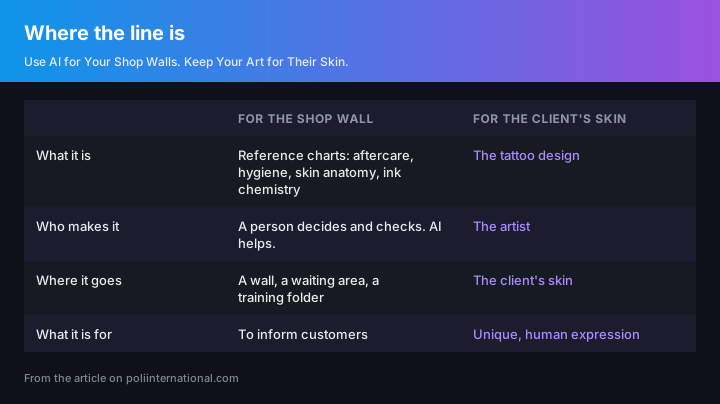
These charts are reference material. They explain why a fresh piercing should not be buried in paste, or what a needle does to the layers of the skin. They are meant for a wall, a waiting area, a training folder.
They are not tattoo designs, and I am not offering them as tattoo designs. They are simply a way to let one picture do the work of a thousand words, in different styles. The drawing that goes on a client's skin is the artist's work. It should stay the artist's work: unique, and truly a human expression.
So to the two studios who wrote back, and to anyone who feels the same, here is my honest advice:
Use AI for your shop walls, where it will inform your customers. Keep your art for their skin. Get the best of both worlds, and keep cultivating your own expression.
The fair objection
There is a stronger complaint than "it looks cheap", and it deserves to be said properly.
The image tools learned to draw by looking at millions of pictures that people had already made. Illustrators, painters, and very likely tattoo artists too. In most cases nobody asked them and nobody paid them. If I had spent twenty years building a style and found it coming out of a machine, I would have something to say about it.
Here is where I stand. It is my view and nothing more.
I have been on the other side of this. I am the creator of BioFlex® body jewelry. I did not want to trademark the name, but my accountant and my friends told me I had to, to stop the copies. So I paid for it in the UK, and then again at the European office. Did it stop the copies? No. Companies in China, Korea and Thailand used the name for anything that looked like plastic. One of them, in Dongguan, even telephoned me. They wanted to buy the colours they had not managed to copy. They were already selling the rest.
What did I own, really? A piece of paper!
When I was young I drew in charcoal and painted about a hundred and fifty canvases in oil. I gave them all away. I never believed they were mine. We are born naked and we leave naked, and even great artists died owning nothing, leaving their art to posterity.
So I cannot tell you that it is unfair, because I do not believe I own what I made either. A koi fish is a real animal. It has been tattooed for hundreds of years by thousands of hands. Whose koi is it?
And tattooing is only one niche. Since the cave walls painted thousands of years ago all around the world, how many drawings have been made, and which part of them belongs to this niche? Who owns what, and for how long?
That is how I see it. A tattooist who has been copied and is angry about it sees it differently, and I understand him better than he might think.
The robotic arms
When I first came to Thailand to help a factory develop body jewelry, I arrived with robotic arms I had brought with me from France.
The Thai factory workers looked at those machines as a threat. They were afraid for their jobs. Nobody had asked them either. I understood them, and that is why, during my eighteen months there, I never put those robotic arms into production. I chose to teach human skills instead.
I cannot tell you that nobody lost a job after that. I do not know. What I can tell you is what I see every day, years later: more factories being built around me, not fewer.
The fear was reasonable. It was not the whole story.
Tattooists may be standing where those workers stood. A machine can produce a striking composition in minutes, and a good design can take an artist days of work to please one client. Calling everything the machine makes "slop" is a way to defend a living. I do not blame anyone for that.
Honesty will decide this
I am sure many tattoo artists already use AI for something: a reference, a mock-up, a reply to a client, their bookkeeping. Some of the people who say "AI slop" loudest may be among them.
The ones who are honest about it will win. Clients feel honesty. And clients today are informed. They do not expect the tattooist from the days when a bottle of whisky was the quick answer to sterilizing. They live with AI themselves. A professional who is up to date, and says plainly what he uses and what he does not, will not lose their trust.
That is why the new version of my email says in its second paragraph that the charts are made with AI help. I should have written it that way the first time. I have corrected it. Sorry for the omission: I am human!
Do I really have to justify myself for two angry replies? Maybe not. But every reply matters to me, and I want more of them. That is what will help us all evolve.
So tell me: where do you draw your own line?
The safety of an AI-assisted chart depends entirely on the human verification behind it, not on whether AI was used to draw it. Every chart on this site is built from a source article, checked against the primary text of the relevant regulation or study, and corrected before publication — a review last month found five tattoo ink metal limits on our pages were too lenient and they were fixed. A wrong label on a skin anatomy or aftercare chart is worse than no chart at all, so nothing goes up unchecked. Slop describes content generated fast and in bulk, by nobody in particular and for nobody in particular — mass-produced filler with no named author, no sources, and no accountability. It is a legitimate thing to be wary of, and the internet is filling up with it. The distinction is authorship and review: someone has to define the output, verify the sources, and sign off before publication, and in this workflow that someone is a human editor who spent seventeen hours at the desk yesterday. No — and this is the line the site draws explicitly. These wall charts are reference material for a waiting area, training folder, or studio wall: healing diagrams, ink chemistry, skin anatomy, hygiene protocols. They are not tattoo designs and are not offered as tattoo designs. A client's skin deserves work that comes from a human artist's hand and judgment, which is why the title says keep your art for their skin. Accuracy is enforced by human review against primary sources, not by trusting the AI. Over eighty automated workflows built through trial and error act as a filter, but the final check is manual: every chart traces back to an article, and every article lists the studies and regulations it stands on. When a check against the regulation text itself revealed five ink metal limits were too lenient, they were corrected and disclosed rather than quietly patched. Two of eighty-three studios that received the offer replied with "AI slop" — one said he would rather close his shop forever than hang it. The objection is reasonable on its face: this trade values provenance and handwork, and artists are rightly suspicious of machine-generated content flooding their space. The honest answer is to describe the process openly — human decides the topic, sources get checked and rechecked, and the machine assists rather than authors — and let each studio decide for itself.FAQ
Is it safe to use AI-generated charts for tattoo and piercing aftercare training?
What does "AI slop" actually mean in the tattoo industry?
Can I use AI-generated images as tattoo designs or flash?
How do you make sure AI-generated health and safety information is accurate?
Why would a tattoo studio refuse free aftercare and hygiene wall charts?