Shop
Polymer Science

Is UV Tattoo Ink Safe? Zinc Sulfide & Glow Ink Risks

PP

Chief Engineer

Patrick Poli

Journal Date

2026-07-31

Last Reviewed

2026-10-14

Is UV or Glow-in-the-Dark Tattoo Ink Safe?

Key Takeaways:

» UV tattoo ink contains phosphorescent compounds such as zinc sulfide doped with copper (ZnS:Cu) or strontium aluminate doped with europium and dysprosium (SrAl2O4:Eu,Dy), not the pigments used in standard ink.
» No UV tattoo ink is FDA approved, and in the EU and UK it must comply with REACH Annex XVII Entry 75, which restricts roughly 4,000 substances in tattoo inks.
» Phosphorus-based UV ink is banned and dangerous; if a supplier offers ink described as phosphorus-based, refuse it and report the supplier.
» Published clinical data on UV ink is thin: case reports describe granulomatous and phototoxic reactions, but long-term cohort studies do not exist.
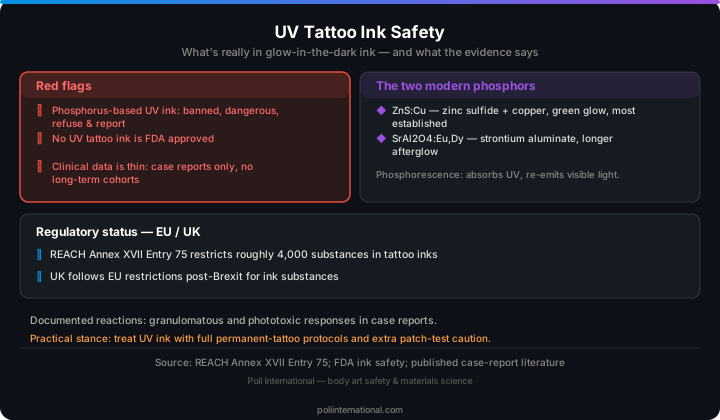
UV tattoo ink safety: the two modern phosphors ZnS-Cu and SrAl2O4-Eu-Dy, REACH restrictions on roughly 4,000 ink substances and why phosphorus ink is banned
Infographic: UV tattoo ink safety: the two modern phosphors ZnS-Cu and SrAl2O4-Eu-Dy, REACH restrictions on roughly 4,000 ink substances and why phosphorus ink is banned

1. What UV tattoo ink actually contains

Standard tattoo ink gets its colour from pigment particles that absorb and reflect visible light. UV ink adds a second optical mechanism: phosphorescence, the ability to absorb UV light and re-emit it as visible light after the excitation source is removed. That is what produces the glow under blacklight. The phosphorescent component is a separate particle suspended alongside or instead of standard pigment. The two phosphors used in modern UV inks are zinc sulfide doped with copper (ZnS:Cu), which produces a green glow and is the most established, and strontium aluminate doped with europium and dysprosium (SrAl2O4:Eu,Dy), a newer generation phosphor with a longer afterglow, common in safety signage and watch dials.

A historical note matters here. Older UV tattoo inks sometimes contained white phosphorus, which is toxic and can cause severe tissue necrosis and systemic poisoning. Phosphorus-based tattoo ink has been banned in most jurisdictions for decades, and modern UV inks use the phosphors listed above. If a supplier offers ink described as phosphorus-based, refuse it and report the supplier. The carrier system for UV ink is broadly similar to standard ink, but the particle size of phosphorescent compounds is typically larger than standard pigment particles, with implications for ink dispersion, needle clogging and long-term dermal behaviour.

2. What makes UV ink different from standard tattoo ink

PropertyStandard tattoo inkUV tattoo ink
Colour mechanismPigment absorption and reflection of visible lightPhosphor absorption of UV, re-emission as visible light
Particle typeOrganic and inorganic pigmentsPhosphorescent compounds, ZnS:Cu or SrAl2O4:Eu,Dy
Visibility in normal lightAlways visibleOften faint white or translucent
FDA approvalNo tattoo inks approved, enforcement discretionNo UV inks approved, less regulatory history
REACH statusAnnex XVII Entry 75 appliesSame restriction, fewer compliant formulations
Clinical historyDecades of observational dataLimited published literature, few long-term studies

UV ink is often pale or translucent and is typically applied without a visible stencil reference, so the artist may work more slowly under blacklight, extending session time and increasing infection risk if aseptic technique is not maintained.

3. Regulatory status: what the agencies say

In the United States, the FDA has not approved any tattoo inks for intradermal injection, including UV inks. Tattoo inks fall under FDA authority as cosmetics, but the agency has historically exercised enforcement discretion rather than pre-market approval. In June 2023 the FDA issued draft guidance on tattoo ink safety that mentions the need to assess pigment safety including impurities, particle size and phototoxicity potential, language directly relevant to UV inks because their phosphorescent compounds are photoactive by design.

In the European Union, REACH Annex XVII Entry 75, effective January 2022 with a January 2023 enforcement date for certain colourants, restricts approximately 4,000 substances in tattoo inks and permanent make-up. The restriction applies to all inks on the EU market, standard, UV-reactive or permanent make-up, and it sets concentration limits on substances classified as carcinogenic, mutagenic or reprotoxic, skin sensitisers, and substances with specific target organ toxicity. The phosphorescent compounds used in UV inks must comply, and a compliant ink must carry a statement of ingredients and a batch number, with the manufacturer submitting a notification to the European Chemicals Agency. The UK retained the EU restriction through UK REACH, which mirrors Entry 75 for Great Britain.

4. Known risks: what the clinical evidence says

The published clinical literature on UV tattoo ink is thinner than for standard ink, partly because UV tattoos represent a smaller share of the market and partly because long-term follow-up studies are absent. What exists falls into four categories. Granulomatous reactions: case reports describe raised nodules at the tattoo site, a Type IV hypersensitivity response where the immune system walls off particles it cannot clear; the larger particle size of some phosphors may contribute to a stronger foreign-body response. Phototoxic and photoallergic reactions: because UV phosphors are designed to interact with UV radiation, there is a reported risk of the site becoming inflamed, blistered or painful after sun or blacklight exposure, and the UV absorption that produces visible light can also generate reactive oxygen species that damage surrounding cells. Migration and fading: UV ink fades faster than standard ink, partly because phosphor particles photodegrade under repeated exposure and partly because larger particles may be less stably entrapped in the dermis.

Direct studies specifically on modern UV phosphor inks in human dermal tissue are scarce. No long-term cohort study of UV-tattooed individuals exists, phototoxicity data for ZnS:Cu in intradermal use is not available in PubMed, and granulomatous reaction case reports are anecdotal. Any studio or client should weigh those gaps honestly.

5. How to reduce the risk if you choose UV ink

These steps reduce but do not eliminate risk; no tattoo ink carries zero risk, and UV ink carries more unknowns than standard pigment-based ink. Verify REACH compliance in the EU and UK by asking for the ingredient list and batch number; if the supplier cannot show the ingredients are below the Annex XVII limits, the ink's regulatory status is unknown. Ask what phosphor is used: ZnS:Cu has the longer safety history, while SrAl2O4:Eu,Dy is brighter and longer-lasting but has less dermal-exposure history. Confirm the ink contains no phosphorus. If you have a history of skin reactions, do a patch test observed for four to six weeks including deliberate sun exposure, and choose placement with limited sun exposure, since sunlit areas photodegrade faster and carry a higher phototoxic reaction risk.

For studio professionals, the obligation is informed consent based on what is actually known. Document the ink brand, batch number, phosphor type and supplier in the client record, manage expectations that fading and touch-ups will be more frequent, and never use UV ink on broken, inflamed or recently tattooed skin.

From the Chief Engineer's Workbench

Patrick Poli · 25+ years in body-jewellery manufacturing

Patrick's Deep Archive

I have been testing materials against skin for more than twenty-five years, and UV ink is the category that makes me most careful in the materials cabinet. Not because the phosphors are poison; zinc sulfide and strontium aluminate are not acutely toxic, and the REACH framework keeps the worst chemistry out of legitimate supply chains. The problem is the evidence gap. With standard pigments I can show you decades of dermatology literature; with UV phosphors I can show you a handful of case reports and a lot of confident marketing. That asymmetry is exactly where careful studios earn their reputation, by telling the truth about what is known and what is not.

My advice to any artist considering stocking UV ink is to treat it like a new machine, not a new colour. Demand the batch certificate and the CAS numbers before you buy. Run a test dot on yourself or a consenting colleague and watch it through a full summer before offering it to clients. Record the phosphor type on every consent form, because five years from now the client will ask what was in their arm. And if a supplier cannot tell you exactly what is in the bottle, walk away. The boring documentation is what keeps the glow from becoming a headline.

PPPatrick PoliChief Engineer · Creator of BioFlex® body jewelry

7. Frequently asked questions

Q: Is UV tattoo ink safe?

Safe is not a binary. UV ink carries a different and less-studied risk profile than standard ink. The phosphors are not acutely toxic, but their long-term behaviour in human dermal tissue is not well characterised, no UV ink is FDA approved, and in the EU it must comply with the same REACH restrictions as standard ink.

Q: Can UV tattoo ink cause an allergic reaction?

Yes. The dermatology literature includes case reports of granulomatous reactions and photoallergic responses to UV tattoo ink. Phosphorescent compounds are foreign particles the immune system may recognise as non-self, and their photochemical activity under UV exposure can generate reactive oxygen species that trigger local inflammation. Anyone with a history of photosensitivity should approach UV ink with particular caution and consider a prolonged patch test.

Conclusion

UV tattoo ink is a different product from standard ink, with a different chemistry and a thinner evidence base. The phosphors are not acutely toxic, but no long-term studies exist, no UV ink is FDA approved, and the REACH restriction applies in full. The professional path is the same as for every material in this trade: verify the specification, document the batch, disclose what is known and what is not, and let the client decide with their eyes open.

For the wider chemistry picture, see the tattoo ink toxic ingredients guide, the REACH tattoo ink compliance analysis, and the real story behind tattoo ink safety headlines.


FAQ


Is UV tattoo ink FDA approved?


No. The FDA has not approved any tattoo ink for intradermal injection, including UV inks, and exercises enforcement discretion rather than pre-market review. In June 2023, the FDA issued draft guidance specifically flagging phototoxicity potential and particle size as safety concerns, which directly implicates phosphorescent compounds like ZnS:Cu because they are photoactive by design.


What chemicals are in glow-in-the-dark tattoo ink?


Modern UV inks use phosphors, not standard pigments: zinc sulfide doped with copper (ZnS:Cu) for a green glow, or strontium aluminate doped with europium and dysprosium (SrAl2O4:Eu,Dy) for a longer afterglow. Phosphorus-based ink, which was historically used, is banned in most jurisdictions because it causes tissue necrosis and systemic poisoning—if a supplier offers it, refuse and report them.


Can UV tattoo ink cause allergic reactions or skin damage?


Published clinical data is thin but case reports document granulomatous reactions and phototoxic responses to UV ink, meaning some individuals develop chronic inflammatory nodules or UV-triggered skin damage. Long-term cohort studies do not exist, so the true incidence of these adverse events is unknown, but the photoactive nature of the phosphors increases theoretical risk compared with standard pigment.


Is UV tattoo ink legal in the EU and UK?


UV ink is legal only if it complies with REACH Annex XVII Entry 75, which has restricted roughly 4,000 substances in tattoo inks since January 2022, with full enforcement on colourants from January 2023. Because fewer compliant UV formulations exist than standard inks, many UV products on the market illegally contain restricted substances, so buyers must verify a formulation's declaration of conformity before use.


Why is UV tattoo ink harder to apply and riskier than standard ink?


UV ink is often pale or translucent, so artists cannot use a visible stencil reference and must work more slowly under blacklight, which extends session time and increases infection risk if aseptic technique lapses. Additionally, the phosphorescent particles in UV ink are typically larger than standard pigment particles, which affects dispersion, promotes needle clogging, and alters long-term dermal behaviour such as migration and encapsulation.


6. What Is Zinc Sulfide Doing in UV Tattoo Ink, and Is It Safe?

When people search for "zinc sulfide used as phosphor pigment source," they are usually trying to work out what is actually inside glow-in-the-dark ink. The short answer: zinc sulfide doped with copper (ZnS:Cu) is a classic phosphor. It absorbs UV light and re-emits it as visible glow. In UV tattoo ink it is suspended in a carrier fluid, not dissolved like a normal pigment, which is exactly why the safety profile is different.

The problem is not that ZnS:Cu is automatically toxic. The problem is that no UV tattoo ink, zinc sulfide based or strontium aluminate based, has FDA approval for injection into human skin. The FDA has not cleared any tattoo ink or pigment for that use. So when someone asks "are UV tattoos safe," the honest answer is that the evidence base is far thinner than for standard black or coloured ink. Zinc sulfide can break down under UV exposure, and the particles are not designed for permanent dermal residence. That is a materials problem, not a marketing problem.

I have spent 25 years working with medical-grade polymers, and the rule I apply is simple: if a material has no long-term dermal implantation data, treat it as unproven. Standard tattoo pigments have decades of observational data. UV phosphors do not. That does not make every UV tattoo a disaster, but it does mean the burden of proof sits with the ink, not with you.

If you already have a UV tattoo, the practical concerns are migration, allergic reaction, and how the phosphor behaves under repeated UV exposure. If you are considering one, ask the artist for the exact ink brand and check whether the manufacturer publishes any biocompatibility data. Most do not. For fresh piercings, the material question is different: medical-grade PP-R is the standard I helped set, and you can read the full material breakdown at /bioflex/ before you decide what goes into your body.

For a step-by-step way to assess any ink or jewellery material against ISO 10993 and REACH criteria, use the safety checklist in our tools section at /tools/.

Mind map · Is UV Tattoo Ink Safe? Zinc Sulfide & Glow Ink Risks

  • UV Tattoo Ink Safety Evidence
    • Chemical Composition

      Modern ultraviolet tattoo inks contain phosphorescent pigments like copper-doped zinc sulfide rather than traditional pigments used in standard inks.

      • Phosphorescent Compounds
        • Zinc Sulfide
        • Strontium Aluminate
      • Toxic White Phosphorus
    • Regulatory Status

      No ultraviolet tattoo inks are approved by the Food and Drug Administration for human intradermal injection.

      • United States Standards
        • FDA Cosmetic Classification
      • European Regulations
        • REACH Annex Restrictions
    • Known Clinical Risks

      Case reports document skin reactions like granulomatous dermatitis and phototoxic inflammation at the application sites of ultraviolet tattoo inks.

      • Immunological Responses
        • Granulomatous Dermatitis
      • Light Exposure Reactions
        • Phototoxic Skin Inflammation
    • Longevity and Fading

      Ultraviolet tattoo inks degrade and fade faster than standard inks because phosphor particles photodegrade under repeated light exposure.

      • Photodegradation Mechanisms
      • Dermal Entrapment Issues
    • Risk Reduction Practices

      Studios must verify chemical ingredient lists for REACH compliance and obtain batch documentation before using ultraviolet tattoo inks.

      • Verification of Ingredients
      • Informed Client Consent
StructureProcessMaterialHazard

5 branches, 0 sources. Each branch cites the article it came from; the labels beneath it are names, not claims.

UV Tattoos Quiz

  1. 1. Which chemical compound is recognized as the classic, most established phosphor used in modern green-glowing UV tattoo inks?

    • ✓ Zinc sulfide doped with copper (ZnS:Cu) — Copper-doped zinc sulfide is the classic green-glowing phosphor with the longest historical presence in UV tattoo ink formulations.
    • • Strontium aluminate doped with europium and dysprosium (SrAl_2O₄:Eu,Dy) — This phosphor represents a newer generation compound valued for a longer afterglow rather than being the classic established option.
    • • Elemental white phosphorus suspended in carrier fluid — White phosphorus is an acutely toxic substance banned decades ago due to tissue necrosis rather than an established modern phosphor.
    • • Organic pigments engineered to reflect visible light — Standard tattoo inks rely on visible light reflection from organic pigments, whereas UV inks rely on phosphorescent absorption and re-emission.
  2. 2. What immediate action should a tattoo studio take if a chemical supplier offers an ink described as phosphorus-based?

    • ✓ Refuse the ink product entirely and report the supplier — Historical phosphorus-based inks cause severe tissue necrosis and systemic toxicity, making them strictly banned across jurisdictions.
    • • Perform a mandatory client patch test for four to six weeks — Patch testing is appropriate for evaluating potential sensitivity to legal modern phosphors, not for verifying banned toxic materials.
    • • Request an FDA pre-market approval certificate from the manufacturer — The FDA exercises general enforcement discretion rather than issuing pre-market approvals for any tattoo ink products.
    • • Dilute the ink with standard carrier fluid before intradermal application — Dilution cannot neutralize the extreme toxicity and necrosis risk associated with elemental white phosphorus.
  3. 3. How does the physical particle size of phosphors in UV ink compare to standard tattoo pigments, and what clinical effect can this produce?

    • ✓ Phosphor particles are typically larger, which can cause needle clogging and trigger stronger granulomatous reactions. — The larger particle dimensions alter fluid dynamics during tattooing and can stimulate a stronger immune foreign-body walling-off response in the dermis.
    • • Phosphor particles are significantly smaller, allowing rapid systemic absorption into blood vessels. — UV ink solids are larger than conventional pigment particles rather than micro-sized compounds that rapidly enter circulation.
    • • Phosphor particles are identical in size, ensuring standard dispersion throughout dermal tissue. — The synthesis and solid-state structure of phosphors result in distinct particle sizes larger than standard ground pigment powders.
    • • Phosphor particles are liquid droplets, preventing any mechanical irritation within the skin. — Phosphors are solid crystalline particles suspended in carrier fluid rather than liquid phase emulsions.
  4. 4. What is the official regulatory standing of the US Food and Drug Administration (FDA) regarding UV tattoo inks?

    • ✓ No UV tattoo inks have received FDA approval for intradermal injection. — The agency regulates tattoo inks under cosmetic authority and has historically exercised enforcement discretion rather than issuing pre-market clearances.
    • • The FDA has approved zinc sulfide formulations while banning strontium aluminate inks. — The FDA has not granted pre-market approval to any individual UV phosphor or standard pigment ingredient.
    • • UV inks are regulated as prescription medical devices requiring licensed physician administration. — Tattoo inks fall under cosmetic authority within FDA regulations rather than medical device pathways.
    • • The FDA maintains an explicit pre-market authorization process strictly for UV-reactive pigments. — The FDA does not perform pre-market safety reviews or approvals for standard or UV tattoo inks prior to commercial distribution.
  5. 5. Under REACH Annex XVII Entry 75 in the European Union and UK, what must a UV ink manufacturer provide for the product to be legally compliant?

    • ✓ An ingredient disclosure statement, a specific batch number, and proof that restricted substances fall below set concentration limits — REACH mandates strict concentration thresholds for roughly 4,000 restricted chemical substances alongside full batch documentation and ECHA notification.
    • • An FDA draft guidance clearance letter and a certificate of zero phototoxicity — European REACH compliance operates under independent chemical safety standards separate from US FDA administrative guidance.
    • • Proof of a completed multi-year human cohort study confirming long-term safety — REACH relies on substance toxicity classifications and chemical limit thresholds rather than mandatory longitudinal human clinical trials.
    • • A guarantee that the ink formulation uses exclusively organic plant-based dyes — REACH framework regulates specific hazardous substances across inorganic and organic compounds rather than restricting inks to plant dyes.
  6. 6. What biological mechanism is responsible for phototoxic and inflammatory reactions following exposure of a UV tattoo to sunlight or blacklight?

    • ✓ UV absorption by photoactive phosphors can generate reactive oxygen species that damage surrounding dermal cells. — The photochemical excitation of phosphors can produce reactive oxygen compounds, leading to local cellular stress, blistering, and swelling.
    • • UV radiation causes the liquid carrier fluid to instantly boil inside the dermis. — Adverse light reactions are driven by biochemical photo-reactivity rather than thermal evaporation of carrier liquids.
    • • Light exposure breaks phosphor compounds down into pure metallic zinc that destroys nearby blood vessels. — Clinical responses stem from photo-induced oxidative stress and immune responses rather than rapid breakdown into metallic elements.
    • • Blacklight radiation converts stable phosphors into elemental white phosphorus within skin tissue. — Inorganic phosphors like zinc sulfide do not synthesize into elementary white phosphorus under light exposure.
  7. 7. According to published clinical literature, what significant scientific gap exists concerning the safety profile of UV tattoo inks?

    • ✓ Long-term cohort studies tracking UV-tattooed individuals over time do not exist. — The published evidence base is limited to isolated clinical case reports, lacking long-term longitudinal research on human dermal residency.
    • • There are no documented clinical case reports of hypersensitivity or granulomatous reactions in human skin. — Case reports documenting granulomatous and photoallergic reactions exist in medical literature, though long-term population studies are absent.
    • • In vitro studies prove that zinc sulfide causes immediate systemic toxicity in human blood samples. — Zinc sulfide is not acutely toxic; clinical concerns centre on unknown long-term dermal behavior and phototoxicity rather than immediate systemic poisoning.
    • • Research is unavailable because UV ink compounds degrade completely within days of skin insertion. — UV ink phosphors remain entrapped in dermal tissue long-term, though they suffer faster fading than standard pigments.
  8. 8. If a artist performs a patch test on a client with a history of skin sensitivity prior to applying UV ink, what protocol should be followed?

    • ✓ Observe the patch test site for four to six weeks while including deliberate exposure to sunlight. — A multi-week observation window combined with light exposure is required to detect delayed Type IV hypersensitivity and photoallergic responses.
    • • Keep the test area covered with a light-proof bandage for 24 hours. — Short-term occlusive testing without light exposure fails to evaluate the photochemical reactivity of the UV phosphors.
    • • Expose the test site to continuous high-intensity blacklight for 72 consecutive hours. — Uninterrupted multi-day light radiation induces acute thermal and radiation tissue injury rather than controlled sensitivity screening.
    • • Apply topical steroid creams daily to the patch test site throughout the observation period. — Applying immunosuppressive steroid creams masks inflammatory reactions, rendering the patch test ineffective.
  9. 9. What essential product details should a studio log in the permanent client record whenever UV tattoo ink is applied?

    • ✓ Ink brand, batch number, phosphor type, and supplier name — Recording complete product details ensures material traceability if the client develops adverse reactions or requests ingredient info years later.
    • • FDA pre-market registration code and ECHA toxicological approval number — Tattoo inks do not possess FDA pre-market registration codes, making this metric non-existent for studio logs.
    • • Blacklight wattage and needle stroke length used during the procedure — Documentation guidelines focus specifically on ink formulation traceability rather than equipment power parameters.
    • • Client systemic phosphorus levels measured before and after application — Modern UV inks utilize stable non-toxic phosphors rather than elemental phosphorus, rendering blood monitoring unnecessary.
  10. 10. How does strontium aluminate doped with europium and dysprosium (SrAl_2O₄:Eu,Dy) differ from copper-doped zinc sulfide (ZnS:Cu)?

    • ✓ SrAl_2O₄:Eu,Dy produces a brighter glow with a longer afterglow, but has less dermal exposure history than ZnS:Cu. — Strontium aluminate is a newer phosphor offering superior luminosity and afterglow, whereas zinc sulfide is the older, more established compound in tattoo inks.
    • • SrAl_2O₄:Eu,Dy is banned under EU REACH, whereas ZnS:Cu holds full FDA approval. — Neither phosphor holds FDA approval, and both modern phosphors must comply with REACH concentration limits.
    • • SrAl_2O₄:Eu,Dy contains elemental white phosphorus, whereas ZnS:Cu does not. — Neither modern phosphor compound contains toxic elemental white phosphorus.
    • • SrAl_2O₄:Eu,Dy dissolves completely in carrier fluid, whereas ZnS:Cu remains solid. — Both phosphors are solid crystalline particles suspended in carrier fluids rather than dissolved solute particles.

Extended Reference Table

8 of 8 rows

Extended reference table generated from the article and its verified research sources. Bracketed numbers jump to the matching entry in the Technical References below.

SafetyItem, Material, or Practice Type Clinical or Regulatory Status Adverse Effects or Risks Key Ingredients or Specifications Source
✅UV Tattoo Ink / UV-Reactive InkModern UV-reactive chemical compoundClassified as cosmetics by FDA; no pre-market approval for human injection. Regulated in cosmetic products.Skin irritations, rashes, blisters, burning pain, and potential cancer links. Phototoxicity and allergic reactions. Blue pigments may fade to yellow or brown over time.Fluorescent or phosphorescent pigments; plastic-like or resin-based carrier solutions. Thinner consistency than traditional ink.
✅Traditional Tattoo PigmentsStandard pigmentNot FDA regulated or approved for cosmetic injection into human skin; FDA exercises enforcement discretion.Allergic reactions, granulomas, chronic dermatitis, and bloodborne diseases. Can cause swelling or burning during MRI exams.Mineral, organic, or carbon-based pigments; stable molecular structure. Alcohol-based; visible in normal light spectrum.
✅Zinc Sulfide (ZnS)Modern UV-reactive chemical compound (Phosphor)Compliant with REACH Annex XVII Entry 75 in EU/UK; No FDA approval for human skin (approved for glow-in-the-dark cosmetics only).Granulomatous reactions, photoallergic responses, and generation of reactive oxygen species. Glow effect reduced if mixed with dark pigments.Zinc sulfide often doped with copper (ZnS:Cu); produces a green glow; larger particle size than standard pigment.
✅PMMA (Polymethylmethacrylate)Chemical Compound / Ink ComponentFDA regulated for specific medical uses; not approved by FDA for human injection in tattoos.Irritation (dermatitis), inflammation, granuloma, and sarcoidosis skin manifestations.Poly(methyl methacrylate) microspheres containing fluorescent dye.
✅Melamine / Melamine FormaldehydeChemical Compound / Ink ComponentNot approved by FDA for human cosmetic use.Granulomatous dermatitis and inflammatory eruption. Refractile foreign material identified under fluorescent light.Polymer matrix or resin containing melamine formaldehyde and coumarin-based dye.
✅PhosphorusChemical element / AdditiveLargely phased out due to safety concerns; banned in most jurisdictions for decades (White Phosphorus).Carcinogenic in high doses; severe tissue necrosis, systemic poisoning, acute toxicity, and intense burning sensations.Phosphorus solution or white phosphorus-based compounds.
✅Radiotherapy MarkingMedical ApplicationSubject of clinical randomized control trials; trialed in the UK for body image improvement.Potential for skin irritation, allergic reactions, or inaccurate setup if markers fade.Invisible, fluorescent, or UV-reactive ink used to mark radiation target areas for cancer treatment.
✅Invisible / UV-Reactive TattooingPracticeState-specific regulations (e.g., Arkansas certification); no FDA-approved inks for intradermal injection.Requires experienced artists; visible scarring/granuloma may reveal design; extended session time and increased infection risk.Applied without a visible stencil; typically worked under UVA blacklight; can vanish or require touch-ups within 18–36 months.

Free Body Art Wall Posters

Print-ready reference posters for your studio or your own wall. Free to download and display, embed on your own site with attribution. Click any poster to preview it full size before downloading.

Choose and download all 39 posters

Technical_References_Archive

  • [1]European Commission. Commission Regulation (EU) 2020/2081 amending Annex XVII to REACH as regards substances in tattoo inks and permanent make-up. Official Journal of the European Union. 2020. eur-lex.europa.eu/eli/reg/2020/2081/oj
  • [2]US Food and Drug Administration. Insanitary Conditions in the Preparation, Packing, and Holding of Tattoo Inks and the Risk of Microbial Contamination: Guidance for Industry. Draft Guidance. June 2023. fda.gov/media/169265/download
  • [3]Schreiver I, Hesse B, Seim C, et al. Synchrotron-based X-ray fluorescence microscopy and micro-FTIR microscopy enable to look into the fate and effects of tattoo pigments in human skin. Scientific Reports. 2017;7:11396. doi.org/10.1038/s41598-017-11721-z
  • [4]Wenzel SM, Rittmann I, Landthaler M, Baumler W. Adverse reactions after tattooing: review of the literature and recommendations for practice. American Journal of Clinical Dermatology. 2013;14(5):375-387. doi.org/10.1159/000346943
  • [5]European Chemicals Agency. Tattoo inks and permanent make-up: REACH Annex XVII Entry 75 restriction guidance. ECHA; 2021. echa.europa.eu/hot-topics/tattoo-inks
  • [6]PMID 37229973 Negi et al. Involvement of type-1 pathway in phototoxicity of benzo[ghi]perylenean ingredient of tattoo ink at ambient exposure of UVR and sunlight.. J Photochem Photobiol B. 2023;244:112700.
  • [7]PMID 37150498 Negi et al. Benzo(ghi)perylene (BgP) a black tattoo ingredient induced skin toxicity via direct and indirect mode of DNA damage under UVA irradiation.. Chem Biol Interact. 2023;379:110508.
  • [8]PMID 22682398 Wamer et al. Photocytotoxicity in human dermal fibroblasts elicited by permanent makeup inks containing titanium dioxide.. J Cosmet Sci. 2011;62(6):535-47.

About the Author

PP

Patrick Poli

Chief Engineer, Poli International · Creator of BioFlex® body jewelry

Patrick has spent 25+ years manufacturing body jewellery and studio equipment, and is the creator of BioFlex® body jewelry. He developed antimicrobial silver-ion body jewellery with Clariant’s polymer laboratory, years before a pandemic made the idea obvious. He also spent two years developing it as a PP-R random copolymer, tested to ISO 10993 and built on a USP Class VI resin.

More about Patrick →

Last reviewed: 2026-10-14 · Published: 2026-07-31

Continue Reading