Polymer ScienceRef: #PB-2026-ALLE

Allergen Cross-Reactivity in Body Art: Why a Nickel Allergy Is Never Just About Nickel

PP

Chief Engineer

Patrick Poli

Journal Date

2026-07-07

Technical Rigor

82%
Video Technical Brief
Audio Journal Interface V3.1

Deep Dive Edition

Full Technical Analysis (10-15 Min)

🎙️

Executive Summary

High-Impact Brief (2-3 Min)

Journal Reference: #PB-2026-XPowered by NotebookLM Clinical Data

Your Client's Allergy History Tells You More Than They Know. Here Is the Map.
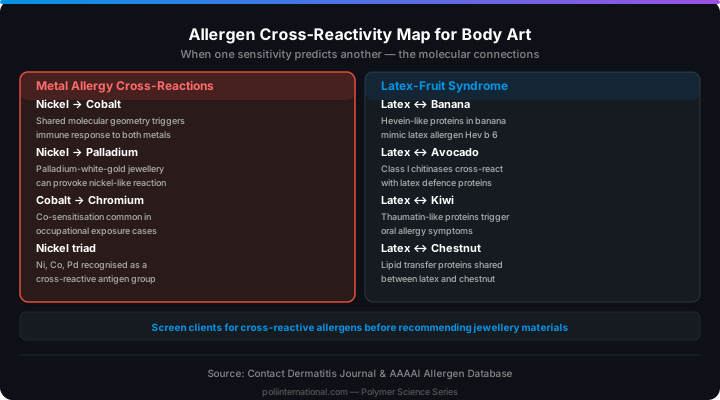

Allergen Cross-Reactivity Map: Metal allergy cross-reactions and latex-fruit syndrome pathways
Infographic: Allergen Cross-Reactivity Map: Metal allergy cross-reactions and latex-fruit syndrome pathways

Key Takeaways:

» Nickel allergy predicts co-sensitisation to cobalt and palladium. A nickel-sensitive client given palladium-white-gold jewellery may react because the immune system recognises the similar molecular geometry, not the metal name.
» Latex allergy cross-reacts with banana, avocado, kiwi, and chestnut through latex-fruit syndrome. A client who reports oral itching after eating these foods should be screened for latex allergy before latex gloves are used.
» Red tattoo pigment reactions are the most common allergic tattoo complication. Cross-reactivity extends to orange and magenta pigments that share naphthol, quinacridone, or diarylide chemistry.
» "Hypoallergenic" is an unregulated claim. "Nickel-free" does not mean cobalt-free or palladium-free. Implant-grade titanium (ASTM F136) and pure niobium are the only reliably cross-reactivity-free metals for fresh piercings.

1. Why Cross-Reactivity Matters in the Studio

Allergic contact dermatitis from body jewellery or tattoo pigments is not always a single-allergen event. The immune system recognises allergens by their chemical shape, not by the marketing name on the packaging. When two substances share similar molecular geometry, T-cells sensitised to one can react to the other. This is cross-reactivity, and in body art it changes the answer to the question "what material is safe for this client?"

A client who knows they react to nickel is straightforward: you recommend implant-grade titanium and verify the mill certificate. But a client who reacts to nickel is also at elevated risk for cobalt allergy, palladium allergy, and, in some cases, reactions to certain pigments. A client with a latex allergy may not know they are also at risk for reactions to banana, avocado, and kiwi, foods a studio might serve as refreshments. The studio that screens for cross-reactivity catches risks the client has never heard of.

2. The Nickel-Cobalt-Palladium Triad

Nickel is the most common contact allergen in the industrialised world, with sensitisation rates of roughly 10 to 20% in the general population and higher in women because pierced ears are the primary vector. But nickel does not sensitise in isolation. The immune system's nickel-specific T-cells frequently cross-recognise cobalt and palladium because all three metals form geometrically similar complexes with skin proteins.

MetalPrimary Body Art ExposureCross-Reacts WithClinical Significance
NickelSteel alloys (304, 316, 316L), white gold, costume jewelleryCobalt, palladium, chromium (partial)10 to 20% of population sensitised; cumulative, every exposure increases future risk
CobaltSteel alloys (trace), some blue/green tattoo pigments (cobalt aluminate), dental alloysNickel, palladiumCo-sensitisation with nickel in roughly 25% of nickel-allergic individuals
PalladiumWhite gold alloys (used as nickel-free whitening agent), high-end body jewelleryNickel, cobaltNickel-allergic client given palladium-white-gold jewellery may still react
ChromiumSteel alloy passive layer, chromium oxide green pigment, leather-tanning residuesNickel (partial), cobalt (partial)Frequently co-exists in the same products as nickel and cobalt

If a client has a confirmed nickel allergy, the safest recommendation is not "low-nickel" steel: it is a metal with zero nickel, zero cobalt, and zero palladium. Implant-grade titanium (ASTM F136, Ti-6Al-4V ELI) meets this requirement. Niobium (99.9% minimum purity) also qualifies. Verify the full compositional certificate, not the marketing claim. A product labelled "nickel-free" may still contain cobalt or palladium at levels that trigger a reaction in a nickel-sensitised client.

3. Latex-Fruit Syndrome: When the Glove Box Predicts a Food Reaction

Latex allergy affects roughly 1 to 6% of the general population and up to 10 to 17% of healthcare workers due to repeated occupational exposure. The mechanism is IgE-mediated type I hypersensitivity, distinct from the delayed type IV hypersensitivity of metal allergy. The IgE antibodies that recognise latex proteins from the rubber tree also bind to structurally similar proteins in certain fruits and vegetables. This is latex-fruit syndrome.

Cross-Reacting FoodRelevance to StudiosRisk Level
BananaCommon studio snack; some aftercare ingredients derived from banana extractsHigh, most consistently cross-reactive
AvocadoIncreasingly common in studio environments (staff kitchens, client refreshments)High
KiwiLess common but widely consumedModerate-high
ChestnutSeasonal; unlikely in studio environmentModerate
Papaya, passion fruit, fig, potato, tomatoLower clinical associationLow-moderate

Latex-fruit syndrome can present as oral allergy syndrome, itching and swelling of lips and mouth immediately after eating, or rarely as systemic anaphylaxis. A client who reports oral itching after eating banana or avocado should be screened for latex allergy before latex gloves are used during their procedure. The simplest policy: default to nitrile gloves for all procedures. Nitrile is latex-free and carries no cross-reactivity risk.
From the Chief Engineer's Workbench

Patrick Poli · 25+ years in body-jewellery manufacturing

What Material Certificates Actually Tell You

I have spent twenty-five years reading alloy composition certificates, and I have learned that what is not on the page matters as much as what is. A certificate that lists nickel content but omits cobalt is not a certificate I can trust. A supplier who says their steel is "surgical grade" but cannot produce an ASTM F138 or ISO 5832-1 batch certificate is not a supplier I work with.

The cross-reactivity problem is why we make BioFlex to ISO 10993-6 for long-term implantation. A polymer does not leach metal ions because there are no metal ions to leach. A nickel-allergic client wearing a BioFlex retainer does not need to think about cobalt co-sensitisation because the material is carbon, hydrogen, oxygen, and silicon. The chemistry is simple and the immunology is simpler: no metal, no metal allergy.

Read our detailed analysis of nickel allergy and EU regulation data and the material comparison between medical elastomers and metals. The cross-reactivity map in this article is the why. Those reference articles are the what to do about it.

PPPatrick PoliChief Engineer · Creator of BioFlex® body jewelry

5. FAQ

Q: If a client has a nickel allergy, can they wear surgical steel once the piercing is healed?

316LVM (ASTM F138) contains 12 to 14% nickel. The chromium oxide passive layer limits nickel ion release in healed piercings but does not eliminate it, and passivation degrades over time in the low-oxygen, high-chloride piercing environment. Nickel sensitisation is cumulative: every exposure increases the probability of a future reaction. For a confirmed nickel allergy, the safest recommendation is zero-nickel metal (titanium ASTM F136 or niobium), healed or not.

Q: Can someone be allergic to titanium?

Titanium allergy is extremely rare. The TiO₂ passive layer is biologically inert and does not release metal ions under physiological conditions. Documented cases exist in the orthopaedic literature at an estimated rate well below 1% of the implanted population. If a client reports a reaction to implant-grade titanium, verify the jewellery was genuinely ASTM F136, not a cheaper alloy containing nickel, and consider niobium as the alternative.

Q: Does cobalt allergy mean I should avoid blue tattoo ink?

Not necessarily. Most modern professional blue inks use copper phthalocyanine (Pigment Blue 15), which is chemically stable and rarely allergenic. The risk is in low-grade or unlabelled inks where the pigment composition is unknown. Verify the pigment identity from the manufacturer's safety data sheet before use.

Q: Are there tattoo ink colours that are universally safe for allergic clients?

No ink colour is universally safe because allergic reactions can occur to the pigment, the carrier, or a contaminant. Carbon black (Pigment Black 7) has the lowest reported incidence because elemental carbon is chemically inert. Titanium dioxide white is also low-risk. The highest-risk colours are reds and oranges using organic pigments with reactive functional groups. A patch test with the specific ink is the only reliable pre-procedure screen.

Conclusion

Cross-reactivity turns "I did not know" into "I should have checked." A client's nickel allergy is not just about nickel. A latex allergy is not just about gloves. A red ink reaction is not just about red. The screening protocol is simple: ask about jewellery reactions, ask about food reactions that suggest latex-fruit syndrome, ask about previous tattoo reactions by colour, and verify every material against its certificate, not its label. These questions add minutes to intake and prevent reactions that can last months.

Technical_References_Archive

  • [1]Laux P, et al. A medical-toxicological view of tattooing. The Lancet. 2016;387(10016):395-402 [doi:10.1016/s0140-6736(15)60215-x](https://doi.org/10.1016/s0140-6736%2815%2960215-x)
  • [2]Thyssen JP, Menné T. Metal allergy: a review on exposures, penetration, genetics, prevalence, and clinical implications. Chem Res Toxicol. 2010;23(2):309-318
  • [3]American Latex Allergy Association: Latex-fruit syndrome cross-reactivity guidance
  • [4]ISO 10993-6: Biological evaluation of medical devices - Tests for local effects after implantation standard catalogue
  • [5]ASTM F136: Standard Specification for Wrought Titanium-6Aluminum-4Vanadium ELI Alloy for Surgical Implant Applications standard catalogue

About the Author

PP

Patrick Poli

Chief Engineer, Poli International · Creator of BioFlex® body jewelry

Patrick has spent 25+ years manufacturing body jewellery and studio equipment, and developed BioFlex®, the implant-grade medical polymer tested to ISO 10993-6 and USP Class VI. He writes this journal from the manufacturing side of the industry: materials data, regulatory files, and what actually comes back from the bench.

More about Patrick →

Continue Reading