Shop
Clinical Physics

Vaseline on a New Tattoo: What to Do

PP

Chief Engineer

Patrick Poli

Journal Date

2026-08-01

Last Reviewed

2026-10-13

Can You Use Vaseline on a New Tattoo?

Key Takeaways:

» Vaseline (petroleum jelly) is an occlusive that blocks oxygen, traps moisture and bacteria, and can pull ink out of a healing tattoo
» During the tattoo session, a thin smear of petroleum jelly is a legitimate lubricant, but it is wiped away constantly and never left on as a healing layer
» For the first 3 days, use a water-based, fragrance-free tattoo aftercare product in a barely visible layer; a plain fragrance-free moisturiser like Lubriderm is a reasonable fallback
» During the peeling phase (days 3 to 14), do not soften scabs with occlusives; let them lift naturally and manage itching with cold compresses
» If your artist recommends Vaseline, they are following pre-2000s advice; modern aftercare guidance from the APP and most manufacturers advises against petroleum-based occlusives on healing tattoos
» Dry healing means using nothing at all; adding Vaseline on top of a dry-heal plan combines the worst of both approaches
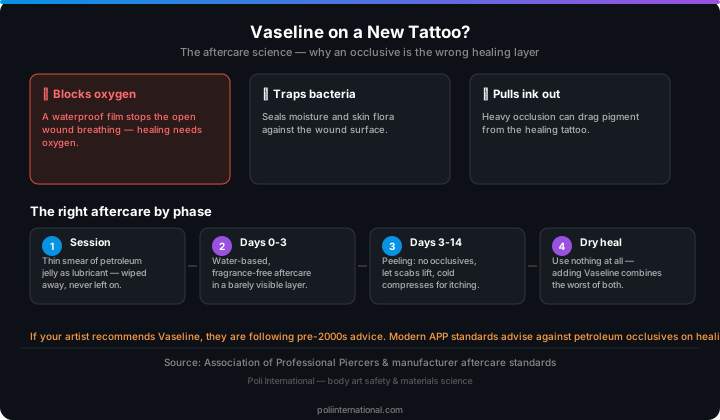
Vaseline on a new tattoo aftercare science: why occlusives block oxygen, trap bacteria and pull ink, plus the right aftercare by healing phase
Infographic: Vaseline on a new tattoo aftercare science: why occlusives block oxygen, trap bacteria and pull ink, plus the right aftercare by healing phase

1. Why Vaseline Is the Wrong Choice for a Healing Tattoo

The short answer is no. The advice has been circulating for decades: put Vaseline on it. Your grandmother swore by it, every bathroom cabinet has a tub, and it feels like it should work. During the session your artist probably used a thin smear of petroleum jelly to reduce friction and stop the needle dragging. So why is it suddenly wrong the next day?

Because a new tattoo is an open wound with pigment trapped in the dermis. It needs oxygen, controlled moisture, and barrier protection from bacteria. Vaseline is an occlusive: it forms a waterproof film that blocks nearly all transepidermal water loss. That is why it works for nappy rash and chapped lips. But a healing tattoo is not a scrape, and three specific problems make it a bad choice.

First, it blocks oxygen. Fibroblasts, the cells that rebuild collagen and close a wound, are oxygen-dependent. Sealing the site under an occlusive layer reduces the oxygen gradient that drives healing, slowing wound closure and prolonging the open-wound window.

Second, it traps moisture, bacteria, and exudate. In the first three to five days a new tattoo weeps plasma and blood, carrying debris out of the wound. Vaseline traps that fluid against the skin. The warm, wet, low-oxygen environment under the petroleum film is exactly what Staphylococcus aureus and Pseudomonas aeruginosa need to colonise. A protective layer becomes a sealed bacterial incubator.

Third, it can pull ink out of the dermis. Petroleum jelly is thick and greasy, and wiping it off creates mechanical friction that can dislodge pigment from the upper dermis while the wound edges are still open. The result is patchy, faded areas, what artists call ink pull, one of the most common reasons clients need a touch-up.

2. What Vaseline Does to Each Healing Stage

Tattoo healing runs through three distinct phases, and Vaseline disrupts each one differently.

Healing phaseNormal processWhat Vaseline does
Inflammatory (days 1-3)Plasma weeps out, carrying debris; immune cells arrive; the wound is openTraps plasma against the skin, creating a wet, warm environment that accelerates bacterial growth and blocks the natural drying that signals the next phase
Proliferative (days 3-14)Fibroblasts lay down collagen; skin re-epithelialises; scabbing forms a natural crustKeeps scabs soft and wet; they detach prematurely when wiped off, pulling pigment with them; fibroblast activity slows from reduced oxygen
Maturation (weeks 2-6+)Collagen remodels; the epidermis regains barrier function; itching and dryness are normalOver-moisturises until the skin stops self-regulating; can cause perifollicular irritation, small red bumps known as petroleum acne

There is one legitimate role for Vaseline in tattooing: during the session itself, as a thin lubricant to reduce needle friction. It is wiped away constantly and never left on as a healing layer. That is not the same as applying a thick coat and leaving it.

3. What to Use Instead, Stage by Stage

Day 1: leave the artist's bandage on for the time they specified, usually 2 to 24 hours depending on whether they used cling film, a medical adhesive drape like Saniderm, or an absorbent pad. Do not apply anything underneath.

Days 1 to 3: once the bandage comes off, wash gently with lukewarm water and a fragrance-free antimicrobial or mild soap. Pat dry with a clean paper towel and let it air-dry for 5 to 10 minutes. Then apply a very thin layer of a dedicated water-based, fragrance-free tattoo aftercare product such as Hustle Butter, After Inked, or Tattoo Goo. A plain fragrance-free moisturiser like Lubriderm or CeraVe lotion is a reasonable fallback. The rule: if it looks shiny or wet on the skin, you have used too much. Dab the excess off with a clean paper towel.

Days 3 to 14: this is when people reach for Vaseline most often, because the tattoo is peeling and itching and Vaseline feels soothing. Do not do it. Scabs need to dry and lift naturally; occlusives soften them and make them tear off early, pulling pigment with them. Continue with a thin layer of fragrance-free moisturiser two to three times a day. For severe itching, hold a cold compress above the tattoo, not touching, and consider an oral antihistamine after checking with your artist or doctor.

Weeks 2 to 6: once the surface is fully closed, a slightly richer moisturiser such as coconut oil, shea butter, or cocoa butter is generally safe. But even now petroleum jelly is unnecessary: a well-formulated moisturiser with humectants and emollients hydrates better than pure occlusion, without the drawbacks.

From the Chief Engineer's Workbench

Patrick Poli · 25+ years in body-jewellery manufacturing

Patrick's Deep Archive

I have spent more than two decades working with materials that sit against broken skin: implant-grade steels, titanium, polymers, and the coatings that separate them from living tissue. The core lesson is that occlusion is a tool with a narrow window. In manufacturing, we use barrier films to protect a part during a defined process step, and we remove them the moment protection is no longer needed. Leave a barrier on past its window and you do not protect the part, you incubate the failure.

A tattoo is the same. The petroleum film that protects a chapped lip is the same film that incubates bacteria on an open wound. I have seen technically excellent tattoos ruined not by the artist but by a client who followed 1980s aftercare advice out of respect for an older artist. The respect is admirable; the chemistry is not negotiable. The wound needs oxygen, controlled moisture, and a clean surface. Modern water-based aftercare products were designed for exactly that job. Trust the mechanism, not the habit.

PPPatrick PoliChief Engineer · Creator of BioFlex® body jewelry

5. FAQ

What happens if I already put Vaseline on my new tattoo?

Wash it off gently with lukewarm water and fragrance-free soap. One application is unlikely to cause serious damage if removed within a few hours. Watch for signs of infection, increasing redness, heat, green or yellow discharge, or foul smell, over the next 48 hours, and switch to a water-based product immediately.

Is Aquaphor the same as Vaseline?

Aquaphor is petroleum-based but less occlusive than pure Vaseline because it contains humectants like glycerin and panthenol. Some artists recommend it. It can still cause problems if applied too thickly, so use the thinnest possible film and stop if you notice moisture trapping.

Can I use Vaseline on a healed tattoo to make it look shiny?

On fully healed skin, 4 to 6 weeks post-tattoo, a tiny dab adds temporary shine for photographs and is harmless because the skin barrier is intact. It is not a moisturiser and does nothing for long-term vibrancy. A sunscreen of SPF 30 or higher does far more to preserve ink.

What about coconut oil or shea butter?

They are safe on healed tattoos but should not be used during the open-weeping phase, the first 3 to 5 days. They are heavier than water-based lotions and can trap moisture if applied too thickly. Reserve them for the maturation phase, weeks 2 and beyond, once the surface is closed.

My tattoo is itching badly and Vaseline is the only thing that helps.

Do not use it, even if it feels soothing. The relief is from the cooling sensation, not any healing benefit. Use a cold, clean compress held above the skin, take an oral antihistamine if approved by your doctor, and contact your artist. Severe itching that does not respond can signal an allergic reaction or early infection; see our infection vs irritation guide to tell the difference.

6. What to Do If You Accidentally Put Vaseline on Your Tattoo

If you've just realized you slathered Vaseline on a fresh tattoo, don't panic. The most common query I see is "I accidentally put Vaseline on my tattoo"—and the answer depends on when and how much. A single thin application is unlikely to ruin your tattoo, but it does need to be removed properly. Petroleum jelly is an occlusive: it creates a barrier that traps moisture, bacteria, and contaminants against the skin while blocking oxygen exchange. That's the opposite of what a healing tattoo needs.

Here's my first-hand advice after 25 years in the industry: gently wipe the area with a clean, lint-free cloth or paper towel using lukewarm water and a mild, fragrance-free soap. Do not scrub. Pat dry with a clean paper towel and leave the tattoo uncovered to breathe. If the tattoo is in the first 24–48 hours and still weeping plasma, a thin layer of petroleum jelly can actually trap that fluid and create a breeding ground for bacteria—so remove it promptly and switch to a recommended aftercare ointment or a breathable dressing. For the next few days, keep the area clean and lightly moisturized with a product designed for tattoo healing, not a heavy occlusive.

What if you applied Vaseline to an older tattoo that's already peeling or itching? The risk is lower, but you should still remove it. Clogged pores can cause folliculitis or a mild rash, and the jelly can soften scabs prematurely, leading to ink loss. Wash gently, pat dry, and let the skin breathe.

I've seen thousands of tattoos heal well after a single mistake—the key is not to repeat it. Monitor for signs of infection: increased redness, swelling, warmth, pus, or fever. If any appear, see a doctor. For a full breakdown of safe aftercare at every stage, read my guide to tattoo aftercare products I recommend. And if you're planning a new piercing to go with that tattoo, start with my body jewellery materials guide to avoid counterfeits and choose medical-grade options.

7. Vaseline on a Tattoo by Healing Stage: Day 3, One Week, Two Weeks

Most of the questions I get about petroleum jelly aren't really "yes or no", they're "when." The answer changes depending on where you are in the healing timeline, so let's break it down by stage.

Day 3 after getting a tattoo. This is when the fresh wound is still open, weeping plasma, and at its most vulnerable to infection. Vaseline is an occlusive: it seals the surface and traps moisture, bacteria, and debris underneath. That's the opposite of what you want on day 3. Keep it clean, use a breathable aftercare product, and let the skin do its job. If you're wondering "can I put Vaseline on my tattoo after 3 days", no. This is the single worst window for it.

After one week. By day 7, the tattoo is typically entering the flaking and itching phase. It feels dry, tight, and uncomfortable, which is exactly when people reach for Vaseline. Don't. The occlusive film can soften the flaking skin prematurely, pull ink out with the peeling layer, and create a breeding ground for bacteria if any micro-cracks are present. Use a light, non-occlusive moisturiser instead and let the flakes fall off on their own.

After two weeks. At this point the surface has usually closed, but the deeper dermis is still remodelling. I've seen people assume that means petroleum jelly is safe now. It isn't, the same occlusive mechanics apply, and you can still disrupt ink settling. A thin layer of a breathable, REACH-compliant aftercare product is what I recommend, not Vaseline.

What about Vaseline cocoa butter lotion? This comes up often. Cocoa butter lotion is not the same as pure petroleum jelly, but many commercial versions contain mineral oil, petrolatum, or heavy occlusives that behave the same way on a healing tattoo. Read the ingredients. If petrolatum appears in the first few lines, treat it like Vaseline and keep it off the tattoo.

I've spent 25 years making BioFlex® body jewelry and watching healing skin because the industry kept repeating myths like "petroleum jelly is a lubricant, so it's fine." It isn't fine for healing skin. During the tattoo session, a thin smear is a legitimate lubricant, but it gets wiped away immediately. That's a completely different use case from daily aftercare.

For a stage-by-stage aftercare routine that won't pull your ink or trap bacteria, use our Aftercare Schedule Generator.

Conclusion

Vaseline has a place in the tattoo studio, but it is on the artist's needle tray, not in your aftercare routine. As an occlusive, it blocks the oxygen a healing wound needs, traps the bacteria and exudate it needs to shed, and can drag pigment out of the dermis when wiped away. Modern water-based, fragrance-free products keep the wound clean, moist, and breathing. Follow the stage-by-stage protocol above, resist the petroleum jar, and let the tattoo heal the way the biology intends. If you already used Vaseline, remove it gently, switch to a proper product, and monitor for infection signs over the next two days.

Mind map · Vaseline on a New Tattoo: What to Do

  • Vaseline on New Tattoos
    • Risks of Petroleum Occlusion

      Vaseline blocks essential wound oxygen, traps moisture and bacteria, and pulls ink particles out of healing skin.

      • Oxygen Deprivation
        • Impaired Wound Healing
      • Infection Vulnerability
        • Trapped Bacteria and Fluid
      • Ink Pullout
        • Patchy and Faded Results
    • Healing Stage Disruptions

      Petroleum jelly disrupts natural healing processes across the inflammatory, proliferative, and maturation stages of a healing tattoo.

      • Inflammatory Phase
      • Proliferative Phase
        • Prematurely Detached Scabs
      • Maturation Phase
        • Pore Clogging Petroleum Acne
    • Specialized Aftercare Alternatives

      Water-based, fragrance-free lotions and specialized tattoo balms allow oxygen exchange while protecting healing skin.

      • Water-Based Lotions
      • Dedicated Tattoo Balms
    • Natural Household Products

      Coconut oil and shea butter provide hydration but are too heavy for the early weeping phase.

      • Coconut Oil
      • Shea Butter
    • Safe Application Timing

      Vaseline is safe as a session lubricant and a shower barrier, or on old fully healed tattoos.

      • Session Lubrication Only
StructureProcessMaterialHazard

5 branches, 0 sources. Each branch cites the article it came from; the labels beneath it are names, not claims.

Tattoo Aftercare Quiz

  1. 1. How does applying an occlusive like Vaseline specifically impair the activity of fibroblasts during early tattoo wound healing?

    • ✓ It reduces the oxygen gradient necessary for collagen-rebuilding cells to close the wound. — Fibroblasts depend on oxygen to synthesize collagen and close wounds, a process impeded by waterproof barrier films that restrict gas exchange.
    • • It accelerates scab formation, forcing the dermal layer to shed trapped ink prematurely. — Premature scab shedding occurs later during the peeling phase due to excess moisture, rather than through immediate fibroblast acceleration.
    • • It chemically breaks down and dissolves ink particles stored within the dermal tissue. — Petroleum jelly dislodges pigment through mechanical friction during wiping rather than through chemical breakdown.
    • • It triggers a systemic immune response that suppresses white blood cell production. — The adverse effects of petroleum jelly are localized to wound mechanics and surface oxygenation rather than systemic white blood cell suppression.
  2. 2. Why does applying a thick layer of petroleum jelly during aftercare frequently cause patchy or faded spots in a healing tattoo?

    • ✓ The mechanical friction generated when wiping off the thick residue pulls pigment out of the open upper dermis. — The effort required to clean away dense, greasy residue dislodges pigment that has not yet settled into the unclosed upper dermis.
    • • Petroleum jelly chemically neutralizes organic ink pigments upon contact. — Fading stems from physical friction when wiping away heavy grease rather than a chemical reaction with pigment molecules.
    • • The fluid barrier causes ink particles to dissolve directly into weeping plasma. — Plasma weeping is a normal physiological response; ink loss occurs from physical wiping rather than chemical dissolution into fluid.
    • • Excessive moisture absorption causes ink particles to migrate into the bloodstream. — Pigment granules are held mechanically within skin tissue and are dislodged by external rubbing rather than internal circulatory absorption.
  3. 3. Following bandage removal during days 1 to 3 of tattoo aftercare, what is the proper protocol before applying a light moisturizer?

    • ✓ Wash gently with lukewarm water and mild soap, pat dry with a paper towel, and let air-dry for 5 to 10 minutes. — Clean, gentle washing followed by brief air-drying removes weeping fluid while preparing the skin surface without trapping excess moisture.
    • • Apply a coat of natural oil to soften plasma before rinsing with hot water. — Applying oils prior to washing prevents effective fluid removal and traps exudate against open skin.
    • • Scrub the area firmly with a cloth towel to eliminate surface plasma immediately. — Vigorous rubbing with fabric towels creates mechanical friction that damages fragile wound edges and pulls out pigment.
    • • Re-seal the open area with adhesive film for an additional 24 hours. — Re-sealing prolongs the open weeping window and creates an environment where trapped exudate can harbor bacteria.
  4. 4. What complication occurs if an occlusive ointment is applied during the proliferative peeling phase (days 3 to 14)?

    • ✓ It keeps scabs soft and wet, causing them to detach prematurely and tear out underlying pigment. — Excessive moisture prevents scabs from drying naturally, leading to premature tearing that pulls trapped ink out of the dermis.
    • • It hardens surface scabs rapidly, preventing new epidermal growth underneath. — Occlusives trap moisture and excessively soften scabs rather than hardening them.
    • • It permanently deadens local nerve endings to stop itching entirely. — Occlusives do not affect nerve pathways; any temporary relief comes from surface cooling rather than nerve deadening.
    • • It stimulates hyper-production of collagen, leading to immediate raised keloid scars. — Reduced oxygen under occlusives actually slows fibroblast activity and collagen synthesis rather than accelerating it.
  5. 5. Why is petroleum jelly acceptable for use during an active tattooing session, but contraindicated for home aftercare?

    • ✓ In a session, a thin smear serves purely as a temporary lubricant and is continuously wiped away rather than left to seal the skin. — Frequent wiping during a tattoo session prevents petroleum jelly from forming a continuous, long-term occlusive layer over open skin.
    • • Tattoo artists use a specialized medical form of petroleum jelly that chemically evaporates within minutes. — Petroleum jelly used in studio trays is standard petrolatum and does not possess chemical evaporation properties.
    • • Needle punctures allow skin to absorb petroleum jelly safely without blocking oxygen. — Open needle punctures increase wound vulnerability, making trapped moisture and restricted oxygen more damaging over time.
    • • Mixing petroleum jelly with tattoo ink changes the ointment's molecular structure so it becomes breathable. — Mixing pigment with petroleum jelly during needle passes does not alter the physical occlusive barrier properties of petrolatum.
  6. 6. What localized environmental conditions created under a petroleum jelly film encourage bacterial colonization on fresh tattoos?

    • ✓ A warm, wet, low-oxygen space where trapped plasma and exudate collect. — Trapping weeping plasma and exudate beneath an impermeable layer creates an ideal low-oxygen incubator for opportunistic bacteria.
    • • A cold, dry environment that strips defensive lipids from the skin surface. — Petroleum jelly prevents drying by trapping weeping fluids underneath its waterproof film.
    • • A high-oxygen micro-climate that speeds anaerobic microbial growth. — Occlusives severely limit oxygen availability rather than creating a high-oxygen environment.
    • • An acidic barrier that dissolves surface tissue proteins. — Petroleum jelly forms a neutral occlusive film that traps weeping fluid rather than an acidic tissue-dissolving layer.
  7. 7. If a tattoo artist advises a client to rely on Vaseline for multi-day aftercare, what does this recommendation indicate according to modern industry guidance?

    • ✓ The recommendation relies on outdated pre-2000s practices, whereas contemporary professional association guidance discourages occlusives. — Modern aftercare standards from professional bodies advise using breathable, water-based products rather than legacy petroleum habits.
    • • The recommendation violates legally mandatory national wound care directives. — Aftercare practices are governed by professional guidelines and industry standards rather than specific statutory wound care laws.
    • • The advice is tailored specifically for tattoos that involve deep shading techniques. — The biological need for oxygenation and moisture control remains identical regardless of shading density.
    • • The artist is attempting to integrate dry healing principles with heavy hydration. — Dry healing relies on using no topical products at all; adding petroleum jelly directly contradicts dry healing methodology.
  8. 8. What skin condition can arise from persistent over-moisturization with heavy petroleum-based products during tattoo recovery?

    • ✓ Petroleum acne, characterized by small red bumps around irritated hair follicles. — Excessive use of occlusive products clogs pores and irritates hair follicles, resulting in localized perifollicular inflammation.
    • • Internal pigment degradation across the entire dermal layer. — Over-moisturization causes surface pore blockages and scab softening rather than chemical destruction of deep pigment.
    • • Ulcerative skin necrosis that extends far beyond the tattoo border. — Pore blockages from heavy ointments lead to minor localized folliculitis rather than severe tissue necrosis.
    • • Nerve desensitization resulting in total loss of localized touch sensation. — Blocked pores trigger inflammatory skin bumps without damaging sensory nerve pathways.
  9. 9. If Vaseline is accidentally applied to a new tattoo, what is the correct recovery procedure?

    • ✓ Gently wash the product off using lukewarm water and mild soap, then monitor the area for infection signs over 48 hours. — Removing the occlusive film restores oxygen flow, while monitoring for symptoms like heat or abnormal discharge catches potential infections early.
    • • Apply alcohol sanitizer immediately to dissolve the petroleum layer before re-wrapping. — Applying harsh sanitizers directly to exposed dermal tissue causes severe cell damage and inflammation.
    • • Allow the ointment to remain undisturbed until it naturally absorbs into the deep tissue. — Petroleum jelly does not absorb into skin layers; leaving it in place prolongs oxygen deprivation and bacterial incubation.
    • • Use an abrasive scrub to strip away the greasy layer along with surface tissue. — Abrasive scrubbing causes mechanical trauma that damages open skin and strips trapped ink.
  10. 10. How can severe itching during the tattoo peeling phase be safely managed without using occlusive ointments?

    • ✓ Hold a clean cold compress slightly above the area without direct contact, and consult a professional regarding an oral antihistamine. — Non-contact cooling soothes local discomfort while oral antihistamines address systemic histamine responses without drenching fragile skin.
    • • Apply a thick coat of ointment to numb nerve endings through continuous cooling. — Thick ointments trap heat and moisture, compounding scab degradation even if the initial touch feels briefly soothing.
    • • Scratch the un-tattooed skin immediately adjacent to the tattoo to relieve nerve signals. — Scratching near an open wound risks transferring bacteria from fingernails into healing skin.
    • • Submerge the tattoo in warm standing water for 30 minutes to soften itchy crusts. — Soaking a healing tattoo in standing water introduces bacterial contamination and causes scabs to swell and detach prematurely.

Extended Reference Table

8 of 8 rows

Extended reference table generated from the article and its verified research sources. Bracketed numbers jump to the matching entry in the Technical References below.

SafetyItem or Practice Type Recommended Phase Biological Function or Mechanism Contraindications or Risks Standards and Specifications
⚠️Petroleum Jelly (Vaseline)MaterialNot recommended for healing (Contraindicated); Maturation for water protection onlyActs as a mechanical lubricant during sessions or an occlusive water barrier post-healing. Seals moisture and protects from rubbing.Blocks airflow, traps heat/sweat/bacteria (Staph risk)," clogs pores, and can lead to ink loss, fading, or infection.100% petrolatum; Medical, Cosmetic, or Industrial Grade
✅AquaphorProductInflammatory / ProliferativeSemi-occlusive/breathable ointment that provides hydration while allowing oxygen exchange for cell regeneration. Contains humectants like glycerin and panthenol.Contains lanolin (known sensitizer); over-application can trap moisture and cause skin maceration.41% petrolatum; Breathable ointment classification
✅Washing ProtocolsPracticeInflammatory / ProliferativeMechanical removal of leaking plasma, surface bacteria, and excess fluids/debris to prevent infection and prepare for moisturizing.Avoid rubbing, scrubbing, or using hot water; avoid fragrance and alcohol which irritate and dry out the wound.Fragrance-free liquid soap and lukewarm water
✅Coconut OilMaterialProliferative / Maturation (typically Day 7+)Rich emollient that absorbs into skin; possesses natural antimicrobial and anti-inflammatory fatty acids.Comedogenic for some; should not be used on open-weeping wounds (first 3-5 days) as it can trap moisture or carry bacteria if unsterilized.Natural plant oil
✅Sunscreen (SPF 30+)ProductMaturation (Post-healing)Prevents photodegradation by blocking UV radiation from breaking molecular bonds of tattoo pigment.Do not use during the initial inflammatory/proliferative phase (first 14+ days) until fully healed.SPF 30 or higher; Broad-spectrum
✅Dry HealingPracticeInflammatory / ProliferativeAllows maximum oxygen exchange for cell regeneration by avoiding heavy ointments; allows the wound to breathe naturally.Excessive dryness can cause irritation or cracking; adding Vaseline over a dry-heal plan combines risks of both methods.Breathable hydration protocols
✅BepanthenProductInflammatory / ProliferativeNappy rash ointment designed to hydrate and create a protective barrier while allowing the skin to breathe.Occlusive nature may interfere with biological repair if over-applied; use only in moderation.-
✅Hustle ButterProductInflammatory / ProliferativeDedicated water-based, fragrance-free tattoo aftercare designed to maintain hydration and breathability.Over-application (layer must be barely visible).-

Free Body Art Wall Posters

Print-ready reference posters for your studio or your own wall. Free to download and display, embed on your own site with attribution. Click any poster to preview it full size before downloading.

Choose and download all 40 posters

Body Art Weekly, every Friday

One email a week: what happened at Poli International, the stories that mattered in tattoo, piercing and PMU, one point of view, and the new plates. Free to print, for your studio or your own wall.

Join, and get 3 plates in 4K, free. You choose them: a comic, a wall chart and an anatomical cutaway.

Technical_References_Archive

  • [1]Singer AJ, Clark RAF. Cutaneous wound healing. N Engl J Med. 1999;341(10):738-746. PMID 10471461.
  • [2]Dieckmann R, Boone I, Willrich N, et al. The risk of bacterial infection after tattooing. Dtsch Arztebl Int. 2016;113(40):665-671. di.aerzteblatt.de/int/archive/article/182859
  • [3]Bolton L, Pirone C, Jordan J, et al. Occlusive dressings: therapeutic agents and effects on drug delivery. Clin Dermatol. 1992;9(4):573-583. sciencedirect.com/science/article/abs/pii/0738081...
  • [4]Association of Professional Piercers. Aftercare standards. safepiercing.org. safepiercing.org/aftercare
  • [5]PMID 41457749 Du-Soriano et al. Efficacy of a Novel Daily-Use Hydrocolloid Pad on Wound Healing: Findings of a 16-Day, Single-Center, Randomized, Controlled Study.. Adv Wound Care (New Rochelle). 2025:21621918251405806.
  • [6]PMID 30756451 Gold et al. Randomized, single-blinded, crossover study of a novel wound dressing vs current clinical practice after percutaneous collagen induction therapy.. J Cosmet Dermatol. 2019;18(2):524-529.

About the Author

PP

Patrick Poli

Chief Engineer, Poli International · Creator of BioFlex® body jewelry

Patrick has spent 25+ years manufacturing body jewellery and studio equipment, and is the creator of BioFlex® body jewelry. He created the push-fit system so jewellery separates on impact instead of tearing the piercing. He also designed the flexible belly bar that lets a navel piercing stay in place through a pregnancy.

More about Patrick →

Last reviewed: 2026-10-13 · Published: 2026-08-01

Continue Reading