Cleaning and Disinfection for Body Art Studios: The Protocol Regulators Actually Inspect
Key Takeaways:
» Cleaning is not disinfection: removing organic and inorganic debris is the prerequisite that lets any disinfectant or sterilant work.
» The Spaulding classification decides everything: critical items that pierce skin must be sterile or single-use, semi-critical items need high-level disinfection, and non-critical surfaces only need low-level disinfection.
» Disinfectant efficacy is governed by five factors: bioburden, microbial type, surface texture, concentration, and contact time; the last two are the ones studios get wrong.
» Chlorine-based disinfectants must never be mixed with ammonia, acids, or peroxides: each combination generates a toxic gas or oxygen that turns a cleaning cart into a hazard.
» UV lamps, glass bead sterilizers, pressure cookers, microwave ovens, and ultrasonic tanks are not sterilization methods, and inspectors know it.
» Documentation is the deliverable: a written schedule, product labels with DIN or EPA registration, and spore-test records are what a regulator looks at first.
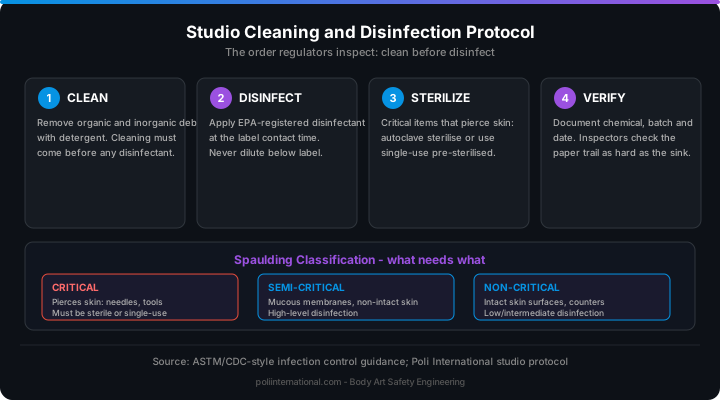
1. Why cleaning comes first, always
A used tattoo needle, piercing taper, or clamp carries more than visible debris. Dried blood, plasma proteins, pigment residue, tissue fragments, and lubricant form a biofilm that shields microorganisms from chemical action. The National Collaborating Centre for Environmental Health (NCCEH) is blunt about the consequence: disinfection and sterilization require a surface with minimal organic and inorganic load, because the activity of the disinfectant or sterilant has to be focused on destroying microorganisms, not on dissolving crusted protein.
The World Health Organization makes the same point for environmental surfaces. Cleaning with water, soap or neutral detergent, and mechanical action removes and reduces dirt, blood, secretions, and other organic matter, but does not kill microorganisms. Organic matter impedes direct contact between a disinfectant and the surface and inactivates the germicidal properties of several disinfectants. In practical terms: a surface that looks clean but was never cleaned will defeat the best disinfectant on the shelf.
This is why inspectors watch the sequence, not just the products. The NCCEH guidance for personal service establishments expects operators to have a regular cleaning schedule and documented procedures for cleaning, disinfection, and sterilization. The Washington State Department of Health school cleaning guidance uses the same two-step logic: clean first to remove soil, then disinfect to kill pathogens, with the disinfectant given its full labeled contact time. Body art studios are held to the same standard, and in most jurisdictions the documentation is what gets audited.
2. The Spaulding classification: what needs what
The Spaulding classification, developed for health care and adapted by several provinces and states for personal service establishments, sorts every item in a studio into three tiers based on the risk of transmitting infection if the item is contaminated.
Critical items enter or penetrate sterile tissue or the bloodstream. For body art that means piercing needles, needle pushers, needle receiver tubes, insertion tapers, clamps, forceps, containers that hold sterile instruments, ring-opening and ring-closing pliers, implants, and the jewelry inserted into a new piercing, plus tattoo needles, needle bars, metal tubes, and grips. These items carry an extremely high risk if not sterile. The standard answer in modern practice is single-use, pre-sterilized, disposable: kept in original sterile packaging, used promptly after opening, and disposed of after use. If reusable, they require sterilization, which means an autoclave validated and spore-tested on schedule.
Semi-critical items contact mucous membranes or non-intact skin but do not penetrate sterile areas. In a studio that includes calipers, swabs and gauze for cleaning, pigment and ink trays, scissors, clippers, razor handles used on skin, and makeup applicators that contact open lesions. These need high-level disinfection at minimum.
Non-critical items contact only intact skin: service trays, furniture, floors, spray bottles, clip cords, motor frames, and control knobs. These need low-level or intermediate-level disinfection, which is where the daily wipe-down routine belongs.
| Class | Contact | Examples | Minimum treatment |
|---|---|---|---|
| Critical | Enters sterile tissue or blood | Piercing needles, tapers, clamps, forceps, new-piercing jewelry, tattoo needles and tubes | Sterilization or single-use disposable |
| Semi-critical | Mucous membranes or non-intact skin | Calipers, pigment trays, scissors, clippers, razor handles on skin | High-level disinfection |
| Non-critical | Intact skin only | Service trays, furniture, floors, clip cords, control knobs | Low- or intermediate-level disinfection |
3. Disinfectant levels and the five factors that decide success
Disinfection destroys pathogenic or potentially pathogenic microorganisms, including bacteria, viruses, fungi, and endospores. Health Canada, like other regulators, recognizes three levels: low-level disinfection destroys most pathogens but not reliably mycobacteria, fungi, or non-lipid viruses; intermediate-level adds mycobactericidal properties; high-level destroys all microbial pathogens including mycobacteria, with spores reduced but not completely eliminated at practical exposure times.
The five factors that govern efficacy appear in every regulator's checklist: bioburden, the number and type of microorganisms present, the texture and composition of the item, the concentration and type of disinfectant, and the contact time. Concentration and contact time are where studios fail most often. A disinfectant sprayed and immediately wiped dry has not had its labeled contact time, usually measured in minutes. A solution diluted by guesswork is either too weak to kill or strong enough to corrode metal and irritate skin.
The WHO bleach guidance gives the arithmetic: to reach 0.1% (1000 ppm) from a 5% household solution, use the formula [percent in product divided by percent desired] minus one, which is nine parts water for each part bleach. For blood and body fluid spills over about 10 mL, 0.5% (5000 ppm) is recommended. Hypochlorite is rapidly inactivated by organic material, which is why the cleaning step before disinfection is not optional.