Shop
Regulatory Pulse

Steam Sterilizers: What a Body Art Studio Actually Needs to Know

PP

Chief Engineer

Patrick Poli

Journal Date

2026-08-01

Last Reviewed

2026-10-13

Steam Sterilizers: The Class B, N, and S Reality Check

Key Takeaways:

» Steam sterilisation is the gold standard for reprocessing heat-stable instruments, but bench-top sterilizers are not interchangeable: EN 13060 classes B, N, and S each have strictly different load capabilities
» A class N sterilizer, the cheapest bench-top unit, can only process unwrapped solid instruments; it cannot sterilise wrapped packs, porous loads, or hollow instruments
» A class B sterilizer with vacuum cycles is the minimum realistic choice for a studio that wraps instruments and sterilises hollow jewellery, forceps, and cannulated tools
» Temperature and time matter less than saturated steam contact: 134 degrees C for 3 minutes or 121 degrees C for 15 minutes, only when steam reaches every surface
» Every sterilizer needs a testing regime: daily chamber checks, periodic Bowie-Dick tests for vacuum units, biological spore tests with Geobacillus stearothermophilus, and documented maintenance
» Water quality is part of the sterilisation process: distilled or demineralised water prevents scale, which can shield bacteria and invalidate a cycle
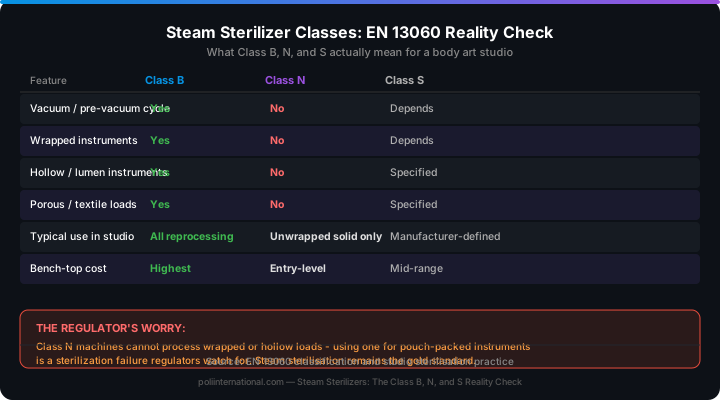
Steam sterilizer class comparison: Class B vs N vs S under EN 13060
Infographic: Steam sterilizer class comparison: Class B vs N vs S under EN 13060

1. Why Steam Sterilisation Is the Baseline

Steam sterilisation has been the reference method for medical instrument reprocessing for over a century, and it remains the standard regulators point body art studios toward. The reason is physical: saturated steam under pressure delivers heat uniformly and rapidly to every surface it can reach, denaturing the proteins of vegetative bacteria, fungi, and spores.

For a piercing or tattoo studio, the instrument stream is small but unforgiving. A bench-top steam sterilizer is designed for exactly this workload, provided the operator understands what their specific machine can and cannot do.

Put a wrapped pack in a machine that cannot drive steam through wrapping, and the instruments come out looking clean while remaining biologically unsterile. That is the failure mode regulators worry about most, and it is why the EN 13060 classification system exists.

2. EN 13060: What B, N, and S Actually Mean

The European standard EN 13060 classifies small steam sterilizers by what they are designed to process. The three letters are not marketing tiers; they are load-capability limits defined by the physics of the vacuum system.

ClassVacuumSafe loadsNot designed forTypical use
NNo vacuumUnwrapped solid instruments onlyWrapped packs, porous materials, hollow or cannulated instrumentsSingle unwrapped instruments processed immediately before use
SManufacturer-specifiedOnly the loads validated for that specific unitAnything outside the validated load listSpecialised loads per the unit's specification
BVacuum (fractionated)Wrapped packs, porous loads, hollow instruments, single instrumentsNothing within reason, when loads are packed correctlyFull studio reprocessing with wrapped instrument sets

A class N machine uses gravity displacement: steam enters the chamber and pushes air out through a drain. That works for solid, unwrapped metal instruments lying on a tray, because steam reaches every surface directly. It fails for wrapped packs, because air trapped inside the wrapping blocks steam contact, and it fails for hollow instruments, because air pockets inside the lumen never get displaced. Regulators and professional bodies consistently warn that class N units are inadequate for anything beyond immediate-use unwrapped instruments.

A class B machine uses a vacuum pump to remove air from the chamber before steam enters, in a series of pulses. With the air gone, steam penetrates wrapped packs, porous materials, and the inside of hollow instruments. This is the class that professional piercing organisations and decontamination guidance expect for wrapped instrument reprocessing.

A class S machine is a middle category, validated by the manufacturer for a specific list of loads. If the manual says the unit is validated for wrapped hollow instruments, it can process them; if it does not, it cannot. The burden is on the operator to read and retain that validation documentation.

3. Choosing and Running a Sterilizer in a Studio

The practical question is not which class is cheapest, it is which class matches the actual instrument workflow. If every instrument is wrapped before sterilisation, the norm in professional piercing, the minimum viable machine is a class B. Choosing an N unit to save money means either switching to unwrapped immediate-use processing, which changes the whole workflow, or running wrapped loads through a machine that cannot sterilise them, a client-safety failure waiting for an inspection.

Once the class is right, the operating discipline is where cycles are won or lost. Loads must be packed so steam can circulate: instruments not jammed together, wrapped packs not overfilled, chamber not overloaded. The door seal must be intact, and the cycle must reach and hold the sterilisation temperature for the full holding time, typically 134 degrees C for 3 minutes or 121 degrees C for 15 minutes.

Water quality is the silent variable. Tap water contains minerals that deposit as scale on chamber walls and heating elements. Scale insulates the heat source, extends warm-up times, and can shield organisms from steam contact. Distilled or demineralised water is the standard recommendation, and the reservoir must be emptied and refilled according to the manufacturer's schedule, not when it looks low.

4. The Testing and Documentation Regime

The professional standard is a layered testing regime.

Periodic: for vacuum units, a Bowie-Dick test, an air-removal test that detects leaks or pump faults by revealing whether steam penetrated a standard test pack, runs on a fixed schedule, typically daily or weekly. Biological monitoring with spore strips containing Geobacillus stearothermophilus, the most heat-resistant organism relevant to steam sterilisation, should run on a set schedule and be incubated and read per the manufacturer's instructions.

Documentation: every cycle logged, every test recorded, every service documented. Regulators and environmental health officers look for evidence of a system, not a spotless autoclave. If a spore test comes back positive, the response is containment, instrument recall, root-cause investigation, and three consecutive passing tests before returning to service, exactly the protocol covered in our sterilization failure protocol guide.

From the Chief Engineer's Workbench

Patrick Poli · 25+ years in body-jewellery manufacturing

Patrick's Deep Archive

Twenty-five years in materials engineering taught me that a process is only as trustworthy as its verification steps, and sterilisation is the purest example in body art. In industry, we never shipped a batch of implant-grade components on the strength of a visual check; we tested coupons from the same batch and kept the records. A sterilizer is the same. The green light on the panel tells you the machine thinks it did its job. The test pack, the spore strip, and the logbook tell you it actually did.

I have walked into studios with expensive class B autoclaves that were never serviced, run with tap water, and loaded like a dishwasher. I have also seen modest machines run with religious discipline produce spotless records for years. The equipment matters, but the operator matters more. If you cannot show an inspector your cycle logs, your Bowie-Dick records, and your spore test results, the sterilizer in the corner is not an asset, it is a liability. Buy the right class, run it by the manual, and document everything.

PPPatrick PoliChief Engineer · Creator of BioFlex® body jewelry

6. FAQ

Can I sterilise wrapped instruments in a class N sterilizer?

No. A class N unit has no vacuum system, so steam cannot penetrate wrapped packs or hollow instruments, and wrapped loads can emerge biologically unsterile. Use a class B unit for wrapped instrument sets.

How often should I run a spore test?

Follow the guidance for your jurisdiction and the manufacturer's instructions, but the professional norm is at least weekly, with daily or weekly Bowie-Dick tests for vacuum units. High-volume studios may test more frequently. Three consecutive passing tests are required after any failed test.

What temperature should a steam sterilizer reach?

The two standard cycles are 134 degrees C for 3 minutes and 121 degrees C for 15 minutes, with the timer starting only after the chamber reaches target temperature. Exact values are defined by load type and the manufacturer's validated cycle.

Does tap water work in a sterilizer?

It will run, but it is not recommended. Mineral scale insulates heating elements and can shield organisms from steam. Distilled or demineralised water is the standard, with the reservoir maintained per the manufacturer's schedule.

How is a sterilizer validated for class S?

Class S machines are validated by the manufacturer for a specific list of loads, unique to each model. Read the validation documentation for your exact unit. If the load you want to process is not on the list, the machine cannot be relied on for it.

Conclusion

Steam sterilisation is the gold standard for studio instrument reprocessing, but the class of the machine determines what it can actually sterilise. Class N units handle unwrapped solid instruments only; class B units with vacuum cycles handle wrapped packs, porous loads, and hollow instruments; class S units do exactly what their manufacturer validated and nothing more. Pair the right class with distilled water, correct loading, daily logs, periodic Bowie-Dick and spore testing, and documented maintenance, and the sterilizer becomes the quiet backbone of studio safety. Pair it wrong, and it becomes a false sense of security, which is worse than no sterilizer at all.

Mind map · Steam Sterilizers: What a Body Art Studio Actually Needs to Know

  • Steam Sterilizers in Studios
    • Class B Vacuum Standard

      A Class B sterilizer with vacuum cycles is the minimum realistic choice for a studio that wraps instruments and sterilizes hollow tools.

      • Active Air Removal
        • Fractionated Vacuum Cycle
      • Wrapped Load Capability
        • Pouched Tool Sets
    • Class N Gravity Limitations

      Class N gravity displacement sterilizers cannot safely process wrapped packs, porous loads, or hollow and cannulated instruments used in professional body art studios.

      • Gravity Displacement Passive Flow
      • Immediate Use Only
    • Class S Specified Loads

      Class S sterilizers are limited to specialized load lists validated by the manufacturer and require operators to verify and retain validation documentation.

      • Manufacturer Validated Parameters
      • Operator Documentation Responsibility
    • Mandatory Validation Protocols

      Every autoclave requires daily chamber checks, periodic Bowie-Dick tests for vacuum units, and regular biological spore tests to verify sterilizer efficacy.

      • Biological Spore Testing
        • Geobacillus Stearothermophilus
      • Bowie Dick Air Test
    • Pure Demineralized Water

      Distilled or demineralized water prevents mineral scale from building up and shielding bacteria from direct saturated steam contact inside the sterilizer.

      • Scale Insulation Risk
      • Weekly Reservoir Care
StructureProcessMaterialHazard

5 branches, 0 sources. Each branch cites the article it came from; the labels beneath it are names, not claims.

Sterilisation Quiz

  1. 1. Why is a Class N steam sterilizer unsuitable for processing wrapped instrument packs?

    • ✓ It relies on gravity displacement without a vacuum system, leaving trapped air inside the wrapping that blocks steam contact. — Class N units rely on gravity displacement without a vacuum, allowing trapped air inside wrapped packs to prevent steam contact with surfaces.
    • • It cannot maintain the required minimum holding temperature of 121 degrees C for 15 minutes. — Class N units easily achieve standard sterilising temperatures, but temperature alone cannot sterilise if air prevents steam contact.
    • • It uses dry heat rather than saturated steam under pressure to reprocess studio tools. — Class N units use steam generated from water rather than dry heat technology.
    • • Its internal chamber dimensions are strictly too small to fit standard instrument trays. — Unsuitability stems from the absence of a vacuum system for air removal rather than physical chamber dimensions.
  2. 2. What mechanism allows a Class B steam sterilizer to effectively sterilise hollow instruments and wrapped sets?

    • ✓ A vacuum pump removes air from the chamber in pulses prior to steam entry. — Fractionated vacuum cycles exhaust air from the chamber and intricate instrument lumens prior to introducing steam.
    • • High-pressure steam is injected at 150 degrees C to melt packaging barriers. — Sterilisation relies on saturated steam contact at standard temperature cycles rather than extreme heat that damages packaging.
    • • Continuous air circulation mixes steam with ambient air throughout the heating phase. — Mixing ambient air with steam creates cold spots and air pockets that obstruct sterilisation.
    • • Water is boiled in a sealed chamber until gravity forces steam through hollow cavities. — Gravity displacement cannot reliably clear air from narrow hollow tools or wrapped packs without active suction.
  3. 3. Under what condition can a body art studio safely process wrapped hollow instruments in a Class S sterilizer?

    • ✓ Only if the sterilizer manufacturer has explicitly validated that specific load type for that model. — Class S machines rely on explicit manufacturer validation documentation for specific non-standard load profiles.
    • • As long as the holding time is doubled from 3 minutes to 6 minutes at 134 degrees C. — Extending holding times on an unvalidated machine cannot overcome physical air-entrapment barriers in hollow items.
    • • Provided distilled water is used and the chamber is loaded below half capacity. — Water quality and chamber capacity affect maintenance and heating efficiency but do not expand an unvalidated load capability.
    • • Whenever a daily Bowie-Dick test passes prior to running the load. — Air-removal tests evaluate vacuum performance rather than validating unlisted load capabilities for Class S equipment.
  4. 4. When does the sterilisation holding time counter begin during a standard steam sterilizer cycle?

    • ✓ Only after the chamber reaches the required target sterilisation temperature. — Target sterilisation conditions must be maintained continuously across all surfaces once target temperature is reached.
    • • As soon as water starts boiling in the internal reservoir. — Water boiling marks the steam generation phase, prior to chamber pressurisation and reaching target exposure temperature.
    • • Immediately when the door locks and the vacuum pump initiates air removal. — Air removal occurs during pre-vacuum phases before the chamber reaches target temperature and sterilisation holding begins.
    • • When the operator manually presses the start button on the panel. — Pressing start initiates the complete cycle sequence, which includes pre-vacuum and heating phases before holding time starts.
  5. 5. Why is distilled or demineralised water specifically recommended over tap water for steam sterilizer operation?

    • ✓ Tap water minerals create scale deposits that insulate heating elements and can shield microorganisms from steam. — Dissolved minerals in tap water form insulating scale that slows heating and physically shields bacteria from direct steam exposure.
    • • Tap water prevents the chamber from reaching pressures high enough to activate the vacuum pump. — Scale buildup affects heat transfer and cleanliness rather than preventing vacuum pump activation.
    • • Demineralised water lowers the boiling point, reducing cycle times to under 60 seconds. — Demineralised water prevents scale formation without altering boiling physics or cycle time parameters.
    • • Minerals in tap water chemically neutralise the biological indicator organism during spore tests. — Water quality impacts physical sterilisation conditions rather than neutralizing biological test organisms.
  6. 6. What primary failure condition is a Bowie-Dick test designed to detect in a vacuum steam sterilizer?

    • ✓ Leaks or vacuum pump faults that prevent steam from penetrating test packs. — Bowie-Dick test packs verify that the vacuum pump successfully extracts air to allow full steam penetration.
    • • The survival of heat-resistant Geobacillus stearothermophilus spores inside the chamber. — Biological spore testing, rather than Bowie-Dick testing, evaluates micro-organism kill rates using spore strips.
    • • Chemical mineral scale buildup in the water reservoir. — Bowie-Dick tests evaluate steam penetration and air removal rather than chemical composition of water reservoirs.
    • • Inaccurate digital temperature displays on the sterilizer control panel. — Control panel calibration is verified through physical servicing rather than porous test pack penetration.
  7. 7. Which microorganism is used in biological spore testing for steam sterilizers due to its extreme heat resistance?

    • ✓ Geobacillus stearothermophilus — Geobacillus stearothermophilus is selected as the standard test organism because its spores exhibit extreme resistance to moist heat.
    • • Bacillus atrophaeus — Bacillus atrophaeus spores are typically used for evaluating dry heat or ethylene oxide sterilizers rather than steam units.
    • • Staphylococcus aureus — Staphylococcus aureus is a vegetative bacterium that is easily killed long before resistant spores are destroyed.
    • • Clostridium tetani — Clostridium tetani is a pathogenic organism not used for routine quality control spore testing.
  8. 8. What is the required protocol before returning a steam sterilizer to service following a failed biological spore test?

    • ✓ Contain instruments, recall affected loads, investigate the root cause, and achieve three consecutive passing spore tests. — Corrective action requires isolating potentially unsterile loads, identifying root causes, and re-validating cycle efficacy over three consecutive passing spore tests.
    • • Run a single Bowie-Dick test and resume normal operation if the chemical indicator changes colour. — Chemical indicators verify steam presence or air removal but cannot replace biological confirmation after a spore failure.
    • • Drain the water reservoir, refill with distilled water, and execute one immediate 134 degree C cycle. — Changing reservoir water addresses scale prevention but does not re-validate a system after a failed biological test.
    • • Wipe down the chamber walls with disinfectant and re-test after 30 days of standard studio use. — Surface disinfection does not address internal cycle parameters or verify microbial destruction inside the chamber.
  9. 9. If a studio chooses to reprocess tools using a Class N sterilizer, how must their instrument workflow adapt?

    • ✓ Instruments must be processed unwrapped and used immediately after sterilisation. — Lacking a vacuum system, Class N sterilizers can only reliably process unwrapped solid tools for immediate use before recontamination.
    • • Instruments must be wrapped in porous crepe paper instead of plastic pouches. — Crepe paper still creates a barrier that traps air in non-vacuum units, preventing saturated steam contact.
    • • Tools must remain inside the sealed chamber for 24 hours post-cycle to achieve sterility. — Extended chamber dwell times do not compensate for the initial failure of steam to penetrate wrapped loads.
    • • Piercing tools must be pre-heated in a dry oven before being placed on the sterilizer tray. — External pre-heating does not eliminate trapped air pockets inside sealed packages during gravity displacement cycles.
  10. 10. What is the primary physical mechanism by which saturated steam under pressure destroys microorganisms?

    • ✓ Delivering rapid, uniform heat that denatures the proteins of bacteria, fungi, and spores. — Saturated steam transfers thermal energy rapidly upon contact, denaturing vital structural and functional proteins within microbes.
    • • Oxidising cellular walls through chemical reactions with dissolved minerals. — Steam sterilisation relies on thermal protein denaturation rather than mineral-based oxidative chemical reactions.
    • • Desiccating vegetative cells by evaporating internal cellular moisture under vacuum. — Wet saturated steam kills through moisture-assisted heat transfer rather than desiccation or drying.
    • • Irradiating cell membranes with thermal ultraviolet waves generated by heat pressure. — Thermal steam cycles utilize pressurized heat transfer without generating ultraviolet light radiation.

Extended Reference Table

8 of 8 rows

Extended reference table generated from the article and its verified research sources. Bracketed numbers jump to the matching entry in the Technical References below.

SafetyItem, Material or Practice Description of Use or Capability Standard, Regulator or Specification Process Requirements Source
✅Class B Process / AutoclaveSterilization of all wrapped or non-wrapped, solid, hollow (Type A/B), and porous products (textiles, rubber).EN 13060, CE MarkFractionated vacuum pulses to remove air; requires 134C at 2.1 bar for 3-4 minutes (standard) or 18 minutes (Prion).[9], [10]
✅Class S Process / AutoclaveSterilization of specific products as declared and validated by the manufacturer (e.g., unwrapped solid plus at least one other type).EN 13060Air removal via supra-atmospheric pressure changes or pulse-vacuum; cycle times from 6.5 minutes.[9]
✅Class N Process / AutoclaveSterilization of non-wrapped solid products only; unsuitable for hollow or packaged items.EN 13060Passive downward gravity displacement; 15-20 minute cycle; no vacuum drying.[9], [10]
✅Biological Spore TestingRoutine monitoring to verify that the autoclave cycle effectively kills resistant micro-organisms.Geobacillus stearothermophilus; Local Health Dept.Minimum monthly (recommended weekly); requires 3rd party lab verification; 24-48 hour incubation.[10]
✅Bowie-Dick TestEvaluation of air removal efficacy and detection of leaks in vacuum-assisted (Class B) sterilizers.EN 13060 (Class B requirement)Performed daily before the first processed load using specialized test packs.
✅STATIM 2000 / 5000 / 7000Cassette-based small steam sterilizers cleared for medical/dental equipment and hollow lumens.FDA 510(k) (K910241, K915054, K962179, K983679)Validated fast cycles (6-9 minutes unwrapped); 134C for standard loads; 121C for rubber/plastic.[9]
✅Anodizer (SMT Micro)Cleaning and passivation of Titanium (Ti) and Niobium (Nb) jewelry surfaces.ASTM F2791, ASTM F86Use of electricity in an alkaline solution to create precise oxide colors without dyes.[9]
✅Sterile Medical GlovesBarrier protection for surgical and patient examination use during procedures.FDA (Sterility Assurance Level 10⁻⁶ )Must be sterilized via validated process (steam or gamma) to a 1 in 1,000,000 probability of non-sterility.[9]

Free Body Art Wall Posters

Print-ready reference posters for your studio or your own wall. Free to download and display, embed on your own site with attribution. Click any poster to preview it full size before downloading.

Choose and download all 40 posters

Technical_References_Archive

About the Author

PP

Patrick Poli

Chief Engineer, Poli International · Creator of BioFlex® body jewelry

Patrick has spent 25+ years manufacturing body jewellery and studio equipment, and is the creator of BioFlex® body jewelry. He developed a thermal process to set stones into polymer without adhesive, because the glues available for the job contain cyanoacrylates. He also registered his own maker’s mark with the Sheffield Assay Office and produced a line in 18-karat gold, platinum, titanium and surgical steel.

More about Patrick →

Last reviewed: 2026-10-13 · Published: 2026-08-01

Related Tools & Reading

Continue Reading