35% of Tattoo Inks Had Live Bacteria, Here’s How You Stay Out of That Third
Key Takeaways:
» A recent FDA-backed study found live bacteria in roughly one-third of unopened tattoo and PMU inks labeled “sterile.”
» Contamination is heavily linked to poor manufacturing hygiene and bad packaging design, not the act of tattooing itself.
» Studios need to treat ink sourcing like medical supply sourcing: batch tracking, supplier audits, and sterile handling as standard practice.
» Clients should care more about ink provenance and studio procedure than ink color trends or “organic” marketing claims.
» REACH-compliant and rigorously tested inks reduce risk, but they don’t replace good aseptic technique in the studio.
---
1. Why Everyone’s Talking About “Dirty Ink” Right Now
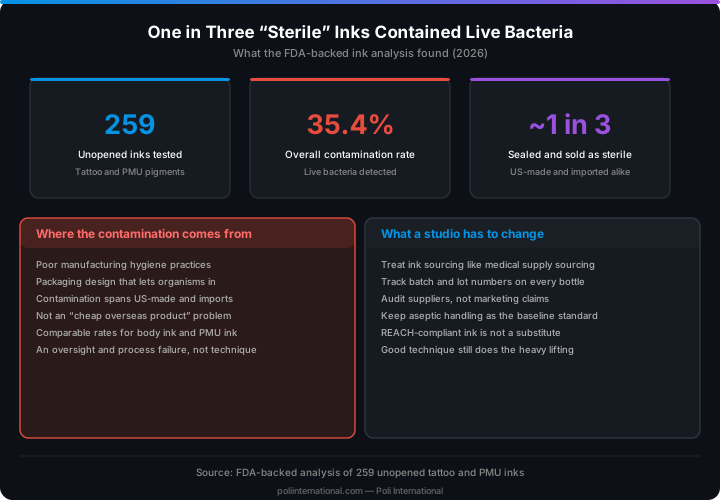
You’ve probably seen the headline by now: more than one in three tattoo inks tested contained live bacteria, even though they were sealed and sold as “sterile professional products.” A recent analysis from the US Food and Drug Administration looked at 259 unopened tattoo and permanent makeup inks and found an overall contamination rate of about 35.4%, with comparable rates for body tattoo inks and PMU pigments.Life Insider summary of the FDA analysis The punchline: contamination was present across both US-made and imported inks, so this isn’t a “cheap overseas” problem, it’s a manufacturing and oversight problem.
Mainstream coverage has turned this into a vague fear: “tattoos might be unsafe.” That’s lazy. The science is more precise and more useful. The bacteria found in these inks are opportunistic pathogens: they don’t magically leap into your bloodstream by existing, but if you inject them into compromised tissue during tattooing, you’ve just bypassed your skin’s barrier for them.New York Times overview on tattoo ink safety and bacterial findings The risk isn’t abstract; it’s a direct line from what’s in the bottle to infection, biofilm formation in the dermis, and more complicated healing.
This story also lands in an industry already under chemical scrutiny. The EU’s REACH regulations banned thousands of tattoo ink components and forced artists to switch brands, reformulate colors, and learn new behavior from pigments that weren’t designed for skin in the first place.BBC coverage of EU REACH tattoo ink restrictions So we’re now in a world where inks are being reformulated for chemical compliance while we’re only just discovering how many of those compliant inks are bacteriologically dirty. If you’re trying to run a safe studio, you’re basically being squeezed from both sides.
This is exactly why understanding the relationship between needle trauma, pigment vehicles, and dermal immune response matters more than ever, the interaction between needle geometry and dermal recovery determines how your client’s macrophages clear not just pigment, but any microbes hitching a ride.
---
2. Dirty Bottles vs Dirty Technique: Where the Real Risk Lives
Let’s separate the villains, because “infection” gets blamed on everything from bad aftercare to the moon being in retrograde.
At the simplest level, you’re dealing with two contamination vectors:
- Manufacturing contamination: bacteria already in the bottle before you ever crack the seal.
- Studio contamination: cross‑contamination from your hands, wash bottles, furniture, and setup.
The FDA study focused specifically on unopened inks, so we know manufacturing hygiene is a major issue.Life Insider summary of the FDA analysis That matters, because many artists treat “factory sterile” as a given and design their workflow around that assumption.
Here’s a clear way to think about it:
| Feature | Cleaner / REACH-Compliant Ink Line | Typical Legacy / Unknown-Provenance Ink |
|---|---|---|
| Regulatory focus | Designed around chemical limits (REACH, SCCS) and heavy-metal thresholds; increasing attention to microbiological testing. | Often focused on color performance and marketing claims; variable adherence to chemical and microbiological standards. |
| Sterility assurance | May include validated sterilization method, lot-based testing, and documented packaging controls; not all “sterile” labels equal. | “Sterile” or “professional grade” often used as marketing language without transparent test protocols. |
| Batch traceability | Formal batch numbers, recall-ready documentation, and published compliance claims. | Batch IDs may exist but rarely linked to public test data or recall history. |
| Contamination risk profile | Lower if manufacturing and packaging are controlled, but not zero. | Higher and harder to quantify; recent FDA data suggests meaningful rates of contamination even in “pro” products. |
| Studio handling assumptions | Designed with the expectation of aseptic technique, disposable cups, and needle systems that minimize backflow. | Often used in mixed workflows: reusing caps, topping off mid‑session, or sharing bottles across setups. |
A separate industry piece recently highlighted how some leading brands are positioning themselves as REACH‑compliant, sterile‑packaged, and batch-consistent, think of lines like Intenze’s Black Label roster emphasizing microbiological controls alongside pigment stability.Trade coverage of REACH-compliant ink rankings and sterile packaging claims That’s the direction we need: ink makers treating their filled bottles like medical devices, not art supplies.
For studios, the comparison table isn’t academic; it’s a purchasing roadmap. If you’re already tracking needle batch numbers and cartridge lot codes to protect clients, the same logic needs to apply to your ink shelf, exactly the kind of systems mindset I argued for when we looked at Karnataka’s tattoo ink crackdown and what studios needed to fix first.
---
3. The Technical Reality: How Bacteria Get in the Bottle (and into Your Client)
Let’s get specific. The FDA analysis reported contamination in roughly one-third of the 259 inks tested, with numbers around 33.3% for tattoo inks and 33.0% for permanent makeup inks, and very similar rates between US-made and imported products.Life Insider summary of the FDA analysis That suggests the problem isn’t one rogue factory; it’s systemic across how we manufacture and package pigments.
Likely contamination routes:
- Water phase issues: Many modern inks are water-based or water-heavy. If the water supply isn’t controlled to pharmaceutical standards, any biofilm in the system can seed the ink.
- Pigment and additive handling: Poorly cleaned mixers, pigment feed systems, or transfer lines can carry residual microbes from batch to batch.
- Filling and packaging: The moment you move ink into bottles, every surface contact is an opportunity. Unvalidated “clean rooms” and casual GMP are how bacteria end up sealed in with the product.
- Fake sterility claims: “Sterile” printed on the label doesn’t mean the ink went through validated sterilization (gamma, EtO, or appropriate filtration). Sometimes it just means the bottles looked clean when they left.
From a clinical perspective, what happens when contaminated ink meets tissue is ugly but straightforward. Tattooing creates a controlled injury: needles pierce the epidermis and upper dermis, delivering pigment in a suspension vehicle. If that vehicle carries a moderate bacterial load, you’ve just injected that load deep enough to bypass most surface defenses. Depending on the species and the client’s immune status, you get:
- Localized infection: redness, swelling, heat, pain, possibly pustules or abscess formation.
- Delayed or chronic healing: low-grade biofilms that keep the tattoo “angry” for weeks.
- Systemic risk: in extreme cases or in high-risk clients (immunocompromised, vascular disease), bacteria can spread beyond the tattooed area.
The irony is that artists have spent years being lectured about needle sterility and cross‑contamination, while manufacturing hygiene for inks has been left in a regulatory grey zone. The same regulators who can quote REACH SVHC thresholds for heavy metals often haven’t demanded equally hard microbiological specifications for pigments.BBC coverage of EU REACH tattoo ink restrictions
For studios, the practical implications are blunt:
- Treat ink brands like you treat needle manufacturers: demand lot documentation, microbiological testing data, and recall history.
- Prefer inks that are not just “REACH-compliant” but explicitly validated for microbial load, with clear sterilization claims tied to methods, not just labels.Trade coverage of REACH-compliant ink rankings and sterile packaging claims
- Build an internal log: which lot was used on which client. It feels tedious until the day you need to track down a cluster of reactions.
- Keep your own aseptic discipline tight. A clean bottle from the factory is still useless if your wash bottle and glove discipline are sloppy, the same logic that governs how needle taper and cartridge design influence trauma and contamination risk.
---
4. Patrick’s Note: The Spec That Lies
The “sterile” line on the bottle is the spec that lies. It’s printed in a nice font and everyone quietly pretends it means “you can stop thinking now.” It doesn’t. It means “the marketing department thinks you’ll feel safer if they write this word.”
According to coverage of the FDA analysis, contamination was found in inks that were sealed, professional-grade, and presented as safe products for direct injection into human tissue.Life Insider summary of the FDA analysis That’s not an artist problem, that’s a supply-chain problem, and it behaves exactly like every other time regulators chase chemical risk and forget microbiology. We’ve already watched something similar with flexible polymers, where “temporary use only” labels were written around TPU behaviour and then lazily slapped onto PP-R materials that don’t share that profile, as I broke down in detail in the piece on phthalates and the new EU test methods that quietly raised the bar for body art materials.
From my side of the fence, manufacturing, I can tell you this: making truly safe body art materials isn’t mystical. It’s boring, disciplined process control. You validate your water system, you validate your mixing line, you validate your cleaning steps, and you treat every filled unit as if it’s going into someone’s bloodstream. The gap between that mindset and “art supply in a colourful bottle” is where your infection cases live.
If you’re in the chair end of this, tattooist, PMU tech, studio owner, you don’t have to become a microbiologist. You just have to stop treating the spec line as sacred. Ask ink suppliers basic questions: “What’s your microbial limit per millilitre? How do you sterilize? How do you test?” If the answer is hand‑waving, that brand doesn’t belong on your shelf. And if that sounds harsh, remember: you’re the one your client will blame when the “sterile” bottle wasn’t.
---
5. FAQ: Technical Q&A
Q: Should I be worried that my existing tattoos were done with contaminated ink?
If your tattoos healed normally, no prolonged redness, swelling, pus, or systemic illness, the odds are you’re fine. The concern is primarily for new work done with contaminated batches and for clients with compromised immune systems. The headline isn’t “all tattoos are dangerous”; it’s “some inks on the market aren’t manufactured to medical standards.”
Q: As a studio, what’s the single most effective step I can take on Monday to reduce this risk?
Start documenting ink lots and suppliers as rigorously as you document needles and sterilization. Pick one shelf, one brand, and write down batch numbers tied to dates and clients. From there, move your purchasing toward manufacturers who publish compliance data and sterilization methods, not just colour charts. When regulators or clients come asking, that paper trail is your shield, the same logic used when I argued for tracking pigment sources in the Karnataka ink crackdown analysis.
Q: Do REACH-compliant or “EU-safe” inks guarantee no bacteria?
No. REACH focuses on chemical safety, carcinogens, sensitizers, heavy metals, not directly on bacteria. An ink can be chemically compliant and still bacterially dirty if the factory treats microbiology as an afterthought. REACH-compliant lines that also invest in sterilization and batch testing are better bets, but you still need to check their microbiological claims and handle them aseptically in the studio.
---
Conclusion: Treat Ink Like a Medical Device
If one-third of unopened inks in a major FDA study carried live bacteria, the old assumption that “factory-sealed ink equals safety” is dead. What protects your clients now is a combination of better manufacturing, smarter purchasing, and tighter studio protocol, not comforting words on a label. The artists and owners who take this seriously will be the ones still working when the next round of recalls and regulations hits.
The practical move is simple: treat every pigment bottle as a medical device with a batch history, not a paint pot. Track lots, interrogate suppliers, and build your workflow around inks that can prove both chemical and microbiological safety, the same systems mindset we’ve already had to adopt for phthalate-tested, biocompatible body art materials in the EU era.