
Why the LemonLime “Tattoo for a Job Interview” Stunt Should Worry Every Studio
Key Takeaways:
» A startup offered guaranteed interviews in exchange for getting tattooed at a company event, blurring the line between consent and coercion.
» Ethically, any tattoo done under hiring pressure is compromised consent, even if the client signs a waiver.
» Technically, event tattoos stack all the worst risk factors: rushed decisions, unknown aftercare, and high odds of regret and removal.
» Studios should treat “corporate activation” gigs as high‑liability work and design strict screening and cooling‑off protocols.
» Clients should never let employment, clout, or peer pressure be the main reason a needle hits their skin.
---
1. The Background: When a Job Offer Shows Up With a Needle
A San Francisco AI startup, LemonLime, landed in hot water after reports that attendees at a company event were offered guaranteed job interviews if they got tattooed on the spot by a live artist at the venue. Several people did exactly that, the internet caught fire, and the founder publicly walked it back, insisting it was meant as a fun “free tattoo” perk and that interviews were “available to all candidates” whether they got inked or not (and that they’d pay for removals for anyone who regretted it later).
Strip the PR language away and what you have is simple: employment-linked body modification. You show up hoping to improve your career prospects; the environment says the brave, committed ones get tattooed now. That is not the same mental state as someone who walked into a studio after months of thinking about a design. Even if nobody said “no tattoo, no job,” the implied pressure hits exactly the same circuits as the worst “my boyfriend says I have to get his name” piercings.
This story isn’t about whether tattoos are professional. That ship sailed years ago; visible ink is normalization-in-progress in offices worldwide. It’s about turning a permanent, invasive procedure into a corporate branding exercise tucked between free drinks and networking. We already know from the science behind decision-making under social pressure and acute stress that people radically underestimate future regret in these environments, in exactly the same way they misjudge the consequences of impulsive large tattoos or extreme placements seen in viral trends. If you want a case study in why cooling‑off periods and informed consent matter, this is it, and it should make studios think very hard about the gigs they accept.
---
2. Why “Event Tattoos” Are a Perfect Storm for Regret
Let’s park the ethics for a moment and look at the engineering and clinical side of what happens when you move tattooing from a studio into a hype‑driven event with a hiring hook attached.
The risk profile shifts because three levers get pushed the wrong way at once:
- Time pressure – decisions made in minutes, not weeks.
- Cognitive load – networking, noise, alcohol, and social signalling all competing with “do I want this on my body forever?”.
- Power imbalance – the company controls access to opportunities; that distorts consent even if nobody says the quiet part out loud.
Clinically, the tattoo needle does not care whether you’re hyped by a startup, a bachelor party, or a festival activation. The physics are the same: thousands of high-velocity needle penetrations delivering pigment into the dermis, creating a controlled injury that your immune system must repair. We’ve already looked at how the relationship between needle geometry and dermal trauma affects healing speed and scarring in detail in the piece on the relationship between needle taper angle and dermal cellular regeneration speed. That biology doesn’t pause because there’s a corporate logo on the wall.
Here’s how “event tattoos” stack up against normal shop conditions:
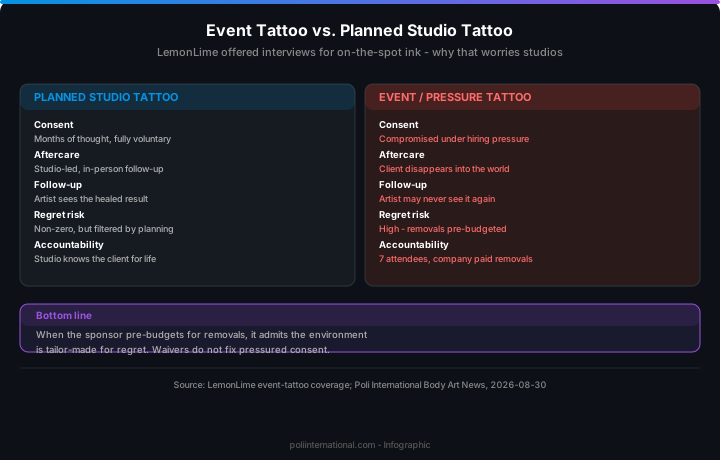
| Feature | Normal studio appointment | Corporate / hype event tattoo |
|---|---|---|
| Decision time | Days to months; often multiple consults, redraws. | Minutes to an hour, often “in the moment.” |
| Motivation | Personal meaning, aesthetic, long-term identity. | Social proof, perceived career benefit, group pressure. |
| Environment | Controlled, quiet, infection‑control optimized. | Mixed-use venue, distractions, variable sanitation control. |
| Aftercare control | Clear instructions, direct line to artist and studio. | Client disappears into the world; artist may never see them again. |
| Regret/removal likelihood | Non-zero, but filtered by the planning process. | Dramatically higher; the company already offered to pay for removals. |
The punchline is in that last row: the startup reportedly contacted all seven tattooed attendees and offered to cover full tattoo removal costs for anyone who regretted the decision. When the sponsor pre‑emptively budgets for removal, it’s admitting the environment is tailor-made for regret. From a risk‑management perspective, that’s like seeding car keys around an open bar and keeping a standing account with a tow yard.
For studios, this is the real technical point: the same needle depth, stroke, and pigment load that heal beautifully under stable conditions become far more likely to yield irregular outcomes when the client disappears into random aftercare, stress, poor sleep, and travel. If you wouldn’t be comfortable never seeing a healed photo and never doing a touch‑up, you shouldn’t be doing that kind of gig.
---
3. The Clinical and Regulatory Angles: Consent, Injury, and Removal
Let’s talk about what’s actually at stake in the skin and in the paperwork.
1. Informed consent under pressure is not informed consent.
Most jurisdictions that regulate tattooing don’t yet have a separate concept for “coercive non-medical body modification,” but the logic is borrowed from medicine: if your decision is materially distorted by fear of losing something important (like a job), consent is compromised. A signed waiver doesn’t magically fix that. A solid consent document spells out:
- That the procedure is permanent, with removal involving multiple sessions, pain, and possible scarring.
- That the decision is entirely voluntary, with no benefits withheld if you decline.
- That you understand complication risks: infection, allergic reactions, scarring, pigment migration, and how these interact with your medical history.
If your corporate client balks at inserting “your chances of working here do not change whether you get tattooed or not” in plain language, you already have your answer.
2. The injury is invasive, and regulators know it.
Tattoo inks are still treated as cosmetics in many countries, but regulators are increasingly acknowledging that injectable colorants behave more like implantable materials than surface products. The EU’s REACH framework and proposed updates focus on carcinogenic and sensitizing components in pigments, and the FDA has already overseen recalls when inks were contaminated with bacteria capable of causing systemic infection. That means every event piece you do is not just “body art” but a permanently implanted, regulated chemical system you are delivering into someone potentially making an impaired decision.
When I talk about polymer jewellery and inks, I always come back to the same principle: materials live in bodies for years, so regulation must be built around long‑term biocompatibility and low impurity levels. That’s exactly why we’ve written at length about how new EU phthalate test methods changed expectations for body art materials in the analysis of phthalates and shifting EU test standards. Treat your inks with the same seriousness, if they’re going into skin under questionable consent, the ethical problem doubles.
3. Removal isn’t a magic Undo button.
Laser removal works by shattering pigment particles into smaller fragments that the immune system can clear. This is not cosmetic erasing; it’s a second, extended injury and an accelerated pigment redistribution experiment on the client’s lymphatic system. Multiple sessions, photothermal damage to the surrounding tissue, and altered skin texture are normal, especially with large or densely packed designs. Any company breezily offering to “cover removal” is effectively saying, “we’ll run you through a multi‑session laser protocol because we didn’t build a cooling‑off period into our event.”
Clinically, the worst combination is high-contrast, saturated pigment done fast on a stressed client, then hit with high‑fluence laser under the same impatience. Studios who find themselves in these setups should insist on:
- A minimum design size and simplicity for any corporate tattoo, so removal is realistically achievable.
- A written explanation that “free removal” still means multiple sessions, possible textural change, and discomfort.
If the brand wants billboard‑sized ink and “don’t worry, we’ll pay to erase it,” walk.
4. Studios’ liability is real.
The startup’s PR crisis will cycle out of the news. Your studio’s malpractice risk won’t. If a client later argues they wouldn’t have consented without the implied job benefit, you don’t want to be the one holding the needle with a paper trail that shows no independent screening. At minimum:
- Make your own consent form, independent of the event’s waiver.
- Document that no compensation, employment, or benefit depends on getting tattooed.
- Give out aftercare instructions with your studio’s contact, not just the event’s brand.
This is the same logic we apply when we warn practitioners about the hidden liabilities of poor-quality sports jewellery and how it shifts injury risk onto the studio in the piece on sports piercings and how metal hardware fails athletes during impact. The environment changes; your legal exposure does not.
---
4. Patrick’s Note: The Spec That Lies
Every tattooist knows the client who walks in saying, “I’m not sure what I want, but I have a coupon.” This is the same story in a more polished suit: instead of a discount code, it’s a tacit promise of career access. I don’t care how nice the branding deck is, once skin is involved, you’re the only adult in the room whose job is not to sell anything. If the brief smells like “activation,” assume the consent is already tilted and you will be the one cleaning up when the hype wears off.
This is exactly why I get so loud when flexible jewellery gets written off as “temporary” because someone copied a label meant for TPU and pasted it onto a completely different polymer class. The spec on the bag says one thing, the real‑world performance says another, and the client pays for the mismatch. We broke that down in the article on how EU phthalate-driven labelling miscast long-term safe PP‑R jewellery as ‘healing only’. The same pattern is happening here: “it’s just a fun perk” on the invite versus “permanent alteration plus potential laser removal” in clinical reality. When those two diverge, pick the side of the skin every time.
---
5. FAQ: Technical Q&A
Q: If a company offers me a guaranteed interview for getting a tattoo, is that ever a good idea?
No. If the main reason you’re getting tattooed is a job lead, the decision is already compromised. Interviews come and go; the ink and potential removal scars don’t. If you love the design enough that you’d get it with zero career benefit attached, book it later at a normal studio on your own terms.
Q: I’m a tattooist and got invited to work a corporate event. How do I make it safer?
Insist on a written agreement that explicitly states employment or benefits do not depend on getting tattooed, and use your own consent forms in addition to anything the company provides. Limit designs to small, simple pieces with low removal complexity, enforce a clear no‑alcohol rule for clients, and provide full aftercare with your own contact details. If the organizer pushes back on any of that, decline the job.
Q: Is offering to pay for tattoo removal enough to make this ethical?
No. Removal is not a “refund”; it’s a second, more complex medical-grade procedure with pain, multiple sessions, and possible scarring or textural change. Covering costs is better than abandoning people, but it doesn’t cancel the original problem: you encouraged permanent procedures under social and professional pressure. The only ethical version is one where declining the tattoo is genuinely consequence‑free and clearly communicated.
---
Conclusion: Keep Needles Out of the Hiring Funnel
The line is simple: tattoos and piercings are personal decisions, not HR tools. The moment career prospects, social clout, or corporate loyalty tokens start steering the needle, consent is distorted and the risk of regret and removal shoots up. Artists and studios have more power than they think here, if enough of you refuse these gigs unless they’re run like real clinical procedures instead of party tricks, the stunt dies on the planning board.
Clients, if you remember nothing else, remember this: if someone is offering you work, money, or status in exchange for letting them alter your body, treat that as a red flag, not a perk. The skin you keep is worth more than any interview slot. For a deeper look at how regulatory shortcuts and mislabelling can quietly shift risk onto the person in the chair, revisit the analysis of phthalates, EU test changes, and what “temporary use only” really meant for body art materials.


