Why the Freckle-Sized Tattoo Story Blew Up, And What It Gets Wrong About Risk
Key Takeaways:
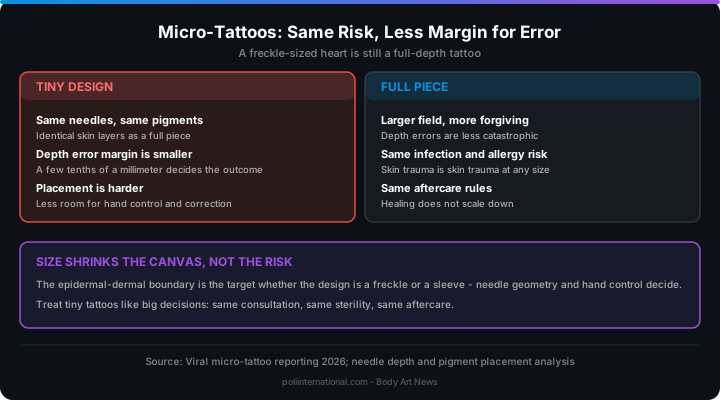
» Micro-tattoos use the same needles, pigments, and skin layers as full pieces, the risk profile is identical.
» “Freckle-sized” designs are harder to execute safely because margin for error in depth and placement is smaller.
» High price for tiny tattoos reflects time, sterile prep, and expertise, not ink volume.
» Poor aftercare on a micro-tattoo can still cause infection, blowout, or scarring, even if the design is barely visible.
» Studios should treat viral micro-trend clients as high-education appointments, not quick cash grabs.
---
1. The Story: A Freckle-Sized Heart, a Viral Price Tag, and a Giant Misunderstanding
Over the last two weeks, one story has dominated tattoo discourse: a TikTok-famous artist going viral for inking a freckle-sized heart tattoo on a client’s shoulder, with the price tag causing mass outrage in the comments and think-pieces across lifestyle news.Tattoo Artist Goes Viral for Inking a Freckle-Sized Heart The video pulled tens of millions of views and ignited the same old debate: “It’s tiny, how can it cost that much?” and worse, “It’s so small, it’s basically risk-free.”
The core misunderstanding is simple: people treated this micro-tattoo like beauty service pricing, a lash fill, a brow wax, a single freckle of pigment, something intuitive and proportional to size.Think Before You Ink: Tattoo Safety In reality, that freckle-sized heart crosses the same epidermal–dermal boundary, uses the same machine, runs the same infection risk, and demands the same sterile protocol as a full forearm piece. The only thing that shrank was the silhouette on the skin, not the clinical footprint.
There’s also a hidden technical point: minuscule tattoos are less forgiving. A 0.5 mm deviation in depth on a tiny heart is a much bigger proportion of the design than the same deviation on a large piece. That makes needle geometry and hand control more critical, not less, the same way micro lettering is harder than big block script. The same engineering logic that governs the relationship between needle taper angle and dermal cellular regeneration speed applies to micro-tattoos: the physics do not scale down just because the design does.
---
2. What Actually Drives Price and Risk in Micro-Tattoos
The comments under the viral clip split into two camps: “It’s a scam, it’s just a dot,” and “You’re paying for the artist, not the ink.” Both are missing the actual cost structure, which is clinical and logistical, not artistic ego.Tattoo Artist Goes Viral for Inking a Freckle-Sized Heart
Here’s the reality:
- Sterile prep is a fixed cost.
Whether you tattoo one freckle-sized heart or a full sleeve, you still need a sterile field, single-use needles, barrier film, disinfected surfaces, and proper hand hygiene.Think Before You Ink: Tattoo Safety
- Clinical risk is not proportional to design size.
A tiny tattoo can still deliver pigment too deep, cause blowout, trigger allergic reaction to ink components, or become infected if aftercare fails.Think Before You Ink: Tattoo Safety
- Time spent is not just machine time.
Consultation, placement discussion, consent forms, skin assessment, and aftercare explanation take almost the same time for a micro-heart as for a larger, simple piece.
To make this very concrete:
| Feature | Micro “Freckle Heart” Tattoo | Standard Small Symbol (e.g., 3–4 cm) |
|---|---|---|
| Sterile setup time | ~10–15 minutes | ~10–15 minutes |
| Machine-on time | ~1–3 minutes | ~10–20 minutes |
| Clinical risk profile | Identical: bloodborne exposure, infection, allergy | Identical: bloodborne exposure, infection, allergy |
| Depth tolerance window | Very narrow; small error dominates design | Slightly more forgiving; micro deviations less visible |
| Price logic | Minimum session fee, not per-mm pricing | Minimum fee or time-based pricing |
| Aftercare demands | Full tattoo aftercare, despite tiny area | Full tattoo aftercare |
So when people say, “It’s a dot, why isn’t it cheap?” they’re implicitly assuming tattoo pricing works like ink per millilitre instead of risk per procedure. That’s not how healthcare works, and tattooing lives closer to minor medical procedure logic than to cosmetics. This is the same mismatch that shows up when clients assume one needle grouping equals one level of trauma, ignoring how different tattoo needle types change how quickly skin can recover regardless of how large the artwork is.
---
3. The Technical Reality: Needles, Depth, Pigment, and Regulatory Concerns
Let’s strip the aesthetics and look at the engineering. That viral micro-heart is essentially a single-pass dermal pigment insertion over a tiny area. The concerns are the same five we talk about in serious studio practice:Think Before You Ink: Tattoo Safety
1. Insertion Depth and Dermal Targeting
Whether you’re doing a freckle or a full back piece, the goal is the same: deliver pigment to the upper dermis so it’s stable, legible, and less likely to blow out.Think Before You Ink: Tattoo Safety In a micro-tattoo:
- Your margin for depth error is tighter.
- Slightly too shallow = rapid fading.
- Slightly too deep = blowout that can visually overwhelm a tiny design.
This is where tool selection matters, the same physics that dictate the choice of taper length for minimizing dermal trauma now decide whether that tiny heart stays crisp or turns into a fuzzy dot.
2. Pigment Chemistry and Allergy Risk
No ink manufacturer offers a “micro-tattoo-safe” pigment line. It’s the same dispersions, same carriers, same potential allergens, metal salts, azo dyes, preservatives, solvents.Think Before You Ink: Tattoo Safety A freckle-sized heart:
- Might use less volume, but
- Still introduces foreign material past the skin’s barrier.
- Can still trigger local reaction or systemic response in sensitized individuals.
Regulators like the FDA explicitly warn that even small tattoos can cause itching, swelling, and long-term complications if ink is contaminated or poorly tolerated.Think Before You Ink: Tattoo Safety
3. Infection Control and Aftercare
A tiny entry point is still an entry point. In microbiology, surface area isn’t the only factor; breach integrity matters. Post-tattoo:
- That micro-heart is an open wound until re-epithelialization completes.
- Contact with sweat, cosmetic products, unwashed hands, or gym equipment can seed bacteria.
- A small, localized infection can disproportionately distort a small design.
The FDA’s consumer guidance makes no distinction between large and small pieces in terms of infection risk, they list the same aftercare and alert signs.Think Before You Ink: Tattoo Safety
4. Regulatory and Documentation Burden
Regardless of size, studios should be recording:
- Ink brand, color, and batch/lot number
- Needle type and configuration
- Date and aftercare instructions given
That documentation is what ties into adverse event reporting if a client reacts.Think Before You Ink: Tattoo Safety Treating micro-tattoos like “casual extras” with no paperwork is not just naive, it’s non-compliant where local health authorities treat tattooing as a regulated procedure.
5. Longevity and Retouch Risk
Micro pieces fade faster because any loss of edge contrast is a larger proportion of design clarity. When a client returns for a touch-up:
- You are now working over previously altered tissue.
- Scar micro-architecture may have changed ink distribution.
- Combining misaligned passes can create permanent blur.
From a tissue engineering standpoint, the healing load has a minimum, there is no real discount for small area once you’ve crossed the barrier. This is the same logic behind why, in piercing, we don’t treat a single “tiny helix” as clinically disposable: the cartilage still takes full damage and needs full support, which is why I’ve pushed hard for BioFlex® jewelry designs that reduce mechanical stress on fresh piercings.
---
4. Patrick’s Note: The Counter-Intuitive Tiny Thing That’s Not Low-Risk
The thing practitioners miss here is deceptively simple: the smaller the mark, the more the client will treat it like makeup. That’s the real hazard, not the heart shape or the price.
When I watch this freckle-heart discourse, I see studios trapped between market pressure and clinical reality. Social media rewards “quick, cute, tiny”, the one-minute procedure you can loop over a trending sound. But your autoclave cycle doesn’t care how cute the tattoo is. Your ink chemistry doesn’t care. Your client’s immune system doesn’t care. The mainstream narrative about “tiny equals trivial” is both wrong and dangerous.Think Before You Ink: Tattoo Safety
My honest take: if you’re going to lean into micro pieces, you should be the most boring, clinical, and uncompromising shop on sterile protocol and documentation for them. Charge a minimum that actually covers setup, give aftercare that treats that dot like a full tattoo, and explain to every client that the decision they’re making is about lifetime pigment in their dermis, not a cosmetic stamp. Precision thinking about procedure risk should be at the heart of how you respond to every viral trend, especially the deceptively small ones.
---
5. FAQ: Technical Q&A
Q: Does a freckle-sized tattoo heal faster than a regular small tattoo?
No. Healing speed is determined by depth, trauma, and individual biology, not design diameter. A well-executed micro-tattoo can heal cleanly in the same timeframe as a small wrist piece, but if depth control is off or aftercare is sloppy, that tiny heart can take just as long, or longer, to settle because any distortion is proportionally larger.Think Before You Ink: Tattoo Safety
Q: Is it reasonable to charge a minimum session fee for a single micro tattoo?
Yes. The studio’s fixed costs, sterilization, consumables, documentation, and time, don’t disappear when the design shrinks. Pricing by square centimetre of ink would incentivize cutting corners on sterile prep; pricing by procedure keeps the focus on safe work, not volume. The viral outrage is a perception problem, not a pricing problem.Tattoo Artist Goes Viral for Inking a Freckle-Sized Heart
Q: Are micro-tattoos riskier in terms of blowout or fading?
They are less forgiving, which functionally increases risk of a disappointing outcome. The same millimetre of blowout that’s barely noticeable on a large script can visually swallow a freckle-sized heart. To keep micro pieces crisp, artists need tight needle control, stable hand position, correct depth, and appropriate pigment load, the same technical discipline we talk about when optimizing needle geometry to reduce dermal trauma and preserve edge definition.Think Before You Ink: Tattoo Safety
---
Conclusion: Treat Tiny Tattoos Like Big Decisions
If there’s one lesson from the freckle-sized heart going viral, it’s this: design size is not a risk discount. Clients are making lifetime skin decisions in a social environment that treats them like “just a cute dot,” and studios have to be the grown-ups in the room, clinically, technically, and economically.
The smart way forward is simple: minimum fees that respect sterile setup, unapologetic explanations of risk, and aftercare that treats a micro-heart like the tattoo it is. If you anchor your practice in the same kind of material and tissue-level thinking that drives better healing outcomes with BioFlex® body jewelry and precision-engineered tools, you can ride the trend without letting social media dictate your safety standards.