Why the Internet’s Favorite Raccoon Is Now on People’s Bodies, and What That Means Clinically
Key Takeaways:
» Viral character tattoos spike fast, then age badly when the meme cycle moves on.
» Pigment choice and needle geometry matter more to long-term appearance than the reference image.
» Fine-line “cute” raccoon tattoos are structurally prone to blurring within 3–5 years if executed poorly.
» Client screening and cooling-off protocols cut regret rates on trend tattoos dramatically.
» Artists need written policies for fan-art and viral IP to stay legally and ethically safe.
---
1. The Story: Jimothy the Raccoon Jumps from Feed to Skin
The standout body art story in the last two weeks is the explosion of the “Jimothy” raccoon tattoo trend, a viral cartoon trash-panda that jumped from social media darling to permanent ink in a matter of days. A recent feature described the “Jimothy tattoo trend” as having “exploded” after the raccoon character took the US by storm, with studios suddenly fielding waves of requests for the same stylized raccoon motif and its catchphrases.New York Post coverage of the viral Jimothy raccoon tattoo trend
On TikTok and Instagram, you can now scroll through endless clips of fresh Jimothy tattoos: tiny linework raccoons on ankles, full-color chest pieces, and matching couples tattoos captioned with “trash but make it aesthetic.” Reddit threads in r/tattoos and r/bodymodification have already moved from “this is cute” to “are we going to regret this in two years?”, which is exactly the right question.Reddit discourse on viral character tattoos and regret in r/tattoos
The coverage frames this as harmless fun: raccoon goes viral, fans get tattoos, everyone laughs. The engineering reality is sharper. When a single, recognisable, meme-driven character gets tattooed at scale in a short window, three things follow like clockwork:
- Regret concentration: a wave of people wanting cover-ups 3–5 years later, often with significant scarring from rushed original work.
- Quality spread: high-end artists producing beautiful adaptations, and low-skill studios pushing fast, underpriced copies with poor line stability and ink choice.
- Legal and ethical grey zones: fan-art versus direct IP reproduction, especially when the character is monetized by someone else.
That last point matters as much as the aesthetic one. When you tattoo a viral character, you’re not just making art, you’re fixing someone else’s brand into living tissue, with all the durability and failure modes that implies. The interaction between tattoo ink chemistry and dermal healing dynamics doesn’t care whether the subject is a raccoon or a rose; trends just compress all the usual risks into a smaller, more visible time frame.
---
2. What Happens to a Jimothy Tattoo in Real Skin?
Most of the viral Jimothy tattoos fall into two categories: fine-line black/grey and flat, saturated color with minimal shading. Those two approaches age very differently.
Here’s the practical breakdown:
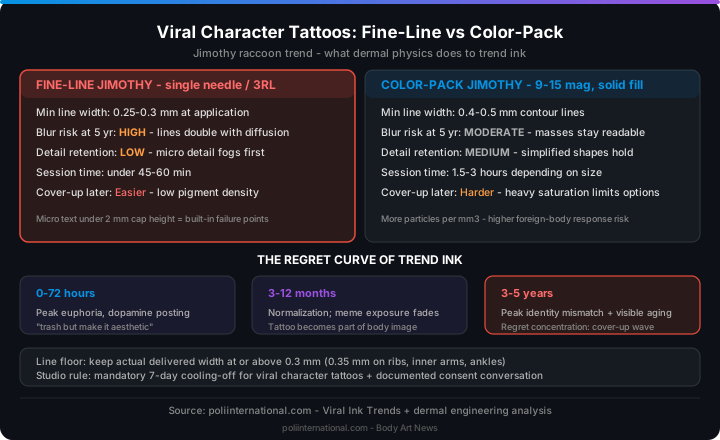
| Feature | Fine-Line Jimothy (single needle / 3RL) | Color-Pack Jimothy (9–15 mag, solid fill) |
|---|---|---|
| Minimum line width | ~0.25–0.3 mm at application | ~0.4–0.5 mm contour lines |
| Blur risk at 5 years | High: lines can double in apparent width with normal dermal diffusion | Moderate: outlines blur, but color masses stay readable |
| Detail retention | Low: tiny whiskers, garbage bag wrinkles, micro text fade first | Medium: simplified shapes remain recognizable |
| Pigment load per cm² | Low; fewer particles, more dependence on precise placement | High; redundancy in pigment deposit masks minor migration |
| Session time | Short; often under 45–60 minutes | Longer; 1.5–3 hours depending on size and detail |
| Cover-up difficulty later | Easier; low pigment density, smaller footprint | Harder; heavy saturation limits future options |
On paper, fine-line raccoons look delicate and “minimalist.” In practice, dermal architecture does not respect minimalism. The collagen matrix and macrophages in the dermis will slowly redistribute pigment over years; that’s why micro text and ultra-fine illustrative detail are the first things to turn to fog.Clinical observations on fine-line tattoo diffusion over time
When you do a fine-line raccoon with:
- very small eye highlights,
- tiny whisker lines,
- micro-script catchphrases under 2 mm cap height,
you are building failure points into the design. The skin will do what it always does: heal, remodel, and gently smear that precision. The raccoon will still be there, but it will look less like the TikTok clip and more like a soft, out-of-focus icon.
Color-pack Jimothy pieces fare better visually because they rely on macro contrast: big shapes, clear silhouettes, strong value separation. Even if lines blur, the mass of pigment keeps the character legible. That said, high saturation comes with its own engineering issues: more particles per cubic millimetre mean higher chances of localized foreign-body response, especially with lower-grade reds and oranges, and more complex cover-ups if the client decides they never want to see this raccoon again.
From a materials standpoint, the choice of pigments and carrier matters more than the meme, just as the difference between carbon black and titanium dioxide in blackwork tattoos matters more than the specific design. If you’re packing Jimothy with cheap, high-heavy-metal content inks because “it’s just a trend piece,” you’re missing the point: the trend will die, but the ink chemistry will keep interacting with the client’s immune system indefinitely.
---
3. Engineering Reality: Pigment, Healing, IP, and Regret Windows
Let’s get precise.
Line stability thresholds
For a character like Jimothy, anything under ~0.25 mm actual delivered line width is functionally unstable in normal skin over a 5–10 year window. On the chest, inner arm, and ribcage, areas with more stretch and movement, that threshold climbs towards ~0.35 mm. The dermal cell turnover and mechanical stress from daily motion accelerate the apparent thickening and diffusion of tiny lines. The relationship between needle taper angle and dermal cellular regeneration speed is directly relevant here: steeper tapers and longer points deliver pigment in a narrower vertical column that’s more easily disturbed by remodeling.
Pigment chemistry and long-term colour
- Blacks and greys: Prefer carbon black-based formulations with verifiable low PAH (polycyclic aromatic hydrocarbon) contamination and documented heavy metal limits. These will hold silhouette and contrast longer with less unwanted hue shift.
- Raccoon browns and warm tones: This is where many trend tattoos are quietly compromised. Cheap brown is often just a badly balanced mix of yellow, red, and black, meaning more individual risk factors. High iron oxide browns with low impurity profiles behave far better clinically, but cost more.
If your raccoon has warm trash-bag tones, streetlamp glow, or “cute blush,” that’s additional pigment complexity. With questionable inks, you get more unexpected darkening, muddying, or localized reactivity around those zones, the exact spots clients focus on when they decide the tattoo “just looks wrong now.” Tattoo regret is seldom purely psychological; the skin is doing its own editing.
Regret window and cooling-off
Trend-driven pieces like Jimothy have a distinctive regret curve:
- 0–72 hours: Peak euphoria, dopamine-laced posting, “we’re trash together” captions.
- 3–12 months: Normalization; meme exposure declines, the tattoo becomes another part of the body image.
- 3–5 years: Peak mismatch between current identity and past trend, compounded by visible aging of fine detail.
Clinically and ethically, that suggests a simple rule for studios:
- For any viral character or catchphrase tattoo, implement a mandatory cooling-off period of at least 7 days between consult and appointment, unless the client already has a pattern of character tattoos and understands the trajectory.
- Document that you’ve had a conversation about trend lifespan, future cover-up complexity, and line aging, not just design placement.
This is not bureaucratic theatre; it’s the same logic behind asking clients to think through multi-session blackout or heavy saturation pieces before they commit. A raccoon seems small, but the combination of recognisable IP and long-term dermal behaviour makes it a more serious decision than most people’s For You Page would suggest.
IP, fan-art, and legal exposure
The viral coverage glorifies “everyone getting Jimothy,” but ignores the IP layer. If the raccoon is a monetised character, the owner has rights over reproduction, including in tattoo flash. Practically, most IP holders will never chase individual clients. They’re more likely to respond if you:
- advertise “official Jimothy tattoos,”
- sell pre-designed sheets and merch featuring the character,
- use the character in your studio branding.
Avoid framing your work as official or licensed unless it actually is. Stick to interpretations and clearly label them as such. From an engineering standpoint, your job is skin; from a legal standpoint, your client shouldn’t discover your enthusiasm crossed a line only when a cease-and-desist email arrives.
---
4. Patrick’s Note: The Counter-Intuitive Thing About “Cute” Tattoos
The thing practitioners miss here is simple: the cuter and more minimal a character tattoo is, the less room you have for the skin to do what skin does. The raccoon looks harmless because it’s small and funny; the engineering problems hide behind its charm.
When I look at the flood of Jimothy tattoos, what jumps out isn’t the raccoon, it’s the line economy and pigment choices. You can see exactly which pieces will blur into soft blobs and which have enough structural thickness to survive. When people talk about “trend tattoos aging badly,” they treat it like a taste issue. It’s not just taste. It’s line width thresholds, pigment particle size distributions, and how the design handles the inevitable diffusion that follows. It’s the same hard lessons people learn when a delicate white-on-black detail collapses because the titanium dioxide load in white ink interacts badly with scar tissue in blackout work.
My honest take: if you’re a studio owner, you should have a written trend policy pinned somewhere your staff cannot ignore. It should spell out minimum line weights for character tattoos, acceptable pigment sets, and mandatory cooling-off for overtly viral designs. Clients think in memes and moods. You have to think in circulating macrophages, collagen remodelling, and what that raccoon will look like on a real forearm in 2031. The gap between those two viewpoints is where most regret lives, and it’s your job to close it before the needle touches skin.Poli Journal’s discussion of blackout saturation and client communication in heavy ink load work
---
5. FAQ: Technical Q&A
Q: What minimum line size should I use on a small Jimothy-style character to keep it readable over time?
Stay above 0.3 mm actual delivered line width for facial features and key outlines, and closer to 0.35–0.4 mm on high-motion areas like ribs, inner arms, and ankles. That usually means stepping up from single-needle or 3RL to a slightly larger grouping and adjusting your hand to accept the bolder look. Below those thresholds, normal dermal diffusion will erase character detail in under a decade.
Q: Are ultra-fine “micro Jimothy” tattoos (like freckle-sized raccoons) clinically safe or just aesthetic risk?
They are mostly an aesthetic and readability risk, not inherently more dangerous clinically, provided the ink is clean and depth control is solid. The tiny footprint limits total pigment load, which is biologically modest. The real issue is that clients think they’re getting a permanent crisp micro-icon, when the physics of pigment dispersion guarantee softening and distortion. You need to explain that a freckle-sized raccoon will eventually look more like a vague dot than a character.
Q: How should I handle clients who show up wanting a viral character they clearly might regret?
Treat it as a structured consent conversation. Explain the trend lifespan, how their skin type and placement will affect aging, and what cover-up options look like in 5–10 years for that design. Offer a sketch that’s less literal and more symbol-based, or integrate the character into a larger composition that can be adapted later. If they still want the pure character, enforce your studio’s cooling-off period and minimum technical standards; you’re not obligated to do technically unsound work just because it’s popular.
---
Conclusion: Design for the Skin, Not the Meme
If Jimothy teaches the industry anything, it’s that a character’s virality and a tattoo’s durability have almost nothing to do with each other. A raccoon can go from nobody to everywhere in a week; collagen and pigment will still follow the same slow, relentless physics for decades. Artists who understand that will build Jimothy pieces that still look like intentional art when the meme’s forgotten. Those who don’t will seed the next wave of cover-up consults.
For studios, the clear action is this: codify how you handle trend tattoos now, before the next viral character lands in your inbox. Set line-weight floors, ink quality requirements, and a mandatory delay between “I saw this on TikTok” and “let’s stencil it.” Clients need you to be the adult in the room, not the algorithm. The more your practice is grounded in dermal engineering and pigment behaviour, the same logic that guides safe blackout saturation and realistic expectations for long-term blackwork aging, the less likely it is that today’s raccoon becomes tomorrow’s regret.