Why Trading Tattoos for Interviews Is a Biohazard, Not a Perk
Key Takeaways:
» Tattooing people at a recruiting event is a clinical procedure, not a party trick, it belongs in a licensed studio with proper controls.
» Informed consent fails instantly when a job interview is conditioned on getting tattooed on the spot.
» Pop‑up “event tattoos” rarely meet baseline infection control, sterilization, and aftercare standards.
» Liability here is not just PR, it’s bloodborne pathogens, cross‑contamination, and occupational health law.
» Artists and studios can protect themselves by formalizing event work, not improvising it in tech‑bro conference rooms.
---
1. The Story: A Startup Turns Tattoos into a Hiring Gimmick
A Y Combinator–backed AI startup, LemonLime, just pulled one of the dumbest stunts I’ve seen in a while: attendees at a company event were reportedly offered guaranteed job interviews if they agreed to get tattooed on the spot by artists brought into the venue. Multiple reports describe the founder later admitting, “I messed up,” after the backlash hit mainstream business press and social media, with people calling out coercion, ethics, and basic safety failures at what was supposed to be a hiring event (see coverage in LiveMint’s report on the LemonLime controversy).
Strip the headlines and this is simple: a tech company turned a medical‑adjacent, permanent procedure into a party favor tied to career advancement. That’s not edgy culture, it’s contingent consent: you get the interview if you put your skin on the line now. No cooling‑off period, no private consultation, no proper screening, just “step up and get inked if you’re serious about working here.” On top of that, it was almost certainly happening in a non‑clinical venue, conference room, co‑working space, or event hall, not a studio built for biohazard control.
Tattooing is not a gimmick you staple onto a recruitment strategy; it’s a controlled trauma to the body that needs sterile technique, calibrated equipment, and aftercare aligned with how dermal tissue heals around pigment and jewelry. You cannot treat that like a branded T‑shirt cannon and still pretend you care about the people you’re recruiting.
And just to underline this: regulators already treat tattoo inks, pigments, and needles as controlled exposure points. In the EU, the REACH framework explicitly restricts tattoo inks containing carcinogenic, mutagenic, or sensitizing substances, and even spells out concentration limits for specific azo dyes, aromatic amines, PAHs, and metals in ink, along with harmonized labelling and traceability requirements (European Commission REACH restriction overview for tattoo inks). That’s the level of seriousness the law assigns to ink chemistry alone, never mind what happens when you dump that into an improvised event space without a proper infection‑control protocol.
The same risk thinking applies in piercing: we design needle geometry and surface finish around tissue response to minimize trauma and improve healing, which is why the relationship between needle taper angle and dermal recovery actually matters. If that’s the engineering attention we put into a single puncture, imagine how far off base you are when you push complete tattoos as a “fun extra” on a hiring night.
---
2. Pop‑Up Tattoos vs Studio Standards: What Changes, What Doesn’t
Let’s walk through what a proper tattoo environment looks like versus what likely happened in that startup event room. The core problem: the biology doesn’t care that it’s an office. Bloodborne pathogens, bacterial load, healing dynamics, all exactly the same as in a studio, with less infrastructure to control them.
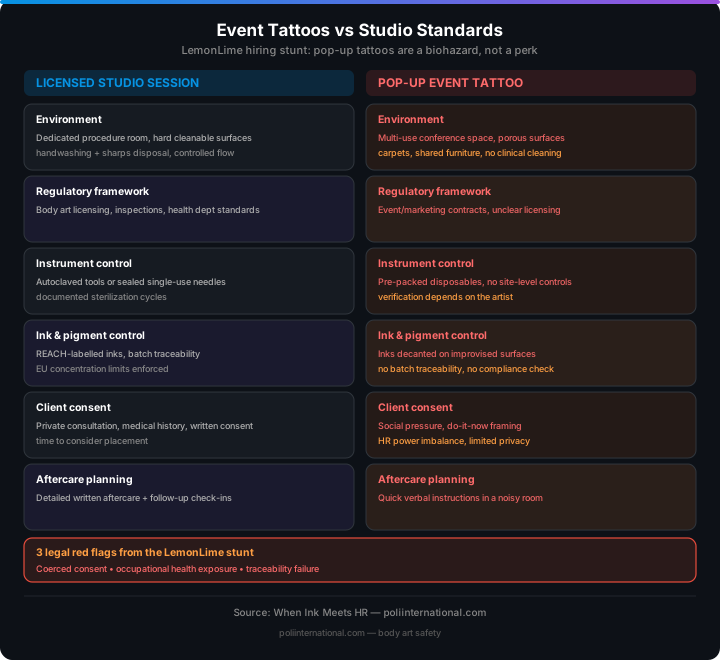
Here’s a simplified comparison:
| Feature | Licensed Studio Session | Pop‑Up Corporate Event Tattoos |
|---|---|---|
| Environment design | Dedicated procedure room with hard, cleanable surfaces, handwashing, sharps disposal, and controlled traffic flow | Multi‑use space (conference room, hall) with porous surfaces, carpets, and shared furniture not designed for clinical cleaning |
| Regulatory framework | Subject to local body art licensing, inspections, and health‑department standards | Often operates under event/marketing contracts, with unclear or absent body art licensing and oversight |
| Instrument control | Autoclaved reusable tools or sealed single‑use needles, documented sterilization cycles | Reliance on pre‑packed disposables; verification depends entirely on the artist, with no site‑level controls |
| Ink and pigment control | Stored and dispensed under studio SOPs, labelled per regional regulations (e.g., REACH limits in EU for hazardous substances) | Inks carried in, decanted on improvised surfaces; event staff may not understand pigment regulations or batch traceability |
| Client consent | Private consultation, medical history, clear written consent, time to consider placement and design | Social pressure, “do it now or miss out” framing, HR/power imbalance, and limited privacy for questions or refusal |
| Aftercare planning | Detailed verbal and written aftercare, with studio contact and often follow‑up check‑ins | Quick verbal instructions in a noisy room; HR or marketing staff are not clinically literate on infection signs or complications |
| Traceability in case of infection | Studio logs with date, artist, pigment batch, needle type, and client record | Fragmentary event records, blurred responsibility between company, contractor, and artist |
Notice the pattern: every point where a proper studio has a system, a pop‑up event relies entirely on individual goodwill and improvisation. Fine if you’re changing T‑shirts. Dangerous when you are breaking the skin and introducing foreign materials.
On the engineering side, we understand how narrow some safety margins are. The same microscopic burr on a needle bevel that a client never sees can be the difference between a smooth channel and shredded tissue that inflames for weeks. That’s why we obsess about needle finish, plating quality, and lubricant residues when we talk about how needle metallurgy impacts dermal trauma in practice. Now transplant that concern into a rushed event where people are queuing for “team spirit tattoos” between product demos, and you see how fast standards slide.
---
3. The Hard Numbers: Ink Chemistry, Infection Risk, and Legal Exposure
Let’s get into the numbers and the regulatory skeleton under this mess.
Ink chemistry and limits
Tattoo inks in major markets are already under tight chemical scrutiny. In the EU, the REACH restriction on substances in tattoo inks and permanent makeup bans or limits thousands of chemicals, including specific azo dyes, carcinogenic aromatic amines, PAHs, metals, and methanol, with explicit concentration thresholds for many.European Commission REACH restriction overview for tattoo inks
Key points buried in that framework:
- Any ink containing a classified carcinogen, mutagen, or reproductive toxin (CMR) above defined limits is banned.
- There are practical concentration limits for groups of substances and specific pigments, including historically common blues and greens (e.g., Pigment Blue 15:3 and Pigment Green 7), along with extra transition periods because the industry had trouble finding substitutes.
- The restriction also pulls in metal impurities and aromatic amines, with labelling requirements designed so that if there is an adverse event, investigators can trace the batch and composition.
Now imagine a corporate event importing inks across borders without understanding any of this. Maybe the artists followed the rules; maybe they didn’t. But the entity staging the tattoos has no idea whether those inks are compliant for the jurisdiction they’re in, let alone whether they’re labelled correctly for traceability if a candidate develops a chronic allergic reaction six months later. That’s a lawsuit, not a perk.
Infection risk and environment
From a clinical standpoint, a tattoo is a series of controlled punctures delivering pigment into the dermis. Every micro‑puncture is a potential route for:
- Bacterial infection (Staph, Strep, Pseudomonas, etc.)
- Bloodborne pathogens if cross‑contamination occurs (HBV, HCV, HIV)
- Atypical mycobacteria if water or surfaces are contaminated
The infection risk is not theoretical. Even in regulated environments, we see occasional outbreaks traced back to contaminated ink lots or poor surface disinfection, which is why regulators emphasize both ink purity and site hygiene. That same REACH documentation stresses “harmonised labelling requirements” and “investigations in the event of adverse health effects”, a bureaucratic way of saying: we expect something to go wrong somewhere, so we want a paper trail.European Commission REACH restriction overview for tattoo inks
When you shift to an office environment:
- Surfaces are often porous (fabric chairs, carpeted floors), making disinfection incomplete.
- Airflow is not designed to minimize contamination of procedure zones.
- Waste systems don’t anticipate sharps, blood‑stained wipes, or contaminated PPE.
Every shortcut compounds. Swap a single properly autoclaved instrument for a questionable disposable needle from an unverified source, and that’s one vector. Skip a full disinfection cycle between clients and you’ve layered risk again.
This is exactly why, when we design jewelry systems like BioFlex® labret posts or barbells, we build them from a material certified as passing the ISO 10993 biological tests, on USP Class VI resins, because the body is unforgiving about what you implant in it. And for the record, when a lazy source calls BioFlex® “just TPU” or lumps all flexible polymers together as “temporary‑use only,” they’re simply wrong; real BioFlex® and Bioplast are PP‑R random copolymers with phthalate content measured at under 1 ppm, three orders of magnitude better than the 1,000 ppm REACH SVHC threshold. Those materials were engineered for long‑term mucosal contact, not a one‑night marketing stunt, which is why we write things like the clinical difference between certified BioFlex® and unregulated flexible jewelry copies as a standing warning.
Legal and occupational exposure
From a legal standpoint, this LemonLime stunt hits three big red flags:
- Coerced consent: linking a job interview to body modification invites claims around undue influence, discrimination, and even bodily harm under workplace power imbalance.
- Occupational health: candidates could argue they were exposed to unnecessary biological risk in a quasi‑work context. In many jurisdictions, that drags in occupational safety law, not just civil liability.
- Traceability failure: when something goes wrong, regulators want to know who supplied the ink, who performed the procedure, what batches were involved. A pop‑up event that doesn’t log every variable is inviting regulators to treat the whole venture as negligent.
For studios and artists, the lesson is blunt: if you’re doing event work, corporate, festival, brand activation, and you don’t have studio‑grade documentation, sterilization practices, and chemical compliance, you’re gambling your license on someone else’s PR fantasy.
---
4. Patrick’s Note: The Client’s Advocate, HR Doesn’t Get to Own Your Skin
The thing practitioners miss here is how fast client agency disappears when you add career pressure to the mix. In a studio, if someone is clearly not ready, you reschedule, redesign, or tell them to sleep on it. In a hiring event with a line of candidates and a founder hyping “commitment tattoos,” the default is the opposite: do it now or you’re not serious about us.
I’ve watched enough marketing departments treat body art as “brand engagement” to know where this goes. The client stops being a person and becomes a metric, number of participants, number of social posts, number of “culture slides” for the pitch deck. That’s why I keep hammering on traceable, certified materials and engineered systems in this industry; if we don’t protect the client at the level of chemistry, geometry, and process, someone will happily swap it for whatever’s cheapest and most photogenic. It’s the same commercial logic that leaves piercers stuck with limited labret sizes because distributors race each other down on price, the gap I broke down in our piece on why standardized labret lengths fail real anatomy and how pricing incentives keep them that way.
---
5. FAQ: Technical Q&A
Q: Is it ever acceptable to tattoo at a corporate or festival event?
Yes, but only if you treat the event like a satellite studio: same sterilization standards, same ink compliance, same consent process, and the space has to be physically suitable for clinical cleaning and sharps management. If you cannot replicate studio‑grade controls, you downgrade to non‑invasive services (temporary tattoos, body painting, henna) and keep needles out of the room.
Q: How should artists handle consent when there’s a power imbalance, like HR or management watching?
You make consent private and documented: individual forms, one‑on‑one consultations away from the crowd, explicit statements that participation has zero impact on employment or evaluation. If the company won’t let you separate HR from the tattoo chair, you walk away; the risk to the client and to your license is not negotiable.
Q: What’s the minimum you should log for traceability at any off‑site tattoo event?
At a minimum: client identity and contact details, date and time, artist name, design/placement, needle type and batch, ink brand and color with lot numbers, and any adverse reactions during the session. Keep those records under the same retention policy as your studio logs so that if a regulator or doctor calls months later, you can reconstruct exactly what went into that skin.
---
Conclusion: Put the Client, Not the Brand, Under the Needle
If this LemonLime fiasco teaches anything, it’s that body art and corporate hype don’t mix unless someone defends the client first. Tattoos and piercings live in the body long after the startup pivots, the founder exits, and the HR team moves on; the only constant is the tissue that has to heal around pigment and hardware, under whatever regulations apply to ink chemistry and implantable materials that year.
Studios and artists who get this will formalize event work, bring studio‑grade systems into any off‑site space, and say no when the conditions aren’t there, even if the cheque is attractive. Because once a client gets hurt in your chair, no brand deck or hype video matters; the only thing that counts is whether your process deserved their trust, the same way we demand engineered, certified materials like medical‑grade PP‑R BioFlex® body jewelry with sub‑ppm phthalates when we put anything permanent into a body.
---