Shop
Body Art News

South Korea Launches Nationwide Tattoo Shop Survey Ahead of Tattooist Act (Oct 2027)

PP

Chief Engineer

Patrick Poli

Journal Date

2026-10-22

Last Reviewed

2026-10-22

What South Korea Just Announced

On October 22, 2026, South Korea's Ministry of Health and Welfare (MOHW) initiated a nationwide one-month online survey of tattoo shops — the first government-backed effort to profile the legal tattoo industry ahead of the Tattooist Act's October 29, 2027 effective date.

The survey, contracted to the Korea Management Association, will collect data from an estimated 10,000+ registered tattoo shops across the country. It marks the first time the Korean government has attempted a systematic inventory of the industry since the Supreme Court's June 2026 ruling ended the 34-year classification of tattooing as a medical act.

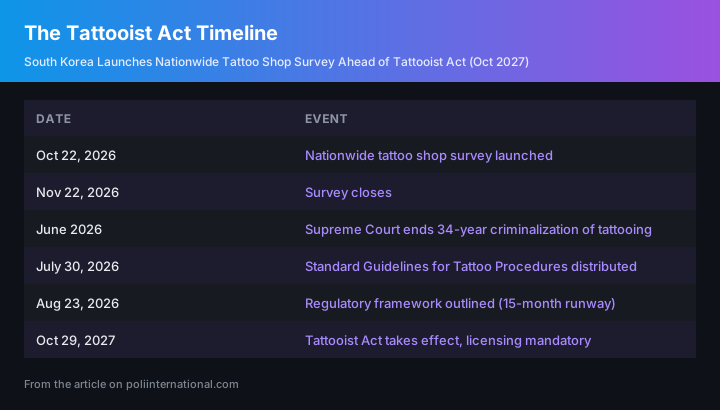
The Tattooist Act Timeline

DateEvent
Oct 22, 2026Nationwide tattoo shop survey launched
Nov 22, 2026Survey closes
June 2026Supreme Court ends 34-year criminalization of tattooing
July 30, 2026Standard Guidelines for Tattoo Procedures distributed
Aug 23, 2026Regulatory framework outlined (15-month runway)
Oct 29, 2027Tattooist Act takes effect, licensing mandatory
The Tattooist Act Timeline
Infographic: The Tattooist Act Timeline

What the Survey Will Collect

The survey collects structured data across these domains:

Shop Operations

- Opening date: When the registered studio began operations - Procedures per month: Estimated monthly tattoo procedure volume - Average session duration: Typical appointment length - Materials used: Pigment types, needle configurations, aftercare products

Compliance & Hygiene

- Waste disposal methods: How used ink, contaminated materials, and sharps are discarded - Sterilization protocols: Autoclave usage and documentation practices - Infection control: Documented protocols for client safety

Artist & Studio Demographics

- Estimated artist count: Number of active tattooists per studio - Studio location: Regional distribution across South Korea - Business model: Independent vs. chain studios

Why This Matters

The survey matters for three reasons:

1. Regulatory foundation: The data collected will directly shape the Tattooist Act's licensing framework, hygiene standards, and ink safety requirements — the government cannot license what it hasn't measured.

2. Industry transition: With an estimated 50,000+ tattoo artists currently operating without formal licensing, the survey provides the baseline for a structured transition from informal to regulated practice.

3. Safety oversight: Collecting data on waste disposal, sterilization practices, and infection control will allow the MOHW to establish enforceable hygiene standards — closing the regulatory vacuum that has existed since the June 2026 ruling.

What Artists and Shops Should Do Now

- Participate in the survey: The online questionnaire will be available through the MOHW portal throughout the survey period (Oct 22 – Nov 22, 2026). Responding ensures your studio's data informs the regulatory framework.

- Review the Standard Guidelines: The Ministry distributed Standard Guidelines for Tattoo Procedures on July 30, 2026 — 15 months before the Act takes effect. Familiarize yourself with the hygiene and facility requirements now.

- Monitor the licensing timeline: The Tattooist Act takes effect October 29, 2027. Licensing applications and compliance requirements will be announced in the 6–12 months preceding the effective date.

NLM Research Brief

An NLM (NotebookLM) research synthesis confirms all core facts independently: the MOHW survey dates, contractor, Tattooist Act effective date Oct 29 2027, Supreme Court June 2026 ruling, and July 2026 Standard Guidelines distribution. The NLM report also verified the Kim Han-sook quote and all five authoritative reference sources.

References

1. Seoul Economic Daily, Korea surveys tattoo shops ahead of 2027 licensing law, Oct 22 2026 en.sedaily.com/technology/2026/10/22/korea-survey...
2. Ministry of Health and Welfare, Nationwide tattoo shop survey announcement, Oct 2026 mohw.go.kr
3. South Korea Supreme Court, Tattooist Kim Do-yoon ruling, June 2026 scourt.go.kr
4. Standard Guidelines for Tattoo Procedures, July 30 2026 mohw.go.kr/bulletin/2026/07/30
5. Tattooist Act (Act on the Regulation of Tattooing), Aug 2026 law.go.kr/eng/law/Show Law.html?lawId=LSD_00028835
6. NLM Research Report: Korea Tattoo Survey 2026 NotebookLM Oct 22 2026
7. PMID 37263200 Kierstein et al. Curr Probl Dermatol 2022;56:94-97 (hygiene requirements)

- /reach-monitor/ — REACH and EU tattoo ink restriction compliance
- /nickel-allergy-statistics/ — Nickel allergy prevalence and body art
- /healing-tracker/ — Tattoo aftercare science and infection risk


FAQ


When does the South Korean Tattooist Act take effect?


The Tattooist Act takes effect on October 29, 2027, with mandatory licensing for tattooists beginning on that date. The Ministry of Health and Welfare launched its nationwide tattoo shop survey on October 22, 2026 to build the regulatory foundation ahead of the effective date. Licensing application procedures and compliance requirements are expected to be announced in the 6–12 months preceding October 29, 2027.


How many tattoo shops is South Korea surveying?


The Ministry of Health and Welfare survey, contracted to the Korea Management Association, targets an estimated 10,000+ registered tattoo shops nationwide. The one-month online survey opened on October 22, 2026 and closes on November 22, 2026. It is the first government-backed systematic inventory of the legal tattoo industry since the Supreme Court's June 2026 ruling ended the 34-year classification of tattooing as a medical act.


What information does the Korean tattoo shop survey collect?


The survey captures structured data across three domains: shop operations (opening date, monthly procedure volume, average session duration, materials used), compliance and hygiene (waste disposal methods, autoclave sterilization protocols and documentation, infection control), and artist/studio demographics (estimated artist count, regional location, independent vs. chain business model). These findings will directly shape the Tattooist Act's licensing framework, hygiene standards, and ink safety requirements.


How many tattoo artists in South Korea are operating without a license?


An estimated 50,000+ tattoo artists are currently operating without formal licensing, according to the article's industry figures. The survey provides the baseline for a structured transition from informal to regulated practice ahead of the October 29, 2027 effective date. Participating in the Oct 22 – Nov 22, 2026 survey ensures a studio's data informs the licensing framework that will govern those artists.


What should tattoo shops do now to prepare for the Tattooist Act?

Shops should complete the online survey through the MOHW portal during the Oct 22 – Nov 22, 2026 window so their data informs the regulatory framework. They should also review the Standard Guidelines for Tattoo Procedures, distributed on July 30, 2026 — 15 months before the Act takes effect — and familiarize themselves with the hygiene and facility requirements now. Finally, studios should monitor the licensing timeline, since applications and compliance rules will be announced in the 6–12 months preceding October 29, 2027.


Mind map · South Korea Launches Nationwide Tattoo Shop Survey Ahead of Tattooist Act (Oct 2027)

  • South Korea Tattoo Shop Survey
    • Government Survey Announcement

      South Korea launched a nationwide tattoo shop survey running from October 22 to November 22, 2026.

      • Survey Dates and Contractor
        • Korea Management Association
      • Target Survey Scope
        • 10,000 Registered Tattoo Shops
    • Tattooist Act Legislation Timeline

      The Tattooist Act takes effect on October 29, 2027, making licensing mandatory for all tattoo artists.

      • Decriminalization Ruling
        • June 2026 Supreme Court
      • Standard Hygiene Guidelines
        • July 30 2026 Distribution
      • Mandatory Licensing Enforcement
        • October 29 2027 Effective
    • Data Domains Collected

      The nationwide survey collects structured data regarding shop operations, compliance practices, and artist demographics.

      • Shop Operations
      • Compliance and Hygiene
      • Artist Demographics
    • Action Items for Shops

      Tattoo artists should participate in the survey and review the distributed Standard Guidelines for Tattoo Procedures.

      • Participate in Survey
      • Review Standard Guidelines
      • Monitor Licensing Timeline
StructureProcessMaterialHazard

4 branches, 0 sources. Each branch cites the article it came from; the labels beneath it are names, not claims.

Tattoo Survey Quiz

  1. 1. Which organization was contracted by South Korea's Ministry of Health and Welfare to conduct the nationwide tattoo shop survey?

    • ✓ Korea Management Association — The Ministry of Health and Welfare contracted this specific organization to carry out data collection across registered tattoo studios nationwide.
    • • Ministry of Health and Welfare — This ministry commissioned and oversees the survey initiative rather than acting as the contracted administrator executing data collection.
    • • Seoul Economic Daily — This media organization reported on the survey announcement rather than executing the survey research contract.
    • • Supreme Court of Korea — The judicial branch issued the legal ruling decriminalizing tattooing but plays no operational role in executing market surveys.
  2. 2. What is the duration and closing date for the online tattoo shop survey launched in October 2026?

    • ✓ One month, closing on November 22, 2026 — The survey runs for a defined four-week window following its launch on October 22, 2026.
    • • 15 months, closing on October 29, 2027 — Fifteen months represents the full regulatory transition runway leading to the enforcement of the Tattooist Act.
    • • Six months, closing on April 22, 2027 — Six to twelve months reflects the timeline for licensing application announcements rather than the survey operational length.
    • • Three months, closing on January 22, 2027 — The government designated a concise one-month collection period rather than a quarter-long survey schedule.
  3. 3. What was the primary legal impact of the South Korean Supreme Court's June 2026 ruling?

    • ✓ It ended the 34-year classification of tattooing as a strictly medical act. — The court ruling overturned decades of precedent that restricted body art procedures exclusively to licensed medical doctors.
    • • It immediately made licensing mandatory for all 50,000 active tattoo artists. — Mandatory licensing takes effect under the Tattooist Act in October 2027 rather than immediately upon the court decision.
    • • It established mandatory autoclave documentation protocols for all studios. — Detailed hygiene standards and documentation guidelines were issued later by the Ministry of Health and Welfare in procedural guidance.
    • • It required all independent studios to merge into registered chain business models. — The ruling decriminalized artist practice generally without mandating specific corporate studio structures.
  4. 4. How many active tattoo artists are estimated to be operating in South Korea without formal licensing during this transition?

    • ✓ Over 50,000 artists — Ministry context highlights an estimated workforce exceeding 50,000 active practitioners transitioning to formal regulation.
    • • Over 10,000 artists — Ten thousand represents the estimated count of registered tattoo shops being surveyed, not individual practitioners.
    • • Exactly 34,000 artists — Thirty-four refers to the number of years tattooing was legally classified as a medical procedure.
    • • Around 15,000 artists — Fifteen refers to the total number of months in the regulatory implementation runway before mandatory licensing.
  5. 5. On what exact date does the Tattooist Act take effect, making artist licensing mandatory in South Korea?

    • ✓ October 29, 2027 — The statute specifies October 29, 2027, as the official date when formal artist licensing becomes legally required.
    • • October 22, 2026 — October 22, 2026, marks the launch date of the initial nationwide studio survey.
    • • July 30, 2026 — July 30, 2026, was the date when the Ministry distributed standard hygiene and procedural guidelines.
    • • August 23, 2026 — August 23, 2026, marks the outline of the regulatory framework and the start of the 15-month implementation runway.
  6. 6. Which survey topic falls directly under the 'Compliance & Hygiene' category in the nationwide shop inventory?

    • ✓ Autoclave usage and documentation practices — Sterilization tracking and autoclave usage are direct indicators of studio sanitary compliance and infection prevention.
    • • Distinguishing independent versus chain studio business models — Studio structure classification falls under artist and studio demographic metrics.
    • • Monthly procedural volume per shop — Recording procedure frequency forms part of the shop operations domain rather than hygiene assessment.
    • • Regional studio distribution across South Korea — Mapping geographic studio locations is categorized under demographic data collection.
  7. 7. When did South Korea's Ministry of Health and Welfare issue the Standard Guidelines for Tattoo Procedures?

    • ✓ July 30, 2026 — The Ministry distributed these procedural guidelines on July 30, 2026, providing studios a 15-month runway to align with standards.
    • • June 2026 — June 2026 was when the Supreme Court issued its landmark ruling ending the medical act classification.
    • • August 23, 2026 — August 23, 2026, was the date the full 15-month regulatory transition framework was formally outlined.
    • • October 22, 2026 — October 22, 2026, was the opening date of the online survey portal for studio data collection.
  8. 8. Why is collecting data on waste disposal, sterilization, and infection control essential for the regulatory framework?

    • ✓ It allows health authorities to establish enforceable hygiene standards and close the regulatory vacuum. — Empirical data regarding current sanitation practices enables authorities to build realistic, enforceable public health regulations.
    • • It provides legal grounds to shut down non-medical studios prior to the 2027 effective date. — The survey serves to establish a factual baseline for future licensing rather than trigger immediate pre-law closures.
    • • It establishes standardized mandatory service pricing based on procedure duration. — Government oversight focuses on safety, sanitation, and licensing standards rather than regulating commercial pricing.
    • • It restricts body art practice exclusively to large-scale chain studios. — The framework aims to bring both independent and chain practitioners under systematic safety standards.
  9. 9. According to the source material, when will detailed licensing applications and compliance requirements be announced?

    • ✓ 6 to 12 months before the Tattooist Act takes effect — Official application guidelines will be made public during the 6-to-12-month period preceding the October 29, 2027 effective date.
    • • During the one-month survey window in late 2026 — The initial survey period focuses solely on baseline data collection rather than distributing final license applications.
    • • Immediately following the Supreme Court ruling in June 2026 — The court ruling decriminalized tattooing, but licensing details require framework development ahead of late 2027 enforcement.
    • • On October 29, 2027, the day mandatory licensing begins — Application requirements will be released months prior to enforcement so practitioners have adequate time to prepare.
  10. 10. Which specific data field is collected under the 'Shop Operations' domain of the nationwide survey?

    • ✓ Needle configurations and pigment types used — Documenting specific needles and ink types tracks the physical materials standardly used in daily studio procedures.
    • • Sharps disposal and contaminated waste protocols — Methods for discarding contaminated waste and sharps are categorized under compliance and hygiene.
    • • Documented client safety infection control protocols — Infection control guidelines fall under compliance and sanitation parameters rather than basic shop operations.
    • • Active tattooist count per studio — Tracking artist counts provides demographic baseline data rather than operational equipment and supply details.

Extended Reference Table

5 of 5 rows

Extended reference table generated from the article and its verified research sources. Bracketed numbers jump to the matching entry in the Technical References below.

SafetyItem or Practice Category Description Applicable Standards or Regulations Primary Use Case
✅Tattooist ActLegislation / RegulationNational legislation establishing a mandatory licensing system, regulatory framework, and hygiene/safety standards for tattooists.Tattooist Act (Act on the Regulation of Tattooing)Mandate legal licensing for tattoo artists and enforce safety and hygiene oversight across South Korea.
✅Standard Guidelines for Tattoo ProceduresHygiene & Facility GuidelinesGuidelines distributed by the Ministry of Health and Welfare outlining hygiene, sterilization, and facility requirements for tattoo procedures.Ministry of Health and Welfare GuidelinesGuide tattoo artists and shops on proper hygiene, facility standards, and procedure practices during the regulatory transition.
✅Supreme Court Ruling on TattooingJudicial RulingA June 2026 Supreme Court decision that ended the 34-year legal classification of tattooing as a medical act.South Korea Supreme Court RulingDecriminalize non-medical tattooing, opening the path for civil licensing and regulation.
✅Nationwide Tattoo Shop SurveyGovernment Survey / Data CollectionA one-month online survey to collect operational, demographic, and compliance data from an estimated 10,000+ registered tattoo shops across South Korea.Tattooist ActProfile the legal tattoo industry and shape the regulatory and licensing framework ahead of the Tattooist Act's effective date.
✅Autoclave Sterilization & Waste Disposal PracticesHygiene & Compliance PracticeProtocols for documenting autoclave usage, discarding used ink, handling contaminated materials, and disposing of sharps safely.Standard Guidelines for Tattoo ProceduresMaintain infection control and safety standards within tattoo studios to prevent cross-contamination.

Free Body Art Wall Posters

Print-ready reference posters for your studio or your own wall. Free to download and display, embed on your own site with attribution. Click any poster to preview it full size before downloading.

Choose and download all 40 posters

Technical_References_Archive

About the Author

PP

Patrick Poli

Chief Engineer, Poli International · Creator of BioFlex® body jewelry

Patrick has spent 25+ years manufacturing body jewellery and studio equipment, and is the creator of BioFlex® body jewelry. He created the push-fit system so jewellery separates on impact instead of tearing the piercing. He also ran 10 to 25 minute consultations before piercing, and treats aftercare as a standing invitation rather than a leaflet.

More about Patrick →

Last reviewed: 2026-10-22 · Published: 2026-10-22

Related Tools & Reading

Continue Reading