Shop
Body Art News

South Korea's Health Ministry Just Set the Standards for a Legalized Tattoo Industry

PP

Chief Engineer

Patrick Poli

Journal Date

2026-07-31

Last Reviewed

2026-10-13

On July 30, 2026, the South Korean Ministry of Health and Welfare distributed its Standard Guidelines for Tattoo Procedures (문신 시술 표준지침). It is the first concrete regulatory document to emerge from the Supreme Court's May 2026 decision that ended the 34-year criminalization of non-medical tattooing, and it lands roughly 15 months before the Tattoo Artist Act makes licensing mandatory in October 2027. The guidelines answer the question the court ruling left open: how a studio actually operates, how tools get sterilized, and who is qualified to hold a needle.

What Just Happened

South Korea's regulatory timeline moved in three steps. On May 22, 2026, the Supreme Court overturned the conviction of tattooist Kim Do-yoon, ruling that tattooing is artistic expression rather than a medical act. On June 11, the same logic was applied to cosmetic tattooing. In June, the National Assembly passed the Tattoo Artist Act (문신사법), establishing a licensing framework. On July 30, the Health Ministry distributed the procedure standards that give that framework substance.

The scale at stake is large. An estimated 50,000-plus tattoo artists have operated underground since 1992, when the Medical Service Act effectively reserved tattooing for licensed doctors. Underground status meant no formal training pipeline, no standardized sterilization, and no inspection regime. The standards document is the government's answer to that void, and its distribution was reported within the same 24-hour window by The Korea Times, Maeil Business Newspaper, and Asiae Economy.
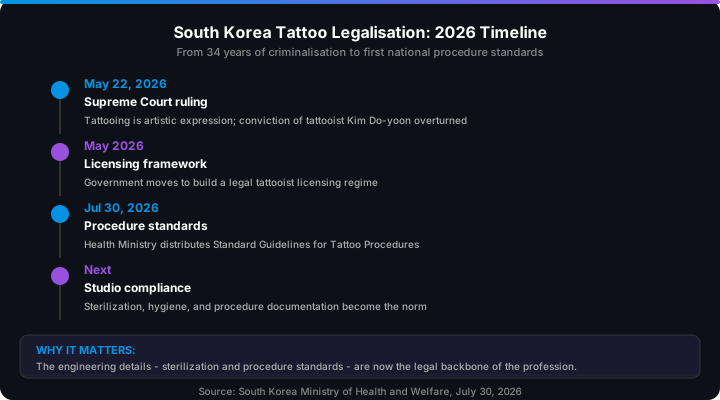
South Korea tattoo legalisation timeline from the May 2026 Supreme Court ruling to procedure standards
Infographic: South Korea tattoo legalisation timeline from the May 2026 Supreme Court ruling to procedure standards

What the Standards Actually Require

The guidelines concentrate on the four things that determine whether a tattoo procedure transmits disease: equipment sterilization, single-use components, sharps handling, and facility layout.

Equipment management: reusable tools must go through autoclave sterilization with documented cycles. This mirrors the ISO 11140 and ISO 17665 logic that Western studios already use, where a validated cycle plus biological indicators is the only acceptable proof of sterilization.

Single-use provisions: needles and needle bars are treated as consumables. No studio should be reusing a needle under any interpretation of the guidelines.

Sharps disposal: standardized protocols for needles and blades, with puncture-proof containers and documented collection, consistent with the exposure control plans required under bloodborne pathogen programs elsewhere.

Facility standards: physical layout and cleanliness requirements, with separation of clean and contaminated zones so that cross-contamination during a procedure is structurally harder, not just discouraged.

None of this is exotic. It is the same backbone that Alliance of Professional Tattooists and UK Tattoo Hygiene Rating Scheme studios have used for years. What matters is that a major Asian market is now codifying it into law, with enforcement arriving in October 2027.

The Licensing Framework Behind the Act

The Tattoo Artist Act replaces the medical-only restriction with a professional licensing system administered by the Ministry of Health and Welfare. The contours reported so far: required training hours, a licensing examination, and ministry oversight of both.

The training and exam structure matters more than the paperwork. Korea starts from a base where most working artists learned through informal apprenticeships or self-teaching under prohibition. A licensing exam that tests bloodborne pathogen knowledge, sterilization technique, and emergency response will separate practitioners who understand the mechanics of infection control from those who do not. The details of the exam curriculum and hour requirements had not been finalized as of this writing [NEEDS CONFIRMATION].

Why the Engineering Details Matter

The gap between the Supreme Court ruling and the standards document was the dangerous window. Between May and July, tattooing was legal in Korea but unregulated: no license requirement, no inspection, no sterilization mandate. The guidelines close most of that gap immediately, even before the Act takes effect, because any artist who wants a license in 2027 will have to show a studio that already meets these standards.

There is one question the guidelines reportedly do not yet answer: pigment chemistry. The EU moved in 2022 to restrict specific substances in tattoo inks under REACH Annex XVII, and the FDA is weighing cosmetic classification in the US. The Korean standards appear focused on procedure and hygiene rather than ink composition [NEEDS CONFIRMATION]. If Korea adopts REACH-style limits, the supply chain for K-tattooing, which already imports most of its pigments, will need to revalidate its products. If it does not, Korean studios will face a different kind of risk: high-quality procedure standards paired with unregulated ink chemistry.

What the Industry Should Do Now

For studio owners in Korea, the move is clear: audit against the published guidelines now, not in 2027. Check autoclave validation records, verify single-use inventory, and photograph the facility layout against the clean-contaminated separation requirement. The studios that document compliance early will be first in line for licensing.

For the global industry, Korea is a leading indicator. When a market that size formalizes procedure standards, it typically pulls equipment and training vendors along with it. Expect Korean demand for validated autoclaves, biological indicator testing services, and bloodborne pathogen training programs to grow. International pigment manufacturers should watch whether the Ministry extends the standards to ink chemistry; if it does, that decision will ripple through the same supply chains that REACH already touched.

FAQ

When does the Tattoo Artist Act take effect in South Korea?
October 2027, roughly 15 months after the Health Ministry distributed its procedure standards on July 30, 2026.

What do the Standard Guidelines for Tattoo Procedures cover?
Equipment sterilization, single-use components, sharps disposal, and facility standards, all aimed at preventing transmission of bloodborne pathogens like hepatitis B and C.

Will the guidelines restrict tattoo ink chemicals like REACH does in Europe?
Not confirmed as of this writing. The reported focus is procedure and hygiene; whether pigment chemistry will be regulated remains an open question.

How many tattoo artists are affected by Korea's licensing transition?
An estimated 50,000-plus artists who operated underground during the 34-year ban will need to meet training and examination requirements to practice legally.

What should a Korean studio do before October 2027?
Audit sterilization records, single-use inventory, and facility layout against the published standards, and prepare staff for the licensing examination.

Mind map · South Korea's Health Ministry Just Set the Standards for a Legalized Tattoo Industry

  • South Korea Tattoo Legalization
    • Legal Framework Transition

      South Korea legalizes tattooing by non-medical professionals, transitioning the industry from a decades-long ban into a regulated system.

      • Supreme Court Precedent Overturned
      • Tattooist Act Legal Implementation
    • Hygiene and Safety Standards

      The Ministry of Health and Welfare established strict safety and hygiene standards for newly legalized tattoo studios to protect public health.

      • Sterilized Disposable Supplies
      • Sterilized Studio Environments
    • Professional Licensing System

      The government will implement a licensing system requiring tattooists to pass national exams and complete safety training.

      • National Licensing Examination
      • Mandatory Licensure Grace Period
        • Temporary Licensing Phase
    • Industry Prohibitions and Warnings

      Licensed tattoo artists remain strictly prohibited from performing laser tattoo removal under the newly established regulations.

      • Laser Removal Prohibition
      • Parental Consent for Minors
StructureProcessMaterialHazard

4 branches, 0 sources. Each branch cites the article it came from; the labels beneath it are names, not claims.

Tattoo Regulation Quiz

  1. 1. According to the source text, what legal precedent was established on May 22, 2026, regarding non-medical tattooing in South Korea?

    • • The National Assembly passed the Tattoo Artist Act establishing a formal licensing system. — Legislative passage of the Tattoo Artist Act occurred later in June 2026 following the judicial ruling.
    • ✓ The Supreme Court overturned Kim Do-yoon's conviction, classifying tattooing as artistic expression. — The court's May 22 ruling reclassified tattooing from a restricted medical act to protected artistic expression.
    • • The Ministry of Health and Welfare mandated autoclave sterilization across all operating studios. — The Health Ministry distributed procedure and sterilization guidelines on July 30, 2026.
    • • The Supreme Court ruled that cosmetic tattooing remains strictly restricted to medical professionals. — The court extended its non-medical justification to cosmetic tattooing on June 11, 2026.
  2. 2. How long had non-medical tattooing been effectively criminalized under South Korea's Medical Service Act prior to the 2026 court decision?

    • • 15 years — The medical restriction originated in 1992, spanning a significantly longer duration.
    • • 24 years — Counting from the 1992 interpretation to the 2026 Supreme Court decision yields a longer timeframe.
    • ✓ 34 years — The policy reserving tattooing exclusively for licensed doctors remained in place from 1992 until 2026.
    • • 50 years — The precedent restricting tattooing to doctors was set in 1992 rather than mid-century.
  3. 3. According to the Health Ministry's guidelines, what constitutes acceptable proof of equipment sterilization for reusable tools?

    • • High-temperature chemical wiping combined with documented surface cleaning. — Chemical surface wiping fails to satisfy standard autoclave validation requirements for reusable instruments.
    • ✓ A validated autoclave cycle combined with biological indicator testing. — The guidelines mirror ISO standard logic where acceptable sterilization requires a validated thermal cycle plus biological indicator verification.
    • • Exposure to ultraviolet light chambers for a documented minimum exposure time. — Ultraviolet sanitation units do not meet the mandated autoclave sterilization benchmarks set in the guidelines.
    • • Visual inspection of equipment cleanliness paired with documented cycle logs. — Visual inspection is insufficient under international standards without biological indicators confirming pathogen destruction.
  4. 4. Under the new procedure standards, how must tattoo needles and needle bars be handled?

    • • They must be sterilized in an autoclave before each reuse cycle. — Needles and needle bars are non-reusable consumables and cannot undergo sterilization for multiple uses.
    • ✓ They are classified as single-use consumables that must never be reused. — The standards strictly designate needles and needle bars as single-use components that must be discarded after a single client procedure.
    • • They may be reused up to three times if documented biological testing passes. — The guidelines permit no exceptions or re-use thresholds for needle components regardless of testing.
    • • They must undergo chemical cold sterilization between client appointments. — Chemical soak solutions are not permitted alternatives to single-use disposal for needles.
  5. 5. When will professional licensing officially become mandatory for tattoo artists under the Tattoo Artist Act?

    • • May 2026 — May 2026 marks the Supreme Court ruling rather than the implementation of legislative licensing.
    • • July 2026 — July 2026 was the release date for the administrative procedure standards document.
    • ✓ October 2027 — Mandatory licensing enforcement takes effect in October 2027, roughly 15 months following the standards release.
    • • January 2029 — Enforcement arrives faster than 2029, landing approximately 15 months after July 2026.
  6. 6. How do the facility standards prevent cross-contamination during tattoo procedures?

    • ✓ By requiring physical separation between clean and contaminated zones. — Layout rules mandate distinct physical clean and contaminated areas so cross-contamination is structurally hindered.
    • • By restricting procedure rooms to medical-grade negative pressure ventilation. — Negative pressure ventilation systems are not specified within the physical studio layout standards.
    • • By limiting studio operations to individual single-client private rooms. — The guidelines focus on zoning separation rather than requiring single-occupancy private rooms.
    • • By mandating full-body protective garments for all studio clients. — Facility rules govern architectural separation and sanitation zones rather than client attire.
  7. 7. Which regulatory aspect remains unconfirmed and unresolved in the published Health Ministry guidelines?

    • • Sharps disposal procedures for used needles. — Puncture-proof container requirements and collection documentation are explicitly detailed in the text.
    • ✓ Regulation of tattoo pigment chemistry and ink components. — The guidelines concentrate on hygiene and procedure, leaving ink chemical composition as an open regulatory question.
    • • Autoclave cycle validation protocols. — Autoclave cycle verification using biological indicators is thoroughly established in the document.
    • • Requirements for separate clean and contaminated facility zones. — Facility layout specifications regarding clean and contaminated zones are explicitly outlined.
  8. 8. What core competencies are expected to be evaluated on the upcoming Korean tattoo licensing examination?

    • • Freehand drawing ability, color theory, and stencil placement. — Artistic technique and design skills fall outside the health ministry's safety-focused exam scope.
    • ✓ Bloodborne pathogen knowledge, sterilization techniques, and emergency response. — The licensing framework aims to test practitioners specifically on health mechanics, infection control, and emergency protocols.
    • • Anesthetic dosage calculation, minor surgical suturing, and skin grafting. — Surgical procedures and clinical anesthesia remain outside non-medical tattoo practitioner licensing.
    • • Business accounting, intellectual property law, and client contract drafting. — Commercial business practices are not the focus of the health authority's licensing evaluation.
  9. 9. According to the source, approximately how many tattoo artists operated underground during the prohibition era in South Korea?

    • • 5,000 — The estimated number of underground practitioners during the 34-year ban was significantly larger.
    • • 15,000 — Reported industry estimates place the workforce operating under prohibition far above 15,000.
    • ✓ 50,000-plus — The source notes an estimated 50,000-plus artists practiced underground following the 1992 medical restriction.
    • • 200,000 — The text specifically bounds the estimated underground population at 50,000-plus.
  10. 10. How did the European Union regulate tattoo safety in 2022, serving as a global precedent mentioned in the text?

    • ✓ By restricting specific hazardous substances in tattoo inks under REACH Annex XVII. — The EU enacted REACH Annex XVII restrictions in 2022 to limit hazardous chemical components in tattoo pigments.
    • • By requiring all European tattoo artists to hold formal medical degrees. — The EU framework does not restrict tattooing practices exclusively to licensed physicians.
    • • By standardizing physical layout requirements for clean and contaminated zones. — The specific 2022 EU regulation cited in the source addresses raw ink chemical limits rather than studio architecture.
    • • By establishing a centralized EU-wide biological indicator registry. — REACH Annex XVII governs chemical classification and safety rather than equipment testing registries.

Extended Reference Table

8 of 8 rows

Extended reference table generated from the article and its verified research sources. Bracketed numbers jump to the matching entry in the Technical References below.

SafetyItem, Material, or Practice Description and Regulatory Context Safety, Compliance, or Specification Source
✅Tattooist License (문신사 면허)National qualification issued by the Minister of Health and Welfare required for legal practice. Includes semi-permanent makeup (microblading).Tattooist Act Articles 4, 5, 6, 9; Act No. 21070
✅National Tattooist ExaminationState-administered exam managed by the Korea Health Personnel Licensing Examination Board (KHPLEB/Guksivon) covering hygiene, anatomy, and laws.Presidential Decree (Examination Framework); National Technical Qualification Digital Transformation Roadmap
✅Disposable Needles (1회용 바늘)Single-use sterile tools mandatory for pigment injection to prevent cross-contamination and disease transmission.Tattooist Act Article 18, Paragraph 1, Item 2; MOHW Safety Management Standards
✅Equipment SterilizationMandatory protocols requiring the separation of disinfected and non-disinfected tools; includes autoclave use for reusable items.Tattooist Act Article 18, Paragraph 1, Item 1; ISO 11140 and ISO 17665 (validated cycles)
✅Tattoo Removal (문신제거행위)The act of removing artificial markings or ink via laser technology; strictly prohibited for non-medical tattooists.Medical Service Act (Exclusive to Medical Institutions); Tattooist Act Article 8, Paragraph 3
✅Informed Consent and RecordsDuty to explain side effects and risks, obtain written consent, and maintain records of dyes, site, and procedure dates.Tattooist Act Article 19; MOHW Documentation Standards
✅Liability Insurance (보험가입)Mandatory requirement for business owners to join insurance or mutual aid plans to compensate for user damages.Tattooist Act Article 21
✅Annual Hygiene and Safety EducationMandatory annual training sessions required for practitioners to maintain compliance and legal status.Tattooist Act Article 16

Free Body Art Wall Posters

Print-ready reference posters for your studio or your own wall. Free to download and display, embed on your own site with attribution. Click any poster to preview it full size before downloading.

Choose and download all 40 posters

Technical_References_Archive

  • [1]The Korea Times, Korea sets standards for newly legalized tattoo industry, July 30, 2026 koreatimes.co.kr/southkorea/health/20260730/korea...
  • [2]Maeil Business Newspaper, Tattoo Artist Act to take effect October 2027; Standard Guidelines for Tattoo Procedures distributed, July 30, 2026 mk.co.kr
  • [3]Asiae Economy, Health Ministry Distributes Standard Guidelines for Tattoo Procedures, July 30, 2026 asiae.co.kr/en/article/2026073015342577152
  • [4]The Asia Business Daily, Health Ministry Distributes 'Standard Guidelines for Tattoo Procedures'... Tattoo Artist Act to Take Effect from Next October, July 30, 2026 asiae.co.kr
  • [5]EU REACH Regulation (EC) No 1907/2006, Annex XVII, tattoo ink restrictions effective 2022 eur-lex.europa.eu/eli/reg/2006/1907/oj
  • [6]PMID 37263200 Kierstein et al. Medical Tattooing in Hospital Settings versus Parlors and the Challenging Hygiene Requirements.. Curr Probl Dermatol. 2022;56:94-97.
  • [7]PMID 42328541 Al-Atif et al. Body art among Saudi youth: a cross-sectional study of knowledge, practices, and health risks.. Front Med (Lausanne). 2026;13:1773903.

About the Author

PP

Patrick Poli

Chief Engineer, Poli International · Creator of BioFlex® body jewelry

Patrick has spent 25+ years manufacturing body jewellery and studio equipment, and is the creator of BioFlex® body jewelry. He created the push-fit system so jewellery separates on impact instead of tearing the piercing. He also ran 10 to 25 minute consultations before piercing, and treats aftercare as a standing invitation rather than a leaflet.

More about Patrick →

Last reviewed: 2026-10-13 · Published: 2026-07-31

Related Tools & Reading

Continue Reading

South Korea Launches Nationwide Tattoo Shop Survey Ahead of Tattooist Act (Oct 2027)▶
Body Art NewsNew
🎧 Audio

South Korea Launches Nationwide Tattoo Shop Survey Ahead of Tattooist Act (Oct 2027)

South Korea's Ministry of Health and Welfare initiates a nationwide one-month online survey of tattoo shops to assess industry readiness 15 months before the Tattooist Act licensing requirement takes effect Oct 29, 2027. The survey, conducted by the Korea Management Association, collects data on shop openings, procedure types, monthly volumes, and waste disposal — providing the first government-backed portrait of the legalized tattoo industry.

2026-10-22

Read Journal →
South Korea's Supreme Court Just Killed the 34-Year Tattoo Ban, What Actually Changes▶
Body Art News
🎧 Audio

South Korea's Supreme Court Just Killed the 34-Year Tattoo Ban, What Actually Changes

South Korea's Supreme Court has overturned tattooist Kim Do-yoon's conviction and formally ended the 34-year classification of tattooing as a medical act. The ruling affects an estimated 50,000+ underground artists and creates a regulatory vacuum that requires new licensing, hygiene, and ink safety standards.

2026-06-29

Read Journal →
Poland's Sanitary Inspectorate Just Rewrote the Sterilization Rules for Tattoo and Piercing Studios▶
Body Art News
🎧 Audio

Poland's Sanitary Inspectorate Just Rewrote the Sterilization Rules for Tattoo and Piercing Studios

On August 3, 2026, Poland's Chief Sanitary Inspectorate (GIS) published its first comprehensive hygiene and sterilization guidance for the beauty sector since 2016, explicitly covering tattoo artists and piercing specialists. The rules require autoclave sterilization, client-verified sterile packages, three-zone decontamination areas, and documented sterilization batches.

2026-08-08

Read Journal →