Shop
Body Art News

Poland's Sanitary Inspectorate Just Rewrote the Sterilization Rules for Tattoo and Piercing Studios

PP

Chief Engineer

Patrick Poli

Journal Date

2026-08-08

Last Reviewed

2026-10-11

On August 3, 2026, Poland's Chief Sanitary Inspectorate (Glowny Inspektorat Sanitarny, GIS) published comprehensive new hygiene and sterilization guidance for the beauty industry, the first update of this scope in a decade. The document, Zalecenia i wymagania higieniczno-sanitarne Glownego Inspektora Sanitarnego w zakresie swiadczenia uslug w branzy beauty, explicitly names tattoo artists and piercing specialists alongside hairdressers, cosmetologists, and manicurists. For the Polish body art sector, this is the clearest regulatory statement in years about what sterilization actually means in practice.

What Just Happened

GIS published the guidance on its official portal on August 3, 2026, and Polish industry media (PAP/pulshr.pl, FashionBiznes, DlaHandlu.pl) covered it within 24 hours. The previous GIS standards for the sector dated to 2016, which means most Polish studios have been operating against a decade-old baseline while sterilization technology and infection-control expectations moved on.

The document is not a new statute. It is a consolidated statement of recommendations, technical standards, and obligations that already exist under Polish law, anchored in Article 16 of the Act of 5 December 2008 on preventing and combating infections and infectious diseases. That article requires any person performing activities that breach the continuity of human tissue, outside the healthcare system, to implement and apply procedures that protect against infections. What GIS has done is define what those procedures look like for a modern beauty or body art business, and signal that inspectors will use this document as their reference.
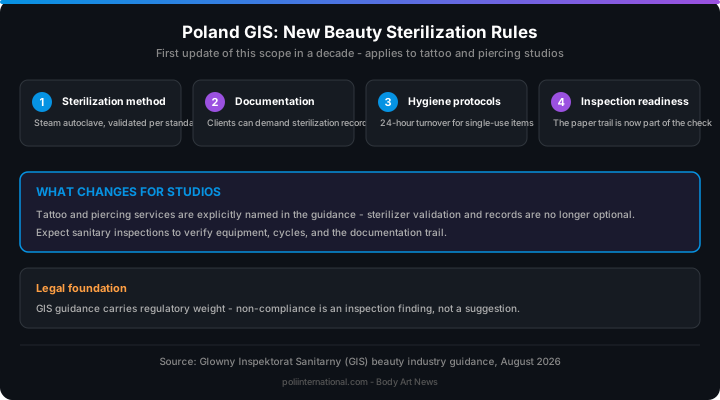
Poland GIS beauty sterilization rules: four requirements for tattoo and piercing studios
Infographic: Poland GIS beauty sterilization rules: four requirements for tattoo and piercing studios

The word recommendation undersells the document's practical weight. Polish sanitary inspectors (sanepid) evaluate studios against published standards, and GIS has now published the standard. A studio that cannot show a written infection-control procedure, a defined decontamination workflow, and sterilization documentation is exposed during inspection, regardless of whether the document is technically a regulation.

The guidance is explicit about the risk it is designed to manage: procedures that breach tissue continuity can transmit bacterial, viral, fungal, and parasitic infections, including hepatitis B, hepatitis C, HIV, herpes, and skin and eye infections. For tattoo and piercing work, where needles and jewelry routinely breach the dermis, this is the entire risk profile of the profession.

What the Guidelines Actually Require

Three requirements stand out as the operational core.

First, autoclave sterilization as the baseline for reusable tools. GIS adopts the Spaulding classification: tools that contact intact skin need disinfection; tools that contact mucous membranes or damaged skin need high-level disinfection or sterilization; tools that penetrate sterile tissue must be sterilized. The preferred method is high-temperature steam sterilization under pressure in an autoclave, and the full decontamination chain runs pre-disinfection, washing, proper disinfection, rinsing, drying, packaging, sterilization, and storage.

Second, client-verified sterile packages. Tools in closed sterile packages must be opened directly before the procedure, preferably in the presence of the client. The client may ask to inspect the package and the documents confirming sterilization. Damaged, unsealed, or previously opened packages must be treated as non-sterile. This turns sterilization transparency into a customer-facing feature, not just an internal process.

Third, documented process control. Sterilization must be verified with physical, chemical, and biological indicators. GIS calls for the Bowie-Dick test daily before work on steam sterilizers, biological indicator testing at least weekly, and a documentation log for every sterilization batch covering the operator, the date, package labeling, and the results of physical, chemical, and biological controls. Autoclaves must be serviced regularly, with maintenance records kept on site.

What Changes for Tattoo and Piercing Studios

The spatial requirements are the biggest practical change. Studios that sterilize their own instruments must organize decontamination into three zones: contaminated, clean, and sterile, with tool flow moving in one direction only, from used and soiled to finished sterile packages. Cleaning tools must not happen at the same time as tissue-breaching procedures. Studios may instead outsource sterilization to a specialized external facility, but must keep documentation such as a contract, invoices, or a register proving regular transfers.

Hand hygiene rules are tightened. Gloves must be changed for every client and do not replace hand washing, which must last at least one minute for non-tissue-breaching services. Sterile single-use gloves are recommended for procedures that breach tissue continuity. Workstations must display hand-hygiene instructions and carry a disinfectant dispenser.

Storage rules close a common loophole. Tools and accessories must be kept in cabinets, drawers, or closed containers, not on work surfaces, and single-use, disinfected, and sterile items must not be stored loose together in one box or case. Packaged sterile instruments must be labeled with sterilization date and sterility-validity period.

What This Means for the Industry

For Polish studios, the practical message is to treat the GIS document as the new inspection benchmark immediately. The gap between a 2016-era process and a 2026-era one is real: three-zone layouts, documented batches, biological indicators, and client-facing transparency are not what most small studios inherited from the last decade.

The broader lesson extends beyond Poland. This is the same trajectory the rest of Europe has been on since the EU REACH tattoo ink restrictions took effect in 2022: regulators moving from ink chemistry to process control. When a national sanitary authority writes client-verified sterilization into its official guidance, the industry standard has shifted. Studios that already run documented autoclave programs, one-directional decontamination flows, and transparent client processes are ahead of the curve, and that is exactly where a body art business should want to be.

FAQ

Is the new Polish GIS guidance legally binding?

The document itself is a collection of recommendations and technical standards, not a new law or regulation. But it restates obligations that already exist under Article 16 of the 2008 Act on preventing infections, and GIS has said it will serve as the reference point during sanitary inspections.

Does the guidance apply to tattoo and piercing studios?

Yes, explicitly. The document names hairdressers, cosmetologists, manicurists, tattoo artists, and piercing specialists, plus salon owners and anyone responsible for organizing work.

What sterilization method does GIS require?

Steam sterilization under pressure in an autoclave for any reusable tool that can breach skin or mucous membranes. Tools are classified by Spaulding risk categories, and high-risk tools that penetrate sterile tissue must be sterilized.

Can clients really demand to see sterilization documentation?

Yes. Sterile packages must be opened directly before the procedure, preferably in the client's presence, and the client may ask to inspect the package and documents confirming sterilization was performed. Damaged or previously opened packages must be treated as non-sterile.

What should a Polish studio do before the next sanitary inspection?

Audit the decontamination area for a three-zone layout (contaminated, clean, sterile) with one-directional flow, verify autoclave testing (daily Bowie-Dick where applicable, weekly biological indicators), and start documenting every sterilization batch with operator, date, package labeling, and control results.
Mind map · Poland's Sanitary Inspectorate Just Rewrote the Sterilization Rules for Tattoo and Piercing Studios

  • Poland 2026 Beauty Sanitary Guidelines
    • Autoclave Sterilization Standards

      The Polish beauty guidelines require steam sterilization in autoclaves for all tools that breach skin tissue.

      • Class B Autoclaves
        • Fractionated Vacuum Cycle
      • Process Effectiveness Monitoring
        • Weekly Biological Testing
    • Three Zone Spatial Separation

      Salons sterilizing tools on site must divide their decontamination area into contaminated, clean, and sterile zones.

      • Contaminated Zone
        • Tool Cleaning and Disinfection
      • Clean Zone
        • Pouch Packaging
      • Sterile Zone
        • Unloading and Storage
    • Medical Waste Management Rules

      Beauty studios that generate hazardous medical waste must register with the Polish electronic BDO waste database.

      • Hazardous Infectious Waste
        • Rigid Red Containers
      • National BDO Database
        • Waste Transfer Cards
    • Infection Prevention Legal Basis

      Polish infection prevention law requires individuals performing tissue-breaching activities to apply procedures that protect against infections.

      • Infection Control Act
        • Article 16 Obligations
      • Official Sanitary Inspections
StructureProcessMaterialHazard

4 branches, 0 sources. Each branch cites the article it came from; the labels beneath it are names, not claims.

GIS Sterilization Quiz

  1. 1. What is the specific legal foundation underlying the GIS hygiene and sterilization guidance published in August 2026?

    • ✓ Article 16 of the Act of 5 December 2008 on preventing and combating infections and infectious diseases. — The guidance consolidates requirements anchored in Article 16 of the 2008 Act, which mandates infection control procedures for non-healthcare activities breaching tissue continuity.
    • • A newly enacted statutory law passed by the Polish Parliament in August 2026 specifically for body art. — The GIS document is a consolidated statement of recommendations and technical standards rather than a newly enacted statutory law.
    • • The 2022 EU REACH regulation governing tattoo ink chemistry and studio sanitation standards. — EU REACH regulations restrict tattoo ink chemical compositions rather than forming the national legal basis for Polish sanitary guidance.
    • • The 2016 Chief Sanitary Inspectorate decree establishing mandatory autoclave certification for small businesses. — The 2016 document was the previous GIS baseline standard, not a statutory decree establishing autoclave certifications.
  2. 2. Under the Spaulding classification adopted in the GIS guidance, how must reusable tools that penetrate sterile tissue be processed?

    • ✓ High-temperature steam sterilization under pressure in an autoclave. — Tools penetrating sterile tissue fall under the highest risk category, requiring complete sterilization with steam under pressure as the preferred method.
    • • High-level chemical disinfection followed by rinsing with sterile water. — High-level disinfection is designated for tools contacting mucous membranes or damaged skin, not tools penetrating sterile tissue.
    • • Surface disinfection using a certified anti-viral dispenser solution. — Surface disinfection is reserved only for tools coming into contact with intact skin.
    • • Pre-disinfection and ultrasonic washing without requiring high-pressure thermal processing. — Pre-disinfection and washing are merely initial stages in the decontamination chain preceding actual sterilization.
  3. 3. What daily process-control test does GIS require before starting work on steam sterilizers?

    • ✓ The Bowie-Dick test. — The guidance specifically mandates a daily Bowie-Dick test on steam sterilizers before operational work begins.
    • • A biological indicator assay. — Biological indicator testing is required at least weekly rather than as a daily pre-work check.
    • • A chemical indicator strip placed inside storage drawers. — Chemical indicators are evaluated per sterilization batch rather than placed inside storage drawers.
    • • A one-minute thermal flow validation check. — One minute represents the minimum required duration for hand washing during non-tissue-breaching services, not an autoclave test.
  4. 4. According to the 2026 GIS guidance, what spatial layout must a studio implement if it sterilizes instruments on site?

    • ✓ A three-zone layout (contaminated, clean, sterile) operating with strict one-directional tool flow. — On-site sterilization requires three distinct zones where tools move progressively from contaminated to clean to sterile without reversing direction.
    • • A two-zone system separating chemical disinfection areas from active client tattooing workstations. — A two-zone setup fails to establish the mandatory separation between clean prep areas and final sterile packaging zones.
    • • A centralized open-plan processing station equipped with dedicated air filtration units. — Open-plan setups violate spatial segregation and risk cross-contamination during simultaneous tissue-breaching procedures.
    • • A single isolated storage cabinet housing unwashed, disinfected, and sterile tools in separate bins. — Storing unwashed and disinfected items alongside sterile items in one container is explicitly prohibited by storage rules.
  5. 5. What are the specific requirements established by GIS regarding hand hygiene and glove usage?

    • ✓ Gloves must be changed for every client, and hand washing before non-tissue-breaching services must last at least one minute. — GIS requires fresh gloves for each client, specifies a one-minute minimum hand wash for non-tissue services, and explicitly notes gloves do not replace washing.
    • • Gloves replace hand washing if sterile single-use gloves are worn throughout the procedure. — The guidelines explicitly state that wearing gloves never replaces the necessity of performing proper hand washing.
    • • Hand washing must last at least three minutes prior to every service, regardless of whether tissue continuity is breached. — The standard hand washing duration defined for non-tissue-breaching services is one minute rather than three minutes.
    • • Disinfectant dispensers can replace hand washing stations as long as they are installed at every workstation. — Workstations must display instructions and carry disinfectant dispensers, but these supplement rather than replace hand washing.
  6. 6. What client-facing rights regarding sterilization transparency are explicitly outlined in the GIS guidelines?

    • ✓ Clients may ask to inspect both the sterile package and the documents confirming sterilization before a procedure. — The rules state packages must be opened directly before the procedure, preferably in front of the client, who has the right to inspect packages and sterilization logs.
    • • Clients can request that reusable tools be disinfected on workstation surfaces immediately prior to use. — Surface disinfection is insufficient for tissue-breaching tools, which must undergo full autoclave sterilization and remain sealed until use.
    • • Clients must personally sign the studio's daily Bowie-Dick test log prior to receiving a piercing or tattoo. — The documentation log is maintained by the equipment operator for every batch, not signed by individual clients.
    • • Clients may opt out of single-use sterile packaging if tools were processed in an autoclave within the last 24 hours. — Sterile packaging is a strict requirement for processed tools, and damaged or unsealed packages must always be treated as non-sterile.
  7. 7. If a studio chooses to outsource its instrument sterilization to an external facility, what documentation must it maintain on site?

    • ✓ A contract, invoices, or a register proving regular transfers of instruments to the specialized facility. — Studios outsourcing sterilization are exempt from maintaining on-site decontamination zones provided they keep records like contracts, invoices, or transfer registers.
    • • Daily Bowie-Dick test logs generated and certified by the external facility's operator. — External facilities maintain their own daily equipment logs; the studio only needs to document the transaction and transfer of tools.
    • • A written waiver from the local sanitary inspectorate exempting the studio from spatial zoning rules. — Outsourced sterilization is an approved alternative method within the guidance, requiring transfer documentation rather than an inspectorate exemption waiver.
    • • Weekly biological indicator culture tubes shipped back to the studio for local storage. — Biological testing is performed on the sterilizer equipment itself at the external facility, not shipped back as raw culture tubes to the studio.
  8. 8. Which option correctly lists the complete order of steps in the instrument decontamination chain mandated by GIS?

    • ✓ Pre-disinfection, washing, proper disinfection, rinsing, drying, packaging, sterilization, and storage. — GIS defines the complete chain in exact chronological order from initial pre-disinfection through cleaning, proper disinfection, drying, packaging, autoclaving, to final storage.
    • • Washing, pre-disinfection, packaging, proper disinfection, sterilization, drying, and storage. — Pre-disinfection must occur prior to washing, and packaging occurs after tools are properly disinfected, rinsed, and dried.
    • • Pre-disinfection, packaging, steam sterilization, proper disinfection, rinsing, drying, and storage. — Packaging must take place before tools enter the sterilizer, not before the proper disinfection and drying phases.
    • • Surface disinfection, washing, drying, steam sterilization, proper disinfection, and packaging. — Surface disinfection is not part of the reusable instrument decontamination chain, and packaging must precede sterilization.
  9. 9. What specific rule applies to the storage of disinfected, sterile, and single-use items in a body art studio?

    • ✓ They must be stored in closed cabinets or drawers and cannot be kept loose together in a single box. — Storage rules mandate that tools reside in closed furniture and strictly prohibit mixing single-use, disinfected, and sterile loose items in one container.
    • • They can be stored together loose in a single container provided the container is kept on a clean workstation surface. — Storing loose items of different cleanliness statuses together in one box is explicitly identified as a prohibited practice.
    • • Packaged sterile items can be kept uncovered on active work surfaces if used within 24 hours of sterilization. — Tools and accessories must be stored inside cabinets, drawers, or closed containers, never left sitting open on work surfaces.
    • • Sterile packages only require labeling with the operator's initials and autoclave model number. — Packaged sterile instruments must be labeled with the sterilization date and sterility-validity period.
  10. 10. How frequently must body art studios perform biological indicator testing on their in-house steam sterilizers under the 2026 GIS guidance?

    • ✓ At least weekly. — While physical and chemical controls occur per batch and Bowie-Dick tests run daily, biological indicators must be tested at least weekly.
    • • Daily before work begins. — Daily testing before work is required for the Bowie-Dick test, not the biological indicator testing.
    • • After every individual sterilization batch. — Biological testing is mandated on a weekly frequency rather than for every single batch run through the machine.
    • • Monthly during equipment routine cleaning. — Biological testing must be conducted at least weekly to ensure continuous sterilizer efficacy.

Extended Reference Table

8 of 8 rows

Extended reference table generated from the article and its verified research sources. Bracketed numbers jump to the matching entry in the Technical References below.

SafetyItem, Practice or Standard Industry Sector Requirement or Specification Decontamination Protocol Personnel Obligations Source
✅Small Steam Sterilizers (PN-EN 13060)Tattoo, Piercing, Cosmetics, Podiatry, HairdressingMust meet PN-EN 13060 medical standards for Class B (fractionated vacuum) for porous/hollow loads.Validated sterilization at 121°C (15-20 min) or 134°C (3-5 min). Requires daily Bowie-Dick/Helix tests.Ensure annual servicing by authorized technicians. Monitor and archive physical parameters (temp, pressure, time) for every cycle.
✅WHO Hand Hygiene TechniqueBeauty Industry, Tattoo, Piercing, PodiatryAyliffe technique; compliance with Act on Preventing Infections (Art. 16) and GIS guidelines.Wash with liquid soap (30-60s) followed by alcohol-based disinfectant rub on dry skin (30s).Remove all hand jewelry/watches. Disinfect before/after clients, before donning gloves, and after removing gloves.
✅Biological Sterilization Control (Sporal A)Tattoo, Piercing, Cosmetics, PodiatryGeobacillus stearothermophilus indicators to confirm total microbial destruction.Indicator placed in the most difficult-to-reach area of the load. Frequency: at least quarterly, recommended weekly.Archive lab results and sterilization logs for 10 years for inspection by sanitary authorities.
✅Sterilization Packaging (Paper-foil)Beauty Industry (All sectors), Tattoo, PiercingPN-EN 868-5; maximum storage of 2 months in closed cabinets (up to 6 months in specific conditions).Fill to max 3/4 capacity with 3cm margins. Use heat seals or self-adhesive strips; verify seal integrity before use.Label with date and expiration. Place internal chemical indicators (Class 4, 5, or 6). Open only in client's presence.
✅Medical Waste ManagementTattoo, Piercing, Cosmetics, Aesthetic MedicineCode 18 01 03*; containers must be rigid, red, and puncture-resistant with single-close mechanisms.Store infectious waste for max 72h (or 30 days at ≤ 10°C). Fill sharps containers to max 2/3 or 3/4 capacity.Register in BDO database; maintain Waste Transfer Notes (KPO). Use gloves when handling biological waste.
✅Straight Razors (Brzytwy)Barbering, HairdressingHigh-risk tools requiring full decontamination due to potential blood contact.Remove disposable blade to sharps container. Handle: wash, clean, disinfect (broad-spectrum), and sterilize in autoclave.Use protective gloves. Stop service immediately if injury occurs and follow occupational exposure protocols.
✅Invasive Tools (Nippers/Needles)Cosmetics, PMU, Tattoo, Piercing, PodiatrySpaulding Classification: Tools penetrating sterile tissue must be sterile. Single-use needles are mandatory.Pre-disinfection (up to 3h dry), ultrasonic cleaning, rinsing, drying, packaging, and steam sterilization.Verify tool integrity and lubricate joints. Maintain HBV vaccination. Open sterile packages in front of the client.
✅Ultrasonic CleanerCosmetology, Hairdressing, Tattoo, NailsMechanical cleaning device used as a preliminary step before sterilization.Use dedicated cleaning-disinfecting agents and room temperature water for a time specified by the manufacturer.Personnel must know preparation concentrations (e.g., 2.0% dilution) and mark containers with the date and product name.

Free Body Art Wall Posters

Print-ready reference posters for your studio or your own wall. Free to download and display, embed on your own site with attribution. Click any poster to preview it full size before downloading.

Choose and download all 40 posters

Technical_References_Archive

About the Author

PP

Patrick Poli

Chief Engineer, Poli International · Creator of BioFlex® body jewelry

Patrick has spent 25+ years manufacturing body jewellery and studio equipment, and is the creator of BioFlex® body jewelry. He created the push-fit system so jewellery separates on impact instead of tearing the piercing. He also ran 10 to 25 minute consultations before piercing, and treats aftercare as a standing invitation rather than a leaflet.

More about Patrick →

Last reviewed: 2026-10-11 · Published: 2026-08-08

Related Tools & Reading

Continue Reading