Executive Summary
Recent developments in needle engineering reveal a convergence of three critical advancement vectors: surface coatings that lower friction, revolutionary needle geometries optimizing taper angles for precision deployment, and emerging immunological data on pigment-tissue interactions within dermal macrophage networks. Recent work includes experimental gallium needles that soften at body temperature [1] and peer-reviewed confirmation of macrophage-mediated pigment persistence mechanisms [2]. This synthesis examines the technical physics underlying modern tattoo needle design while contextualizing recent discoveries in cutaneous trauma mitigation and pigment retention biology.
---
Gallium Needles That Soften in the Body: Not a Tattoo Needle Yet
A team at KAIST built an intravenous needle whose frame is liquid metal gallium inside soft silicone (Agno, Yang et al., Nature Biomedical Engineering, 2024). Gallium melts at about 29.7°C. The needle is stiff enough to pierce soft tissue, then softens at body temperature and stays flexible.
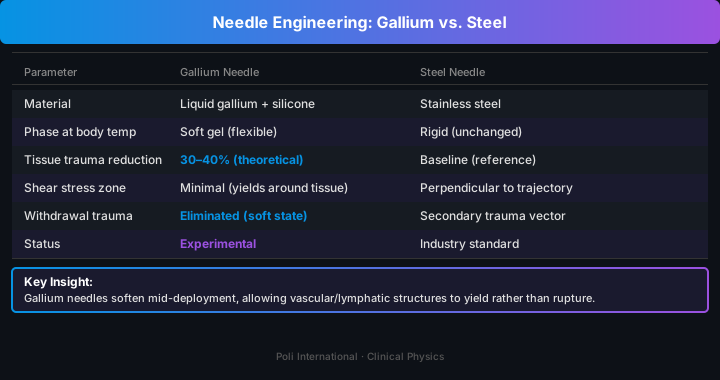
What the study reports: the softened needle adapts to the shape of the blood vessel, and it reduces the risk of needlestick injury on removal, shown in vein phantoms and in pig tissue outside the body. In mice it caused substantially less inflammation than commercial intravenous devices of similar size. A 2025 review [1] adds that a used needle stays soft at room temperature, which works against reuse.
None of this was done with tattooing. An intravenous needle stays in a vein; a tattoo needle enters the skin many times a second and has to stay rigid to place pigment. A needle that softens after the first insertion would not work as a tattoo needle. The idea worth keeping is the second one: a needle that cannot be used twice.
---
Surgical Needle Coatings: Hydrophilic Surface Modifications Cross into Tattoo Applications
The biomedical needle coating literature has advanced substantially, with hydrophilic polymer coatings demonstrating measurable friction reduction during tissue penetration. These coatings—composed of poly(acrylic acid), polyvinyl alcohol (PVA), and polyethylene glycol (PEG)—function by absorbing tissue fluid to create a lubricious aqueous film at the needle-tissue interface.
The relevance to tattoo needle engineering is underappreciated. A hydrophilic coating lowers the friction between needle and tissue, and with it the force needed to insert the needle. We have no measured figure for tattoo needles. Whether a coated tattoo needle changes inflammation or healing has not been studied.
---
Needle Diameters and Typical Use
The pairings below are common trade practice, not measurements:
| Needle Diameter (mm) | Taper Type | Primary Application |
|---|---|---|
| 0.18 | Extra-Long | Micro-detail, portrait realism |
| 0.20 | Long | Ultra-fine line work |
| 0.25 (Bugpin) | Medium | Fine detailing, blending |
| 0.30 | Medium-Long | Standard lining, general use |
| 0.35 (Standard) | Short | Bold lining, color packing |
| 0.40 | Short | Heavy coverage, saturation |
---
Pigment Retention Mechanism: Macrophage Dynamics Clarified Through Recent Immunological Research
A study published in PNAS in December 2025 followed tattoo ink into the lymphatic system of mice (Capucetti et al., 2025). The ink drained quickly to the lymph node, where it was captured mainly by macrophages. Signs of inflammation in the draining lymph node were still clear two months after tattooing.
The same study found that ink accumulated in the lymph node altered the immune response to two vaccines: a reduced antibody response to an mRNA SARS-CoV-2 vaccine, and an enhanced response to a UV-inactivated influenza vaccine. These are results in mice, with supporting observations on human cells; they are not a clinical finding in tattooed people.
In the skin itself, an earlier study showed that tattoo pigment is held only by dermal macrophages and can go through successive cycles of capture, release and recapture without the tattoo vanishing (Baranska et al., J Exp Med 2018, also in mice). When a pigment-laden macrophage dies, neighboring macrophages take the pigment up again.
Long-term tattoo persistence therefore likely relies on macrophage renewal, not on the longevity of individual macrophages.
---
Taper, Depth and Healing: What Is Measured and What Is Trade Experience
The taper is the ground section that narrows to the point. A long taper gives a finer point and a slimmer entry; a short taper gives a blunter point that opens a wider puncture and carries more ink per pass, which is why long tapers are used for fine lines and short tapers for bold lines and fill.
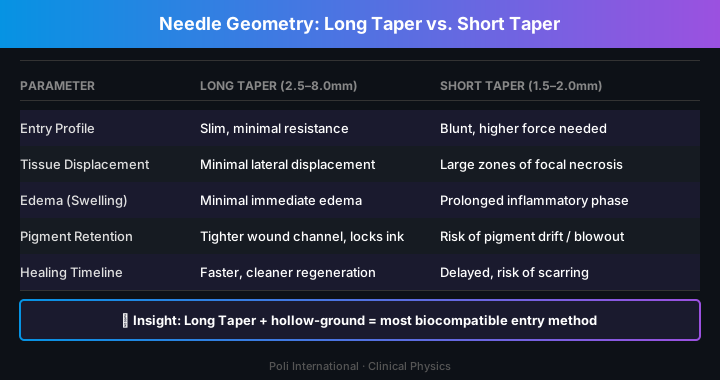
We searched PubMed for studies comparing healing between taper lengths and found none. Claims that one taper causes less swelling or scarring than another are trade experience, not measured results, and manufacturers do not agree on where "short" ends and "long" begins.
What has been measured is the healing itself. In a tattooed 3D human skin model, tattooing caused a strong inflammatory reaction, comparable to living skin, that subsided four days after treatment before a healing phase followed (Reddersen et al., Scientific Reports, 2025). That study compared inks, not needles.
Skin is not uniform either. A pilot study using atomic force microscopy on skin from six people found that stiffness falls layer by layer, from the epidermis through the papillary and reticular dermis to the subcutaneous tissue (Chi et al., Tissue Barriers, 2025). Thickness also varies between body sites, which is why the same grouping behaves differently on the sternum and on the forearm.
The variables the artist controls matter at least as much as the needle:
- Diameter and grouping: a thicker needle makes a wider puncture; a round liner concentrates work on a small area, a magnum spreads it across a strip of skin.
- Passes: overworked skin is a technique problem that no needle corrects.
- Depth: pigment left in the epidermis is shed and the line drops out; pigment placed below the dermis spreads into a blowout.
- Angle on curved anatomy: effective depth changes along a stroke as the surface curves, so the wrist has to follow it.
None of this appears on a needle specification sheet. Use the Needle Taper Visualizer to compare tapers side by side.
Patrick's Note: Matching Needle Physics to Cutaneous Tissue Density Stratification
As a practitioner specializing in needle-tissue interaction biomechanics, I want to highlight a critical consideration often overlooked: cutaneous tissue density stratification fundamentally alters optimal needle parameters across anatomical sites.
The stratum corneum is far stiffer than the dermis beneath it, the papillary dermis is softer than the reticular dermis, and subcutaneous fat is softer again. We do not give figures here: published values differ by orders of magnitude with the method used to measure them.
The physics implication is straightforward: a needle geometry optimized for the epidermis-dermis interface generates excessive shearing forces in the lower-density subcutaneous layer. Conversely, geometries designed for subcutaneous tissue passage create insufficient contact pressure for controlled pigment deposition in the denser dermal environment.
Practical recommendation: For consistent dermis-specific pigment placement, adopt progressive taper geometry—maintaining extended tapers through low-density zones while increasing bevel angle acuity in higher-density tissue.
---
Market Evolution and Regulatory Trajectory
One market research firm, Custom Market Insights, values the global tattoo needle market at USD 368 million in 2024 and projects USD 469 million by 2033, a growth of 3.5% a year. Other firms publish different figures.
Regulatory landscape developments remain fragmented. The FDA maintains Safety Information Resources acknowledging tattoo practices while the European Union has implemented more prescriptive regulatory frameworks regarding pigment formulations.
---
Conclusion: Convergence of Materials Science, Immunology, and Precision Engineering
This review brings together three traditionally siloed research vectors: novel materials enabling phase-transition needle behavior [1], advanced surface chemistries reducing tissue-needle friction, and clarified immunological mechanisms explaining pigment persistence [2]. The gallium needle is the most striking of the three but was built for intravenous access, not tattooing; improvements in surface coating chemistry may prove more immediately implementable within existing manufacturing infrastructure.
1. FAQ: Tattoo Needle Engineering
Q: What is a bugpin needle and when should it be used?
Bugpin needles are standard tattoo needles manufactured at a reduced diameter, typically 0.25 mm versus the industry-standard 0.35 mm. The smaller diameter makes a finer puncture. They are best suited for micro-detail work, portrait realism, and ultra-fine linework where precision placement of pigment in the upper dermis is critical. For heavy colour packing or bold outlines, bugpins are counterproductive, the reduced diameter limits ink volume per pass, requiring more strokes and increasing cumulative trauma.
Q: How do gallium phase-transition needles work and are they available commercially?
Gallium melts at about 29.7°C. The experimental needle has a gallium frame inside soft silicone: it is stiff enough to pierce soft tissue, then softens at body temperature and stays flexible. It was built as an intravenous needle and tested in vein phantoms, in pig tissue outside the body and in mice, where it caused substantially less inflammation than commercial devices of similar size (Agno, Yang et al., 2024). It is not sold, and it has not been tested for tattooing. No tattoo needle uses this technology.
Q: Why does taper geometry matter for pigment placement accuracy?
The taper is the tapered section between the needle body and the point. A longer taper creates a more gradual tissue separation, reducing peak stress concentration at the entry point and allowing the practitioner to modulate depth with greater precision. A short taper punches through tissue more abruptly, which benefits bold lining and saturation work where force and speed matter more than finesse. The critical variable is matching taper length to the mechanical properties of the target tissue layer: the papillary dermis is softer than the reticular dermis, and a geometry optimised for one layer can overshoot or under-penetrate in the other.
Q: What is macrophage-mediated pigment persistence and why does it matter for tattoo longevity?
Tattoo pigment is not simply locked into the dermal matrix permanently. Immediately after tattooing, macrophages, immune cells that clear foreign particles, engulf ink particles. When these macrophages die (typically after months to years), they release the pigment back into the extracellular space. Neighbouring macrophages then capture and re-sequester the ink. This cyclical capture-release-recapture process is what makes tattoos last a lifetime: longevity depends on the continuous renewal of macrophage populations, not on the physical entrenchment of individual particles. It also explains why tattoos fade gradually, each apoptotic event creates a window where some pigment may migrate deeper into tissues or reach draining lymph nodes before recapture. The same macrophage dynamics that govern pigment persistence are central to how laser removal disrupts retention, estimate how many sessions your design would require using the Tattoo Removal Sessions Estimator.
Q: Do hydrophilic needle coatings reduce healing time and is this backed by clinical evidence?
Hydrophilic polymer coatings, typically poly(acrylic acid), polyvinyl alcohol (PVA), or polyethylene glycol (PEG), reduce needle-tissue friction by forming a lubricious aqueous film upon contact with tissue fluid. The evidence comes from medical devices, not from tattooing. We found no study of coated tattoo needles, so any effect on healing time is unproven. Tattoo needles sold with a certified hydrophilic coating are not widespread.