Shop
Clinical Physics

Surface Finish Physics: Why Polished Jewelry Resists Bacteria Better
PP

Chief Engineer

Patrick Poli

Journal Date

2026-08-02

Last Reviewed

2026-10-12

Surface Finish Physics: Why Polished Jewelry Resists Bacteria Better

Surface finish and bacterial adhesion: how roughness and surface energy control biofilm formation on body jewelry
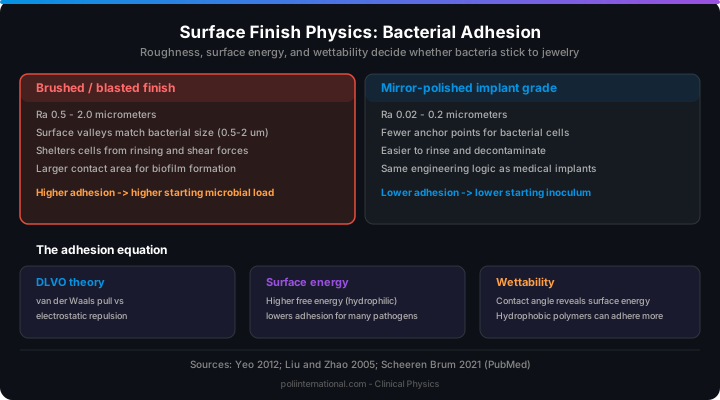
Infographic: Surface finish and bacterial adhesion: how roughness and surface energy control biofilm formation on body jewelry

Key Takeaways:

>> Bacterial adhesion is colloid physics, not luck: roughness, surface energy, and wettability decide whether bacteria stick
>> Mirror-polished jewelry (Ra below 0.2 micrometers) gives bacteria fewer anchor points than brushed or matte finishes
>> DLVO theory explains adhesion as a balance of van der Waals attraction and electrostatic repulsion
>> Higher surface free energy (hydrophilic) generally lowers bacterial adhesion for many clinically relevant pathogens
>> No finish is antibacterial; low roughness only reduces the starting load that aftercare must remove

1. The Hidden Metric: Surface Roughness

Every piece of body jewelry has a surface finish, and every finish has a number: Ra, the arithmetic average of surface height deviations from the mean line. A mirror-polished implant-grade steel post typically measures Ra 0.02 to 0.2 micrometers. A brushed, blasted, or matte finish measures 0.5 to 2 micrometers or more. That gap is not cosmetic; it is the difference between a surface that bacteria can grip and one they slide off.

Bacteria are roughly 0.5 to 2 micrometers in size. Surface features in that same size range act as physical shelters. A scratch or valley of comparable dimension shields part of the bacterial cell from shear forces during rinsing, increases the true contact area between cell and surface, and slows the effect of antimicrobial rinses. Systematic clinical evidence supports this: a systematic review of early biofilm formation on titanium found that rough specimens accumulated more biofilm than smooth ones across multiple clinical studies. The mechanism is not species-specific; it is geometry.

2. DLVO Theory: Why Bacteria Stick at All

The standard framework for bacterial adhesion is DLVO theory, developed for colloid science and applied to microbiology since the 1980s. A bacterium behaves like a charged colloidal particle roughly one micrometer across. As it approaches a surface, two forces compete: van der Waals attraction pulls it in, while electrostatic repulsion between the bacterium surface charge and the material charge pushes it away. Whether the cell lands depends on the net balance at the minimum of the interaction energy curve.

The extended XDLVO model adds a third term: Lewis acid-base interactions, which capture the hydrophobic effect. This matters because it connects adhesion to the material surface chemistry, not just its topography. Experimental work using jet impingement has shown that DLVO and XDLVO calculations predict measured bacterial adhesion on polymer and metal surfaces with reasonable accuracy. The physics is predictive enough to be useful, which is more than can be said for most folklore in the piercing industry.

3. Surface Energy and Wettability

Wettability is the practical expression of surface energy. When a drop of liquid sits on a surface, the contact angle it forms tells you the surface free energy: low contact angle means hydrophilic, high surface energy; high contact angle means hydrophobic, low surface energy. For many clinically relevant pathogens, hydrophilic surfaces with higher surface energy show lower bacterial adhesion than hydrophobic ones.

The classic demonstration comes from Liu and Zhao, who modified surfaces to vary surface energy and measured adhesion of several bacterial strains. Adhesion decreased as the surface became more hydrophilic, and the relationship tracked the thermodynamic work of adhesion. The practical implication for body jewelry is uncomfortable for one popular material family: smooth hydrophobic polymers can be easier for some bacteria to colonize than polished metal. Surface energy is not the only variable, but it is a real one, and it should be part of the material decision, not an afterthought.

4. From the Laboratory to the Piercing Studio

Translate the physics into studio practice and three rules emerge. First, specify the finish: implant-grade components should arrive with a documented polish, not a texture you can feel with a fingernail. Second, protect the finish: repeated autoclave cycles, ultrasonic cleaning, and rough handling with metal tools all introduce micro-scratches that raise the effective Ra over the life of the jewelry. A piece that starts at 0.05 micrometers can degrade toward 0.5 with years of abuse, quietly becoming a better anchor for biofilm. Third, clean the geometry: the crevice where a threadless pin meets its receptacle is a roughness feature of its own, and no polish removes it. That junction is where low-roughness surfaces matter least and where meticulous aftercare matters most.

4.5. Dermal Anchors: Where Smoothest Is Not the Whole Story

Everything above concerns jewellery that passes through a healed or healing channel, where the goal is for nothing to stick. A dermal anchor is different: its base sits under the skin permanently, and the surrounding tissue has to hold it. A mirror finish keeps bacteria off, but it also gives fibroblasts very little to attach to, and an anchor the tissue cannot grip relies on its base shape alone. In mobile areas that can mean micro-movement, chronic irritation and eventual rejection.

Research on percutaneous and transmucosal titanium implants (bone-anchored prostheses, dental implants) has therefore moved towards engineered surface topography, including laser surface texturing, which patterns the titanium itself rather than adding a coating that could chip. Reviews describe better soft-tissue attachment on suitably textured, more wettable surfaces, while stressing that the texture must stay fine enough not to trap debris. That evidence comes from medical implants, not from body jewellery trials, so treat it as direction rather than proof for anchors.

For a studio the practical checks are the same as for any implant: genuine ASTM F136 titanium, a texture applied to the parent metal rather than a coating, and a conservative choice for clients with a history of keloid or hypertrophic scarring.

5. What the Physics Does Not Promise

Surface finish is one term in a larger equation. Material composition, geometry, wear, the wearer skin microbiome, and aftercare compliance all contribute to infection risk. A perfect mirror polish does not make jewelry antimicrobial; it lowers the starting inoculum that a healing channel must tolerate. That reduction is real and measurable, which is why medical implant manufacturers spend real money on electropolishing. It is the same engineering logic applied to a smaller product.

Clinical Takeaways

1. Prefer mirror-polished implant-grade jewelry with Ra at or below 0.2 micrometers, especially for initial piercings
2. Treat brushed, blasted, or textured surfaces as higher-adhesion surfaces that need more aggressive cleaning
3. Inspect jewelry for visible scratches at every aftercare visit; replace worn pieces
4. Do not rely on polish to compensate for poor geometry: junctions, hinges, and threads still trap debris
5. Consider surface energy alongside material when choosing between metal and polymer jewelry


FAQ


What Ra value should body jewelry have to minimize bacterial adhesion?


Mirror-polished implant-grade jewelry should have an Ra (arithmetic average surface roughness) below 0.2 micrometers, with premium pieces often measuring between Ra 0.02 and 0.1 micrometers. This is critical because bacteria are roughly 0.5 to 2 micrometers in size, and surface features in that range act as physical shelters from shear forces during rinsing. Systematic reviews of early biofilm formation on titanium confirm rough specimens consistently accumulate more biofilm than smooth ones, making low Ra a measurable, non-negotiable baseline for safe jewelry.


Is a polished surface actually antibacterial, or does it just reduce bacteria?


No finish is antibacterial; a mirror polish only reduces the starting bacterial load that your aftercare routine must remove. Polished surfaces (Ra below 0.2 micrometers) give bacteria fewer anchor points and increase the effectiveness of rinsing, but they do not kill microbes. The practical benefit is a lower baseline contamination, which means your saline spray or rinse has less biofilm to overcome, making your aftercare intrinsically more effective.


Why does DLVO theory matter for choosing body jewelry materials?


DLVO theory predicts whether a bacterium will adhere by balancing van der Waals attraction against electrostatic repulsion, and the extended XDLVO model adds a Lewis acid-base term that captures hydrophobicity. This physics is predictive: experimental jet impingement studies have shown DLVO/XDLVO calculations match measured bacterial adhesion on polymer and metal surfaces with reasonable accuracy. For jewelry selection, this means material chemistry and surface charge matter just as much as polish—they determine whether the net interaction energy curve favors the cell sticking or sliding off.


Are hydrophobic or hydrophilic surfaces better for resisting bacteria on body jewelry?


Hydrophilic surfaces with higher surface free energy generally show lower bacterial adhesion for many clinically relevant pathogens. The classic demonstration by Liu and Zhao modified surfaces to vary surface energy and found adhesion decreased as surfaces became more hydrophilic, with the trend tracking the thermodynamic work of adhesion. This has a direct implication for jewelry: smooth hydrophobic polymers can be easier for some bacteria to colonize than polished metal, so high surface energy is a real factor in material choice, not an afterthought.


Does brushing or matte-finish jewelry hold more bacteria than mirror-polished jewelry?

Yes, brushed or blasted finishes measuring Ra 0.5 to 2 micrometers or more provide significantly more physical shelter for bacteria than a mirror polish. Surface features in the same size range as the bacterial cell (0.5–2 micrometers) shield part of the organism from shear forces, increase true contact area, and slow the penetration of antimicrobial rinses. The mechanism is purely geometrical and not species-specific, meaning a matte finish is not a cosmetic neutral choice—it is a quantified disadvantage in biofilm management.


Mind map · Surface Finish Physics: Why Polished Jewelry Resists Bacteria Better

  • Surface Finish and Bacterial Adhesion
    • Microscopic Surface Roughness

      Mirror-polished implant-grade jewelry with roughness below 0.2 micrometers provides fewer physical anchor points for bacteria.

      • Roughness Metrics and Thresholds
        • Ra Below 0.2 Micrometers
        • Brushed Finishes Over 0.5
      • Bacterial Micro-Shelters in Valleys
        • Protection From Rinsing Shear
    • DLVO Physics Model

      Colloid science explains bacterial adhesion as a balance between attractive van der Waals forces and electrostatic repulsion.

      • Classical DLVO Adhesion Forces
        • Van der Waals Attraction
        • Electrostatic Repulsion Outliers
      • Extended XDLVO Model Forces
        • Lewis Acid Base Interactions
    • Surface Energy and Wettability

      Hydrophilic surfaces with high surface free energy generally show lower bacterial adhesion than hydrophobic surfaces for many pathogens.

      • Wettability Metric Measurements
        • Contact Angle Analysis
      • Pathogen Adhesion and Polymers
        • Hydrophobic Polymer Adhesion Risks
    • Studio Applications and Takeaways

      Studio practices require specifying mirror-polished jewelry and protecting the finish from micro-scratches during cleaning and autoclave cycles.

      • Preserving Mirror Finish Integrity
        • Avoid Raw Ultrasonic Vibrations
      • Hygiene Limits and Warnings
StructureProcessMaterialHazard

4 branches, 0 sources. Each branch cites the article it came from; the labels beneath it are names, not claims.

Surface Finish Quiz

  1. 1. What does the surface finish metric Ra represent in the context of body jewelry?

    • ✓ The arithmetic average of surface height deviations from the mean line. — This metric quantifies average surface profile variations to evaluate micro-level roughness.
    • • The maximum depth recorded from the deepest single scratch on the post. — Peak-to-valley maximum depth is a single extreme peak measurement rather than an arithmetic average of all surface deviations.
    • • The total surface area increased by surface texturing relative to a flat plane. — This describes relative surface area expansion rather than average height deviation along a mean line.
    • • The rate at which a metal surface undergoes chemical oxidation. — Chemical reaction rates pertain to material degradation dynamics rather than physical topography measurements.
  2. 2. Why do surface features in the range of 0.5 to 2 µm significantly increase bacterial retention on jewelry?

    • ✓ They closely match bacterial dimensions, physically shielding cells from shear forces during rinsing. — Micro-scale depressions provide physical shelter that protects bacteria of comparable size from liquid flow.
    • • They trigger covalent bonding between metal atoms and bacterial cell walls. — Surface topography influences physical contact and shear shielding rather than forming chemical covalent bonds.
    • • They eliminate moisture in micro-cavities, creating dry environments required for biofilm growth. — Biofilm formation requires aqueous environments rather than dry, moisture-free conditions.
    • • They generate localized magnetic fields that pull free-floating bacterial cells to the surface. — Adhesion forces at this scale involve colloidal physics and physical topography rather than magnetism.
  3. 3. According to DLVO theory, which two fundamental forces dictate whether a bacterium adheres to a surface?

    • ✓ Van der Waals attraction and electrostatic repulsion. — DLVO theory models adhesion as the net balance between long-range attractive dispersion forces and surface charge repulsion.
    • • Capillary attraction and gravitational force. — Gravitational forces are negligible for micrometer-scale colloidal particles compared to surface interaction potentials.
    • • Hydrophobic attraction and viscous drag. — Viscous drag relates to dynamic fluid resistance rather than the static energy potential modeled in classical DLVO theory.
    • • Magnetic flux and covalent bonding. — Colloidal adhesion models focus on electrostatic and dispersion interactions rather than magnetic field forces.
  4. 4. What addition distinguishes the extended XDLVO model from classical DLVO theory when predicting bacterial attachment?

    • ✓ Lewis acid-base interactions. — The extended model incorporates acid-base interactions to account for electron donor-acceptor properties and hydrophobic effects.
    • • Tensile yield strength metrics. — Bulk mechanical properties like tensile strength do not govern interfacial colloidal forces.
    • • Thermal expansion coefficients. — Thermal expansion relates to bulk dimension changes with temperature rather than surface energy interactions.
    • • Gravitational acceleration vectors. — Gravitational forces do not explain the short-range hydrophobic effects added in the extended model.
  5. 5. Which experimental approach is highlighted in the source text as validating DLVO and XDLVO adhesion predictions on metals and polymers?

    • ✓ Jet impingement. — Jet impingement testing provides quantifiable hydrodynamic shear data to verify theoretical adhesion models.
    • • Ultrasonic bath agitation. — Ultrasonic cleaning is discussed as a maintenance process that can scratch jewelry rather than a model-validation experiment.
    • • Autoclave thermal cycling. — Autoclaving tests heat sterilization effects rather than measuring colloidal adhesion energy curves.
    • • Atomic force indentation. — Indentation measures surface mechanical hardness rather than hydrodynamic detachment and adhesion predictions.
  6. 6. How are liquid contact angle measurements interpreted regarding surface free energy and wettability?

    • ✓ A low contact angle indicates high surface free energy and a hydrophilic surface. — When liquid spreads easily, forming a low contact angle, the high surface energy attracts water droplets.
    • • A low contact angle indicates low surface free energy and a hydrophobic surface. — Low surface free energy causes liquids to bead up into high contact angles rather than spreading.
    • • A high contact angle indicates high surface free energy and a hydrophilic surface. — High contact angles reflect poor spreading, characteristic of hydrophobic low-energy materials.
    • • Contact angle measures surface roughness independently of surface free energy. — Contact angle is the primary practical expression used to evaluate surface free energy and wettability.
  7. 7. Based on the findings of Liu and Zhao, how does surface energy modification affect pathogen adhesion?

    • ✓ Bacterial adhesion decreases as the surface becomes more hydrophilic. — Increased wettability lowers adhesion trends by altering the thermodynamic work of adhesion for clinical pathogens.
    • • Bacterial adhesion increases linearly with higher surface energy. — Higher surface energy in hydrophilic surfaces was shown to reduce bacterial retention rather than increase it.
    • • Bacterial adhesion remains unchanged because surface energy only affects inert liquids. — Surface free energy directly influences living bacterial cells as colloidal particles in aqueous media.
    • • Bacterial adhesion relies entirely on surface roughness, making surface energy irrelevant. — Surface energy acts as an independent chemical factor alongside physical surface roughness in determining attachment.
  8. 8. How does repeated mechanical handling or autoclaving affect mirror-polished body jewelry over time?

    • ✓ It creates micro-scratches that elevate Ra from around 0.05 µm toward 0.5 µm. — Wear and rough cleaning tools introduce physical surface defects that degrade smooth polish over time.
    • • It converts implant-grade metal into a soft hydrophobic polymer. — Cleaning cycles cause surface wear but do not transform the chemical material class of metals.
    • • It eliminates all electrostatic repulsion forces between metal and bacteria. — Physical scratching alters topography rather than stripping intrinsic material surface charges.
    • • It lowers surface roughness below 0.01 µm through thermal smoothing. — Abrasive contact and repeated processing increase roughness rather than smoothing the surface.
  9. 9. Why is the junction where a threadless pin meets its receptacle considered a high-risk area for bacterial accumulation?

    • ✓ The physical crevice forms a geometric roughness feature that surface polishing cannot smooth away. — Structural seams create mechanical gaps where surface topography control is ineffective, requiring thorough aftercare.
    • • Threadless pin mechanisms demagnetize adjacent metal, drawing bacteria inward. — Bacterial retention at pin junctions is driven by geometry and crevices rather than magnetic phenomena.
    • • The junction chemically neutralizes saline aftercare rinses upon contact. — Mechanical joins do not alter the chemical composition or effectiveness of topical cleaning solutions.
    • • Threadless components release hydrophobic oils during normal wear. — Accumulation is caused by mechanical geometry gaps rather than oil release from components.
  10. 10. What does a high-quality surface polish achieve regarding overall infection control?

    • ✓ It reduces the initial bacterial load that the healing tissue must withstand. — Smoothing the surface lowers initial microbial attachment, easing the burden managed by aftercare and body defenses.
    • • It imparts active antimicrobial properties that kill bacteria on contact. — Polished finishes alter surface topography to reduce attachment but do not possess biocidal properties.
    • • It eliminates the need for routine aftercare and clinical hygiene. — Low starting bacterial loads still require proper hygiene protocols to prevent infection during healing.
    • • It prevents any future wear or scratching caused by cleaning instruments. — Polishing improves initial surface smoothness but does not harden metal against mechanical damage.

Extended Reference Table

8 of 8 rows

Extended reference table generated from the article and its verified research sources. Bracketed numbers jump to the matching entry in the Technical References below.

SafetyItem or Practice Material or Component Standard or Specification Technical Details Source
✅Wrought Titanium Alloy (Ti-6Al-4V ELI)Titanium, 6% Aluminum, 4% VanadiumASTM F136Extra Low Interstitial alloy; specifies chemical and metallurgical requirements for surgical implants.[9]
✅Wrought Stainless SteelStainless Steel Alloy (e.g., 316L)ASTM F138 / ISO 5832-1Wrought nitrogen-strengthened steel; requires vacuum melting to limit nickel release and ensure biocompatibility.[10]
✅Unalloyed TitaniumCommercially Pure TitaniumASTM F67Grades certified for human implant applications and initial piercings.
✅Surface Preparation and MarkingMetallic Surgical ImplantsASTM F86Standard practice for cleaning, removing contaminants (iron/ceramic), and chemical or electrochemical passivation.
✅Areal Surface Texture MeasurementComplex Implant GeometriesISO 25178Defines 3D parameters: Sa (Arithmetic mean height), Sz (Maximum height), and Sq (Root mean square height).
✅Surface Texture Profile MeasurementMedical Device SurfacesISO 4287Defines 2D parameters: Ra (Arithmetic mean deviation), Rz (Maximum height), and Rq (Root mean square deviation).
✅Wrought Nickel-Titanium AlloyNitinolASTM F2063Shape memory alloy for stents; typically requires final polish of Ra < 0.5 µm for biocompatibility.
✅Surface Roughness SpecificationImplant-grade componentsRa (Arithmetic Average)Target Ra ≤ 0.2 µm for mirror finish; Ra = 0.2 µm is the threshold below which plaque accumulation does not significantly decrease.

Free Body Art Wall Posters

Print-ready reference posters for your studio or your own wall. Free to download and display, embed on your own site with attribution. Click any poster to preview it full size before downloading.

Choose and download all 40 posters

Technical_References_Archive

  • [1]Yeo IS, Kim HY, Lim KS. Implant surface factors and bacterial adhesion: a review of the literature. Int J Artif Organs. 2012;35(10):762-772. PMID 23138699.
  • [2]Liu Y, Zhao Q. Influence of surface energy of modified surfaces on bacterial adhesion. Biophys Chem. 2005;117(1):39-45. PMID 15907363.
  • [3]Scheeren Brum R, Apaza-Bedoya K, Labes LG, et al. Early Biofilm Formation on Rough and Smooth Titanium Specimens: A Systematic Review of Clinical Studies. J Oral Maxillofac Res. 2021;12(4):e3. PMID 35222868.
  • [4]Bayoudh S, Othmane A, Mora L, et al. Assessing bacterial adhesion using DLVO and XDLVO theories and the jet impingement technique. Colloids Surf B Biointerfaces. 2009;73(1):1-9. PMID 19493661.
  • [5]PMID 37014907, Mu M et al. Influence of Surface Roughness, Nanostructure, and Wetting on Bacterial Adhesion.. Langmuir. 2023;39(15):5426-5439. [PMID 37014907](https://pubmed.ncbi.nlm.nih.gov/37014907/)
  • [6]PMID 30376953, Carniello V et al. Physico-chemistry from initial bacterial adhesion to surface-programmed biofilm growth.. Adv Colloid Interface Sci. 2018;261():1-14. [PMID 30376953](https://pubmed.ncbi.nlm.nih.gov/30376953/)
  • [7]Yang et al. Bacterial anti-adhesion surface design: surface patterning, roughness and wettability: A review. J Mater Sci Technol. 2021. [doi:10.1016/j.jmst.2021.05.028](https://doi.org/10.1016/j.jmst.2021.05.028)
  • [8]Hermansson M. The DLVO theory in microbial adhesion. Colloids Surf B Biointerfaces. 1999. [doi:10.1016/s0927-7765(99)00029-6](https://doi.org/10.1016/s0927-7765(99)00029-6)
  • [9]Influence of alumina shot blasting induced roughness on bacterial adhesion to titanium: pmc.ncbi.nlm.nih.gov/articles/PMC12515120
  • [10]Jewelry for Initial Piercings - Association of Professional Piercers: safepiercing.org/jewelry-for-initial-piercings
  • [11]PMID 38530973, Shrivas et al. Soft and Hard Tissue Integration around Percutaneous Bone-Anchored Titanium Prostheses: Toward Achieving Holistic Biointegration. ACS Biomater Sci Eng. 2024;10(4):1966-1987.
  • [12]PMID 33444803, Guo et al. Orchestrating soft tissue integration at the transmucosal region of titanium implants. Acta Biomater. 2021;124:33-49.
  • [13]PMID 40966911, Yuan et al. The barrier-erecting of titanium dental implant: Surface modification strategies for enhancing soft tissue integration. Biomaterials. 2026;326:123697.

About the Author

PP

Patrick Poli

Chief Engineer, Poli International · Creator of BioFlex® body jewelry

Patrick has spent 25+ years manufacturing body jewellery and studio equipment, and is the creator of BioFlex® body jewelry. He created the push-fit system so jewellery separates on impact instead of tearing the piercing. He also designed the flexible belly bar that lets a navel piercing stay in place through a pregnancy.

More about Patrick →

Last reviewed: 2026-10-12 · Published: 2026-08-02

Related Tools & Reading

Continue Reading