Executive Summary
A piercing is an electrochemical cell whether or not anyone intended it to be. Two conductors, an electrolyte and a continuous electrical path are the only requirements for galvanic corrosion, and a titanium post wearing a gold end inside a healing fistula supplies all three. What varies is the current, which decides how much metal enters tissue. Potential differences of a few hundred millivolts, concentrated onto a small anodic area, drive ion release measured in micrograms per square centimetre per week, the same unit the European nickel limits use.
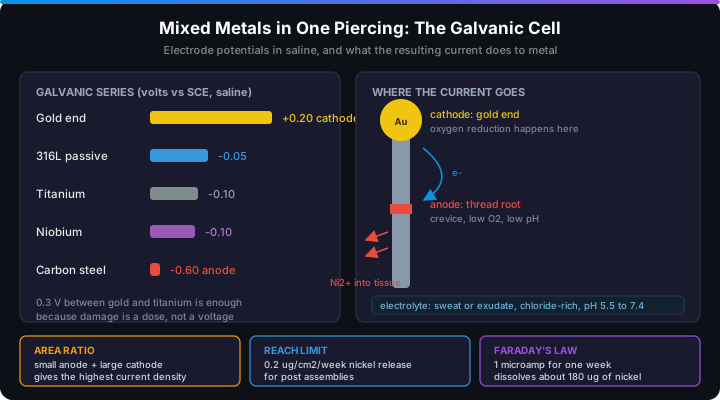
What Makes a Galvanic Cell
Three conditions must hold at once: two metals with different electrode potentials, metallic contact between them, and an electrolyte bridging both. Break any one and the couple goes inert.
Assembled body jewelry satisfies all three by default. A threadless titanium labret with a gold end, a 316L post with a silver ball, a steel ring with a niobium captive bead: each is two alloys in threaded or press-fit contact, sitting in a wound that weeps chloride-rich fluid. In saline, titanium settles near -0.1 V against a saturated calomel reference while gold sits near +0.2 V. A difference near 0.3 V is modest, and it need not be large: biological damage is a dose problem, not a voltage problem.
Titanium, niobium and 316L stainless sit near the noble end of the galvanic series because of the passive film, an oxide layer a few nanometres thick that shifts surface potential and starves the anodic reaction of exposed metal. The film, not the bulk alloy, does the work. Scratch it, gall it at a thread root, or breach a coating, and the surface behaves like a less noble metal.
The Electrolyte Nobody Models
Sweat is roughly half a percent sodium chloride, buffered near pH 5.5 at the skin surface. Wound exudate is closer to plasma, with chloride high enough to pit stainless steel and a pH that drifts downward as healing progresses. Chloride is the aggressive ion in all of these systems: it penetrates the passive film at defects and holds a pit open.
Oral piercings add acid to the picture. Saliva sits near pH 6.5 at rest but can fall below 4 during an acidic meal. Mellado-Valero and colleagues, working in artificial saliva, found that titanium and Ti6Al4V begin actively dissolving below about pH 3.5 when 1000 ppm fluoride is present, and that a nickel-chromium-titanium alloy loses its passive domain entirely with fluoride. That is the physics behind a familiar observation: an oral piercing that behaved for months can flare after a change of mouthwash or diet.
Masood, Walsh and Zafar immersed stainless steel, titanium and gold-plated titanium piercings in lactic, citric, phosphoric and hydrochloric acids for 7 and 34 days. The inorganic acids released far more material than the organic ones, with iron, titanium, chromium, nickel and cobalt among the elements detected. Gold-plated titanium was in the panel, which matters: the coating is all that separates substrate from electrolyte.
Area Ratio Decides the Damage
Corrosion damage is set by anodic current density, not by couple voltage. In a galvanic couple the current is limited by the cathode's capacity to support reduction at its surface, then distributed over the anode. Spread a fixed current over a large anode and little happens. Spread it over a small anode and metal dissolves quickly. Anodic current density therefore scales with the cathode-to-anode area ratio, and a small anode coupled to a large cathode is the geometry that fails.
Mixed jewelry inverts flat-plate intuition. Gold is noble, so a gold end acts as the cathode. The stainless thread it screws onto acts as the anode, and it dissolves faster than it would alone because a cathode it never asked for is driving it. Thread roots are also crevices: oxygen-starved, chloride-concentrated and acidified inside the gap, which keeps the anode active exactly where nobody can inspect it.
Faraday's Law: Why Microamps Matter
Faraday's law links charge to mass: moles dissolved equal charge passed, divided by electrons per ion and the Faraday constant. One microamp for a week passes 0.6 coulombs, which for divalent nickel is about 180 micrograms of metal, while a 0.1 cm² thread area is permitted 0.02 micrograms per week under the 0.2 microgram limit for post assemblies. Much of that metal reprecipitates as oxide or chloride rather than reaching tissue, so released dose is smaller than dissolved mass. The order of magnitude is the point: a current no handheld meter could detect moves more metal than a legal limit allows.
Yuan and colleagues showed why alloy identity beats nickel content. In artificial sweat, weekly nickel release was 2.06 micrograms per square centimetre for type 303, 1.51 for type 201, 0.08 for type 304 and 0.02 for type 316L. Type 303 holds less nickel than 316L yet released about a hundred times more, because its sulfide inclusions make it free-machining and electrochemically leaky. Free-machining alloys are cheap to thread, which is why cheap jewelry uses them.
What the Clinical Data Shows
The exposure side is well quantified. A 2025 systematic review and meta-analysis by von Spreckelsen and colleagues found nickel allergy significantly associated with piercings in the general population, with an odds ratio of 5.9 (95 percent confidence interval 3.6 to 9.4) and an aetiological fraction of 82 percent. The same review found 24.7 percent of European earrings intended for piercing exceeded EN 1811 release limits.
Screening is weaker than it looks. Wennervaldt and colleagues tested 304 earrings from the Danish market: 14.8 percent exceeded the release limit, yet the dimethylglyoxime spot test caught only 45.2 percent of items at the 0.2 microgram threshold and 61.1 percent at 0.5. A negative spot test is a screen result, not a certificate.
The counterweight matters. Zartman and colleagues reviewed mixed stainless steel and titanium couples in orthopaedic implants and found no discernible galvanic effect in vivo, because both alloys passivate in body fluid. Costa and colleagues used electrochemical impedance spectroscopy to separate intact from porous gold coatings on piercing studs, after earlier work showed nickel and zinc leaching from the substrate. Passivated couples are usually quiet. A breached coating, a small anode and a chloride electrolyte are what make the same physics bite.
The Studio Protocol
One alloy per piercing until the fistula matures. If a client insists on mixing, keep passive materials on both sides, meaning titanium, niobium or 316L, and keep plated components out of a healing piercing.
Inspect where the cell starts: thread roots, press-fit pins, and any point where a coating flexes. A plating failure converts a cosmetic component into the anode of a working cell.
Treat the spot test as a filter, not a verdict, and ask suppliers for EN 1811 release data rather than a material certificate alone.
Replace rather than polish. Polishing removes the passive film that was limiting current, and repassivation takes hours in air and longer in a wound. A scratched end that keeps a piercing irritated is an electrochemical problem dressed as a mechanical one.