Shop
Clinical Physics

The Needle Grouping Paradox: Why Your Liner Configuration Doesn't Predict Trauma the Way You Think

PP

Chief Engineer

Patrick Poli

Journal Date

2026-03-26

Last Reviewed

2026-08-04

Tight Groupings Don't Automatically Mean Less Trauma, The Physics Is More Complicated Than Studio Convention Suggests

Key Takeaways:
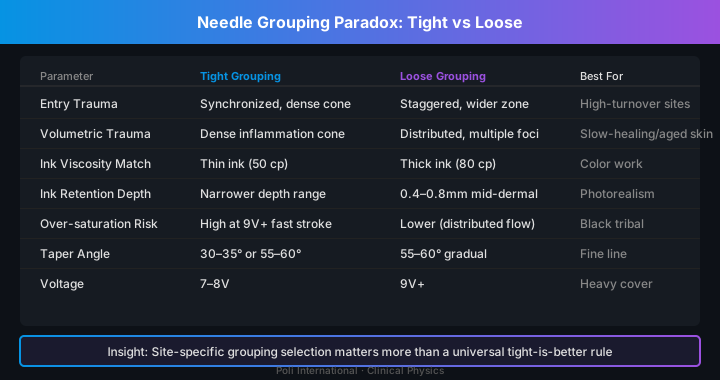
» Tight needle groupings produce synchronized entry trauma in a dense inflammation cone; loose groupings distribute trauma across wider dermal zones with staggered penetration, neither is universally superior.
» A 55–60 degree taper angle reduces perpendicular deviation and frictional drag on the upstroke, making it superior for color work at high voltage (9V+).
» Ink viscosity interacts directly with grouping width: thin ink (50 cp) performs better with tight groupings; thick ink (80 cp) flows more efficiently through the distributed pressure wells of loose groupings.
» The most persistent tattoos show ink distributed across 0.4–0.8mm of mid-dermal depth, a distribution that loose groupings support through natural depth sampling variance.
» Over-saturation risk is highest with tight groupings at high stroke speeds with standard-viscosity ink, the Hagen-Poiseuille fluid dynamics create faster ink-move that can exceed optimal deposition density.

1. The Entry Trauma vs. Volumetric Trauma Distinction

The studio convention that tighter needle groupings equal less trauma conflates two physically distinct events. Entry trauma is what happens at the moment of skin penetration, the stratum corneum breach and initial dermal disruption. Volumetric trauma is the total tissue disruption across all needle penetrations in a single machine cycle at operating frequency (100–150 Hz).

These do not scale linearly with grouping density, and that non-linearity is where studio convention breaks down. When a 0.30mm needle enters skin at 100–150 Hz, it experiences shear forces perpendicular to its axis. The epidermis varies 0.05–1.5mm in thickness depending on body location, age, and tension, it is not a uniform target. Research on wound healing mechanics confirms that sequential trauma in rapid succession generates different inflammatory cascades than simultaneous trauma spread across a wider area. A tight 5-round liner creates a dense inflammation cone, all five needles hitting the dermal layer within the same microsecond. A loose 5-round spread across 3mm produces staggered penetration across ~0.2mm of dermal depth difference, recruiting immune cells across a wider region.

The paradox: the loose grouping's distributed trauma pattern accelerates interstitial fluid flow and can increase ink dispersion in the first 48 hours, which is worse for blur control on high-turnover healing sites (inner arm, torso).
Needle Grouping Paradox: Tight vs Loose

But on slower-healing areas (foot, hand, older skin), the loose grouping's multiple micro-focal points for phagocyte activity actually support better long-term ink retention by stabilizing pigment particles across a wider collagen network.

The practical protocol: for high-turnover healing sites, use tighter groupings to minimize the blur zone of early ink diffusion. For slow-healing or aged skin, the distributed trauma pattern of looser groupings supports ink permanence. Site-specific grouping selection matters more than a universal tight-is-better rule.

2. Taper Angle and Grouping Width Decision Matrix

ConfigurationTaper AngleVoltageBest ApplicationMechanism
Tight grouping, steep taper30–35°7–8VBlack tribal, heavy coverEfficient ink-move, minor depth deviation acceptable
Tight grouping, gradual taper55–60°7–8VFine line black workDepth precision, low frictional drag
Loose grouping, gradual taper55–60°9V+Color, photorealismDepth distribution, perpendicular needle path
Loose grouping, steep taper30–35°9V+AvoidHigh frictional lag at speed negates grouping advantage
Tight grouping, high stroke speedAny9V+Caution: over-saturation riskHagen-Poiseuille: fast ink-move in narrow channel

3. The Viscosity-Grouping Interaction and Dermal Depth Targeting

Ink viscosity (50–80 centipoise for standard tattoo ink) interacts with needle spacing through fluid dynamics that most artists do not account for. When needles punch through skin, they create a pressure differential that draws ink from the cartridge toward the wound channel. A tight grouping produces a smaller, deeper pressure well, ink concentrates in a narrower zone, depositing higher density per pass. A loose grouping produces a larger, shallower pressure well, ink distributes across a wider area at lower concentration per unit area.

Hagen-Poiseuille fluid dynamics in confined geometries show that flow rate through parallel needle channels is inversely proportional to channel length and directly proportional to the pressure differential and the fourth power of channel radius. In practical terms: thin ink (50 cp) moves more efficiently through tight groupings; the higher pressure concentration overcomes viscous drag. Thick ink (80 cp) flows better through loose groupings because distributed pressure wells avoid the bottleneck effect in tightly packed needle channels.

Dermal depth targeting adds the third dimension. The dermis is stratified: papillary dermis (0.1–0.3mm, loose collagen, highly vascularized), mid-dermis (0.3–1mm, dense collagen bundles, optimal ink retention zone), and reticular dermis (1–2mm, tight collagen, granulomatous inflammation risk if over-penetrated). Dermatology research on ink particle distribution confirms the most persistent tattoos show pigment distributed across 0.4–0.8mm of mid-dermal depth, not concentrated in a thin layer. A tight grouping drills a narrow vertical column; if machine timing or hand angle varies, you risk missing the mid-dermal band entirely, depositing either too shallow (papillary zone, faster fading) or too deep (reticular dermis, inflammation risk). A loose grouping naturally samples across a range of depths, this built-in variance actually improves mid-dermal hit rate for color permanence work.

From the Chief Engineer's Workbench

Patrick Poli · 25+ years in body-jewellery manufacturing

What 25 Years of Watching Artists Work Taught Me About Configuration Dogma

In my 25 years manufacturing needles and watching artists across every discipline, I've observed one consistent pattern: the most technically skilled artists have strong opinions about their configurations, and those opinions are almost always based on feel rather than measured outcomes. That's not a criticism, feel is how the body learns technique. But it creates a blind spot around the mechanisms underneath.

What I've observed is that the artists who transition from good to exceptional are the ones who start testing their configurations deliberately. They change one variable, grouping width, taper angle, or stroke speed, and run it on the same skin type for a consistent period, then evaluate healed results rather than fresh results. The fresh appearance is not the outcome that matters. The 90-day healed photograph is the outcome that matters.

The needle grouping paradox I've described, where loose groupings can outperform tight groupings for specific permanence outcomes, is something I see validated repeatedly when artists run these tests systematically. It contradicts the intuition built from watching fresh work, which always looks "cleaner" with tighter configurations. The healed result tells a different story on slow-healing skin and aged dermis. For the broader biomechanical context of how surface geometry affects tissue response at the implant and needle interface, the CoCr vs Titanium Fatigue Resistance analysis covers material-level mechanics that parallel these needle configuration principles.

PPPatrick PoliChief Engineer · Creator of BioFlex® body jewelry

5. FAQ: Technical Q&A

Q: At what point does a tight grouping at high stroke speed create over-saturation versus optimal density?
The threshold depends on ink viscosity and machine Hz. At 9V+ with 50 cp ink and a tight 5-round grouping, single-pass saturation can exceed the mid-dermal absorptive capacity if stroke speed is above 6 cm/s. The visual indicator is ink pooling on the surface between passes, the skin is rejecting excess before it can deposit. If you see consistent surface pooling with tight configurations at high voltage, slow your stroke speed before switching groupings; often that adjustment alone resolves the over-saturation.

Q: How does the 55–60 degree taper advantage for color work translate to cartridge selection in practice?
Most cartridge manufacturers do not publish taper angles explicitly, but describe their needles as "standard," "long taper," or "extra long taper." Long and extra long taper typically correspond to the 50–60 degree range that reduces perpendicular deviation. For photorealism and color portraiture, move to your brand's longest available taper in the same grouping, you should observe improved depth consistency across multi-layer color work within one or two sessions of use.

Q: Does the loose grouping depth-sampling advantage apply to all skin types equally?
No. The advantage is most pronounced in aged skin (reduced elasticity, thinner papillary dermis) and slower-healing anatomical sites (hands, feet, areas with slower cellular turnover). On young, resilient skin with consistent elasticity, tight groupings deliver adequate depth targeting without the blur risk that loose groupings introduce. Calibrate grouping selection to the specific client's skin condition and healing history, not a universal rule. For a complete guide on how ink colours perform across all six Fitzpatrick skin types, including fade rates and visibility scores, use the Skin Tone & Pigment Matcher.

Conclusion: Configuration Matching Is the Skill Separating Competent from Elite

Needle grouping geometry, taper angle, ink viscosity, and machine voltage are not independent variables, they interact through biomechanical and fluid dynamics principles that studio convention has historically oversimplified. The paradox is that the configuration that looks cleanest in fresh work (tight grouping, high density, uniform surface appearance) is not always the configuration that produces the most permanent result in healed skin. Understanding why, through the entry trauma versus volumetric trauma distinction and the Hagen-Poiseuille fluid dynamics, gives practitioners the analytical framework to test deliberately and adapt configurations to specific skin conditions.

For practitioners working at the intersection of needle configuration and material science, particularly in how biomechanical forces affect both needle performance and jewelry substrate behavior, the CoCr vs Titanium Fatigue Resistance analysis provides relevant context on how cyclic stress loads behave across different material geometries.

Mind map · The Needle Grouping Paradox: Why Your Liner Configuration Doesn't Predict Trauma the Way You Think

  • Needle Grouping Paradox
    • Loose shader configurations

      Loosely arranged round shaders enter the skin easily and cause less damage than double-lining with tight needle groupings to achieve equivalent line weights.

      • Pins remain straight
      • Solder run far back
      • Minimal skin damage
    • Stiff straight liners

      Straight liners feature solder run one point five millimeters closer to the tip than round shaders, producing a stiffer grouping that resists pressure.

      • Solder run closer
      • Resist footballing flex
      • Consistent line weight
    • Needle taper dynamics

      Long taper needles create smaller entry points for soft shading, while short taper needles produce larger punctures suitable for solid color packing.

      • Long taper details
        • Minimal skin resistance
      • Short taper details
        • Immediate ink deposit
    • Needle grouping functions

      Tight round liners form a single piercing point for crisp lines, whereas round shaders feature slightly spread tips that deposit ink more softly.

      • Round liner crisp lines
      • Round shader soft shading
    • Voltage and speed mapping

      Lining techniques typically require higher hertz frequencies of one hundred twenty to one hundred fifty hertz for crisp, fast needle movement.

      • High hertz lining speed
      • Low hertz shading speed
StructureProcessMaterialHazard

5 branches, 0 sources. Each branch cites the article it came from; the labels beneath it are names, not claims.

Tattoo Quiz

  1. 1. In the construction of tattoo needles, what is the primary physical difference between a Straight Liner and a Round Shader?

    • ✓ The solder on a Straight Liner is placed 1.5 mm closer to the tip to increase stiffness. — Extending the solder closer to the tip reduces individual pin flex, preventing the grouping from changing shape under pressure.
    • • The pins in a Straight Liner are tapered, whereas Round Shader pins remain perfectly cylindrical. — Both configurations utilize the natural taper of the pins to create the grouping's overall shape and line weight.
    • • Straight Liners use a tight grouping of pins, while Round Shaders use a hollow-center configuration. — Both utilize similar straight-pin arrangements; the distinction lies in the solder length rather than the presence of a hollow center.
    • • Round Shaders are soldered further forward to allow the pins to splay out for better color saturation. — Round Shaders are actually soldered further back to allow for flexibility, which was originally intended to reduce skin damage during coloring.
  2. 2. According to fluid dynamics principles like the Hagen-Poiseuille law, how does ink viscosity influence the choice of needle grouping?

    • ✓ Thin ink (50 cp) moves more effectively through tight groupings due to higher concentrated pressure. — Tight groupings create a smaller, deeper pressure well that overcomes viscous drag in narrow channels more efficiently for lower-viscosity fluids.
    • • Thick ink (80 cp) requires tight groupings to force the pigment into the mid-dermal layer. — Higher viscosity inks actually flow better through loose groupings because distributed pressure wells help avoid bottlenecking in the needle channels.
    • • Ink viscosity is irrelevant to grouping choice as long as the machine voltage is set above 9V. — Viscosity interacts directly with the capillary space between needles, meaning grouping density significantly affects delivery regardless of voltage.
    • • Loose groupings are preferred for thin inks to prevent over-saturation and pigment pooling. — Thin inks in loose groupings can lead to excessive dispersion; tight groupings are better for controlling low-viscosity flow.
  3. 3. When managing viral character trends like the 'Jimothy' raccoon, what is the recommended minimum line width for high-motion areas like the ribs or ankles?

    • • 0.20 mm to 0.25 mm — Lines in this range are functionally unstable over long periods and are highly susceptible to doubling in width due to dermal diffusion.
    • ✓ 0.35 mm to 0.40 mm — Higher-motion areas require a thicker line weight to account for the increased mechanical stress and faster pigment dispersion in those dermal zones.
    • • 0.10 mm to 0.15 mm — This ultra-fine width is typically reserved for delicate realism on stable skin and will blur into a soft fog within a few years on mobile joints.
    • • 0.55 mm to 0.70 mm — While highly stable, this thickness is generally too bold for the minimalist aesthetic required by most viral character designs.
  4. 4. What happens to a tattoo's appearance if the biological 'Capture-Release-Recapture' cycle fails due to excessive scarring?

    • • The pigment particles are chemically dissolved by extracellular enzymes. — Tattoo pigments are generally too stable for enzyme dissolution; their permanence is a cellular management issue.
    • ✓ The released pigment drifts through the scarred tissue, resulting in blurry or 'blown out' lines. — Neighboring macrophages cannot effectively navigate or reach pigment trapped in dense scar tissue, allowing the ink to migrate before it can be re-engulfed.
    • • The skin triggers an immediate hyper-inflammatory response to eject the loose pigment. — While inflammation occurs, the primary long-term aesthetic failure is the migration of the ink rather than its immediate ejection.
    • • Fibroblasts permanently bond to the loose ink, turning the tattoo a muddy brown color. — Fibroblasts encapsulate the wound area, but they do not bond to the ink in a way that prevents the optical blurring caused by macrophage failure.
  5. 5. Why does a 55-60° needle taper angle provide a technical advantage for color portraiture and realism?

    • • It creates a larger entry wound that allows for massive, immediate pigment deposits. — Larger entry wounds are a characteristic of short tapers with steeper angles, not the gradual angles described here.
    • ✓ It reduces perpendicular deviation and frictional drag on the upstroke during high-voltage work. — A shallower, more gradual taper allows the needle to enter and exit with less resistance, maintaining precision at higher machine speeds.
    • • It increases the 'give' of the needle, allowing it to bounce off the reticular dermis. — Needle 'give' is a mechanical setting of the machine, while taper geometry determines the entry profile and tissue displacement.
    • • It facilitates the 'Hagen-Poiseuille' effect to move ink faster in tight 3RL groupings. — While fluid dynamics are involved, the specific advantage of this taper angle is related to mechanical resistance rather than just flow rate.
  6. 6. In the context of the 'Needle Grouping Paradox,' why might a loose grouping be superior for long-term ink retention on aged skin?

    • • It concentrates inflammation into a single dense cone to jump-start regeneration. — Tight groupings, not loose ones, create dense inflammation cones by hitting the same micro-region simultaneously.
    • ✓ It supports better pigment stability by sampling ink across a wider range of mid-dermal depths. — Loose groupings account for variations in skin elasticity and thickness by naturally distributing ink across the optimal 0.4-0.8 mm dermal band.
    • • It minimizes the interstitial fluid flow, preventing early ink dispersion. — Loose groupings actually increase interstitial flow, which can be a disadvantage on high-turnover skin sites.
    • • It requires lower voltage, which protects the thinner epidermis of older clients from tearing. — Larger, loose groupings typically require more voltage due to increased surface area resistance, not less.
  7. 7. How does the presence of a damping membrane in a cartridge system disproportionately affect Long Taper (LT) needles compared to Short Taper (ST) needles?

    • • The membrane increases the vibration of LT needles, making fine lines easier to achieve. — Membranes are designed to dampen vibration, which can actually mute the delicate feedback required for fine-line work.
    • ✓ The LT's natural flex interacts with the membrane's resistance, potentially muting fine-line gradations. — Because LT needles are more flexible, the added dampening of a cartridge can interfere with the subtle 'feel' and precision of the taper.
    • • ST needles are more likely to snag on the silicone membrane due to their blunter profile. — Short tapers are largely unaffected by damping because the stiff needle geometry couples more directly to the drive mechanism.
    • • Cartridges automatically adjust the stroke length to compensate for the LT needle's length. — Cartridges do not adjust stroke; the damping slightly alters the effective stroke behavior, requiring manual compensation by the artist.
  8. 8. What is the clinical rationale for implementing a mandatory 7-day cooling-off period for viral trend tattoos?

    • • To allow the artist time to research the intellectual property rights of the character. — While IP is a concern, the cooling-off period is primarily focused on the client's psychological commitment and long-term satisfaction.
    • ✓ To reduce regret rates by ensuring the client has moved past the peak euphoria of the meme cycle. — Trend tattoos have a specific regret curve; a delay ensures the decision is based on more than just a dopamine spike from social media.
    • • To ensure the client can perform an allergy patch test for the specific pigments used. — While patch tests are useful, they are not the primary engineering or ethical reason for a cooling-off protocol for viral designs.
    • • To give the skin's collagen matrix time to stabilize before receiving high-density pigment. — Collagen does not need to 'stabilize' before a tattoo; the timing is about the client's decision-making process.
  9. 9. Which machine frequency range is recommended for soft shading to avoid over-working the dermal layer?

    • • 120-150 Hz — This higher frequency range is typically used for lining to ensure crisp, continuous movement.
    • ✓ 80-110 Hz — Lower frequencies are more effective for shading, allowing for a softer delivery that matches a slower hand speed and reduces trauma.
    • • 160-200 Hz — Frequencies this high carry a significant risk of over-working the skin and causing excessive dermal trauma.
    • • 40-60 Hz — Frequencies this low would likely cause the machine to snag or provide uneven saturation during the shading process.
  10. 10. How does the 'Volumetric Trauma' of a tattoo needle differ from the 'Entry Trauma'?

    • • Entry trauma is the total tissue disruption over a full machine cycle, while volumetric trauma is the initial breach. — These definitions are reversed; entry trauma refers to the specific moment of penetration.
    • ✓ Volumetric trauma accounts for the total tissue disruption across all needle penetrations at the operating frequency. — It measures the cumulative effect of the repetitive strikes, which creates a different inflammatory response than a single entry event.
    • • Entry trauma is dictated by machine voltage, while volumetric trauma is determined solely by the needle count. — Both types of trauma are influenced by a combination of needle geometry, count, voltage, and hand speed.
    • • Volumetric trauma only occurs when using Round Shaders due to their loose arrangement. — Every needle grouping produces volumetric trauma; the patterns differ based on whether the grouping is tight or loose.

Extended Reference Table

8 of 8 rows

Extended reference table generated from the article and its verified research sources. Bracketed numbers jump to the matching entry in the Technical References below.

SafetyItem, Material, or Practice Category Technical Specifications or Standards Clinical or Engineering Guidance Source
✅BioFlexMaterialMedical-grade polymer; REACH compliant; ISO 10993 and USP Class VI testedBio-inert, flexible, metal-free material for body jewelry; reduces trauma, chemical sensitivity, and allergic reactions; accommodates initial piercing swelling.
✅Long Taper (LT) NeedlesNeedle Geometry2.5mm to 8.0mm taper length; 2.5° to 3.5° angle; up to or over 7mm exposureCreates slim wound channels with minimal lateral displacement and reduced edema; ideal for fine-line realism and reducing blowout risk.
✅REACH RegulationRegulatory StandardRegulation (EC) No 1907/2006; UK REACH 2025; SVHC (Substances of Very High Concern)Used to monitor and restrict hazardous chemicals in tattoo inks and piercing materials; essential for preventing chemical sensitivities.
✅Machine Voltage ConfigurationEngineering PracticeVariable DC voltage typically 4V to 12V; 9V+ for high-angle tapersMust synchronize stroke length with hand speed to manage friction and tissue trauma; higher surface area (e.g., 15M vs 3RL) requires increased voltage.
✅ASTM F136 TitaniumMaterialWrought Titanium-6Aluminum-4Vanadium ELI (Extra Low Interstitial)Clinical minimum for implant-grade safety; provides high fatigue resistance and minimizes nickel sensitization risk in surgical and piercing contexts.
✅Short Taper (ST) NeedlesNeedle Geometry1.0mm to 2.5mm taper length; 6° to 10° angleActs as a blunter instrument causing larger zones of focal necrosis; preferred for bold traditional styles and maximum pigment volume.
✅Hand HygienePracticeWHO or CDC standards for surgical hand scrub; specific Body Art Studio protocolsCritical clinical practice to prevent biological infection pathways and chemical cross-contamination during procedures.
✅316L Surgical SteelMaterialStainless steel alloy; high-nickel and chromium contentUsed for corrosion resistance and edge retention; allows for sharp passes but poses a higher risk of nickel sensitization compared to titanium.

Technical_References_Archive

About the Author

PP

Patrick Poli

Chief Engineer, Poli International · Creator of BioFlex® body jewelry

Patrick has spent 25+ years manufacturing body jewellery and studio equipment, and is the creator of BioFlex® body jewelry. He created the push-fit system so jewellery separates on impact instead of tearing the piercing. He also reworked the push-fit discs in medical-grade soft polymer, EO-sterilised, for people fighting bumps and keloids.

More about Patrick →

Last reviewed: 2026-08-04 · Published: 2026-03-26

Related Tools & Reading

Continue Reading