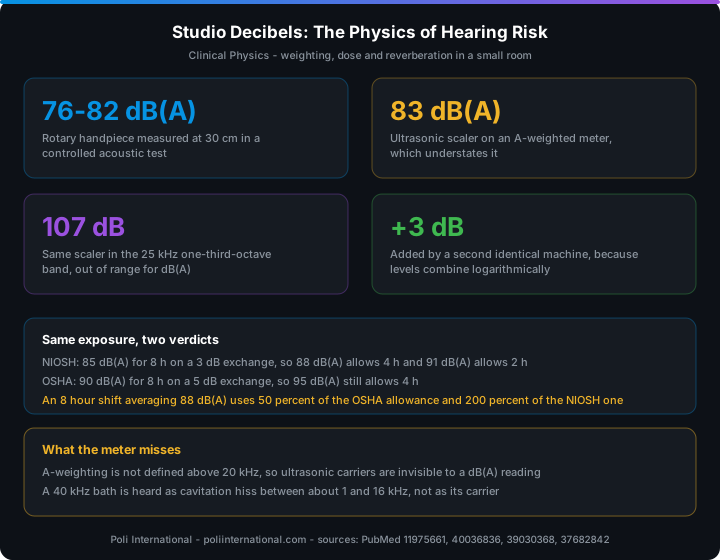
Executive Summary. No peer-reviewed survey of noise levels inside tattoo or piercing studios exists. The closest measured analogue is the dental operatory, which runs the same equipment class: rotary handpieces, high-volume suction and an ultrasonic bath. In the laboratory those devices measured 76 to 82 dB(A) at the handpiece and 83 dB(A) at a scaler, yet the same scaler emitted 107 dB in the 25 kHz one-third-octave band. The A-weighted figure on a datasheet describes a fraction of the energy leaving the device.
Key Takeaways
- Decibels are logarithmic: two identical machines add 3 dB, not double the reading.
- A-weighting is undefined above 20 kHz, so it cannot describe ultrasonic equipment.
- NIOSH allows 85 dB(A) for eight hours, OSHA 90 dB(A): same data, fourfold different verdict.
A decibel is a ratio, not a quantity
Sound pressure level is L = 20 log10(p / p0), with p0 = 20 micropascals, the hearing threshold at 1 kHz. Because the scale is logarithmic, 10 dB is tenfold sound power and about 6 dB is a doubling of pressure. Incoherent sources combine as L_total = L + 10 log10(n), so two identical machines add 3 dB and four add 6. Two pens at 62 dB(A) each produce 65 dB(A), not 124.
A-weighting discards the top of the spectrum
The A-weighting filter imitates the ear's sensitivity at low levels, attenuating sharply below 500 Hz and rolling off above 10 kHz to about minus 9 dB at 20 kHz. IEC 61672 does not define the curve above 20 kHz at all. Ultrasonic scalers run near 25 to 30 kHz and cleaning baths near 40 kHz, so the carrier of both sits where dB(A) means nothing.
Sorainen and Rytkonen measured that gap. The scaler read 83 dB(A) overall but 107 dB in the 25 kHz band. What a person hears from a bath is not the carrier but cavitation noise: a broadband hiss between roughly 1 and 16 kHz, plus tank resonances that shift with fill level. An A-weighted reading reports the hiss and ignores the carrier.
Dose is level multiplied by time
Exposure is a percentage of a daily allowance: D = 100 x (C1/T1 + C2/T2 + ...), where C is hours at a level and T is the hours permitted there. OSHA allows 90 dB(A) for eight hours on a 5 dB exchange, so 95 dB(A) permits four. NIOSH recommends 85 dB(A) on a 3 dB exchange, so 88 dB(A) permits four hours, 91 dB(A) two, 94 dB(A) one.
The two disagree by a factor of four on identical data. A 2024 dosimetry study of simulated crown preparations measured 84.9 and 86 dB(A) equivalent level for air-driven and electric handpieces: a passing OSHA result and a failing NIOSH one.
Small rooms do not let sound escape
Free-field intuition says level falls 6 dB per doubling of distance, which holds only in the direct field. Every room has a critical distance where direct and reverberant energy are equal, and in a 12 square metre studio with tiled floor and hard ceiling that is often under a metre. Beyond it, stepping away changes almost nothing.
Reverberation follows RT60 = 0.161 V/A, so hard surfaces keep absorption small and a small room can ring near a second. Low modes are worse: wavelengths from 3.4 metres at 100 Hz to 1.1 metres at 300 Hz match the room itself.
The music usually dominates the total
A rotary pen at 62 to 70 dB(A) is rarely the exposure driver; a monitor at 95 dB(A) is. Adding a 70 dB(A) source to a 95 dB(A) bed gives 95.1 dB(A). A survey that omits playback measures the wrong thing, and raising the music to mask the machine solves a masking problem by creating an exposure problem.
Measuring it, and protecting against it
The minimum instrument is a class 2 meter to IEC 61672, calibrated, at ear height, logging equivalent level over ten minutes of representative work. A dosimeter worn for a full shift is the only figure that survives scrutiny, because it captures machine time against idle time. Phone apps use uncalibrated microphones, clip near 100 dB and cannot report above 20 kHz.
A foam plug rated NRR 29 does not deliver 29 dB in a working ear. NIOSH derates NRR by half and OSHA uses (NRR minus 7) divided by 2, which puts it near 11 to 14 dB. Flat-response plugs at 9 to 15 dB preserve speech and machine cues. Hearing that feels dull after a shift and recovers overnight means the allowance was exceeded.
What a studio should do
1. Measure once with a calibrated meter at ear height, then again with music at working level.
2. Turn playback down 6 dB. It is the largest lever and costs nothing.
3. Close the ultrasonic bath lid and site the unit away from the work chair.
4. Service on schedule: worn bearings raise high-frequency output before a machine fails.
Why this matters clinically
The dental literature is the best analogue because the equipment and room geometry match. A 2024 scoping review of 28 studies found that of 12 with objective measurements and control groups, eight reported significantly higher hearing loss among dental personnel; a 2023 systematic review found a positive association in 82 percent of included studies. That does not prove a studio is dangerous. It establishes that the exposure is plausible, unmeasured and cheap to measure. Related mechanics sit in tattoo machine electromechanics and needle geometry.
No published series measures tattoo machine output, so the magnitude is unknown rather than zero. A rotary pen is a small motor in a handpiece; dental handpieces measured 76 to 82 dB(A) at 30 centimetres. Under NIOSH, 85 dB(A) for eight hours is the full allowance and 88 dB(A) halves it. OSHA allows 90 dB(A). A monitor at 95 dB(A) spends the whole NIOSH budget in under two hours. No. Apps use uncalibrated microphones, clip near 100 dB and cannot report ultrasonic content. They compare positions; a policy or insurance claim needs a class 2 meter. Yes, above 85 dB(A) or with hours of playback. Choose flat-response musician plugs rated 9 to 15 dB rather than foam, because an artist needs to hear a client and the machine.FAQ
Do tattoo machines damage hearing?
How loud is too loud in a studio?
Is a phone decibel app good enough?
Should artists wear earplugs?