A four-hour permit rush is a capacity signal, not just a local news item
Key Takeaways:
» Nashville health officials approved nearly 400 permits for tattoo artists, body piercers, and technicians in four hours for the 2026 Villain Arts Tattoo Festival.Yahoo News
» A high-volume convention can create a short, intense demand spike without proving that permanent local studio demand has grown at the same rate.
» Studios should treat convention weekends as a separate commercial product, with dedicated staffing, deposits, consumables, and minimum pricing.
» The strongest opportunity is not simply selling more appointments; it is converting festival traffic into follow-up work, jewellery sales, and future bookings.
» Before buying additional stock or hiring help, calculate contribution per booked hour and the break-even number of appointments.
1. A permit rush reveals concentrated demand
Nashville health officials issued nearly 400 permits in four hours to tattoo artists, body piercers, and technicians attending the 2026 Villain Arts Tattoo Festival.Yahoo News That is a striking operational number, but its commercial meaning needs to be read correctly: it measures the scale of temporary market access, not automatically the long-term health of every Nashville studio.
Conventions concentrate consumers, artists, and purchasing decisions into a short window. A visitor who might spend weeks comparing local studios can make a booking, buy jewellery, commission a small tattoo, or schedule a consultation in one afternoon. For suppliers, that concentration creates a demand pulse for needles, cartridges, barriers, inks, gloves, aftercare, piercing jewellery, and display stock.
The useful comparison is with a normal studio week. A festival booth may generate high revenue per day but also carry travel, permit, accommodation, staffing, card-processing, and unsold-stock costs. A studio that measures only gross sales can mistake an expensive burst of activity for profitable expansion. The broader studio margin and contribution-per-booked-hour model is more useful here than a simple appointment count.
2. Convention economics versus ordinary studio economics
| Feature | Convention weekend | Permanent studio week |
|---|---|---|
| Demand pattern | Concentrated over a few days | Distributed across appointments and walk-ins |
| Customer acquisition | High foot traffic, limited decision time | Lower volume, stronger local repeat potential |
| Cost base | Temporary permits, travel, booth, extra labour | Rent, utilities, insurance, sterilisation, software |
| Pricing opportunity | Deposits, minimums, flash menus, premium time slots | Hourly rates, deposits, consultations, repeat work |
| Inventory risk | Unsold display and consumable stock after event | More predictable replenishment |
| Commercial objective | Maximise contribution and capture contacts | Build repeat utilisation and lifetime value |
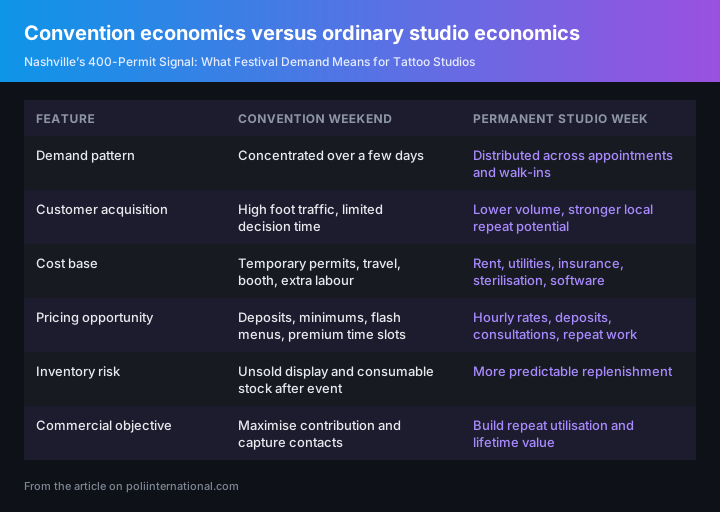
The key distinction is capacity utilisation. During a convention, the scarce resource is not necessarily ink or jewellery; it is the number of productive working hours available before the event closes. A booth that accepts every low-value request may look busy while producing less profit than one that protects time for higher-contribution work.
Studios attending a major event should therefore set three prices before opening: a minimum service charge, a fixed menu for fast work, and a premium rate for custom or time-intensive pieces. This is not about making the customer solve the studio’s cost structure. It is about preventing a temporary, high-cost operating environment from being priced like a quiet Tuesday in the shop.
The same discipline applies to suppliers. A distributor preparing for convention demand should not assume that a large order is automatically a good order. Forecast demand by SKU velocity, not by optimism: core needle configurations, barrier consumables, common wearable sizes, and proven jewellery profiles deserve depth; slow variants should remain shallow unless pre-sold.
3. The numbers behind a profitable festival
Nearly 400 permits in four hours indicates substantial artist participation, but the source does not provide total consumer spending, completed procedures, booth turnover, or organiser revenue.Yahoo News Those missing numbers matter because permits measure supply entering the event, while profitability depends on the ratio between available artist hours and paying demand.
A simple event forecast should include:
- Available hours: working artists multiplied by realistic operating hours, less breaks, setup, sanitation, and payment delays.
- Booked hours: confirmed appointments plus a conservative estimate of walk-in conversion.
- Contribution per hour: revenue less artist commission, consumables, payment fees, event-specific labour, and other directly attributable costs.
- Break-even sales: fixed event cost divided by contribution per appointment or booked hour.
- Post-event conversion: deposits or consultations secured for future studio work.
For example, if a booth carries $6,000 in event-specific fixed costs and produces $120 contribution per completed appointment, it needs 50 appointments merely to break even. That calculation excludes the value of future clients, but it also excludes cancellations and unsold stock. The figure should be known before the deposit is paid, not discovered when the card terminal stops beeping.
Studios should also separate event revenue from event acquisition cost. A customer who buys a small piece at a convention may be valuable if the studio captures consented contact information, books a follow-up, and sells compatible aftercare or jewellery. Without that follow-up, the studio may have paid for an expensive one-off transaction.
For distributors, the opportunity is often less glamorous but more dependable. A convention creates a replenishment deadline. Buyers need stock delivered before setup, not after the weekend. Suppliers that can offer accurate cut-off times, consolidated freight, clear backorder communication, and sensible minimum-order quantities can win business even without the lowest unit price.
4. Patrick’s Note: Busy Is Not the Same as Profitable
A packed convention floor can make a poor business model look healthy for three days. The temptation is to measure success by queue length, then discover later that the queue was full of low-ticket work, the premium slots were underpriced, and the extra stock has become a slow-moving display of good intentions.
The commercial answer is to price the event separately and decide what the event is supposed to achieve: immediate contribution, new local clients, distributor relationships, or all three. The terms-and-landed-cost shift affecting tattoo-supply buying matters here because a rushed pre-event order can turn a reasonable sales weekend into an expensive freight exercise. Buy the proven core SKUs early, negotiate delivery and returns in writing, and do not confuse urgency with leverage.
5. FAQ: Technical Q&A
Q: Should a studio hire extra artists for a major convention?
Only when projected contribution covers the additional commission, travel, accommodation, permits, consumables, and management time. Use confirmed bookings first, then apply a conservative walk-in forecast; do not hire solely because the event is expected to be busy.
Q: Should convention pricing be higher than normal studio pricing?
Yes, when the event creates higher direct costs or limits productive capacity. Publish a clear minimum and menu so customers understand the commercial structure, while reserving premium pricing for custom work, scarce time slots, and work requiring additional preparation.
Q: What should a distributor stock for a high-volume tattoo event?
Prioritise proven, fast-moving configurations and sizes: core cartridges, barriers, gloves, disinfectants, aftercare, and the jewellery profiles local piercers already reorder. Avoid turning an attendance forecast into speculative depth across every variant; negotiate replenishment, delivery windows, and unsold-stock terms instead.
Conclusion: Turn Footfall Into Repeat Revenue
Nashville’s four-hour approval of nearly 400 festival permits is a useful capacity signal: the body-art economy can mobilise significant temporary supply when a major event concentrates demand.Yahoo News It is not, by itself, proof that permanent studio demand has expanded by 400 artists.
The commercial decision is straightforward. Buy core consumables before the event, negotiate delivery and replenishment terms rather than overstocking slow variants, protect convention minimums, and require every booth to track contribution per booked hour and post-event conversion. For the longer-term strategy, compare the result against the geographic movement of tattoo demand and supply spending before adding permanent capacity.