Stop treating “fake tattoo awareness” as a joke: the stunt exploited basic trust, platform incentives, and body-art literacy gaps
Key Takeaways:
» The viral forehead-tattoo clip was designed to look real, and that is exactly why it spread.
» The science lesson is not about ink; it is about how viewers process image evidence under social pressure.
» Artists should treat viral stunt content as reputation risk, because audiences remember the deception longer than the punchline.
» Clients should not confuse engagement bait with actual tattoo practice, healing, or safety.
» The real controversy is not the fake tattoo itself, but how easily platform algorithms reward outrage over accuracy.
1. The Fake Forehead Tattoo That Fooled Everyone
The most interesting body-art story in the last stretch is not a perfect tattoo, a clever piercing, or a glamorous celebrity reveal. It is the fake forehead tattoo clip that circulated as if it were a real act, then flipped into a “tattoo awareness” defense after the internet had already done what the internet does best: believed the first outrageous thing it was fed. The viral clip was widely reported as a hoax after the creator admitted the tattoo was not real, despite the video drawing massive attention and backlash.[dexerto.com/entertainment/tiktoker-backflips-afte...]
Why does this matter to actual tattoo and piercing people? Because the story sits at the intersection of visual plausibility, social proof, and platform design. A fake forehead tattoo is not technically hard to stage, but it is psychologically efficient: it triggers moral judgment before verification. That is why it travels. BBC’s tattoo coverage shows that the public already treats body art as a mix of identity, fashion, and spectacle, which makes it fertile ground for high-emotion content.[bbc.com/news/topics/ck8z5dpg61jt] The same dynamic shows up in community spaces where body art is debated as craft, rebellion, and performance rather than simply skin work.[bbc.com/news/topics/crr7mlg0g1nt]
The engineering truth is blunt: this story was not about tattoo technique at all. It was about how quickly a convincing image can outpace skepticism. A real forehead tattoo raises serious practical questions about placement, visibility, healing, social consequences, and consent; the stunt bypassed all of them by remaining fake. That is why it hooked people. The audience was not reacting to body modification—they were reacting to a violation of common sense dressed up as body modification. TikTok and adjacent social platforms reward that kind of confusion because confusion holds attention longer than competence does.[dexerto.com/entertainment/tiktoker-backflips-afte...]
The industry has seen this movie before in different costumes. A tiny “freckle-sized heart” tattoo went viral for the opposite reason: not outrage, but microscopic precision and a price point that made viewers do a double take.[sg.news.yahoo.com/tattoo-artist-goes-viral-inking...] One post sold the fantasy of shock; the other sold the fantasy of impossible delicacy. Same machine, different bait. If you want the broader pattern, the viral tattoo content economy and why miniature work explodes online is the real story underneath the story.
2. What Viewers See Versus What Tattooists Check
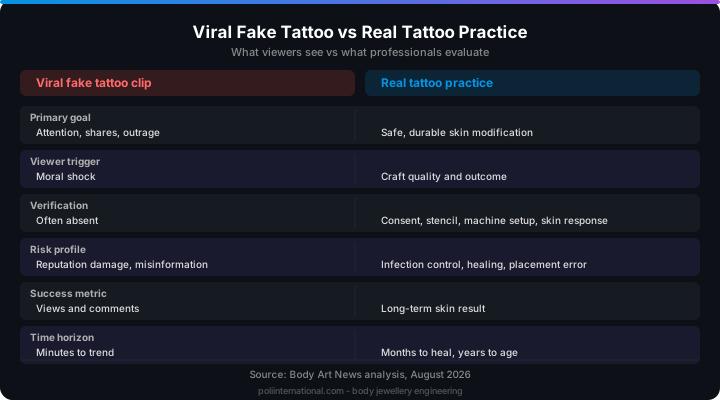
Here is the useful comparison: what viral viewers think they are seeing versus what a working professional is actually evaluating.
| Feature | Viral fake tattoo clip | Real tattoo practice |
|---|---|---|
| Primary goal | Attention, shares, outrage | Safe, durable skin modification |
| Viewer trigger | Moral shock | Craft quality and outcome |
| Verification | Often absent | Consent, stencil, machine setup, skin response |
| Risk profile | Reputation damage, misinformation | Infection control, healing, placement error |
| Success metric | Views and comments | Long-term skin result |
| Time horizon | Minutes to trend | Months to heal, years to age |
That table is the whole problem. Viral content gets rewarded on the wrong axis. A tattoo is a long-duration craft, but social media compresses it into a three-second judgment. The same compression fuels piercing misinformation too, especially when people mistake decorative placement for safe anatomy. The difference between viral body-art aesthetics and anatomical reality is where most of the nonsense starts.
There is also a materials lesson here, even though the clip itself had nothing to do with polymers or needles. The public often assumes that if a body-art claim looks technical, it must be technical. That is how bad product claims spread, whether they are about tattoo aftercare, numbing agents, or flexible jewelry. The difference between a real product and a viral prop is documentation, not confidence. The gap between body-art marketing claims and studio-grade evidence is where practitioners keep getting burned.
3. Why the Forehead Is an Unforgiving Placement
If someone actually got a forehead tattoo, the technical discussion would be serious and immediate. The face is not a joke placement. It is highly visible, emotionally loaded, and unforgiving of mistakes in symmetry, saturation, and line drift. Skin on the forehead also moves constantly with expression, which makes healing and long-term retention less predictable than flatter, less mobile areas. That is not moralizing; it is anatomy.
What makes the fake clip effective is that it borrows the look of real needlework without paying any of the physical costs. Real tattooing involves controlled trauma, ink deposition into the dermis, and a healing response that depends on depth, trauma, and aftercare. A staged video skips the biology but keeps the visual grammar: machine noise, skin tension, and immediate astonishment. The average viewer is not equipped to distinguish “looks tattoo-like” from “is tattooing,” especially when the clip is edited for speed.
There is a reason professional bodies keep hammering on practice standards, even when the internet would rather clown around. Industry-facing guidance from groups such as UKAPP and professional piercing publications consistently emphasizes hygiene, anatomy, informed consent, and technique over spectacle.[bbc.com/news/topics/crr7mlg0g1nt] The problem with viral stunt content is that it muddies those standards by making the performance of risk look like the reality of work. That is bad for clients, bad for apprentices, and bad for anyone trying to teach the public what responsible body modification actually is.
If a client comes in quoting a viral clip, the answer is not to sneer. It is to translate. Explain the difference between an image that was made to be believed and a procedure that has to survive healing. Explain why placement matters, why visibility matters, why consent matters, and why the internet has no duty of care. That last point is doing a lot of heavy lifting lately.
4. Patrick's Note: The Overheard Line
What I keep hearing is: “It’s only content.” That sentence is the modern equivalent of shrugging while the roof falls off. Content can be harmless; content can also be a crowbar aimed at public trust, and the platform will still call it engagement.
From a supply-chain perspective, the body-art world already spends half its life cleaning up confusion created by bad labeling, bad claims, and bad habits. The difference between authentic body jewelry materials and counterfeit marketing is a lesson I wish more people would learn before they decide “fake but viral” is a clever business model. The joke is that viewers think they are laughing at the stunt, but the platform is laughing at everyone equally.
5. FAQ: Technical Q&A
Q: How can artists tell whether a viral tattoo video is staged?
Check for impossible speed, awkward camera cuts, missing prep, and no visible aftercare context. A real procedure has setup, not just spectacle. If the clip exists only to provoke disbelief, it is probably built for disbelief.
Q: Does a fake viral tattoo story hurt the industry?
Yes, because it trains the public to treat tattooing as either a prank or a crisis instead of a skilled service. That makes serious conversations about consent, placement, healing, and professionalism harder to have. It also rewards the loudest nonsense, which is a terrible selection system.
Q: What should clients ask before believing a tattoo claim online?
Ask what was actually done, what material was used, who performed it, and whether the result can be verified after healing. If the only evidence is a short clip and a dramatic caption, treat it as entertainment, not instruction.
Conclusion: Ignore the bait, keep the standard
The fake forehead tattoo story matters because it is a clean demonstration of how body-art misinformation spreads: fast, emotionally, and with enough visual polish to fool people who are not looking carefully. The science lesson is simple. If a clip is designed to trigger outrage, do not confuse virality with validity.
For artists, the takeaway is practical: protect your reputation by separating real craft from performative nonsense. For clients, the takeaway is even simpler: if it looks too perfect, too outrageous, or too convenient, it was probably made to be shared, not believed. Keep the standard on the skin, not in the comments, and remember that the internet is not a clinic. The real science behind tattoo and piercing myths is always less dramatic than the clip.