Shop
Body Art News

North West’s “Piercings” Were Mostly Fake — But the Real Story Is About What Viral Body Art Teaches Kids

PP

Chief Engineer

Patrick Poli

Journal Date

2026-11-02

Last Reviewed

2026-11-02

Stop Treating a Visual Joke Like a Piercing Consultation

Key Takeaways:
» North West’s recent viral look included fake and real-looking piercings, temporary tattoos, grills, and bold styling—not a single new clinical piercing event.
» A dermal anchor in the hand is not ordinary jewellery; it is an implanted object in a high-motion, high-impact area.
» Hand and finger placements face constant snagging, pressure, contamination, and rejection risk.
» Parents and creators should distinguish costume styling from body modification before millions of viewers copy the image.
» The useful question is not whether a celebrity looks “edgy”; it is whether the tissue, jewellery, age, consent, and aftercare make sense.

1. The Viral Image Was Not the Procedure

The latest North West piercing debate was less a piercing story than a reality-check failure. The 13-year-old pushed back against online claims that her appearance was “demonic,” while coverage described a mix of blue hair, grills, temporary face tattoos, fake piercings, and other deliberately dramatic styling. One report also repeated earlier attention around a dermal piercing shown on her hand.

That distinction matters because social media collapses three completely different things into one visual category: makeup, costume jewellery, and an actual wound containing an implant. They may look identical on a phone screen. Biologically, they are not even in the same postcode. A sticker comes off. A clip-on ring comes off. A dermal anchor has to be placed through tissue, maintained while the body responds to it, and removed properly if the project ends badly.

The internet saw a rebellious aesthetic and immediately started arguing about morality. The more useful conversation is engineering: what is attached, where is it attached, what forces act on it, and who is responsible for understanding the difference?

2. A Dermal Hand Piercing Is a Mechanical Problem Before It Is a Fashion Problem

The hand is a poor environment for permanently mounted jewellery. It moves constantly, contacts desks, phones, clothing, door handles, sports equipment, and other people, and has relatively little soft-tissue shelter over many areas. A flat-backed dermal anchor may look neat in a photograph, but its stability depends on tissue integration around an object that is repeatedly loaded from different directions.

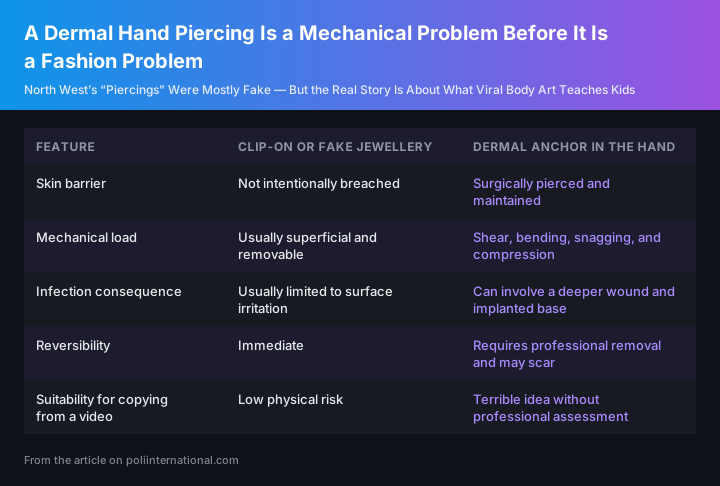
FeatureClip-on or Fake JewelleryDermal Anchor in the Hand
Skin barrierNot intentionally breachedSurgically pierced and maintained
Mechanical loadUsually superficial and removableShear, bending, snagging, and compression
Infection consequenceUsually limited to surface irritationCan involve a deeper wound and implanted base
ReversibilityImmediateRequires professional removal and may scar
Suitability for copying from a videoLow physical riskTerrible idea without professional assessment
A Dermal Hand Piercing Is a Mechanical Problem Before It Is a Fashion Problem
Infographic: A Dermal Hand Piercing Is a Mechanical Problem Before It Is a Fashion Problem

The critical force is not simply “pain.” It is shear. A ring or anchor catches on fabric, then the hand continues moving. That creates a sideways load through the tissue. Repeated sideways loading can irritate the channel, encourage migration, and make the jewellery sit at an angle. The body does not care that the placement looked excellent under studio lighting.

This is why a viral photograph is useless as a suitability test. It captures alignment at one moment, not the tissue thickness, anatomy, jewellery geometry, healing behaviour, or daily mechanical environment. The same principle explains why why hand and finger piercings fail under ordinary daily forces is a more valuable question than whether the placement is fashionable.

3. The Anatomy Does Not Read the Comments Section

A dermal anchor is not a surface sticker with a more committed attitude. It consists of a base placed beneath the skin and a visible top attached above it. The body must tolerate the implant while the entry site settles. That process is affected by depth, tissue quality, local movement, jewellery profile, contamination, impact, and the wearer’s ability to leave it alone.

The hand is especially unforgiving because it combines high movement with high exposure. Every bend of a finger changes the local skin tension. Every grip can press the jewellery into a hard surface. Every snag can pull the visible top while the base resists below. That creates leverage. The smaller the base and the thinner the tissue, the less mechanical margin exists before the site begins to complain.

A normal early response may include mild tenderness, limited swelling, and a small amount of clear or pale fluid that dries into a crust. The red flags are different: worsening pain, spreading redness, heat, thick yellow or green discharge, fever, red streaking, sudden embedding, or jewellery that begins visibly tilting toward the surface. Those signs call for medical assessment, not a comment-section diagnosis.

The answer is not to drown the site in antiseptic. Harsh chemicals can damage healing tissue and extend irritation. A clean, appropriate saline routine and protection from friction are sensible basics, but a suspected infection or migration needs a clinician or qualified piercer to assess the problem. Removing an embedded or infected object casually can make the situation worse.

The age issue also deserves precision. A child’s or young teenager’s appearance is not automatically a public referendum on parental morality. But an actual body modification requires informed consent, anatomy assessment, aftercare comprehension, and a realistic understanding of permanence. A teenager can understand style. That does not mean every teenager can safely manage an implanted object through school, sport, sleep, hygiene, and family life.

4. Patrick’s Note: The Screen Is Not the Skin

A fake piercing can be fun. A real piercing can be meaningful. The trouble starts when the camera erases the difference and the audience assumes the body is just another surface for styling.

The hand is a terrible place to turn that confusion into a trend. It is busy, exposed, and mechanically hostile. A dermal anchor there is not “just jewellery”; it is a small implant negotiating with every pocket, keyboard, sleeve, handshake, and bad decision in the wearer’s day. I have written more about the practical failure modes of high-impact placements in the engineering limits of hand and finger piercings, because the hand does not become a better piercing site merely because an image performs well.

The useful correction is simple: ask whether the object is real before discussing whether it is safe. If it is real, assess the anatomy and the forces. If it is fake, enjoy the styling and stop pretending a filter is clinical evidence.

5. FAQ: Technical Q&A

Q: How can someone tell whether a piercing in a viral video is real?

You usually cannot tell reliably from a video. A real dermal anchor may show a stable base and a top that sits flush, but lighting, makeup, filters, and editing can imitate those details. Treat the image as styling evidence, not proof of a procedure.

Q: Are hand or finger dermals automatically unsafe?

No placement is automatically condemned by a photograph alone, but hand dermals carry unusually high mechanical risk. The wearer must have suitable tissue, accept the snagging and migration risks, and commit to professional placement, monitoring, and removal if the site deteriorates.

Q: What should someone do if a dermal piercing starts rejecting?

Book an assessment with a reputable piercer promptly, especially if the anchor is tilting, becoming more visible, or the skin over it is thinning. Do not push it back down, tape it tightly, twist it, or remove it with household tools. Seek medical care for spreading redness, heat, severe pain, fever, or significant discharge.

Conclusion: Look Past the Jewellery

North West’s viral moment was not evidence that a new piercing trend has arrived. It was evidence that modern styling can make fake jewellery, temporary tattoos, grills, and real implants look interchangeable. They are not interchangeable, and the consequences of confusing them land on the wearer’s skin.

The clear takeaway is this: copy the look only when the look is removable; treat anything that breaches skin or sits inside tissue as a medical and mechanical decision, not a fashion impulse. For a deeper look at how viral images distort body-art risk, read why a convincing fake tattoo can fool millions online.

Further Reading

  • The Tattoo Ban That Proves Regulation Can Be Pure Theatre
  • The Bali “Pain-Free Tattoo” Trend Is Anaesthesia Wearing a Party Hat
  • Pearland’s Piercing Ban Is a Regulatory Joke—And Studios Should Pay Attention
  • Mind map · North West’s “Piercings” Were Mostly Fake — But the Real Story Is About What Viral Body Art Teaches Kids

    • Viral Body Art Teaches Kids
      • Viral Styling versus Body Modification

        Social media collapses temporary makeup, costume jewellery, and surgical wounds containing implants into one visual category.

        • Removable Styling
          • Fake Piercings and Tattoos
        • Actual Tissue Implants
          • Surgically Placed Dermal Anchors
      • Mechanical Load on Hand Placement

        Continuous movement and contact subject hand piercings to shear forces that irritate tissue and cause anchor migration.

        • Shear Force Irritation
          • Sideways Tissue Loading
        • High Impact Area Hazards
      • Anatomical and Infection Risks

        High exposure and constant skin tension in the hand increase risks of infection, tissue rejection, and anchor embedding.

        • Normal Early Healing Responses
        • Red Flag Complications
          • Spreading Redness and Discharge
      • Consent and Age Evaluation

        Actual body modification requires informed consent, anatomy assessment, aftercare comprehension, and realistic understanding of permanence.

        • Aftercare Comprehension
        • Informed Consent Requirements
      • Practical Body Art Takeaway

        Removable looks can be copied safely, whereas any skin-breaching modification must be evaluated as a medical decision.

        • Copy Removable Looks Safely
        • Assess Mechanical Exposure Risk
    StructureProcessMaterialHazard

    5 branches, 0 sources. Each branch cites the article it came from; the labels beneath it are names, not claims.

    Dermal Piercing Quiz

    1. 1. According to the article, what is the primary mechanical force (rather than mere pain) that drives channel irritation and migration in hand dermal piercings?

      • • Tensile force caused by normal skin hydration. — Skin hydration does not generate the direct directional load that displaces an anchor within tissue.
      • ✓ Shear force from repeated sideways loading. — Catching jewellery on objects creates a sideways load through tissue when the hand continues moving, straining the channel.
      • • Compression force from deep tissue contraction. — Soft tissue contraction does not produce the lateral leverage described as the main driver of instability.
      • • Hydrostatic pressure from topical aftercare routines. — Proper fluid cleaning exerts no structural force on the anchor base or surrounding skin tissue.
    2. 2. Which of the following signs is identified in the text as a normal early response during dermal anchor healing?

      • • Spreading redness accompanied by red streaking. — Red streaking and spreading redness are listed as critical red flags requiring clinical evaluation.
      • ✓ Clear or pale fluid that dries into a crust. — A small amount of clear or pale fluid forming a crust is an expected response while the tissue entry site settles.
      • • Sudden embedding of the visible top beneath the skin. — Embedding indicates severe tissue complication and mechanical failure rather than normal settlement.
      • • Thick yellow or green discharge around the base. — Purulent discharge signals potential infection and warrants medical assessment.
    3. 3. Why does the source explicitly advise against drowning a troubling dermal piercing site in harsh antiseptics?

      • • Antiseptics react chemically with titanium to accelerate anchor corrosion. — The text focuses on biological tissue damage rather than chemical reactions with metals.
      • • Chemical cleansers permanently alter skin pigmentation around the base. — Pigmentation changes are not cited as the primary danger of applying harsh topical cleansers.
      • ✓ Harsh chemicals can damage healing tissue and extend irritation. — Aggressive chemicals destroy vulnerable regenerating skin cells needed for proper channel recovery.
      • • Antiseptics cause immediate mechanical dislodgement of the buried anchor. — Liquid cleansers do not physically pull or unseat an anchor base from dermal tissue.
    4. 4. Based on the source's comparison table, how do infection consequences differ between clip-on jewellery and dermal anchors?

      • ✓ Clip-on irritation is usually limited to surface skin, whereas dermal anchors can involve deeper wounds and implanted bases. — Clip-ons act superficially on unbroken skin, whereas dermal anchors breach the barrier and embed structural bases in tissue.
      • • Clip-on jewellery carries a high risk of deep tissue abscesses, whereas dermal anchors only irritate superficial pores. — The table notes that clip-ons present superficial risks, whereas dermal anchors carry deeper wound risks.
      • • Both items carry identical infection risks because both disrupt the primary skin barrier. — Clip-on jewellery does not intentionally breach the skin barrier, unlike dermal anchors.
      • • Dermal anchors present low physical risk, while clip-on items require clinical surgical removal. — Clip-on jewellery has low physical risk and immediate reversibility, whereas dermal anchors require professional removal.
    5. 5. What is the recommended course of action if a dermal anchor begins showing signs of tilting or rejection?

      • • Tape the visible top tightly to force the anchor base back into position. — Taping tightly adds downward pressure and tension, which can worsen tissue trauma and accelerate rejection.
      • • Remove the anchor at home using disinfected household tools. — Home removal with household tools risks severe tissue tearing, heightened scarring, and infection.
      • ✓ Book a prompt assessment with a reputable piercer or clinician. — Professional evaluation ensures the anchor is evaluated or removed safely without damaging surrounding tissue.
      • • Twist the visible top daily to encourage deeper tissue integration. — Twisting the top destabilizes the anchor base and disrupts delicate healing tissue.
    6. 6. According to the source, what primary issue arises when social media blurs the distinction between cosmetic styling and real implants?

      • ✓ Audiences assume an actual wound containing an implant is just another surface styling choice. — Collapsing implants, makeup, and costume jewellery into one visual category leads viewers to ignore mechanical and biological risks.
      • • Filters make fake piercings look so painful that viewers avoid all body art. — The text states that social media makes invasiveness invisible, leading to trivialization rather than avoidance.
      • • Online coverage forces creators to stop using temporary tattoos and grills. — The source explicitly encourages temporary removable styling while warning against unassessed implants.
      • • Viewers become unable to distinguish temporary hair dye from permanent ink tattoos. — The primary concern highlighted in the text is confusing removable surface items with internal tissue implants.
    7. 7. Why does the source describe the hand as an unforgiving, mechanically hostile environment for dermal anchors?

      • • Hand skin continuously sheds epidermal layers at twice the rate of other body areas. — Epidermal shedding rates are not cited in the text as the primary mechanical driver of failure.
      • ✓ Hand placements combine high movement and high exposure with minimal soft-tissue shelter. — Constant finger flexing, contact with hard surfaces, and thin soft-tissue shelter create relentless mechanical loading.
      • • High blood pressure in finger capillaries constantly pushes anchor bases outward. — Vascular pressure is not identified as a force acting mechanically to displace dermal anchors.
      • • The lack of sweat glands on the hand prevents natural lubrication of the piercing channel. — Lubrication is not the issue; frequent surface contact, movement, and leverage are the critical failure factors.
    8. 8. According to the text, what distinguishes a teenager's ability to appreciate style from their ability to carry a dermal implant?

      • ✓ Managing an implant requires informed consent, anatomy assessment, aftercare comprehension, and understanding permanence. — Understanding fashion is purely aesthetic, whereas carrying an implant requires physical, mechanical, and hygiene commitments.
      • • Teenagers lack the fine motor skills required to clean superficial clip-on jewellery properly. — The text affirms teenagers can easily handle removable styling, but stresses the management complexity of embedded hardware.
      • • Cosmetic styling choices require clinical clearance, while real body modifications do not. — Cosmetic styling carries low physical risk, whereas invasive body modifications require anatomical and clinical consideration.
      • • Managing an implant requires daily application of harsh antiseptic washes throughout the school day. — Harsh antiseptics are explicitly discouraged in favor of basic saline routines and friction protection.
    9. 9. What essential question does the author urge viewers to ask before discussing whether a viral body art look is safe?

      • • Ask how many views the video received to evaluate its professional credibility. — Social media engagement metrics bear no relation to biological safety or anatomical suitability.
      • ✓ Ask whether the object is real before evaluating safety, copying only looks that are removable. — Establishing whether an item is superficial styling or an invasive procedure must precede any mechanical safety assessment.
      • • Ask whether the styling product was applied in a licensed clinical setting. — Temporary styling does not require clinical settings; the key step is identifying whether tissue was breached.
      • • Ask if the wearer used topical numbing creams before photographing the look. — Topical anaesthetics do not alter the long-term mechanical interaction between tissue and an implant.
    10. 10. How does the text structurally describe a dermal anchor to explain why it cannot be treated like a surface sticker?

      • • It consists of a single curved barbell passed completely through two skin openings. — That describes a surface piercing, whereas a dermal anchor utilizes a buried base and a single entry site.
      • • It consists of a magnetic backing held in place by an adhesive external disc. — Dermal anchors are implanted body modifications rather than adhesive or magnetic surface attachments.
      • ✓ It consists of a base placed beneath the skin with a visible top attached above it. — An anchor relies on an internal base embedded beneath tissue that holds an external top through an entry site.
      • • It consists of a hollow tube inserted into cartilage that drains lymphatic fluid. — Dermal anchors are single-point implants placed in dermal tissue, not drainage tubes.

    Extended Reference Table

    4 of 4 rows

    Extended reference table generated from the article and its verified research sources. Bracketed numbers jump to the matching entry in the Technical References below.

    SafetyItem Material Practice or Standard Category Description and Usage in Article Biological or Physical Impact Regulatory Standards and Compliance
    ✅Dermal Anchor in the HandBody Modification / ImplantSurgically pierced implant consisting of a base placed beneath the skin in a high-motion, high-impact area and a visible top attached above it.Subject to shear, bending, snagging, and compression forces; prone to severe migration, embedding, infection, tissue irritation, and scar formation.Not in source
    ✅Clip-on or Fake JewelleryCostume / Temporary JewelleryUsed for temporary fashion and dramatic styling; skin barrier is not intentionally breached and reversibility is immediate.Low physical risk; surface irritation usually limited to outer skin; removable without structural loading on tissue.Not in source
    ✅Saline RoutineAftercare PracticeA clean, appropriate saline application and protection from friction used for early healing care of a piercing site.Supports non-damaging tissue hygiene without causing chemical irritation.Not in source
    ✅Harsh Antiseptic ChemicalsAftercare Material / PracticeApplication of harsh antiseptics or chemical drownings to a suspected infection or irritated piercing site.Can damage healing tissue and extend irritation.Not in source

    Free Body Art Wall Posters

    Print-ready reference posters for your studio or your own wall. Free to download and display, embed on your own site with attribution. Click any poster to preview it full size before downloading.

    Choose and download all 32 posters

    Body Art Weekly, every Friday

    One email a week: what happened at Poli International, the stories that mattered in tattoo, piercing and PMU, one point of view, and the new plates. Free to print, for your studio or your own wall.

    Join, and get 3 plates in 4K, free. You choose them: a comic, a wall chart and an anatomical cutaway.

    Technical_References_Archive

    About the Author

    PP

    Patrick Poli

    Chief Engineer, Poli International · Creator of BioFlex® body jewelry

    Patrick has spent 25+ years manufacturing body jewellery and studio equipment, and is the creator of BioFlex® body jewelry. He created the push-fit system so jewellery separates on impact instead of tearing the piercing. He also ran 10 to 25 minute consultations before piercing, and treats aftercare as a standing invitation rather than a leaflet.

    More about Patrick →

    Last reviewed: 2026-11-02 · Published: 2026-11-02

    Related Tools & Reading

    Continue Reading