On 23 August 2025, photographs taken in Rome showed North West, then 12, the daughter of Kim Kardashian and Ye, with what appeared to be a dermal piercing on her middle finger. People magazine reported it on 2 September 2025. The piercing was identified by fans from the photographs; the report does not quote the family confirming it.
The reaction
Most of the public reaction was about her age. The trade answered in its own terms. Brian Keith Thompson, a piercer and the owner of Body Electric Tattoo in Los Angeles, told People that he requires clients to be 18 for dermal piercings "because it takes a level of maturity to get through the healing process". He also said the piercings are "not dangerous".
Both halves of that answer matter to a studio. The procedure is not exotic. The site is the difficulty.
Why it matters
- Demand signal: a celebrity photograph reaches clients who have never been in a studio. Expect questions about finger and hand piercings from young clients and from their parents.
- Safety: a finger is a poor site for an anchor. It moves, it gets wet, it gets knocked. We set out the mechanics in Finger Piercings Are Trending. The Hand Is Not a Piercing Site.
- Age: the client in the photograph was 12. Whatever the law allows where you work, the studio decides what it will do on a minor's hand.
What Studios Should Do
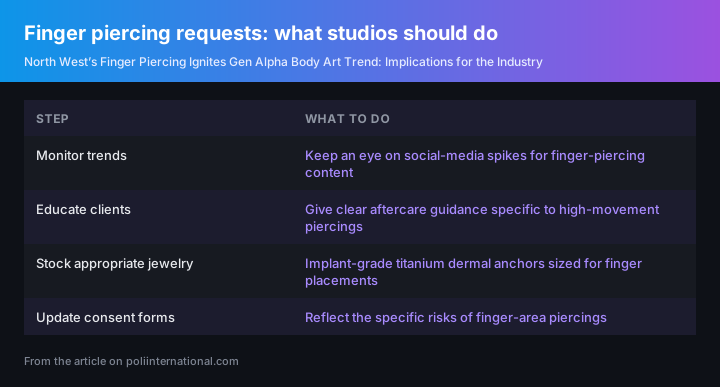
1. Monitor Trends: Keep an eye on social-media spikes for finger-piercing-related content.
2. Educate Clients: Provide clear aftercare guidance specific to high-movement piercings.
3. Stock Appropriate Jewelry: Ensure inventory includes implant-grade titanium dermal anchors sized for finger placements.
4. Update Consent Forms: Reflect the specific risks associated with finger-area piercings.
Conclusion
A photograph started the requests. The answer a studio gives should come from the anatomy of the hand and from its own policy on minors, not from the photograph.
Corrected on 12 October 2026. An earlier version of this article gave the wrong date, age, finger and city, attributed figures to the Association of Professional Piercers and the American Academy of Dermatology that we could not find in their publications, and stated healing times and jewelry sizes without a source. Those have been removed.
The finger piercings in this story are dermal anchors: a small base set under the skin with one visible end, not a bar passing through tissue from one side to the other. An earlobe is soft tissue that barely moves. A finger bends, grips and knocks against things all day, so the jewelry is under load from the first hour. Migration, rejection, infection and scarring. The skin on a finger is thin and the hand is always in use, in water and against surfaces, so the jewelry is easily caught or torn out. We have not found a published rejection rate for finger dermals and do not give one. Implant-grade titanium, from a supplier who can show the material certificate, in a size chosen by the piercer for that finger. Avoid steel of unknown composition: nickel is a common cause of contact allergy. There is no reliable figure. Healing on a hand is slower and less predictable than on a stable site, and many dermal anchors on fingers are lost before they settle. A client should be told that before the procedure, not after. The law depends on the country and, in the United States, on the state: check the rule that applies to your studio and keep the parent's consent on file where it is required. Beyond the law, some piercers refuse dermal piercings to anyone under 18. Brian Keith Thompson of Body Electric Tattoo in Los Angeles told People that he does, because healing one takes maturity.FAQ
What is a finger piercing and how is it different from an earlobe piercing?
What are the main risks?
What jewelry is suitable?
How long does a finger piercing take to heal?
Should minors get finger piercings?