Stop Treating a Finger Piercing Like a Fashion Accessory
Key Takeaways:
» Finger skin is thin, mobile, and constantly exposed to impact, friction, water, and contamination.
» A piercing through the hand can interfere with grip, snag on clothing, and migrate under repeated mechanical stress.
» A celebrity image is not a suitability assessment; the same placement can behave very differently across bodies and lifestyles.
» Bridge and facial piercings also require anatomy-specific planning, not imitation.
» Clients should choose a qualified piercer who can explain rejection, scarring, aftercare, and realistic longevity before taking money.
1. The Image Was Viral; the Anatomy Was Not
A recent wave of online discussion around North West’s facial styling and alleged finger piercing has produced the usual internet cocktail: celebrity fascination, moral panic, and thousands of people trying to determine whether jewellery is real. The facial pieces shown in circulating footage were reportedly fake, while the finger piercing had already attracted warnings because the hand is a mechanically hostile environment.North West’s clarification about the facial piercings matters less than the question underneath it: why does a placement become desirable simply because it appears on a famous person?
Because social media removes the part where the body says no.
A finger is not a miniature earlobe. The skin moves over joints, tendons, and dense connective structures. It is compressed when someone grips a phone, carries a bag, opens a door, washes their hands, plays sport, or simply sleeps badly. Jewellery placed through that tissue experiences shear, not just pressure. Shear is the quiet vandal of body modifications: it repeatedly moves adjacent tissue in different directions until the channel becomes irritated, elongated, or pushed toward the surface.
That is why the straightforward conclusion in the already published analysis of why finger piercings fail under hand anatomy and daily mechanical stress remains sound. The issue is not that every finger piercing fails instantly. The issue is that the placement has very little mechanical forgiveness.
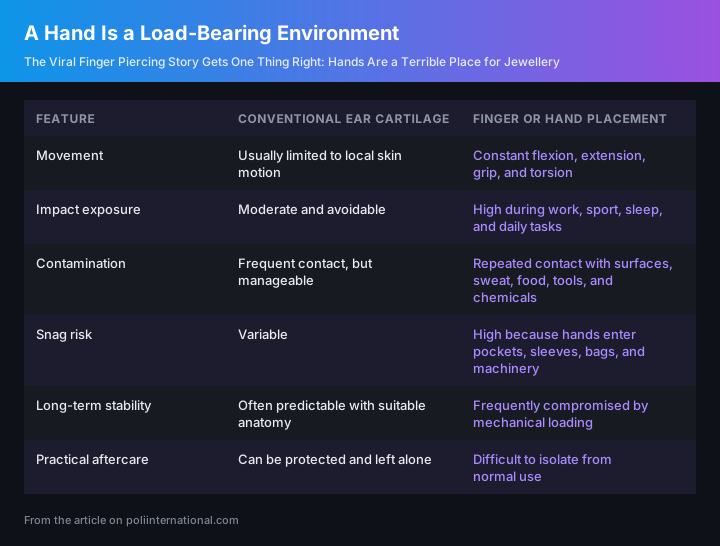
2. A Hand Is a Load-Bearing Environment
The internet tends to classify piercings by how dramatic they look. Engineering classifies them by load, movement, contamination, and tissue depth. Those are less glamorous words, but they are the ones that determine whether a channel remains stable.
| Feature | Conventional ear cartilage | Finger or hand placement |
|---|---|---|
| Movement | Usually limited to local skin motion | Constant flexion, extension, grip, and torsion |
| Impact exposure | Moderate and avoidable | High during work, sport, sleep, and daily tasks |
| Contamination | Frequent contact, but manageable | Repeated contact with surfaces, sweat, food, tools, and chemicals |
| Snag risk | Variable | High because hands enter pockets, sleeves, bags, and machinery |
| Long-term stability | Often predictable with suitable anatomy | Frequently compromised by mechanical loading |
| Practical aftercare | Can be protected and left alone | Difficult to isolate from normal use |
A piercing channel needs relative calm while its walls organise collagen and the body reduces the initial inflammatory response. That does not mean the tissue becomes inert. It means the mechanical environment must be tolerable enough for repair to outpace disruption.
On a finger, the client is effectively asking a wound to mature inside a piece of living machinery. The jewellery is exposed to lateral forces every time the hand closes. Even a perfectly executed procedure cannot abolish those forces. A skilled piercer can select a safer location, appropriate jewellery, and realistic expectations; they cannot negotiate with a doorknob.
This is where celebrity influence becomes particularly unhelpful. A public figure may wear a piece briefly for a shoot, use a convincing fake, remove it before filming, or have access to styling and medical support that an ordinary client does not. The visual evidence tells you almost nothing about wear duration, tissue condition, jewellery quality, or whether the modification is still present.
3. The Technical Problem Is Repeated Shear
The most important distinction is between acute injury and chronic mechanical irritation. Acute injury is the obvious event: a snag, blow, tear, or contaminated puncture. Chronic irritation is slower and more deceptive. It begins as tenderness, persistent redness, crusting, or a channel that seems increasingly shallow. Clients often interpret that as normal healing because nothing dramatic happened.
The tissue is saying otherwise.
A stable piercing needs jewellery that matches the anatomy without creating constant compression. Too-short jewellery presses into swelling and traps debris. Too-long jewellery moves excessively and catches. On a finger, both problems are amplified because the surrounding tissue changes shape repeatedly throughout the day.
The principal failure modes are:
- Migration: the channel shifts toward the surface as tissue is repeatedly loaded.
- Rejection: the body progressively expels the jewellery, often leaving a thin scar.
- Embedding: swelling or pressure causes jewellery to sink into tissue.
- Tearing: a snag converts a small channel into a larger wound.
- Contact dermatitis or irritation: soaps, gloves, adhesives, and cleaning chemicals inflame the area.
- Infection: contamination becomes more likely when the site is continually touched or exposed.
A particularly foolish mistake is treating visible healing as proof of structural stability. The skin may look calm while the channel is being stretched beneath it. No pus does not mean no mechanical problem. A piercing can be clean and still be failing.
Jewellery geometry matters too. Sharp edges, excessive external profile, poor surface finish, and inappropriate curvature all increase snagging and tissue loading. The material is not a magic shield. A biocompatible material can reduce one category of risk while the placement remains mechanically unsuitable.
The same principle applies to facial placements. A bridge piercing, for example, depends on tissue depth, surface anatomy, jewellery length, and the client’s tendency to catch or press the area. Online commentary correctly noted that bridge piercings can leave significant scarring when they migrate or reject.Reporting on the debate around facial piercing risks The lesson is not “never get one.” The lesson is “do not confuse a striking image with a low-risk procedure.”
4. Patrick's Note: The Hand Does Not Care About Trends
A finger piercing looks small because the jewellery is small. That is the visual trick. The tissue underneath still has to survive every handshake, pocket, keyboard, shopping bag, and accidental impact.
The phrase I would retire is “it’s only a little piercing.” Little objects can create large mechanical problems when they are placed where the body is constantly bending and gripping. I would rather disappoint someone before the procedure than watch them return later with a channel migrating toward the surface and a story about how the jewellery caught on a towel.
The engineering reality behind hand piercings and their limited long-term stability is not complicated. A good piercer evaluates anatomy, occupation, sport, hand dominance, jewellery profile, and the client’s willingness to protect the site. If those answers do not line up, the professional job is to say no or redirect the design—not to perform optimism with a needle.
5. FAQ: Technical Q&A
Q: Are finger piercings always unsafe?
No, but they are mechanically high-risk and often unsuitable for long-term wear. The decisive factors include exact placement, tissue depth, hand use, jewellery profile, and the client’s ability to protect the area. “Possible” is not the same as “sensible.”
Q: If the piercing stops hurting, is it healed?
Not necessarily. Reduced pain only means the acute inflammatory phase has settled; the channel may still be weak or slowly migrating. Watch for thinning skin, increasing jewellery visibility, persistent crusting, redness, or a change in angle.
Q: What should someone do if the jewellery is catching or sinking in?
Stop treating it as an annoyance and return to a qualified piercer promptly. Do not twist it, force it out through swollen tissue, or use harsh disinfectants. If there is spreading redness, heat, severe swelling, fever, pus, or loss of sensation, seek medical care.
Conclusion: Choose the Body, Not the Screenshot
The viral moment is not really about whether a celebrity’s jewellery was genuine. It is about how quickly a photograph becomes a procedure recommendation. A hand is exposed to more motion, impact, contamination, and snagging than most piercing sites, and no trend can repeal that biology.
Before copying a placement, ask a more useful question than “does it look good?” Ask whether the tissue can tolerate the forces your life will apply to it. For the hand, the honest answer is often no. The practical guide to why finger piercings fail and what clients should consider instead is the place to start before a viral image becomes a permanent scar.