Shop
Body Art News

The Piercing That Went Viral for the Wrong Reason

PP

Chief Engineer

Patrick Poli

Journal Date

2026-09-10

Last Reviewed

2026-10-07

When “extreme” stops being a trend and becomes a medical event

Key Takeaways:
» Extreme body modification gets attention fast, but tissue loss is not a flex; it is a permanent change with infection and healing consequences.
» The visible drama on social media is not the real story; the real story is vascularity, nerve damage, and aftercare.
» Studios should refuse procedures that cross from modification into predictable harm, even if the client has already built a fantasy around the look.
» Clients should treat any request for surgical alteration as a separate medical issue, not “just another piercing.”
» The market rewards shock, but biology collects the bill.
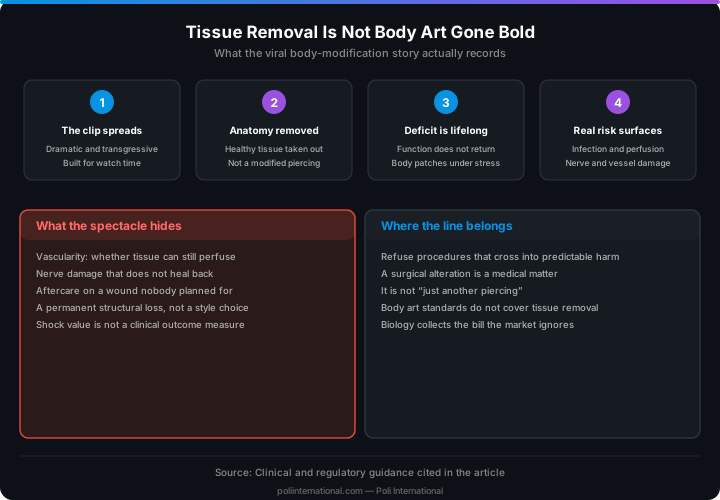
The Piercing That Went Viral for the Wrong Reason
Infographic: The Piercing That Went Viral for the Wrong Reason

1. The Story That Blew Up

A recent viral body-modification story centered on a man known online for extreme tattoos, facial implants, and piercings who had two fingers removed to create claw-like hands. The clip spread because it is exactly the kind of thing the internet cannot resist: dramatic, transgressive, and horrifying enough to keep people watching. The headline writes itself; the tissue damage does not.

What matters is not the spectacle but the mechanical truth. Once you remove healthy anatomy, you are not “upgrading” a piercing or refining a style. You are creating a lifelong functional deficit, then asking the body to patch it under stress. The body is not impressed by aesthetic commitment. It only cares about perfusion, infection control, and whether the remaining tissue can survive the insult.

This is the same basic issue that underlies so many bad outcomes in body art: people mistake intensity for expertise. That confusion is why skin trauma, healing time, and the real mechanics of piercing recovery matter more than the viral image ever will. If you want to understand why some “insane” body-mod content ends in regret, start with biology, not branding.

2. Piercing Versus Removing Tissue

The comparison here is blunt: elective alteration that preserves tissue is one category; elective alteration that removes tissue is another.

FeaturePiercing / reversible modificationSurgical amputation for body-mod aesthetics
Tissue impactPenetration or limited alterationPermanent loss of anatomy
Healing burdenLocalized wound care and monitoringMajor wound healing, scar formation, functional adaptation
Infection riskPresent, but usually manageable with proper careHigher stakes because of larger wound surface and deeper tissue involvement
ReversibilityOften partially reversible or removableNot reversible
Functional consequenceUsually limited if done wellLoss of grip, dexterity, and fine motor function

The viral audience often collapses all body art into one bucket, but the difference between a cartilage piercing and a digit amputation is not cosmetic. It is structural. One is a controlled wound; the other is a removed part. Treating them as equivalent is how people end up making terrible decisions with a straight face.

The market also feeds the confusion by rewarding the most shocking images, not the safest practices. That is why the relationship between jewelry rigidity, movement, and oral or cartilage damage belongs in this conversation too: the body reacts to pressure, leverage, and friction whether the content creator understands it or not.

3. What Losing a Finger Does to the Hand

The medical problem with extreme modification is not moral panic; it is predictable physiology. A finger contains bone, tendon, nerve, artery, vein, and skin arranged for precision work. When one or more digits are removed, the hand must re-map motor control and compensate for loss of surface area, balance, and load distribution. Even when healing is uncomplicated, scar tissue does not behave like the original structure.

Infection risk rises with wound size and depth. So does the chance of delayed healing, neuroma pain, hypersensitivity, and chronic inflammation. The more tissue you remove, the less margin you have when something goes wrong. A small piercing can be managed with local care and observation. A surgical alteration of this scale belongs in the world of informed consent, sterile technique, and post-operative monitoring, not social-media applause.

For studios, the practical line is simple: if the “modification” requires a scalpel, it is no longer a studio service in any meaningful sense. It is a medical intervention with aesthetic intent. That distinction matters because the standards for safe practice are not improvised from vibes. The same principle applies in less dramatic settings too: the clinical evidence on jewelry material behavior and long-term wear is useful precisely because it separates what looks edgy from what the body can tolerate.

4. Patrick's Note: The Thing People Pretend Is Still “Just Style”

THE COUNTER-INTUITIVE: the thing that looks more expressive is often the thing that leaves the least room for the body to cooperate.

The internet loves to act as if body modification is all one spectrum and the only difference is confidence. That is nonsense. A client asking for a piercing wants an opening, a placement, a material that behaves, and a result that can heal. A person asking for finger removal is asking for a permanent structural change with consequences that do not care how committed the camera looks. One is body art. The other is a wound with a costume on top.

What irritates me is how quickly people confuse shock with sophistication. The louder the reveal, the thinner the thinking. A sharp object can make a dramatic video in ten seconds; it cannot create back the function you threw away for the clip. The body keeps receipts. It always does.

5. FAQ: Technical Q&A

Q: Is a viral extreme body-mod video a sign that the practice is becoming normal?
No. Viral visibility is not normalization; it is algorithmic amplification. A thing can be widely watched and still be rare, dangerous, or clinically poor. Popular does not mean prudent.

Q: What is the biggest medical risk when body modification crosses into tissue removal?
Permanent functional loss is the first issue, followed by infection, nerve pain, scarring, and unpredictable healing. Once you remove healthy anatomy, you are no longer in the realm of reversible body art.

Q: How should a studio respond if a client asks for something that requires surgery?
Do not pretend it is a piercing or a tattoo with extra drama. Say it plainly: the request is outside normal studio work and belongs in a medical setting, if it is appropriate at all.

Conclusion: Keep the Work in the Right Category

The lesson from this viral body-mod story is not that people are “too extreme.” It is that the internet keeps rewarding ideas that biology punishes. Once a modification stops being reversible, the standard changes completely: different risks, different consent, different consequences.

If the goal is body art, stay inside the limits where the body can still do its job. If the goal is permanent structural loss, call it what it is and stop pretending the camera changed the rules. For a related reality check on material choices and what the body actually tolerates, read why flexible body jewelry outperforms rigid metal in high-movement piercings.

Mind map · The Piercing That Went Viral for the Wrong Reason

  • Viral Extreme Body Modification Analysis
    • Viral Amputation Case Study

      A viral body modification story featured a man surgically removing two fingers to create claw-like hands.

      • Digital Amputation Spectacle
        • Claw Hand Creation
        • Algorithmic Attention Rewards
      • Permanent Tissue Loss
    • Controlled Wounds Versus Structural Insults

      Piercings create controlled wounds, whereas surgical amputations cause permanent loss of anatomical structures and fine motor function.

      • Reversible Piercing Care
      • Irreversible Anatomical Loss
        • Grip and Dexterity Deficits
    • Physiological Risks and Motor Impairment

      Digit removal disrupts nerves, bones, and tendons, causing lifelong motor control re-mapping, neuroma pain, and severe infection risks.

      • Anatomical Disruption
        • Motor Control Remapping
      • Complication Hazards
        • Neuroma Pain and Infections
    • Studio Scope and Medical Boundaries

      Body art studios must refuse surgical procedures, as scalpel modifications represent medical interventions rather than standard piercing services.

      • Refusing High Risk Procedures
      • Medical Setting Requirement
StructureProcessMaterialHazard

4 branches, 0 sources. Each branch cites the article it came from; the labels beneath it are names, not claims.

Body Modification Quiz

  1. 1. According to the source material, what distinguishes surgical amputation from standard piercing regarding functional consequences?

    • • Amputation causes localized cartilage damage, while piercing alters bone density. — The source notes that cartilage damage is associated with rigid jewelry in piercings rather than amputation.
    • ✓ Surgical amputation leads to the loss of grip, dexterity, and fine motor function, whereas piercing consequences are usually limited if done well. — Surgical removal of digits strips away anatomical structures required for fine motor work, whereas controlled piercings leave functional structures intact.
    • • Piercings involve deeper tissue involvement, whereas surgical amputation only impacts surface-level skin. — Surgical amputation extends through bone, tendon, and deep vascular networks, making its tissue involvement far deeper than a standard piercing.
    • • Both procedures result in identical long-term loss of load distribution and motor mapping. — The text explicitly contrasts the permanent structural loss of amputation with the minimal functional impact of standard piercings.
  2. 2. How does the hand adapt physiologically when healthy digits are removed for extreme body modification?

    • • The remaining tissue immediately regenerates lost nerve paths to restore original tactile sensation. — Nerve damage and neuroma pain can occur after structural loss, but natural re-growth of original pathways does not occur.
    • ✓ The hand re-maps motor control and compensates for changes in surface area, balance, and load distribution. — Removing anatomical components forces the nervous system and remaining structures to adjust how weight and movement are distributed.
    • • Scar tissue takes over tendon functions, fully restoring fine motor dexterity over time. — Scar tissue lacks the specialized elasticity and mechanical function of original tendons and muscles.
    • • Vascularity increases significantly to allow scar tissue to behave identically to original bone and muscle. — The article emphasizes that scar tissue never behaves like original anatomical structures regardless of healing.
  3. 3. According to the article, what is the defining boundary line for studios when evaluating extreme client requests?

    • • If a client has already built a social media audience around the modification, the studio may proceed. — The text stresses that social media visibility and client fantasies do not alter safe operational boundaries.
    • ✓ If a procedure requires a scalpel, it ceases to be a studio service and becomes a medical intervention. — Procedures involving surgical cut-and-remove techniques cross out of body art into medical procedures requiring clinical standards.
    • • If a modification uses rigid metal rather than flexible material, it must be referred to an orthopedic specialist. — Jewelry material choice impacts tissue tolerance in piercings, but scalpel usage is the specific boundary defined for surgical procedures.
    • • If the client provides signed consent, any elective anatomical removal can be safely performed in a studio. — Informed consent does not convert a surgical amputation into an appropriate studio service.
  4. 4. What does the source material identify as the underlying reason viral extreme body-mod content spreads rapidly?

    • ✓ Algorithmic amplification that rewards shock and spectacle rather than medical prudence. — Online platforms amplify transgressive and dramatic images to maximize viewer engagement regardless of safety.
    • • Widespread societal normalization and acceptance of major anatomical removals. — The FAQ section clarifies that high viral visibility represents algorithmic reach rather than general normalization.
    • • Regulatory approval by international trade associations promoting extreme modifications. — The text attributes viral spread to social media mechanics rather than institutional endorsements.
    • • Clinical evidence proving that extreme modifications shorten overall wound healing times. — Surgical tissue removal increases healing burdens and infection risks rather than reducing recovery duration.
  5. 5. Which physiological factors must remaining tissue manage following severe elective anatomical removal?

    • • Complete structural reversibility and rapid surface tension reduction. — Surgical tissue removals are explicitly categorized as permanent and non-reversible.
    • ✓ Perfusion, infection control, and remaining tissue survival under stress. — Once anatomy is severed, blood flow delivery and wound defense dictate whether compromised tissue survives.
    • • Immediate scar elimination and full tendon re-attachment. — Scar formation is a permanent outcome of major wound healing rather than something the body eliminates.
    • • Automatic normalization of load distribution without motor adaptation. — The body must actively re-map motor control to handle changed load distribution when parts are missing.
  6. 6. What counter-intuitive principle does Patrick highlight regarding expressive body modifications?

    • • The more dramatic a modification appears, the easier it is for the body to heal efficiently. — The text argues that visual drama usually correlates with severe biological stress and poorer biological cooperation.
    • ✓ The thing that looks more expressive often leaves the least room for the body to cooperate. — Severe structural changes compromise natural anatomy, limiting the biological mechanisms required for uncomplicated healing.
    • • Reversible piercings carry a higher risk of deep neuroma pain than full digit amputations. — Deeper tissue loss and nerve disruption from amputation carry significantly higher risks of chronic neuroma pain than surface piercings.
    • • Removing tissue allows remaining structure to tolerate greater mechanical leverage and friction. — Eliminating healthy anatomy reduces the structural margin of safety when subjected to physical pressure.
  7. 7. What mechanical forces act upon body modifications regardless of whether the content creator understands them?

    • • Perfusion, sterilization, and viral engagement. — Perfusion and sterilization are biological and clinical concepts, whereas viral engagement is an online metric.
    • ✓ Pressure, leverage, and friction. — Physical interactions between hardware, movement, and tissue exert mechanical forces that the body reacts to automatically.
    • • Neuroma, scar formation, and re-mapping. — These represent biological consequences and neurological adaptations rather than external mechanical forces.
    • • Inoculation, elasticity, and tension. — These terms are general physical or biological concepts not cited together as the mechanical drivers of tissue wear.
  8. 8. Why is infection risk significantly higher in surgical amputation compared to standard piercings?

    • • Piercings involve deeper vascular networks than complete digit removals. — Surgical digit removals cut through bone, tendons, and deep blood vessels, which are much deeper than piercing channels.
    • ✓ Amputation exposes a larger wound surface and involves deeper tissue layers. — Larger and deeper surgical wounds present greater surface area for potential pathogens and involve complex deeper structures.
    • • Piercing materials constantly release toxic compounds into localized cartilage. — The article mentions material behavior in piercings, but attributes high amputation infection risks to wound scale and depth.
    • • Amputations rely on rigid metal jewelry that increases continuous friction. — Amputation refers to the permanent removal of anatomical structures rather than the placement of jewelry.
  9. 9. Statement: A viral extreme body-modification video is a reliable indicator that the featured practice is becoming normalized in society.

    • • True — High view counts on social media reflect algorithmic preference for shocking content rather than cultural or clinical acceptance.
    • ✓ False — The FAQ explicitly states that viral visibility represents algorithmic amplification rather than societal normalization.
  10. 10. How should a studio respond if a client requests an aesthetic procedure requiring surgical amputation?

    • • Treat it as a standard piercing service with extra post-care instructions. — The text emphasizes that surgical alterations cannot be treated as routine studio work or standard piercings.
    • • Perform the modification using sterile studio tools if the client signs a consent form. — Studios must refuse surgical interventions regardless of client consent or client enthusiasm.
    • ✓ Explain plainly that the request lies outside studio scope and belongs in a medical setting. — The source advises stating clearly that surgical procedures belong in medical environments rather than body art studios.
    • • Offer flexible jewelry options to reduce the mechanical friction of the scalpel wound. — Flexible jewelry choices apply to standard piercings, not surgical amputation protocols.

Extended Reference Table

7 of 7 rows

Extended reference table generated from the article and its verified research sources. Bracketed numbers jump to the matching entry in the Technical References below.

SafetyItem, Material, or Practice Classification Common Risks and Complications Clinical Standards and Specifications Source
✅Nose PiercingBody Modification / PiercingStaphylococcus aureus infection, local inflammation, septicemia, abscess, spinal compression, bone marrow infection, and paraplegia.Establishment must follow hygiene standards, use sterilized materials, and perform proper skin sanitation.
✅Breast ImplantsClass III medical deviceCapsular contracture, implant failure, gel migration, silicone bleeding, and inflammatory reactions.FDA Approved; Multilayer elastomer shell.
✅Implant-Grade TitaniumBiocompatible MaterialHypoallergenic and corrosion-resistant; low risk of allergic reaction or rejection.ASTM F136; Ti6Al4V ELI.
✅Surgical-Grade Stainless SteelBiocompatible MaterialNickel sensitivity leading to allergic contact dermatitis; slow healing or rejection if non-implant grade.ASTM F138; 316L/316LVM.
✅TattoosPermanent or Semipermanent Body ModificationSkin infections, allergic reactions, transmission of bloodborne pathogens (Tetanus, Tuberculosis, Hepatitis).Pigment depth typically 0.6 to 2.2 mm; American Academy of Pediatrics (AAP) guidance.
✅Tongue PiercingOral PiercingDental problems (chipped teeth, enamel wear), gum erosion, aspiration, and risk during medical intubation.Medically performed; placement must account for individual anatomy.
✅Snake Eyes PiercingHorizontal Tongue PiercingRestricted tongue movement, muscle damage, nerve damage, speech impediment, and gum erosion.-

Free Body Art Wall Posters

Print-ready reference posters for your studio or your own wall. Free to download and display, embed on your own site with attribution. Click any poster to preview it full size before downloading.

Choose and download all 40 posters

Technical_References_Archive

About the Author

PP

Patrick Poli

Chief Engineer, Poli International · Creator of BioFlex® body jewelry

Patrick has spent 25+ years manufacturing body jewellery and studio equipment, and is the creator of BioFlex® body jewelry. He created the push-fit system so jewellery separates on impact instead of tearing the piercing. He also ran 10 to 25 minute consultations before piercing, and treats aftercare as a standing invitation rather than a leaflet.

More about Patrick →

Last reviewed: 2026-10-07 · Published: 2026-09-10

Continue Reading