Shop
Body Art News

The TikTok Piercing Clip That Went Sideways: What It Really Shows

PP

Chief Engineer

Patrick Poli

Journal Date

2026-09-01

Last Reviewed

2026-10-08

When a piercing video looks brutal, the real question is not “was it dramatic?” but “was the jewelry, anatomy, or technique wrong?”

Key Takeaways:
» Viral piercing videos usually expose technique problems more than “bad luck.”
» A piercing that looks angry on day one is not automatically infected; pressure, trauma, and poor fit are the first suspects.
» For clients, the fix is often simple: remove the cause, not the piercing.
» For studios, the cheapest mistake is still the most expensive one: the wrong jewelry length or shape.
» If a clip makes a piercer look reckless, the useful takeaway is to inspect the setup, aftercare, and consent context before piling on.
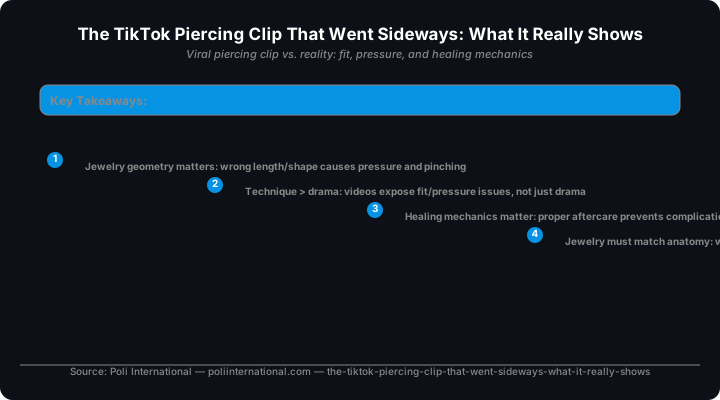
Viral piercing clip vs. reality: fit, pressure, and healing mechanics
Infographic: Viral piercing clip vs. reality: fit, pressure, and healing mechanics

1. The Story Behind the Clip

The most-discussed body-art story I found in the last stretch is another TikTok piercer drama: a client video that spread fast because it looked uncomfortable, sloppy, or outright botched, and the comments predictably turned into a public trial. That formula is almost boring now. Social media does not reward nuance; it rewards the second a needle, a face, or a flinch can be turned into a verdict.

The useful part is not the outrage. It is the anatomy lesson hiding inside it. A piercing can look horrific online for three different reasons: the jewelry is wrong, the angle is wrong, or the moment is being judged without healing context. Those are not the same thing, and the internet flattens them into one ugly screenshot. For a practical trade read on fit and wear, the discussion around why flexible jewelry can protect mouth and cartilage piercings long-term is still more useful than another round of comment-section moral theatre.

What matters is that piercing is not a beauty filter; it is a mechanical system. If the post-swell space is too tight, the tissue gets pinched. If it is too long, it gets knocked around. If the post is too rigid for the anatomy, the body does what bodies do: it reacts. That is why the real science sits in load, movement, and friction, not in whether the video had dramatic music.

2. Good Setup Versus Bad Setup

FeatureGood SetupBad Setup
Jewelry fitEnough room for swelling without excess movementToo tight, causing compression and trauma
Material behaviorStable, biocompatible, appropriate for the siteCheap flex or mystery alloy that bends, leaches, or irritates
Wound responseMild redness, swelling, tendernessSevere heat, throbbing, discharge, migration
Client outcomeComfortable healing and stable channelProlonged irritation, rejection risk, and avoidable panic

The biggest technical error in viral piercing content is treating every swollen piercing as if it were infected. That is lazy and it sends people chasing the wrong fix. A fresh piercing commonly shows localized redness, heat, and tenderness; those are expected inflammatory signs. What is not expected is worsening pain, expanding redness, thick colored discharge, or a piece of jewelry that is clearly cutting into tissue. The difference matters because one is normal healing and the other is a mechanical failure.

This is also why the “one-size-fits-all” jewelry mindset causes so many avoidable problems. A labret that is too short compresses tissue. A curved barbell in the wrong anatomy can torque the channel. A stud with poor finish or sloppy tolerances creates irritation that people then call “sensitivity,” as if the body invented the problem for fun. It did not.

3. The First 72 Hours of a Fresh Piercing

The clinical basics are uncomplicated: fresh piercings are vulnerable because the skin barrier has been breached, the channel is immature, and the tissue is managing trauma. The first 24 to 72 hours are often the most visibly swollen. That does not make the piercing doomed; it means the body is doing repair work. The practical task is to keep pressure low, movement minimal, and fit appropriate.

For studios, the numbers that matter are the boring ones. Internal diameter, wearable length, thread quality, polish, and material consistency all affect outcome. In a healed or healing piercing, “close enough” is not a standard. If the post is too short, you get pressure necrosis risk. If it is too long, you get leverage, bumping, and migration. If the finish is rough, you add surface trauma. The body will respond to all of that faster than a customer can post a shaky close-up online.

This is also where bad public advice gets dangerous. The internet loves to say, “It’s just irritated, keep going.” Sometimes that is true. Sometimes it is the exact sentence said right before a piercing begins to fail. The right response is to assess the cause: fit, angle, aftercare, snagging, sleep pressure, or material quality. If the issue is material and the jewelry is a flexible polymer product, the conversation must also separate genuine certified material from counterfeit copies; otherwise people end up blaming the chemistry for a knockoff’s failures. The discussion around how body-art regulations and ink restrictions keep shifting under studio practice shows the same pattern: rules often lag behind material reality.

One more technical point the viral crowd misses: not every visible problem is a hygiene problem. A piercing can be clean and still fail if the mechanics are wrong. That is why “sterile” is necessary but not sufficient. The channel can be sterile and still be crushed by bad geometry.

4. Patrick's Note: What I Would Tell You Across the Counter

A fresh piercing that looks angry is not automatically a disaster. The thing you are actually worried about is whether the piercing is being pinched, knocked, or pushed off angle. That is the answer people need in the first minute, because panic makes clients touch it more, sleep on it more, and “check it” more, which is a lovely little recipe for making inflammation worse.

What I would tell you across the counter is simple: if the jewelry is tight, digging in, or getting worse instead of settling, go back and have it checked. If it is sore, swollen, and a bit dramatic but not cutting in, that can still be normal. The body does not read the captions under the video. It heals on its own schedule, not on TikTok’s.

And no, the answer is not to yank it out in a bathroom mirror because someone in the comments said “that looks infected.” Infection has real signs, and irritation has different ones. Confusing the two is how people turn a manageable issue into a mess.

5. FAQ: Technical Q&A

Q: How do I know if a new piercing is irritated or infected? Irritation usually shows up as localized redness, swelling, tenderness, and improvement when the cause is removed. Infection is more likely when pain, heat, redness, and discharge are getting worse, spreading, or accompanied by systemic symptoms. If the jewelry is tight, snagging, or cutting in, treat that as a mechanical problem first.

Q: Should I change the jewelry if the piercing looks swollen?
Not immediately, unless the current piece is clearly too short, embedding, or causing pressure. The right move is to have an experienced piercer assess the fit and site. Changing jewelry blindly can make the problem worse if the new piece is the wrong size or shape.

Q: Why do so many viral piercing videos look more dramatic than the actual problem?
Because cameras exaggerate stress and social media strips away context. A clip shows one moment, not the swelling timeline, the anatomy, or the aftercare. The image may be real, but the conclusion is usually incomplete.

Conclusion: Check the Mechanics

The viral piercing story of the week is not really about one person’s video. It is about how fast the internet turns a mechanical problem into a moral one. Most of the time, the fix is not panic, shame, or wild aftercare hacks; it is better fit, better technique, and a calmer read on what healing actually looks like.

If you want the blunt version: piercings fail when the setup fights the tissue. Get the mechanics right and the drama gets a lot less exciting. For a deeper look at material choices and long-term wear, read the internal note on flexible jewelry and why rigid metal is not always the smarter answer.

Mind map · The TikTok Piercing Clip That Went Sideways: What It Really Shows

  • TikTok Piercing Clip Deconstruction
    • Mechanical Piercing Issues

      Viral piercing videos usually expose technique problems more than bad luck.

      • Improper Jewelry Fit
        • Short Posts Pinch Tissue
        • Long Posts Cause Leverage
    • Normal Inflammatory Phase

      The inflammatory phase begins immediately after the piercing and typically lasts for a few days.

      • Expected Wound Symptoms
        • Localized Swelling and Redness
        • Whitish Yellow Lymph Fluid
    • Jewelry Sizing Standards

      Initial jewelry should be intentionally longer than the final fitted piece to allow space for the ear to swell.

      • Biocompatible Jewelry Materials
        • Implant Grade Titanium
        • Solid Gold Fourteen Karat
    • Infection Risks

      Removing jewelry before healing is complete can allow the channel to close and trap bacteria.

      • Bacterial Infection Symptoms
        • Spreading Heat and Fever
        • Thick Opaque Discharge
StructureProcessMaterialHazard

4 branches, 0 sources. Each branch cites the article it came from; the labels beneath it are names, not claims.

Piercing Quiz

  1. 1. According to the source material, what primary factor usually accounts for a piercing looking severe or angry in social media clips?

    • ✓ Mechanical technique problems and improper jewelry fit. — The text emphasizes that viral clips typically expose setup, angle, and fit issues rather than bad luck or hygiene failures.
    • • Unavoidable bad luck during the needle insertion process. — The article explicitly states that viral videos reveal technical errors rather than random bad luck.
    • • Lack of sterile procedures during initial setup. — The source notes that a piercing can be completely clean and sterile yet still look dramatic or fail if mechanical fit is wrong.
    • • Immediate bacterial infection introduced at the studio. — Expected inflammatory signs on day one are frequently misidentified as infections when they are actually mechanical responses.
  2. 2. What is the typical timeframe identified in the article when visible tissue swelling peaks for a fresh piercing?

    • ✓ The first 24 to 72 hours. — The initial three days represent the acute inflammatory window where the tissue manages initial trauma and begins repair work.
    • • The first 12 to 24 hours. — Tissue swelling often continues to develop beyond the initial twelve to twenty-four hours after tissue trauma.
    • • Days 4 through 7 post-procedure. — While swelling may persist, the primary initial inflammatory peak described in the text occurs earlier during the first three days.
    • • Weeks 2 through 3 during channel maturation. — Maturation occurs long after the initial 24- to 72-hour window where visible acute swelling is most prominent.
  3. 3. What specific physical risk is created when a labret or post is selected that lacks sufficient wearable length for swelling?

    • ✓ Pressure necrosis from tissue compression. — Jewelry that is too short pinches swelling tissue, restricting circulation and leading to compression trauma or tissue embedding.
    • • Channel migration due to excess mechanical leverage. — Excessive post length, rather than restricted length, causes leverage and bumping that lead to migration.
    • • Rapid chemical leaching from mystery alloy components. — Alloy leaching is a function of improper material biocompatibility rather than post length selection.
    • • Torque forces acting directly on the immature channel. — Torque forces are caused by improper jewelry shape or anatomy curvature rather than undersized post length.
  4. 4. How does the article evaluate the relationship between studio sterility and overall piercing outcomes?

    • ✓ Sterility is necessary for safety, but bad geometry can still cause a sterile piercing to fail. — The text explains that even a completely sterile channel will fail if improper mechanical fit crushes the tissue.
    • • Sterility is the single determining factor in preventing post-piercing trauma and irritation. — Focusing solely on sterility ignores mechanical factors like post length, angle, and friction that drive tissue failure.
    • • Hygiene failures account for the majority of visible complications shown in social media clips. — Social media content often misinterprets mechanical setup errors as hygiene or infection issues.
    • • Proper sterile technique completely offsets risks caused by incorrect post length or shape. — Sterility cannot prevent pressure necrosis or physical trauma if jewelry geometry is incompatible with anatomy.
  5. 5. What issue does the source text highlight when evaluating failures associated with flexible polymer jewelry?

    • ✓ Counterfeit knockoffs are frequently mistaken for genuine certified polymer materials. — Uncertified copies fail mechanically or chemically, leading users to falsely blame flexible polymer technology as a whole.
    • • Flexible polymers naturally leach harmful phthalates into open piercing channels. — The text notes that problems stem from uncertified counterfeit materials rather than inherent properties of certified polymers.
    • • All flexible jewelry lacks sufficient rigidity to hold an angle during initial healing. — The article supports appropriate flexible options and attributes failure to improper fit or fake materials rather than flexibility itself.
    • • Flexible materials degrade completely within the first 24 to 72 hours of contact with body heat. — Certified flexible products maintain structural integrity when genuine materials are utilized.
  6. 6. Which set of symptoms distinguishes a severe mechanical failure or true infection from expected inflammatory healing?

    • ✓ Worsening pain, expanding redness, and jewelry cutting into swollen tissue. — Progressive escalation of pain and swelling combined with tissue embedding indicates mechanical breakdown or secondary infection.
    • • Mild localized redness, mild heat, and initial tenderness around the entry site. — Localized warmth, redness, and tenderness represent normal physiological repair mechanisms within early healing windows.
    • • Minor clear fluid discharge during the first 24 hours. — Light fluid exudate is standard during initial acute tissue repair following skin trauma.
    • • Moderate swelling that remains localized without cutting into the skin. — Contained swelling that does not compress or breach surrounding tissue is an expected part of recovery.
  7. 7. What mechanical issue occurs when an installed jewelry post remains excessively long after swelling subsides?

    • ✓ Increased leverage causing bumping, snagging, and channel migration. — Extra wearable length creates mechanical leverage when bumped or caught, causing physical movement and channel shift.
    • • Immediate tissue compression and localized pressure necrosis. — Tissue compression occurs when jewelry is too short for swelling, not when it is too long.
    • • Increased risk of chemical leaching into surrounding skin layers. — Material leaching depends on alloy composition rather than the length of the post.
    • • Spontaneous tissue embedding within the first 72 hours. — Embedding occurs when posts are too short to accommodate expanding post-swell volume.
  8. 8. According to the source text, what three core reasons explain why a piercing can look alarming in online video clips?

    • ✓ Incorrect jewelry fit, improper angle, or judgment without healing context. — The source explicitly identifies wrong jewelry, wrong angle, and lack of healing context as the three factors masking normal healing.
    • • Poor studio hygiene, unsterilized tools, or contaminated aftercare solutions. — Hygiene and aftercare contamination are not listed among the primary mechanical reasons videos appear dramatic.
    • • Cheap metal alloys, sudden bacterial exposure, or client allergic reactions. — While material quality matters, the text specifically groups the visual online exaggeration into fit, angle, and context.
    • • Needle trauma, lack of client consent, or improper aftercare cleaning frequency. — Video drama stems primarily from mechanical geometry, angle, and time context rather than cleaning frequency.
  9. 9. What client action is specifically cautioned against when a fresh piercing appears swollen or irritated online?

    • ✓ Removing the jewelry at home based on comment section advice. — The author warns clients not to yank jewelry out in a bathroom mirror based on online comments confusing irritation with infection.
    • • Returning to an experienced piercer to assess jewelry length and fit. — Having a professional evaluate mechanical fit across the counter is the recommended protocol.
    • • Keeping pressure off the piercing during sleep and daily routines. — Minimizing sleep pressure and touch trauma is recommended to reduce inflammation.
    • • Leaving swollen jewelry in place if it is not cutting into the tissue. — Allowing localized swelling to settle naturally without premature intervention is safe if tissue is not being pinched.
  10. 10. In the comparative analysis table provided in the text, what defines a 'Bad Setup' regarding material behavior?

    • ✓ Cheap flex or mystery alloy that bends, leaches, or irritates tissue. — The data table specifically categorizes cheap flex or unverified alloys that flex excessively or leach as a bad setup feature.
    • • Stable, biocompatible material appropriate for the specific anatomical site. — Biocompatible and site-appropriate materials are defined in the table as characteristic of a good setup.
    • • Flexible polymer certified to meet international body-art standards. — Certified polymers are highlighted as beneficial options when correctly sourced and applied.
    • • Autoclave-sterilized titanium components fitted with internal threading. — High-grade materials with smooth finishes represent appropriate setups that minimize surface trauma.

Extended Reference Table

8 of 8 rows

Extended reference table generated from the article and its verified research sources. Bracketed numbers jump to the matching entry in the Technical References below.

SafetyItem, Material, or Practice Description Compliance and Specification Anatomical and Technical Notes Source
✅TitaniumA lightweight, biocompatible metal used for initial and healed piercings to minimize irritation and immune response.ASTM F-136, ASTM F1295, ISO 5832-3, ASTM F-67 (commercially pure)Recommended to prevent rejection and chronic inflammation. Can be anodized to create colors. Switching to this material can halt migration caused by metal sensitivity.[9], [10], [11]
✅Surgical SteelA variety of iron-based alloys used for body jewelry, requiring specific biocompatible grades for internal tissue contact.ASTM F-138, ISO 5832-1, ISO 10993-(6, 10, or 11), EEC Nickel DirectiveGrades like 316L are common in stretching kits. Only specific implant grades (ASTM F-138) are proven safe for initial piercings as they limit nickel release to tolerable levels.[9], [10], [11]
✅GoldYellow, rose, or white gold used for initial piercings if meeting specific purity requirements.14k or higher; nickel- and cadmium-freeGold higher than 18k is too soft and prone to scratches; plated or filled gold is unacceptable as it can chip and expose base metals.[11]
✅GlassInert material used for initial piercings and stretching.Fused quartz, lead-free borosilicate, or soda-lime glassMust be able to withstand autoclave sterilization. Recommended for safe dead stretching above 10mm.[9], [11]
✅NiobiumA metal similar to titanium used for many years in the jewelry industry.-Does not have a formal implant-grade designation. Can be anodized black, though color may fade due to friction or body chemistry.[11]
✅PlatinumA heavy, extremely inert precious metal.-Excellent for body piercings but rare and expensive due to manufacturing difficulty.[11]
✅BioFlex / Flexible PolymerBiocompatible polymer materials designed to protect mouth/cartilage piercings or for use by athletes.REACH compliantUsed when rigid metal is not ideal; requires genuine certified material to avoid mechanical failure.
✅Sterile Saline Wound WashA pre-packaged 0.9% sodium chloride solution used for cleaning piercing sites.0.9% Sodium ChloridePreferred over DIY salt mixtures to avoid over-drying tissue. Does not strip natural moisture like harsh chemicals (hydrogen peroxide or BZK).[9]

Free Body Art Wall Posters

Print-ready reference posters for your studio or your own wall. Free to download and display, embed on your own site with attribution. Click any poster to preview it full size before downloading.

Choose and download all 40 posters

Technical_References_Archive

About the Author

PP

Patrick Poli

Chief Engineer, Poli International · Creator of BioFlex® body jewelry

Patrick has spent 25+ years manufacturing body jewellery and studio equipment, and is the creator of BioFlex® body jewelry. He created the push-fit system so jewellery separates on impact instead of tearing the piercing. He also ran 10 to 25 minute consultations before piercing, and treats aftercare as a standing invitation rather than a leaflet.

More about Patrick →

Last reviewed: 2026-10-08 · Published: 2026-09-01

Continue Reading