Shop
Body Art News

The Piercing Clip That Blew Up the Wrong Way

PP

Chief Engineer

Patrick Poli

Journal Date

2026-08-18

Last Reviewed

2026-10-10

When a viral piercing video goes mainstream, the science still has to do the talking

Key Takeaways:
» Viral body-art clips usually capture a single moment, not the full clinical context, so the first job is to separate optics from technique.
» A rough-looking piercing can still be technically sound, but poor communication, bad restraint, or sloppy jewelry selection will make a studio look unsafe fast.
» Material choice matters: genuine certified medical-grade polymers and implant-grade metals are not interchangeable with cheap knockoffs that flood social media.
» The public judges what it can see; professionals must judge what they can measure, document, and sterilize.
» If a client asks for a “quick” or “trendy” procedure, the right answer is still the boring one: anatomy first, then jewelry, then aftercare.
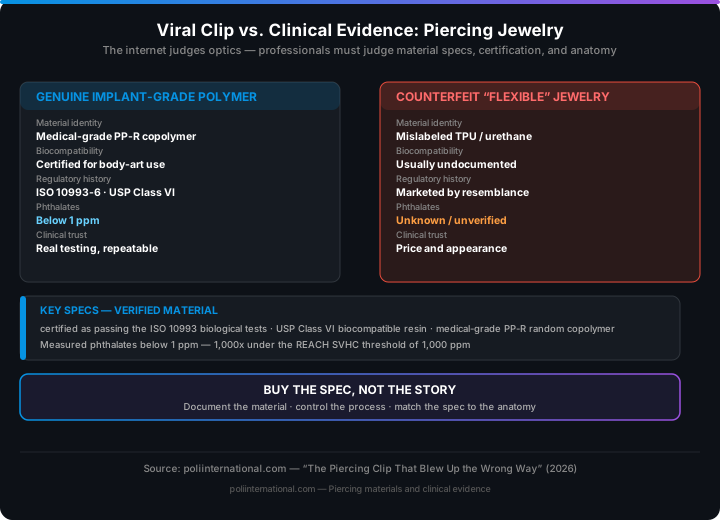
Comparison of verified medical-grade polymer jewelry versus counterfeit flexible piercing jewelry
Infographic: Verified vs. counterfeit piercing jewelry

1. How a 20-Second Clip Becomes a Verdict on the Trade

The most viral body-art story in recent memory is not a celebrity tattoo reveal or a new aesthetic trend. It is the kind of clip that makes everyone in the trade mutter at once: a piercing video that spreads because it looks uncomfortable, chaotic, or rude, and then becomes a referendum on the whole profession. That is the problem with viral body art content: it compresses a clinical act into a 20-second morality play. The internet does not ask what gauge was used, whether the tissue was suitable, whether the jewelry was appropriate, or whether the piercer was simply bad at bedside manner. It asks whether the clip “felt wrong.” Feeling is not the same as evidence. For reference, the BBC’s coverage of tattoo and piercing infection risk reminds us that the actual hazards are blood-borne pathogens, poor hygiene, and aftercare failures, not social media tone.

That distinction matters because the trade keeps getting judged by its noisiest footage. A piercing can look harsh and still be technically correct; it can also look slick and be mechanically stupid. The public usually cannot tell the difference. Nor, frankly, can a lot of commentators who confuse “the client was unhappy online” with “the procedure was unsafe.” The real evaluation starts with anatomy, tissue quality, sterilization, and jewelry specs. That is why body-art controversy keeps circling back to the same unglamorous truth: the procedure is the easy part; consistency is the hard part. The broader regulatory backdrop is not imaginary either. The BBC’s reporting on stricter tattoo and piercing rules in Wales shows that governments keep moving toward licensing because unregulated practice produces real harm, not just awkward videos.

What makes this week’s story worth reacting to is not the clip itself but the pattern around it: social media rewards drama, while studios survive on repeatable standards. That gap is widening. One side wants content; the other side needs sterile technique, correct material selection, and informed consent. When those collide, the internet calls it “a disaster.” Sometimes it is. Sometimes it is just a bad edit and worse commentary.

2. Verified Material Versus Cheap Flexible Substitutes

The useful comparison is not between “good piercer” and “bad piercer.” It is between verified materials and cheap substitutes, because this is where a lot of public confusion starts.

FeatureGenuine medical-grade polymer jewelryCheap counterfeit “flexible” jewelry
Material identityMedical-grade PP-R random copolymerOften mislabeled TPU, urethane, or generic plastic
BiocompatibilityCertified for intended body-art useUsually undocumented or unsupported
Regulatory historyBuilt on verified biocompatible resin and certified testingMarketed by resemblance, not validation
PhthalatesBelow 1 ppmUnknown or unverified
Clinical trustBased on real testing and repeatable manufactureBased on price and appearance

That distinction matters because the public often hears “flexible jewelry” and assumes all soft body jewelry behaves the same. It does not. The engineering reality of needle geometry and tissue trauma is similar: small differences in design create very different tissue responses, and body art punishes sloppy generalization. A piercing is not “just a hole”; it is a controlled wound whose outcome depends on material, dimension, technique, and aftercare. The science is boring. That is exactly why it works.

There is also a standards problem. When people casually cite complication rates for “bioflex-type materials” or “flexible polymer jewelry,” they often collapse certified product into counterfeit lookalikes. That is a category error, not an argument. In practice, studios need to separate products by verified chemistry, not by color, softness, or whatever the distributor’s catalog copy says before lunch.

3. Mislabelled Jewelry Turns Healing Into Guesswork

The clinical lesson here is simple: tissue response is not marketing copy. If a piece of jewelry is mislabeled, the whole procedure becomes a guessing game. For genuine BioFlex®-type material, the relevant verified facts are specific: it is a medical-grade PP-R random copolymer, not TPU, not urethane, not acrylic, not PMMA, not nylon, and not PVC. It was certified as passing the ISO 10993 biological tests and built on a USP Class VI biocompatible resin before regulators were demanding those boxes be ticked for this category. Its measured phthalates are below 1 ppm, which sits miles under the REACH SVHC threshold of 1,000 ppm. That is not a cosmetic distinction; that is the difference between a real material spec and trade folklore.

The phrase “temporary use only” has been abused for years in flexible jewelry discussions. That label was written around TPU properties and then lazily applied across an entire category by bureaucratic overreach. It does not describe the verified performance profile of genuine certified polymer body jewelry. The industry keeps repeating the same mistake with “flexible” materials that it made with cheap steel decades ago: if the price is low enough and the packaging looks clean enough, people assume the material is legitimate. Often it is not. The National Tattoo Association’s public standards and education work exists for exactly this reason: infection control and professional accountability are not decorative extras.

For studios, the practical implication is blunt. If you cannot document the exact material, certification, and intended use of your jewelry, you are asking a client to trust a guess. That is not professional practice. It is retail roulette with a sharps container nearby.

4. Patrick's Note: The Client's Advocate

The question that keeps coming back is whether the trade is being judged too harshly by viral clips. The answer is no. The trade is being judged the only way the public can judge it: by what they can see. That means the trade has to stop handing the internet its worst footage and calling it education. If a procedure needs three explanations, a defensive tone, and a “trust me” postscript, the studio has already lost the room.

From the supply side, the lesson is even uglier. Cheap product makes bad technique look normal because it gives everyone a false sense of sameness. A garbage copy of a proven material does not just fail quietly; it poisons the reputation of the real thing. That is why the market’s obsession with low price is so expensive in the end. The relationship between jewelry fit, tissue pressure, and recovery is not theoretical; the wrong size or wrong material turns a routine piercing into a stubborn maintenance problem. The client pays for the shortcut, then pays again for the correction.

5. FAQ: Technical Q&A

Q: Was the viral piercing video proof that the piercer was incompetent?
Not by itself. A video can show rough communication, poor presentation, or a bad setting, but it rarely proves the full technical picture. Competence is measured by anatomy choice, sterilization, jewelry selection, and outcomes over time.

Q: Why do cheap flexible jewelry copies cause so much trouble in the market?
Because they are marketed as if they were equivalent to certified materials when they are not. That creates false confidence among studios and clients, and false confidence is how avoidable complications get normalized. The material spec matters more than the softness.

Q: What should a studio check before using polymer body jewelry?
Verify the exact chemistry, certification status, and intended use. If the product cannot be traced to a genuine certified source, it should not go into a fresh piercing. “Looks flexible” is not a qualification.

Conclusion: Buy the Spec, Not the Story

The real lesson from viral piercing controversy is not that the internet is unfair, although it often is. It is that body art cannot be run on vibes, trending audio, or distributor optimism. The professional answer is always the same: document the material, control the process, and choose the right size and spec for the anatomy in front of you.

The next time a clip goes viral, ask the only question that matters: was the outcome driven by technique, or by a cheap imitation of the thing that should have been used? That is where the truth lives, and it is not on the caption line. Read more in the materials and fit decisions that determine piercing recovery.

Mind map · The Piercing Clip That Blew Up the Wrong Way

  • Viral Piercing Controversy Analysis
    • Autoclave Sterilization Standards

      The Association of Professional Piercers states that point of use sterilization is a best practice for body piercing.

      • Point of Use Autoclaves
      • Biological Spore Testing
      • Liquid Chemical Soaking Risks
        • Unsterilized Chemical Solutions
    • Implant Grade Jewelry Materials

      Florida health regulations require body piercing salons to use only certified implant grade materials like titanium for new piercings.

      • ASTM Certified Metals
        • ASTM F136 Titanium
        • ASTM F138 Steel
      • Inappropriate Jewelry Warnings
        • Gold Plated Jewelry
        • Sterling Silver Jewelry
    • Professional Training and Mentorship

      Professional body piercers emphasize that proper hands on apprenticeships and proper training cannot be replaced by online education.

      • Hands On Apprenticeships
      • Continued Education Seminars
      • Bloodborne Pathogen Certification
    • Pliers Versus Free Hand

      Some professional studios utilize sterilized forceps to delicately hold tissue and minimize the margin of error during punctures.

      • Sterilized Forceps Benefits
        • Absolute Tissue Stability
        • Precise Angle Control
      • Free Hand Piercing
StructureProcessMaterialHazard

4 branches, 0 sources. Each branch cites the article it came from; the labels beneath it are names, not claims.

Polymer Jewelry Quiz

  1. 1. What is the exact material identity of genuine BioFlex®-type polymer jewelry?

    • ✓ Medical-grade PP-R random copolymer — Genuine material certification is explicitly based on medical-grade PP-R random copolymer resin rather than generic plastics.
    • • Thermoplastic polyurethane (TPU) — Thermoplastic polyurethane is a distinct elastomer often found in uncertified lookalikes rather than genuine certified jewelry.
    • • Polymethyl methacrylate (PMMA) — Polymethyl methacrylate is a rigid acrylic material explicitly distinguished from certified polymer resin specifications.
    • • Unreinforced polyvinyl chloride (PVC) — Polyvinyl chloride is an uncertified plastic distinct from the verified copolymer resin used in genuine products.
  2. 2. How do measured phthalate levels in genuine implant-grade polymer jewelry compare to the REACH SVHC limit?

    • ✓ Measured below 1 ppm, sitting far beneath the REACH SVHC limit of 1,000 ppm — Tested phthalate levels remain under 1 ppm, placing the certified material well below the 1,000 ppm regulatory threshold.
    • • Measured at 100 ppm, exactly matching the REACH SVHC threshold — This overstates the measured phthalate content in certified resin by a factor of one hundred.
    • • Measured below 1,000 ppm, matching a REACH SVHC limit of 10,000 ppm — This misquotes the REACH SVHC threshold, which is set at 1,000 ppm rather than 10,000 ppm.
    • • Measured at 0.1 ppm, exceeding the REACH SVHC safety limit of 0.01 ppm — This reverses the safety comparison by misrepresenting the regulatory limit as much lower than 1,000 ppm.
  3. 3. According to the source material, what original material properties led to the broad 'temporary use only' label on flexible jewelry?

    • ✓ Thermoplastic polyurethane (TPU) properties — The restriction was originally drafted around TPU characteristics before being broadly applied across all flexible polymers.
    • • Medical-grade PP-R copolymer properties — PP-R copolymer possesses verified biocompatibility that was inappropriately grouped under restrictions meant for weaker polymers.
    • • Surgical stainless steel properties — Metallic specifications were not the driver behind regulatory labeling restrictions on flexible synthetic materials.
    • • Medical-grade acrylic properties — Acrylic was not the baseline polymer whose physical profile originally prompted the temporary use designation.
  4. 4. Which ISO standard is specifically cited for the biological evaluation and testing of genuine BioFlex®-type material?

    • ✓ ISO 10993 — This standard specifically governs the biological evaluation and tissue response testing verified for the genuine material.
    • • ISO 9001 — This standard addresses general organizational quality management rather than specific biomedical tissue testing.
    • • ISO 13485 — While applicable to medical device quality systems, it is not the specific biological testing standard cited.
    • • ISO 14001 — This standard focuses on environmental management systems rather than tissue biocompatibility testing.
  5. 5. According to BBC reporting referenced in the text, what are the primary clinical hazards in body art practice?

    • ✓ Blood-borne pathogens, poor hygiene, and aftercare failures — Actual health risks stem from pathogen exposure, inadequate studio hygiene, and post-procedure care failures.
    • • Rough verbal communication, unpolished video editing, and dramatic tone — These factors describe public relations and bedside manner concerns rather than physical clinical infection hazards.
    • • High retail price points, limited social media presence, and strict licensing — Commercial factors and media visibility do not constitute biological or clinical health risks.
    • • Rapid procedure completion, tight jewelry fit, and dry sterilization — These procedural parameters do not represent the primary biological threats highlighted in public health coverage.
  6. 6. How do cheap counterfeit 'flexible' jewelry products typically differ from genuine implant-grade polymers in material documentation?

    • ✓ Counterfeits are often mislabeled TPU or generic plastic, whereas genuine is certified PP-R random copolymer. — Cheap alternatives rely on undocumented polymers while imitating the soft physical appearance of certified PP-R resin.
    • • Counterfeits consist of rigid PMMA acrylic, whereas genuine polymer is made of uncertified PVC. — Counterfeits target the flexible market using mislabeled elastomers rather than rigid acrylics.
    • • Counterfeits are verified to USP Class VI standards, whereas genuine polymer lacks biocompatibility testing. — USP Class VI testing belongs to genuine verified resins, not cheap undocumented lookalikes.
    • • Counterfeits contain zero phthalates, whereas genuine polymer contains unverified plasticizers. — Counterfeit products leave phthalate levels undocumented, whereas genuine material tests below 1 ppm.
  7. 7. Why does the source text argue that public judgment of viral piercing clips is frequently flawed?

    • ✓ The public judges visible optics and drama rather than measurable parameters like anatomy, sterilization, and material specs. — Social media audiences judge emotional tone and video clips rather than technical clinical variables.
    • • The public focuses exclusively on long-term complication rates documented in scientific research journals. — Viral media audiences rarely review clinical documentation or long-term complications before forming opinions.
    • • The public accurately measures chemical composition and resin purity through standard video clips. — Chemical specs and material safety cannot be evaluated visually through short social media videos.
    • • The public overemphasizes needle geometry and underestimates the softness of counterfeit plastic. — Public perception is driven by visual drama rather than technical analysis of needle mechanics.
  8. 8. Besides ISO 10993, what biocompatible resin certification was genuine BioFlex®-type material built upon?

    • ✓ USP Class VI — The underlying resin used in genuine certified material was developed on USP Class VI biocompatible resin standards.
    • • ASTM F136 — This specification applies to surgical titanium alloys rather than flexible polymer resins.
    • • REACH SVHC 100 — REACH SVHC represents a European chemical regulatory threshold rather than a resin biocompatibility standard.
    • • EN 1811 — This standard relates to nickel release testing in metals rather than polymer resin biocompatibility.
  9. 9. What regulatory movement in Wales is highlighted in the text to illustrate changing government oversight in body art?

    • ✓ Moving toward licensing because unregulated practice creates real physical harm — Governments move toward mandatory studio licensing to prevent actual health hazards caused by unregulated practice.
    • • Banning all flexible polymer jewelry from commercial piercing studios — Welsh regulations address practitioner licensing and safety standards rather than blanket bans on polymer materials.
    • • Requiring public health officers to approve piercing videos before they are posted online — Regulatory agencies oversee physical health and safety standards rather than online video content.
    • • Delegating hygiene inspection responsibilities directly to jewelry distributors — Government regulation increases direct licensing oversight rather than transferring control to commercial suppliers.
  10. 10. According to the text, what industry mistake recurs when studios select 'flexible' body jewelry?

    • ✓ Assuming cheap products with clean packaging are legitimate without verifying exact material specifications — Studios frequently mistake low cost and clean presentation for verified material safety and traceable chemistry.
    • • Demanding expensive independent laboratory testing for every piece of titanium jewelry — The text points out uncritical acceptance of cheap knockoffs rather than excessive studio testing.
    • • Refusing to use polymer jewelry in favor of unsterilized metal alloys — The core problem discussed is accepting cheap unverified lookalikes, not rejecting polymer materials entirely.
    • • Over-documenting resin lot numbers and chemical certificates for routine procedures — Most studios fail to verify material documentation rather than maintaining excessive records.

Extended Reference Table

8 of 8 rows

Extended reference table generated from the article and its verified research sources. Bracketed numbers jump to the matching entry in the Technical References below.

SafetyItem/Practice Name Type/Category Standards and Regulatory Compliance Material Specifications Safety Requirements Clinical Application Source
✅ASTM F-136 TitaniumImplantable MaterialASTM F136Medical-grade Ti6Al4V ELI alloyHigh-quality surface finish; biocompatibility to prevent nickel allergies; corrosion resistantPrimary jewelry for initial piercings to ensure safe healing and biocompatibility[9]
✅Implant Grade Stainless SteelJewelry MaterialASTM F-138316LVM (specific implant standard variant)Distinguished from generic 'surgical steel'; must be free of nicks, scratches, or irregular surfacesSafe for initial piercings; used for new piercings to facilitate faster healing
✅Medical-grade PP-R random copolymerImplant-grade polymer jewelryISO 10993; USP Class VI; REACH SVHC (<1,000 ppm)Phthalates below 1 ppm; not TPU, urethane, or nylonVerification of exact chemistry and certification status prior to useBiocompatible jewelry for body art and fresh piercings[10]
✅AutoclaveSterilization EquipmentAB1168 (California Health Code); Chapter 64E-19 (F.A.C.)Pressure vessel using validated steam sterilization technologyRequires monthly spore testing; use of Class 5 integrators every cycle; must maintain tracking logSterilization of jewelry, needles, and reusable tools before use on clients[11]
✅Sharps ContainerWaste DisposalOSHA 29 CFR 1910.1030Puncture-resistant medical grade plasticLabeled with biohazard symbol; used for immediate disposal of single-use needlesPrevention of needle-stick injuries and containment of biohazardous sharp waste[9], [11]
✅Bloodborne Pathogens TrainingStaff CertificationOSHA 29 CFR 1910.1030Documented certification of training completionRequires annual re-certification; prevents transmission of Hepatitis, MRSA, and HIVEnsures piercers understand disease transmission prevention and safe handling of biological contaminants[9]
✅Solid GoldJewelry MaterialSection 381.0075(11)(a)5, F.S.At least 14K weightMust be solid, not plated, and free of surface irregularitiesSafe material for use in new body piercings
✅NiobiumJewelry MaterialSection 381.0075, Florida StatutesHigh-quality metalFree of nicks and scratchesMaterial approved for use in new piercing procedures

Free Body Art Wall Posters

Print-ready reference posters for your studio or your own wall. Free to download and display, embed on your own site with attribution. Click any poster to preview it full size before downloading.

Choose and download all 32 posters

Technical_References_Archive

About the Author

PP

Patrick Poli

Chief Engineer, Poli International · Creator of BioFlex® body jewelry

Patrick has spent 25+ years manufacturing body jewellery and studio equipment, and is the creator of BioFlex® body jewelry. He created the push-fit system so jewellery separates on impact instead of tearing the piercing. He also ran 10 to 25 minute consultations before piercing, and treats aftercare as a standing invitation rather than a leaflet.

More about Patrick →

Last reviewed: 2026-10-10 · Published: 2026-08-18

Related Tools & Reading

Continue Reading