A neck tattoo can be unfinished without being acceptable—artists need a consent checkpoint before the permanent part begins
Key Takeaways:
» A viral unfinished tattoo dispute is primarily a communication and consent failure, not proof that unfinished tattoos are inherently misleading.
» Neck tattoos need a staged design review because anatomy, swelling, movement, and viewing angle can radically change visual perception.
» Strong silhouettes and high-contrast shapes can create unintended sexual or anatomical associations before shading clarifies the image.
» “It’s not finished” is not a complete defence when the client has already identified a serious design problem.
» Artists should pause, document the concern, and agree on a correction plan before adding more permanent pigment.
1. The Background: A Feather, a Neck, and a Very Bad Visual Read
A Wyoming tattoo dispute has gone viral after a client said an unfinished neck tattoo intended to depict an eagle feather looked unmistakably phallic. The artist reportedly argued that the work was only a preliminary stage and was not yet complete; the client wanted the design repaired. The story spread because the image apparently crossed the line between “unfinished composition” and “permanent mistake” before the final shading could rescue it.The reported Wyoming eagle-feather tattoo dispute shows exactly why clients and artists can look at the same skin and see two entirely different outcomes.
The internet’s preferred diagnosis is simple: either the client is unreasonable or the artist is incompetent. Both are lazy. A tattoo is a visual system, not a collection of isolated lines. The viewer reads silhouette, negative space, taper, symmetry, contrast, and orientation before the brain gets around to asking whether the object is a feather, a flower, a dagger, or something that should not be on a neck unless everyone has signed several forms.
A design can be technically clean and still fail as an image. That is the uncomfortable part. Line quality does not rescue a composition whose dominant shape produces the wrong first impression. The same principle explains why needle geometry and dermal recovery speed matter: engineering details affect the result, but they do not replace judgment about the whole system.
2. The Engineering of a Misread Image
The technical issue here is visual ambiguity. Human perception identifies large forms before fine detail. A long central shaft, a rounded terminal mass, and tapered side elements can be interpreted in milliseconds, especially when the tattoo is viewed from a distance or at an angle.
Neck placement amplifies the problem. The skin curves around a moving cylinder, stretches when the wearer turns their head, and changes shape when the neck flexes. A design that reads correctly on a flat stencil or tablet screen may read differently once wrapped around anatomy. Skin is not a poster. It is a living, rotating display surface with a poor warranty department.
| Feature | Feather design | High-risk visual condition |
|---|---|---|
| Central shaft | Narrow, irregular, visibly organic | Straight, uniform, strongly vertical |
| Outer silhouette | Uneven barbs with varied length | Symmetrical, smooth, rounded edges |
| Terminal shape | Tapered or broken tip | Blunt, bulbous, high-contrast end |
| Negative space | Open gaps between barbs | Tight enclosure around the central form |
| Viewing angle | Reads across multiple neck positions | Only reads correctly from one angle |
| Early-stage appearance | Recognisable in linework alone | Requires later shading to reveal the subject |
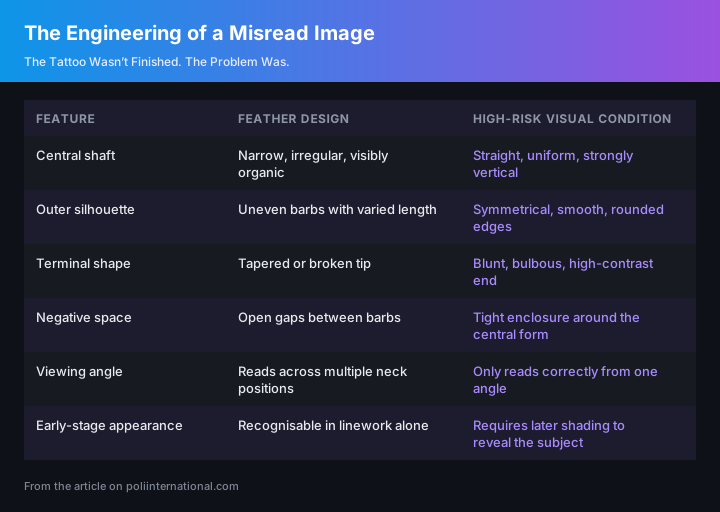
The key distinction is whether the unfinished stage is already structurally legible. Shading can add depth, texture, and material cues. It cannot always reverse a dominant silhouette. If the linework says one thing loudly and the planned shading is supposed to whisper another thing later, the artist has created a problem that may become more expensive with every pass.
This is why a staged approval process matters. Before tattooing a high-visibility design, the client should see the stencil from the front, side, and natural conversational distance. The artist should ask one blunt question: “What is the first thing this looks like to you?” Not “Do you like it?” People are trained to be polite. They will say they like a design while privately wondering whether it resembles anatomy.
3. Technical Deep Dive: Why “It’s Unfinished” Is Not Enough
Fresh tattoo work is affected by edema, plasma, redness, and local inflammation. These can temporarily thicken lines and reduce contrast between adjacent marks. During healing, epidermal turnover and pigment settling change the surface appearance again. None of that, however, explains away a fundamentally ambiguous silhouette.
The practical threshold is not whether the finished tattoo might eventually look acceptable. The threshold is whether the current stage has created a materially different visual interpretation from the one the client consented to. If the answer is yes, the procedure should stop.
For studios, the correction workflow should be concrete:
- Photograph the tattoo immediately after the client raises the concern, using neutral lighting and multiple angles.
- Record the client’s description without arguing about intent.
- Compare the original approved reference, stencil, and tattooed stage.
- Mark the exact shapes producing the unwanted association.
- Decide whether the correction requires added shading, altered contour, negative-space recovery, or removal.
- Do not add more pigment merely to prove that the original plan was right.
A correction may be possible if the mistaken read comes from insufficient texture or contrast. Feather barbs can be broken into irregular tapered groups, the central shaft can be softened, and negative space can be restored. But adding dark shading around a shape that already reads incorrectly can make the problem more permanent. More detail is not the same thing as more clarity.
The artist also needs to understand the limits of tattoo correction. Pigment removal is not an eraser. Laser treatment depends on wavelength, pigment chemistry, particle size, skin response, and time between sessions. Darker pigment is often more responsive than some bright colours, but removal can involve multiple treatments and temporary or lasting skin changes. A client should not be pressured into continuing the tattoo simply because the artist has already started.
The deeper lesson is similar to the one behind why viral tattoo scares often confuse irritation with genuine danger: the dramatic internet framing usually hides a more ordinary technical question. What exactly happened, what is reversible, and what decision makes the least damage from this point forward?
4. Patrick's Note: The First Read
The client is not required to wait politely for the completed version of a permanent image before mentioning that it has taken a wrong turn. If the design currently reads as something else, stop and discuss it. That is not being difficult; that is the only sensible moment to intervene.
I would rather see an artist pause a session than defend a bad read with a speech about artistic process. A tattoo is not a magic trick where the audience is forbidden to comment until the rabbit is fully assembled. The useful question is not who is embarrassed. It is whether the next needle pass improves the intended image or merely buries the evidence.
My practical guide to reading viral tattoo claims makes the same broader point: spectacle attracts attention, but the working details decide whether a body-art story is actually instructive.
5. FAQ: Technical Q&A
Q: Can shading fix an unfinished tattoo that looks like the wrong object?
Sometimes. If the silhouette is sound and the problem is missing texture, shading may clarify the subject. If the central proportions, terminal shape, or negative space create the wrong read, more shading can make the unwanted image darker and harder to correct.
Q: Should an artist continue if the client complains halfway through?
No. Stop, clean the area, photograph the work, and discuss the concern. Continuing while the client is objecting converts a solvable design disagreement into a larger consent and correction problem.
Q: What should a client do before approving a neck tattoo?
View the stencil while standing, sitting, turning the head, and looking at it from normal social distance. Ask several people what they see first, but do not outsource the decision; if the design creates a strong unwanted association, raise it before pigment is placed.
Conclusion: Stop Before It Gets Worse
An unfinished tattoo can look strange. That is normal. An unfinished tattoo that has acquired a completely different dominant meaning is not something to dismiss with “wait until it’s done.” The artist’s responsibility is to recognise when the design needs clarification, not to demand faith from the person wearing it.
The clear takeaway is simple: approve the first read, not the promised final effect. On a neck, where curvature and movement expose every compositional weakness, the best correction is often a pause before the next needle pass. For more on the technical difference between a dramatic tattoo story and a real safety issue, read how viral tattoo incidents separate genuine risk from internet theatre.