Shop
Body Art News

The $50 “Kirkiversary” Tattoo Was Bad Judgment—Not a Technical Innovation

PP

Chief Engineer

Patrick Poli

Journal Date

2026-09-22

Last Reviewed

2026-10-06

Stop confusing viral outrage with a body-art trend worth copying

Key Takeaways:

» A tattoo promotion built around the anniversary and wound location of Charlie Kirk’s killing triggered widespread online backlash in September 2026.The reported promotion and public reaction
» The controversy is primarily ethical and professional, not evidence that neck tattoos are unusually dangerous.
» A fresh tattoo is a controlled skin injury, so placement, hygiene, aftercare, and client consent still determine the real risk.
» Discounting a procedure is not the problem; turning a person’s fatal injury into a sales hook is.
» Studios should separate political expression from clinical responsibility and never let virality become their quality-control system.
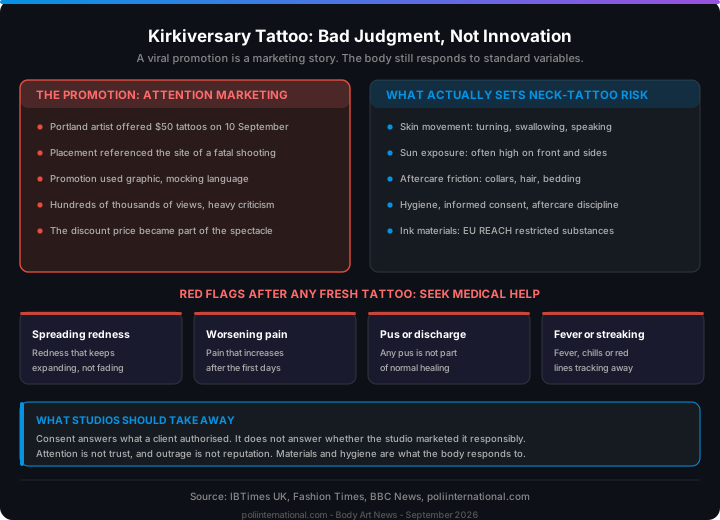
Infographic: the viral $50 Kirkiversary neck-tattoo promotion compared with the clinical factors that actually set neck-tattoo risk, plus the red flags that need medical help
Infographic: Infographic: the viral $50 Kirkiversary neck-tattoo promotion compared with the clinical factors that actually set neck-tattoo risk, plus the red flags that need medical help

1. The promotion was designed to provoke—and it worked

A Portland tattoo artist advertised a “Kirkiversary Special” for September 10, offering $50 neck tattoos positioned near the area where conservative activist Charlie Kirk was fatally shot. The promotion described the location in deliberately graphic, mocking language and circulated widely across social media, drawing hundreds of thousands of views and substantial criticism.The reported “Kirkiversary” promotion

That distinction matters. This was not a viral piercing technique, a new ink formulation, or a clever answer to a problem in studio practice. It was attention marketing attached to a traumatic death. Whether someone agrees with Kirk’s politics is beside the point. A studio can produce political tattoos, protest tattoos, memorial tattoos, or deliberately confrontational work. The question is whether the business is using a person’s killing as a novelty placement and countdown offer.

The body does not care about the joke. A neck tattoo still creates a fresh wound in the skin, deposits pigment through repeated needle passes, and relies on the client’s immune system to manage inflammation and retain the pigment. The ethical framing may be unusual; the tissue response is not. The body remains stubbornly uninterested in engagement metrics.

2. What the science says about a neck tattoo

A tattoo needle creates a series of microscopic punctures through the epidermis and into the dermis. Pigment is deposited primarily in the dermal layer, where macrophages—immune cells that engulf foreign particles—take up some of the pigment. When those cells die or move, other macrophages capture pigment particles, which is one reason tattoos persist while still gradually softening over time.

The technical risk of a neck tattoo depends on ordinary variables:

FeatureNeck tattooTattoo elsewhere
Skin movementHigh; frequent motion from turning, swallowing, and speakingVaries by location
Sun exposureOften high, especially on the front and sidesDepends on clothing and habits
Aftercare frictionCollars, hair, jewellery, and bedding can irritate itClothing and movement vary
Visibility during healingHigh; swelling and redness are difficult to concealOften easier to cover
Primary infection concernContamination during healing or poor aftercareSame basic mechanism
Technical challengeStretching, curvature, and client movementDepends on anatomy and design

The neck is not automatically a dangerous tattoo site. It is simply a high-motion, high-visibility area with more opportunities for friction and sun exposure. Clients should expect redness, warmth, tenderness, and mild swelling immediately after tattooing. Those symptoms should gradually settle. Worsening pain, spreading redness, pus, fever, or red streaking are not “part of the healing process”; they warrant prompt medical attention.

The most avoidable risk remains water exposure while the skin barrier is open. Fresh tattoos are not sealed by optimism, plastic wrap, or an artist’s dramatic Instagram caption. The relevant practical issue is timing: swimming pools, hot tubs, lakes, and open seawater can expose the wound to microorganisms and chemicals before the surface has closed. The relationship between fresh tattoos, water exposure, and infection risk deserves more attention than another argument about whether a provocative flash sheet is funny.

The artist’s defenders may argue that customers chose the tattoos freely. That is an important fact, but it is not a complete defense. Consent answers whether a client authorized the procedure. It does not answer whether the studio marketed the procedure responsibly.

A client can consent to a provocative tattoo while still being exposed to manipulative advertising, inadequate explanation, or a rushed decision. Neck tattoos are particularly difficult to reverse socially and professionally. Removal is expensive, takes multiple sessions, and is not guaranteed to restore untouched skin. A serious consultation should cover the design, size, exact placement, visibility, expected healing, sun exposure, and the possibility that the client’s feelings may change.

Discounts create another pressure. A low price is not automatically suspicious; artists may run flash days, community fundraisers, apprentices’ specials, or introductory offers. But when the discount is tied to a precise anatomical reference to a killing, the price stops functioning merely as access. It becomes part of the spectacle.

That is where professional judgment matters. A studio does not have to accept every idea simply because an adult can request it. Tattooing is not a vending machine with needles. The working artist remains responsible for deciding what they are willing to put into the world under their name.

There is also a technical misconception worth removing: provocative subject matter does not make a tattoo chemically more dangerous. The ink’s composition, sterility, pigment quality, and regulatory compliance matter. Under the European Union’s REACH framework, tattoo inks and permanent-makeup products are subject to restrictions covering thousands of hazardous substances, including carcinogens, mutagens, reproductive toxicants, and skin sensitisers.The current REACH body-art restrictions and nickel limits

That does not make every product safe or every studio compliant. It means the correct argument is about materials, contamination control, documentation, and exposure—not whether an unpleasant joke has somehow changed the biology of the needle.

4. Patrick's Note: The Overheard Line

“People are talking about it, so it must be good marketing.”

That sentence has quietly damaged more studios than a bad stencil. Attention is not trust, and outrage is not reputation. A tattoo shop can become famous for a week while teaching every future client that its judgment is for sale to the algorithm.

The client’s consent still matters, but so does the artist’s decision to frame the work. If the selling point is a person’s death, the studio is no longer just providing body art; it is manufacturing a reaction and making the customer part of the content. That is a commercial choice, not an artistic inevitability.

The practical standard is simple: would the promotion still look defensible if the victim’s family saw it, if the client’s employer saw it, and if the artist had to explain the wording without the protection of a comment section? If the answer is no, the problem is not that the public “doesn’t understand tattoo culture.” The problem is that the campaign was built to avoid adult scrutiny.

I have written before about how fresh tattoos should be protected from water exposure during early healing, because that is the kind of advice that prevents a real problem. A clever caption cannot sterilize a needle, close a wound, or make a client’s regret cheaper.

5. FAQ: Technical Q&A

Q: Is a neck tattoo more dangerous than a tattoo on my arm?
Not automatically. The main risks are the same: contamination, excessive trauma, poor aftercare, and unregulated or unsuitable ink. The neck moves constantly and is exposed to collars, hair, sunlight, and rubbing, so healing may be more irritating and the result more visible.

Q: Is redness after a neck tattoo normal?
Mild redness, warmth, swelling, and tenderness are normal immediately after tattooing and should improve. Increasing pain, spreading redness, pus, fever, or red streaks are warning signs, not normal healing; contact a healthcare professional promptly.

Q: Can I get a tattoo because of a viral trend or controversial promotion?
You can, but wait until the attention has passed and decide whether you still want the image, placement, and meaning. A tattoo lasts much longer than a news cycle, and removal is slower, more expensive, and less predictable than posting the original design.

Conclusion: Let the Work Survive the News Cycle

The “Kirkiversary” promotion went viral because it combined a cheap offer, a politically charged subject, a precise wound reference, and social-media outrage. That explains its reach. It does not make it a model for tattooing, branding, or professional conduct.

Studios should compete on skill, safety, honesty, and work that remains defensible after the comments disappear. Before accepting a controversial concept, examine the design, the client’s understanding, the placement, the healing burden, and the way the promotion treats real human suffering. That is not censorship. It is judgment—the one piece of equipment no studio should discount.

For practical guidance, read the body-art engineering principles behind safe healing and responsible studio practice.

Mind map · The $50 “Kirkiversary” Tattoo Was Bad Judgment—Not a Technical Innovation

  • Kirkiversary Tattoo Evaluation
    • Provocative Marketing Campaign

      A Portland tattoo artist advertised a discounted neck tattoo campaign using the location of Charlie Kirk's fatal shooting to generate viral media outrage.

      • Discounted Neck Offerings
        • $50 Neck Tattoos
        • Traumatic Death Hook
      • Viral Outrage Goal
        • Social Media Backlash
    • Biological and Technical Risks

      A neck tattoo creates a controlled skin wound in a high-motion area subject to constant friction, sun exposure, and infection risks during healing.

      • High Motion Site
        • Friction from Collars
        • Sunlight Exposure Risks
      • Medical Complication Signs
        • Spreading Redness and Pus
    • Client Consent and Guidance

      Informed consent requires explaining long-term professional visibility, costly removal, and expected healing rather than relying on rushed promotional discounts.

      • Informed Consultation Need
        • Permanent Visibility Factors
        • Expensive Removal Process
      • Discount Pressure Risks
    • Studio Ethics and Judgment

      Professional tattoo studios must separate clinical responsibility from viral outrage marketing, building reputations on craftsmanship rather than exploiting traumatic deaths.

      • Clinical Responsibility Focus
        • Craftsmanship Over Virality
      • Defensible Business Practice
StructureProcessMaterialHazard

4 branches, 0 sources. Each branch cites the article it came from; the labels beneath it are names, not claims.

Tattoo Quiz

  1. 1. What biological mechanism primarily explains why tattoo pigment remains persistent in the skin over time while gradually softening?

    • ✓ Macrophages in the dermal layer engulf pigment particles and are recaptured by other macrophages when they die. — Pigment deposited in the dermis is taken up by macrophages, and when those immune cells die or move, new macrophages capture the released particles.
    • • Pigment permanently fuses with epidermal keratinocytes during initial needle passes. — Epidermal cells constantly shed and renew, whereas tattoo pigment must reach the deeper dermal layer to persist long term.
    • • Collagen fibers encapsulate loose ink particles strictly within the outer subepidermal layer. — Immune cell activity by macrophages, rather than simple outer collagen encapsulation, governs pigment retention.
    • • Antibodies systematically break down pigment particles, flushing them continuously through the lymphatic system. — If antibodies continuously destroyed and flushed pigment rapidly, tattoos would disappear completely rather than persist.
  2. 2. According to the article, why does a neck tattoo present higher healing and technical challenges compared to many other body locations?

    • ✓ The neck involves frequent skin movement, higher sun exposure, and constant friction from clothing and hair. — The neck is a high-motion, high-visibility area subject to turning, swallowing, collar contact, and solar exposure.
    • • The neck lacks a dermal layer, making pigment absorption chemically volatile. — Neck tissue possesses standard epidermal and dermal skin layers like other parts of the body.
    • • Neck tissue contains no macrophage activity, preventing normal inflammation responses. — The immune system responds to skin punctures on the neck in the exact same biological manner as elsewhere on the body.
    • • Neck placement requires specialized, high-viscosity ink to prevent immediate systemic drift. — The technical challenge stems from anatomical movement and curvature rather than requiring unique ink chemical formulations.
  3. 3. What is identified as the most easily avoidable practical risk while a fresh tattoo wound is actively healing?

    • ✓ Exposing the open wound to bodies of water like pools, hot tubs, lakes, or seawater. — Unclosed skin exposed to standing or natural water introduces harmful microorganisms and chemicals before the surface seals.
    • • Applying temporary plastic protective wrap immediately after the studio session. — Proper early protective wrapping is a standard care step rather than the main avoidable contamination hazard highlighted.
    • • Normal skin movement caused by speaking, turning the head, or swallowing. — Involuntary physiological movements contribute to friction, but water submergence is the major avoidable infection risk.
    • • Using sterile equipment manufactured under European compliance standards. — Sterile regulatory-compliant equipment reduces infection risks rather than creating an avoidable hazard.
  4. 4. Which set of post-procedure symptoms indicates a serious issue requiring prompt medical evaluation rather than normal tattoo healing?

    • ✓ Worsening pain, spreading redness, pus, fever, or red streaking. — These symptoms signal active clinical complications or infection rather than standard wound recovery.
    • • Mild warmth, slight tenderness, and localized swelling immediately after the session. — Immediate mild warmth and swelling are expected tissue responses to controlled needle punctures.
    • • Gradual reduction of surface redness over the first forty-eight hours. — A progressive decrease in redness demonstrates normal skin barrier recovery.
    • • Temporary tenderness around high-friction collar areas during the first day. — Initial tenderness from collar contact is common, whereas fever and spreading streaks indicate infection.
  5. 5. How does the article distinguish client consent from professional studio responsibility?

    • ✓ Consent confirms the client authorized the procedure, but it does not mean the studio marketed or managed it responsibly. — Client authorization does not excuse manipulative promotions, inadequate consultations, or predatory sales hooks.
    • • Obtaining client consent legally absolves a studio from all ethical concerns surrounding public promotions. — Ethical marketing and clinical responsibility remain the studio's burden regardless of client signature.
    • • Client consent guarantees that an offer was understood without any influence from discounted pricing. — Discounted prices can create decision pressure even when formal consent is given.
    • • Consent is only required when performing high-visibility tattoos on high-motion body sites. — Client authorization is mandatory for any procedure, but it does not validate inappropriate studio marketing.
  6. 6. Why are neck tattoos noted as being particularly impactful long-term choices for clients?

    • ✓ Removal is expensive, requires multiple sessions, and is not guaranteed to fully restore untouched skin. — Socially visible tattoos on the neck carry lasting professional implications, and laser reversal is costly and imperfect.
    • • Laser removal on neck tissue is strictly prohibited under federal health safety guidelines. — Laser removal is permitted on the neck, though it remains tedious, expensive, and variable in outcome.
    • • Pigment placed in high-motion areas migrates into muscle tissue within days of application. — Pigment stays within the dermal layer macrophages rather than migrating into underlying muscle.
    • • European Union regulations require permanent registration for anyone receiving visible body art. — EU REACH regulations govern chemical ingredients in inks, not personal registration of tattoo recipients.
  7. 7. Under the European Union's REACH framework, what aspect of tattooing is strictly regulated?

    • ✓ Chemical safety restrictions covering hazardous substances, carcinogens, and skin sensitisers in inks. — REACH regulates thousands of hazardous chemical substances found in tattoo inks and permanent makeup.
    • • Mandatory minimum pricing structures for viral flash promotions. — REACH is a chemical regulatory framework, not a business policy on service pricing or marketing.
    • • Standardized apprenticeship duration requirements for professional body artists. — Professional labor guidelines are distinct from chemical safety regulations on body-art products.
    • • Strict limitations on which body sites clients are permitted to have tattooed. — REACH focuses on material safety and ink composition rather than restricting anatomical placements.
  8. 8. What key misconception regarding controversial or provocative tattoo designs does the text correct?

    • ✓ Provocative subject matter does not make a tattoo chemically or biologically more dangerous. — The physical safety of a tattoo depends on sterility, materials, and aftercare, not the ethical nature of the image.
    • • Offensive concepts alter the body's immune response by increasing pigment rejection rates. — The biological tissue response relies purely on physical trauma and immune capture, irrespective of artistic concept.
    • • Discounted viral tattoos automatically utilize unsterile or non-compliant pigment blends. — A price promotion reflects business judgment, not an automatic chemical change in ink sterility.
    • • Tattoos inspired by news events heal significantly faster due to client adrenaline levels. — Biological healing timelines depend on standard wound care and tissue recovery rather than news context.
  9. 9. What problem does the author identify with adopting the mindset 'People are talking about it, so it must be good marketing'?

    • ✓ Viral outrage generates short-term attention but compromises studio trust and professional reputation. — Attention gained through public shock damages long-term reputation and signals that studio judgment is easily bought.
    • • Social media algorithms automatically penalize tattoo studios that post discounted prices. — The concern raised is about ethical judgment and trust, not automated algorithm penalties on discounts.
    • • High online engagement directly triggers health department audits of studio sanitation. — Public criticism centers on professional ethics rather than triggering automatic clinical inspections.
    • • Provocative captions void the manufacturer guarantees on sterile tattooing needles. — Needle sterility is a manufacturing and handling process unaffected by social media captions.
  10. 10. According to the article's conclusion, what benchmark should artists use to judge if a controversial promotion is defensible?

    • ✓ Whether the promotion remains defensible if seen by the victim's family, the client's employer, and outside comment sections. — A promotion should withstand adult scrutiny in the real world beyond the protection of anonymous online followers.
    • • Whether the campaign reaches over one hundred thousand views on social media platforms. — Virality and view counts are engagement metrics, not standards for ethical business defensibility.
    • • Whether local trade associations have officially issued a fine against the flash sheet. — Professional judgment rests on studio ethics rather than waiting for external regulatory fines.
    • • Whether the client promises never to seek laser removal in the future. — Defensibility relies on responsible marketing and framing by the studio, not client removal promises.

Extended Reference Table

8 of 8 rows

Extended reference table generated from the article and its verified research sources. Bracketed numbers jump to the matching entry in the Technical References below.

SafetyItem, Practice, or Standard Type Description or Requirements Associated Risks or Safety Notes Source
✅Keloid ScarsClinical Scar CategoryRaised, thick scars that grow beyond the original wound borders due to overproduction of collagen.High risk of triggering new growth through needle trauma; tattooing is generally discouraged without medical clearance.[Source_Number_Inferred]
✅Hypertrophic ScarsClinical Scar CategoryRaised, thickened scars that remain within the boundaries of the original wound or incision.Can result in uneven ink saturation; tattooing should wait 1–2 years until the scar is flattened and softened (white/silver).[Source_Number_Inferred]
✅Atrophic ScarsClinical Scar CategorySunken or pitted skin tissue resulting from a loss of underlying structures like fat or muscle.Higher risk of ink blowout (pigment spreading) due to thin tissue; requires a very light touch.[Source_Number_Inferred]
✅Informed ConsentPractice StandardMandatory process involving written agreement and verbal explanation of risks, health history, and aftercare.Failure to verify client sobriety or identify health conditions violates state standards and increases liability.[Source_Number_Inferred]
✅OAR 331-915-0065Regulatory StandardOregon Administrative Rule governing safety standards, practitioner conduct, and age restrictions for tattooing.Non-compliance can lead to civil penalties, license suspension, or professional sanctions.[Source_Number_Inferred]
✅SPF 50 ProtectionAftercare StandardMandatory daily application of high-factor sun protection on healed scar tissue tattoos.Scar tissue burns easily; sun damage can cause the original scar color to reappear through the pigment.
✅Inks, dyes, or pigmentsMaterialPigments purchased from commercial suppliers with visible expiration dates on the container.Use of expired or FDA-restricted products is prohibited; subject to EU REACH hazardous substance limits.
✅Facility LicenseRegulatory RequirementMandatory annual permit issued by the Oregon Health Licensing Office (HLO) for all body art facilities.Operating without a license can result in civil penalties up to 5,000 per violation.

Free Body Art Wall Posters

Print-ready reference posters for your studio or your own wall. Free to download and display, embed on your own site with attribution. Click any poster to preview it full size before downloading.

Choose and download all 40 posters

Technical_References_Archive

About the Author

PP

Patrick Poli

Chief Engineer, Poli International · Creator of BioFlex® body jewelry

Patrick has spent 25+ years manufacturing body jewellery and studio equipment, and is the creator of BioFlex® body jewelry. He created the push-fit system so jewellery separates on impact instead of tearing the piercing. He also ran 10 to 25 minute consultations before piercing, and treats aftercare as a standing invitation rather than a leaflet.

More about Patrick →

Last reviewed: 2026-10-06 · Published: 2026-09-22

Related Tools & Reading

Continue Reading