
The problem is not mystery ink; it is bad chemistry, sloppy labeling, and a public that assumes “temporary” means removable
Key Takeaways:
» A tattoo that is still visible after a year is usually not a miracle product; it is a label problem, a chemistry problem, or both.
» “Temporary” body art that claims to last months or a year sits in a dangerous zone where marketing outruns material performance.
» The real question for studios and clients is not “Does it look cool?” but what resin, solvent, and application method were actually used.
» Viral posts about “tattoos that won’t come off” spread fast because they are visually simple and technically messy.
» The practical fix is boring but necessary: ask for composition, intended wear time, removal method, and patch-test guidance before anything touches skin.
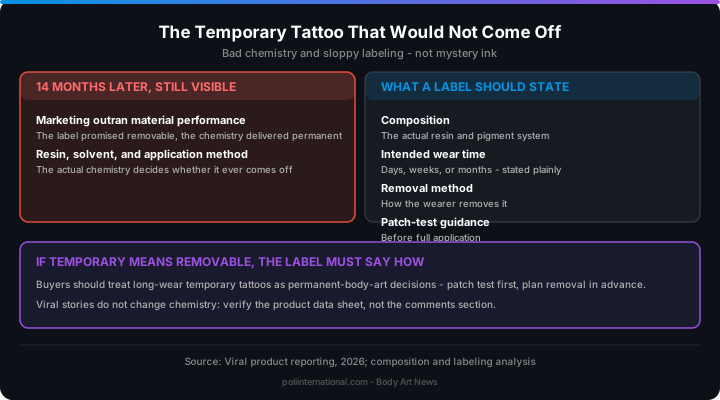
1. The Temporary Tattoo That Stayed for Months
The most interesting body-art story in the last stretch is the recurring viral claim that a temporary tattoo has not come off months later, with one recent example drawing attention because the promised wear time and the actual outcome did not match. The internet loves this kind of story because it is easy to understand at a glance: a person was told one thing, the skin did another, and now everyone gets to argue in the comments like they are formulators.
That is also why these stories are technically useful. In body art, “temporary” can mean several very different things: cosmetic pigment on the stratum corneum, adhesive decals, semi-permanent dyes, or products sold with vague timelines that do not actually match how the material behaves on skin. When a consumer expects a clean fade and gets persistence instead, the failure is often not the body’s fault; it is the product’s specification problem. That same mismatch shows up in many other trends, including the recent wave of ultra-fine, nearly invisible tattoo work that goes viral because it photographs beautifully but can be brutally unforgiving in execution, placement, and longevity. A good example of how the market can over-reward tiny visual gimmicks is the ongoing fascination with micro tattoos and “how little can you get away with,” which is exactly the sort of trend that makes clients underestimate needle depth, line spread, and heal quality.
There is also a social-media problem here. A clip that says “temporary tattoo still hasn’t come off after 14 months” is engineered to be shared because it is both mundane and outrageous at once. It invites the viewer to pick a side before they understand the product. That is the modern body-art cycle: a simple visual claim, a flood of expert-looking opinions, and very little actual chemistry. The best trade coverage on tattoo visibility and trend spikes has long shown that what goes viral is rarely what lasts in practice.
2. Tattoo Pigment Versus Skin-Surface Products
The useful comparison is not “real tattoo vs fake tattoo.” It is what kind of skin-bound product is being sold and how it is supposed to behave.
| Feature | True tattoo pigment | Semi-permanent / temporary skin product |
|---|---|---|
| Location in skin | Deposited in the dermis | Sits on or near the superficial skin layers |
| Expected wear | Long-term, often permanent | Days to months, depending on chemistry |
| Removal | Requires laser or surgical methods in some cases | Should fade, wash off, or exfoliate predictably |
| Failure mode | Blowout, fading, scarring, allergy | Staining, unexpected persistence, irritation |
| Main consumer risk | Permanent result | Mislabeling and false expectation |
| Studio concern | Technique, sterility, aftercare | Product identity, patch testing, removal claims |
The important threshold is simple: if a product is sold as temporary but behaves like a long-wear stain, the problem is not just disappointment; it is consumer deception by performance mismatch. That is why these stories become more than internet drama. They force the industry to confront the difference between a product that is designed to persist and one that merely failed to fade on schedule.
This is where materials matter. In the piercing world, we already know how often market labels blur into nonsense. The same kind of confusion can happen with flexible body jewelry: the market loves convenient shorthand, but shorthand is how people end up calling one polymer by five different names and then acting surprised when it behaves differently. I wrote recently about the broader problem of material identity versus marketing identity in body-safe polymer jewelry and what the label does not tell you. The lesson is the same here: the name on the package is not a spec sheet.
3. What Studios Should Ask About a Temporary Product
For studios, the technical issue is not whether a temporary tattoo is “real” in the emotional sense. It is whether the product has a defined vehicle, stain mechanism, removal profile, and irritancy data. If it uses dyes, the concentration, solvent system, and film-former determine how deeply the color binds to the superficial layers of skin. If it uses adhesive transfer technology, the failure point is usually edge lift, sweat interaction, or incomplete release from the carrier. If it is marketed as “lasts a year,” then the burden is on the seller to explain what skin mechanism makes that plausible without crossing into actual dermal implantation.
Clinically, the biggest red flags are predictable: uneven persistence, irritation from solvents, and the false assumption that “temporary” means harmless. That assumption is how people ignore patch testing, then act shocked when a skin reaction appears. The same logic applies in piercing aftercare: the body does not care what the brochure said. It responds to chemistry, friction, occlusion, and time. That is why any product that contacts skin for extended wear should be treated as a contact-material decision, not a trend accessory.
If a client asks whether a long-lasting skin stain is safer than a tattoo, the honest answer is that “safer” depends on the formulation and use case. A product that stays visible for months can be less invasive than dermal tattooing, but only if the ingredients are actually skin-appropriate and the application is controlled. Otherwise, the user may have traded permanence for irritation and uncertainty. And when a viral clip creates a run on a product category, studios get the downstream questions whether they wanted them or not. The best defense is technical clarity, not social-media optimism.
This is also where the broader body-art ecosystem has become weirdly consistent: viral novelty sells because it compresses complexity into one image, while the working professional is left to clean up the ambiguity. That has been true in the tattoo trend cycle around tiny hearts, hidden script, and “barely there” work, and it is just as true in piercing when the public confuses decorative hardware with medically appropriate materials.
4. Patrick's Note: THE QUESTION HE ASKS AND ANSWERS
What’s the question people keep asking about this story? If it was called temporary, why didn’t it come off? Because “temporary” is not a law of physics; it is a promise, and promises are cheap in a market that rewards the thumbnail more than the spec sheet.
A product that survives long after the advertised wear window is usually telling you one of three things: the formula was designed for longer retention than advertised, the removal conditions were never realistic, or the marketing department got ahead of the chemist and decided the customer would not notice. That last one is almost a family tradition in beauty and body art, and the client is the one who gets to wear the proof.
What I tell working professionals is simple: if you cannot explain the mechanism in one sentence, do not sell it as if it is settled science. That goes for skin products, jewelry materials, and anything else that touches a human body and hopes to be forgiven later. The industry has a bad habit of treating “looks fine on TikTok” as a technical standard. It is not. It is a lighting condition with comments.
5. FAQ: Technical Q&A
Q: Is a temporary tattoo that lasts over a year automatically unsafe?
Not automatically, but it is automatically a labeling problem if the wear time was not accurately explained. Persistence alone does not prove toxicity, but it does mean the product behaved differently than the buyer was led to expect. The right test is ingredient disclosure, skin compatibility, and whether the removal pathway was realistic from the start.
Q: What should artists ask before recommending a skin-applied temporary tattoo product?
Ask what the active mechanism is, how long it is designed to last, what the removal method is, and whether patch testing is recommended. If the answer is vague or salesy, that is your answer. A serious product should have a clear wear profile and a clear failure mode.
Q: When a viral tattoo trend looks delicate, what is the hidden technical risk?
The hidden risk is often not the image itself but the execution margin: tiny work leaves less room for error in depth, spacing, and healing. Fine designs can look great online and age badly on skin if the technique or placement is weak. That is why the trend matters less than the materials and hands behind it.
Conclusion: Stop Treating “Temporary” Like a Guarantee
The lesson from this viral story is not that body art is unpredictable; it is that marketing language is often sloppier than the chemistry. If a product is sold to the public as temporary, the maker owes a credible explanation of how it fades, how it is removed, and what happens when it does not behave as advertised.
For studios and clients, the practical rule is brutal and useful: do not buy a promise until you know the material. The next time a “temporary tattoo” refuses to leave, the mystery is rarely mystical. It is usually just bad specification wearing a better outfit. For more on how the industry confuses labels with performance, read the material truth behind flexible body jewelry labels.
6. The Real Risk: What “Temporary” Labels Don’t Tell You
Every time a story like this goes viral, my phone buzzes with the same question: “Patrick, how is this possible?” I’ve spent 25 years in body jewellery and materials science, and I can tell you, there’s no magic ink. The material science is simple: some pigments are engineered to sit on the skin’s surface; others are designed to penetrate and persist. The term “temporary” is a marketing label, not a chemical guarantee.
Most adhesive-applied tattoos use a polymer film that carries the pigment. But when that film is thin, brittle, or improperly cured, it can break down into micro-particles that lodge in the top layers of the stratum corneum. Over time, those particles can migrate deeper. That’s not a mystery, it’s basic diffusion mechanics. The real issue is that the label claims “temporary” while the chemistry under it behaves more like a semi-permanent stain. It’s a labeling failure and a chemistry failure, and the public pays the price.
I’ve seen this same carelessness in body jewellery. That’s why I founded Poli International and created BioFlex® body jewelry, made from a PP-R polymer that’s inert, biocompatible, and built for safety over flash. We don’t rely on catchy labels; we rely on REACH compliance, medical-grade testing, and 25 years of hands-on experience with skin contact materials.
If you’re buying temporary tattoos, or any body art product, ask the supplier for the full material datasheet. Look for clarity on pigment size, carrier polymer, and penetration depth. If they can’t give you specifics, walk away. Your skin is not a test lab.
For body jewellery that’s backed by real science, check out our BioFlex® product line. And if you’re a studio owner or supplier wanting to avoid these label traps, our industry tools give you the checklists and compliance guides you need.
Don’t trust “temporary.” Trust data.


