Shop
Body Art News

Biodegradable Tattoo Ink: Why Ephemeral Ink Fails & Safety

PP

Chief Engineer

Patrick Poli

Journal Date

2026-07-31

Last Reviewed

2026-10-14

Viral one-year tattoos are still visible after 14 months, here’s why “disappearing ink” is a materials problem, not a magic trick

Key Takeaways:
» “Year-long” temporary tattoos failing to fade are a predictable materials-science outcome, not a freak incident.
» Any pigment injected into the dermis is, by definition, behaving like a permanent tattoo unless its chemistry and particle size are radically different.
» Marketing claims about “fade in 9–15 months” ignore how macrophages, fibroblasts, and collagen remodeling actually work in real skin.
» Artists and clients need to treat ephemeral-style inks with full tattoo safety protocols and assume permanence unless proven otherwise by independent data.
» Studios should document ink lots, informed consent language, and healing outcomes exactly as they would for permanent work, because that’s what the body is treating it as.

---
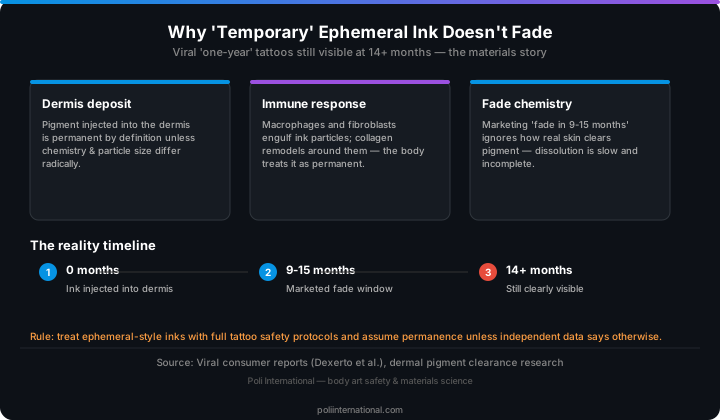
Why ephemeral temporary tattoos fail to fade: dermis pigment deposit, immune response and the marketed 9-15 month fade window versus the 14+ month reality
Infographic: Why ephemeral temporary tattoos fail to fade: dermis pigment deposit, immune response and the marketed 9-15 month fade window versus the 14+ month reality

1. The Viral Story: A “One-Year” Tattoo That Didn’t Get The Memo

Over the last two weeks, TikTok and Reddit have been chewing on one story: a woman who bought into a “temporary tattoo” marketed to disappear in about a year and is now sitting at 14 months with the design still clearly visible on her skin. A recent report describes her video going viral as she explains the ink was supposed to be gone in 9–15 months, but it’s still there and she’s calling it a “scam.” The coverage notes that these tattoos were sold as a bridge between henna and real ink, promising the look of a tattoo without the long-term commitment, and that many customers are now posting similar complaints that their “ephemeral” designs haven’t substantially faded (Dexerto’s viral tattoo report).

Community subs like r/tattoos and YouTube body art commentary channels have picked up the story, with the same theme: if you inject pigment into the dermis, you’re not playing in the same universe as henna, sticker tattoos, or cosmetic skin stains. Artists are rightly asking whether these products are closer to permanent tattoo ink with marketing spin, and whether anyone outside the brand has ever seen rigorous dermal data to back the “one-year fade” claim.

This isn’t the first time the industry’s been burned by “innovative tattoo tech that’ll safely disappear.” We’ve seen this dance with UV-reactive inks, black henna disasters, and glow-in-the-dark gimmicks, all sold as safe and temporary until real skin reactions showed otherwise. The pattern is always the same: clever marketing overpromises, biology quietly wins. The current viral backlash fits neatly into that longer history of body art trends that ignore the underlying tissue mechanics until it’s too late, the same blind spot that drives problems like over-traumatizing tissue when artists don’t understand the relationship between needle taper angle and dermal cellular regeneration speed.

---

2. “Ephemeral” vs Real Tattoo Ink: What’s Supposed To Be Different?

The big claim behind these “year-long” tattoos is that their ink is designed to break down and disappear over time, unlike traditional tattoo pigments that are meant to remain stable in the dermis for life. In theory:

- Traditional tattoo inks use insoluble pigments with particle sizes that macrophages can’t easily clear.
- Ephemeral-style inks claim to use biodegradable pigment capsules that slowly dissolve, allowing the body to remove them over a set time window, say 9–15 months.
- Clients are told they’ll get the look of a real tattoo with the emotional safety of knowing it will fade on its own.

The problem is that none of that marketing survives contact with actual skin if the chemistry, particle size, and degradation kinetics aren’t dialed in with precision. Once you inject something into the dermis, you’re fighting three big forces:

- Macrophage uptake and retention
- Fibroblast encapsulation in collagen
- Scar and remodeling behavior over time

If your ink design doesn’t anticipate all three, your “temporary” tattoo behaves like a permanent one, or worse, a patchy ghost image with uneven fade, which the woman in the viral story explicitly complains about. Tattooed tissue doesn’t just let you drop in an experimental material and politely follow the marketing brochure.

Here’s how the engineering story should look, versus what clients are actually getting:

FeatureTraditional Tattoo Ink“Ephemeral” / Year-Long Tattoo Ink
Pigment typeInsoluble inorganic/organic pigments designed for long-term stabilityBiodegradable polymer-bound pigment or degradable particles (in theory)
Target locationDermis, intentionally permanentDermis too, still a real tattoo, despite “temporary” branding
Macrophage interactionPigment largely retained; some migration but long-livedSupposed to be fully cleared as carriers break down over 9–15 months
Fade mechanismGradual sun damage, tissue remodeling, occasional laser removalTimed chemical degradation plus immune clearance; heavily dependent on material design
Outcome in practicePredictable permanence with slow agingIncreasingly reported as “still visible after promised fade window” and highly variable by person and placement

Once you see that both options live in the dermis and rely on the same immune and healing machinery, you realize the “temporary tattoo” pitch is trying to bend physiology around a marketing timeline. That never ends well when the engineering isn’t ruthlessly tested in real-world skin over several years, the same kind of testing BioFlex® went through under ISO 10993 before touching a single piercing, instead of relying on a cute sales narrative.

---

3. The Clinical & Materials Detail: Why That Ink Is Still There

Let’s get specific. A product that promises to last “9–15 months” is implicitly claiming controlled degradation kinetics. In materials science terms, that means:

- The pigment carrier must hydrolyze or otherwise break down in the aqueous, enzyme-rich environment of human tissue.
- Particle size after breakdown must be small enough for macrophages to transport, but not so reactive that you trigger inflammation.
- The default immune response in different body zones (forearm vs ribs vs ankle) must still hit the same approximate window of clearance.

That’s a tall order. There’s no regulator that certifies “will fade in exactly 12 months,” and the FDA’s own guidance on tattoo safety emphasizes that tattoo inks, even conventional ones, are poorly characterized as medical products and can cause short-term and long-term complications that are hard to predict in advance (FDA consumer update on tattoo safety). When you add degradable polymers or novel pigment architectures to the mix, you are basically running a live human trial across thousands of customers.

From what’s publicly visible in this viral case and similar complaints:

- At 14+ months, the tattoo is reportedly lighter but still clearly recognizable, meaning substantial pigment or carrier material remains sequestered in the dermis.
- The fade isn’t uniform, some zones are more ghosted than others, which tells you local immune activity and microtrauma from the original tattoo session are driving the outcome, not some neat countdown timer baked into the ink formulation.
- Different clients report different durations and intensities of fade, exactly what you’d expect from individual variation in tissue remodeling rather than a precisely engineered one-year vanish.

Think about what has to happen for the tattoo to truly disappear:

1. The pigment carrier must break down into fragments small and inert enough for the body to safely process.
2. Those fragments must exit the dermis, either via macrophage migration to lymph nodes or gradual diffusion supported by tissue turnover.
3. The collagen matrix that formed around the pigment must remodel enough that optical scatter in the skin no longer reveals the design.

That third step is where these products usually fail. Even if the pigment clears, the dermis doesn’t revert to “never tattooed.” You’ve created micro-scarring and micro-patterns in collagen, and under certain lighting, those can show as a faint “ghost tattoo” or texture difference. Artists who work a lot with cover-ups know this intimately, the same way piercers who place large-gauge jewelry understand that micro-scarring and tunnel formation will persist long after jewelry removal, a dynamic I’ve broken down in the context of how cartilage tissue handles high-gauge helix and conch piercings over multi-year timelines.

Now stack all that real biology against a marketing line that says “gone in a year.” The viral story isn’t surprising; it’s inevitable.

For studios, the practical implications are blunt:

- Treat ephemeral-type inks as permanent tattoo inks for consent and documentation.
- Keep lot numbers, brands, and batch IDs documented for every client, precisely as the FDA advises for any ink that ends up in a complaint or adverse reaction (FDA’s ink tracking recommendation).
- Be explicit in aftercare and consultation that fade timelines are not guaranteed, and that laser removal may still be required if the client wants a fully clean slate.

This isn’t “fun tech.” It’s a long-term experiment in dermal materials. Clients deserve to know they’re signing up for that.

---

4. Patrick’s Note: What The Marketing Never Tells You

The thing practitioners miss here is that once you cross the epidermal–dermal boundary with a needle, you’re playing a medical device game, whether anyone admits it or not. I’ve watched this cycle for decades: someone invents a cool new material, slaps it into a tattoo or piercing workflow, and hopes the body cooperates. That’s not engineering; that’s wishful thinking.

That’s why I get blunt when I see tattoo inks sold as “temporary” without long-term data behind them.

If you’re a studio, don’t let someone else’s marketing carry the liability for you. Ask the hard questions: What’s the base polymer? What are the degradation products? Who’s done independent testing? If the answers are either vague or heavily “proprietary,” you already know what to do, treat it like permanent ink, and tell your clients the truth.

---

5. FAQ: Technical Q&A

Q: As an artist, should I treat these “year-long” tattoos as permanent during client consults?
Yes. If you’re injecting pigment into the dermis, you should assume permanence from a consent and planning perspective. Explain that fade timelines are marketing estimates, not guarantees, and that anatomical site, immune response, and sun exposure will all change the outcome. Clients who are genuinely commitment-shy should be steered to surface-level options like henna or airbrush, not experimental dermal inks.

Q: Are ephemeral-style inks safer than traditional tattoo inks because they’re designed to disappear?
Not automatically. “Designed to degrade” introduces new unknowns: what are the breakdown products, how fast do they form, and are they inert in tissue? Traditional inks have their own risk profile, but at least we’ve seen decades of real-world behavior. A degradable ink without transparent, independent toxicology and long-term follow-up is not inherently safer, it’s just newer.

Q: What should I document if a client gets one of these tattoos and later complains it hasn’t faded?
Record ink brand, color, batch or lot number, date of application, and anatomical location, plus photos at key timepoints. Note any sun exposure, skincare products, or medical conditions that could affect healing. Encourage the client to report to local regulators or agencies following guidance similar to the FDA’s reporting process, and keep your own internal log, that data will protect both you and your future clients.

---

Conclusion: Assume Permanence, Engineer For Reality

If you take anything from this viral “temporary tattoo that never left” story, let it be this: the body doesn’t care about marketing copy. Once pigment lives in the dermis, all the rules of real tattooing apply, and any promise that ignores macrophages, collagen, and tissue remodeling is setting clients up for regret.

Studios that stay ahead of this do one simple thing: they tell the truth about permanence and demand real engineering data before trusting a new material. That’s the same mindset behind our work on precision-engineered needle systems that minimize trauma while maximizing pigment stability, and it should be the mindset you apply to every “innovative” ink pushed into your station. Your clients’ skin is not a beta test environment. Treat it, and them, accordingly.

6. Biodegradable Tattoo Ink and Ephemeral Safety: What Artists Must Know

When clients ask if ephemeral tattoos are safe, I tell them the same thing I've told piercers for 25 years: the material is the message. Biodegradable tattoo ink is designed to break down in the dermis, but that very process triggers an immune response that varies wildly from person to person. Some bodies clear the pigment in months; others hold onto it for years. That's not a failure of the client's aftercare, it's a failure of the ink's formulation to account for human biology. If you're searching for tattoos that are not permanent, you need to understand that 'biodegradable' does not automatically mean 'safe' or 'predictable.'

I've spent my career on BioFlex® body jewelry because I got tired of watching the body reject materials that were never meant for long-term wear in healing tissue. The same principle applies to disappearing tattoo ink. Many biodegradable inks use polycaprolactone (PCL) or similar polymers that degrade into acids. In a controlled lab, that's fine. In living tissue, those byproducts can cause granulomas, allergic reactions, or, as the viral 14-month tattoo shows, simply hang around far longer than promised. REACH compliance matters here because it forces a full toxicological review of every ingredient, not just the pigment but the carrier, the solvents, and the degradation products. Most ephemeral ink brands don't have that data.

So what should a professional artist do? First, stop treating 'biodegradable' as a synonym for 'temporary.' Second, ask your ink supplier for the same safety documentation you'd demand for any implant-grade material. Third, consider offering alternative body art that doesn't rely on dermal pigment at all, because a tattoo that fades unpredictably is worse than one that stays. If you want to see how I approach material safety for body jewellery, start with our BioFlex® polymer range at /bioflex/. For artists who need to evaluate ink or jewellery safety protocols, our tools and checklists at /tools/ will walk you through the same REACH compliance questions I ask my own suppliers.

Mind map · Biodegradable Tattoo Ink: Why Ephemeral Ink Fails & Safety

  • Ephemeral Dermal Tattooing Analysis
    • Consumer Complaints and Refunds

      Customers filed Better Business Bureau complaints because Ephemeral Tattoo failed to issue refunds after tattoos lasted longer than three years.

      • Regret Nothing Guarantee Breaches
        • Unanswered refund claims
        • Tattoos lasting past three years
      • Automated Customer Support Loops
    • Biodegradable Ink Molecular Engineering

      Ephemeral ink contains bioabsorbable polymers and color additives that are designed to degrade over time in the presence of water.

      • Bioabsorbable Polymer Matrix
        • Surgical suture components
        • Water-induced hydrolysis degradation
      • Encapsulated Biodegradable Pigments
    • Dermal Macrophage Immune Cycle

      Dermal macrophages engulf tattoo pigments and continuously release and recapture them when these cells die, which maintains tattoo permanence.

      • Continuous Cellular Phagocytosis
        • Pigment capture by macrophages
        • Pigment release upon cell death
      • Dynamic Pigment Recapture
    • Fading Failures and Limited Remedies

      Traditional laser treatments do not fade Ephemeral tattoos because applying heat fails to replicate the water-exposure degradation process of its polymers.

      • Ineffective Removal Technologies
        • Laser heat degradation failures
      • Long Fading Timelines
        • Tattoos visible after three years
StructureProcessMaterialHazard

4 branches, 0 sources. Each branch cites the article it came from; the labels beneath it are names, not claims.

Tattoo Knowledge Quiz

  1. 1. In the viral case highlighted in the article, how long was the temporary tattoo visible before the user publicly reported that it failed to disappear?

    • ✓ 14 months — The viral report detailed a woman who purchased a tattoo marketed to fade in 9 to 15 months, but it remained clearly visible after 14 months.
    • • 6 months — This timeframe is well within the advertised 9 to 15 month fade window, so it would not have prompted a public complaint about failure to fade.
    • • 24 months — Although some clients report multi-year retention, the specific viral incident highlighted in the text occurred at the 14-month mark.
    • • 36 months — Three years exceeds the timeline reported in the viral account mentioned in the text.
  2. 2. Which polymer is explicitly identified in the text as being commonly used in biodegradable tattoo inks that can degrade into acidic byproducts within living tissue?

    • ✓ Polycaprolactone (PCL) — Polycaprolactone is explicitly named as a polymer in biodegradable inks that breaks down into acidic byproducts, potentially causing reactions or granulomas.
    • • BioFlex PP-R — BioFlex PP-R is an implant-grade polymer formulated for body jewelry, not a degradable ink carrier.
    • • Polytetrafluoroethylene (PTFE) — PTFE is a non-degradable material rather than the acidic biodegradable polymer carrier described in the text.
    • • Polyethylene glycol (PEG) — While PEG is used as a solvent in various formulations, the text specifically identifies PCL as the polymer degrading into acids.
  3. 3. According to the source material, why might a faint 'ghost tattoo' remain visible even if all ink pigment particles are completely cleared from the tissue?

    • ✓ Micro-scarring and micro-patterns created in the dermal collagen matrix alter optical scatter in the skin. — Mechanical disruption and collagen remodeling during tattooing leave structural micro-patterns that scatter light even after pigment removal.
    • • Remaining epidermal cells continue to produce localized dark melanin in response to prior needle trauma. — Epidermal cells turn over continuously and do not maintain permanent localized pigment patterns in the underlying dermal tissue.
    • • Fibroblasts continuously regenerate synthetic dye molecules inside empty macrophage vacuoles. — Fibroblasts encapsulate foreign particles in collagen, but they cannot synthetically manufacture dye molecules after clearance.
    • • The ink carriers permanently dye the underlying muscle fascia beneath the dermal layer. — Tattoo needles target the dermis rather than deep muscle fascia, and optical ghosting occurs within the dermal collagen structure.
  4. 4. What regulatory framework is credited in the text with requiring a full toxicological review of pigments, solvents, carriers, and degradation products?

    • ✓ REACH compliance — REACH compliance forces a comprehensive toxicological evaluation of all ink constituents, including carriers and breakdown byproducts.
    • • ISO 10993 — ISO 10993 is cited in the text for the biological testing of medical materials like BioFlex, not for ink toxicological compliance.
    • • FDA pre-market approval — The text notes that FDA guidance treats tattoo inks as poorly characterized products that lack pre-market medical device approval.
    • • ASTM International standard specification — ASTM standards cover material specifications, whereas REACH is specifically cited for thorough toxicological ingredient reviews.
  5. 5. Under what standard testing protocol was the BioFlex polymer evaluated prior to its use in body piercing applications?

    • ✓ ISO 10993 — The text specifically mentions that BioFlex underwent testing under ISO 10993 before being used in any piercing application.
    • • REACH Annex XVII — REACH is mentioned regarding toxicological ingredient compliance for inks rather than the specific implant testing standard for BioFlex.
    • • FDA Class III device validation — The FDA does not certify body jewelry polymers under Class III medical device validation in the source context.
    • • ASTM F136 implant testing — ASTM F136 is a standard for surgical titanium, whereas BioFlex is certified as passing the ISO 10993 biological tests.
  6. 6. What three dermal biological forces are identified in the article that any ink formulation must navigate once injected into the skin?

    • ✓ Macrophage uptake and retention, fibroblast encapsulation in collagen, and scar/remodeling behavior over time. — The text explicitly lists macrophage uptake, fibroblast collagen encapsulation, and tissue remodeling as the three major dermal responses.
    • • Epidermal shedding, lymphatic drainage of water, and subcutaneous fat saponification. — Epidermal shedding occurs above the dermis, while fat saponification is not a physiological ink retention mechanism.
    • • Neutrophil phagocytosis, vascular constriction, and superficial melanin production. — While acute inflammation involves neutrophils, the long-term dermal stability of ink depends on macrophages, fibroblasts, and collagen remodeling.
    • • Bacterial colonization, capillary thrombosis, and keratinocyte turnover. — These represent complications or superficial epidermal processes rather than the core dermal mechanisms governing ink retention.
  7. 7. How does the article instruct studio practitioners to manage documentation and consent for 'ephemeral' or temporary tattoo inks?

    • ✓ Treat them with full permanent tattoo protocols, including documenting lot numbers, brands, batch IDs, and assuming permanence. — Because the body treats dermal injection identically regardless of ink marketing, studios must document batch details and treat the work as permanent.
    • • Issue a standard 12-month satisfaction warranty and offer free laser touch-ups if fading is uneven. — Studios should never guarantee marketing timelines or assume liability for unpredictable degradation behavior in human tissue.
    • • Document them under cosmetic skin-staining guidelines similar to surface henna procedures. — Surface henna does not breach the dermal barrier, so applying surface guidelines to dermal injections creates severe liability and safety risks.
    • • Require clients to undergo dermal allergy scratch testing 24 hours prior to using degradable polymers. — While safety is emphasized, the text specifically stresses documenting lot numbers and treating consent with permanent tattoo standards.
  8. 8. According to the FDA consumer update cited in the text, how are tattoo inks generally characterized regarding safety and regulation?

    • ✓ They are poorly characterized as medical products and can cause hard-to-predict short-term and long-term complications. — FDA guidance emphasizes that tattoo inks lack thorough characterization as medical products and present unpredictable risks.
    • • They are strictly regulated as Class II medical devices requiring pre-market clearance. — FDA guidance highlights the lack of comprehensive medical device regulation for tattoo pigments rather than Class II classification.
    • • They are certified by federal agencies to fade uniformly when bound to synthetic polymer carriers. — Federal agencies do not certify fade timelines or guarantee uniform degradation for temporary ink formulations.
    • • They are classified as non-invasive cosmetics provided they remain within the upper dermis. — Any ink injected into the dermis breaches the cutaneous barrier, placing it outside non-invasive surface cosmetic categories.
  9. 9. If a client who is hesitant about long-term commitment requests a temporary tattoo, what recommendation should the artist make according to the text?

    • ✓ Direct the client to surface-level non-dermal options like henna or airbrushing. — The text advises steering commitment-shy clients toward surface options because any pigment injected into the dermis carries a risk of permanence.
    • • Dilute standard permanent tattoo ink with sterile water to encourage faster dermal clearance. — Diluting permanent ink alters pigment concentration but does not change particle retention mechanics or guarantee clearance.
    • • Apply the ephemeral ink shallowly into the epidermis so it sloughs off during natural skin turnover. — Depositing ink purely in the epidermis leads to immediate washing out during healing rather than a controlled fade process.
    • • Perform the tattoo using smaller needle taper angles to prevent deep pigment retention. — Needle taper affects tissue trauma during application but does not convert a dermal pigment injection into a guaranteed temporary mark.
  10. 10. Why does the degradation of polycaprolactone (PCL) or similar polymers in living dermal tissue present biological risks beyond simple ink fading?

    • ✓ Its degradation byproducts are acidic, which can cause inflammatory reactions, granulomas, or prolonged tissue retention. — Breakdown into acidic compounds inside living tissue can trigger immune responses like granulomas or unpredictable long-term retention.
    • • It converts surrounding collagen fibers into rigid bone-like calcified structures. — Polymer degradation causes localized inflammation and acid release, not tissue calcification or ossification.
    • • It prevents macrophages from entering the dermis, completely shutting down localized immune responses. — Polymer presence attracts immune responses and macrophage activity rather than suppressing or blocking immune cell entry.
    • • It completely dissolves localized capillary beds, leading to permanent dermal necrosis. — The source highlights inflammatory responses like granulomas and acid reactions, not total vascular necrosis.

Extended Reference Table

8 of 8 rows

Extended reference table generated from the article and its verified research sources. Bracketed numbers jump to the matching entry in the Technical References below.

SafetyItem/Practice/Standard Category Primary Material/Mechanism Fade Duration or Persistence Clinical/Technical Considerations Regulatory or Safety Status
✅Ephemeral InkTattoo Ink MaterialMedical-grade bioabsorbable polymers and water-based carrier; degrades into water and CO₂ .Advertised 9-15 months; up to 3 years; documented persistence 33+ months.Passive degradation; macrophages consume particles once polymer matrix breaks down. Affected by placement depth and artist technique.Sterile, single-use, and plant-based; lacks heavy metals. Uses food/medical-grade components.
✅Traditional Permanent InkConventional Tattoo MaterialInsoluble inorganic/organic pigments, heavy metals, and plastics.Permanent; remains in the dermis for life with gradual aging.Particles are too large for macrophages to remove; remains locked in the dermal collagen matrix indefinitely.Poorly characterized as medical products; FDA warns of long-term complications.
✅MacrophagesBiological EntitySpecialized white blood cells (immune response) that engulf pigment via phagocytosis.Long-term persistence; recaptures pigment released by dying cells.Key to both ink trapping (traditional) and removal (ephemeral) through the lymphatic system.Inherent biological component.
✅Laser Treatment / SurgeryMedical ProcedureQ-switched or Picosecond laser energy; pulses cause thermolysis to fragment pigment.Variable; depends on treatment cycles and macrophage recapture.Fragmented particles are often recaptured by new macrophages. Ineffective on Ephemeral formulations due to different degradation triggers.FDA cleared for permanent tattoo removal.
✅FDA Guidance on Tattoo SafetyRegulatory StandardConsumer updates and safety recommendations for ink tracking.-Emphasizes documenting ink brand, color, and batch/lot numbers for adverse reaction tracking.Highlights that inks are not well-characterized and can cause unpredictable complications.
✅ISO 10993-6Technical StandardStandard for biological evaluation of medical devices (local effects after implantation).-Used to validate the safety of materials before they touch human tissue.International standard for biocompatibility testing.
✅USP Class VIRegulatory StandardPlastic/polymer biocompatibility classification.-Used as a base standard for medical-grade polymers to ensure tissue compatibility.High-level medical grade classification for materials.
✅FDA Color Additive RegulationRegulatory StandardRegulatory oversight of pigments.-No color additives are currently approved by the FDA for injection into the skin for tattooing.Federal regulatory requirement for cosmetic safety.

Free Body Art Wall Posters

Print-ready reference posters for your studio or your own wall. Free to download and display, embed on your own site with attribution. Click any poster to preview it full size before downloading.

Choose and download all 40 posters

Technical_References_Archive

About the Author

PP

Patrick Poli

Chief Engineer, Poli International · Creator of BioFlex® body jewelry

Patrick has spent 25+ years manufacturing body jewellery and studio equipment, and is the creator of BioFlex® body jewelry. He created the push-fit system so jewellery separates on impact instead of tearing the piercing. He also ran 10 to 25 minute consultations before piercing, and treats aftercare as a standing invitation rather than a leaflet.

More about Patrick →

Last reviewed: 2026-10-14 · Published: 2026-07-31

Related Tools & Reading

Continue Reading