Shop
Body Art News

The 15-Minute Microneedle Tattoo Patch: Engineering, Regulation, and the Questions Nobody Has Answered

PP

Chief Engineer

Patrick Poli

Journal Date

2026-08-01

Last Reviewed

2026-10-13

A London startup called CipherX is claiming the first genuinely painless permanent tattoo: a microneedle patch you apply like a plaster, leave on for about 15 minutes, and peel off to reveal pigment deposited in your skin. The Verge, Gizmodo, Hypebeast, Man of Many, and more than a dozen other outlets covered the announcement between July 25 and 31, 2026, and the company says mail-order distribution is the goal.

That is a big claim. Tattooing has been a needle-and-machine industry for over a century, and the barriers to entry - pain, licensing, sterilization, ink chemistry - are exactly what keep the profession regulated. If a dissolving patch can deposit permanent pigment without a machine, an artist, or a shop, it changes the risk equation for everyone: consumers, regulators, and the 700,000+ licensed professionals who currently own that responsibility. Here is what the engineering actually says, and what the company has not told us.

The Mechanism: How a 15-Minute Patch Deposits Pigment

Traditional tattoo machines use reciprocating needles that puncture the skin 50 to 150 times per second, driving ink droplets into the dermis. That is mechanically violent by design: the needle must penetrate past the epidermis - the outer layer that sheds every 2 to 4 weeks - into the dermis, where pigment stays for decades.

The Microdot system replaces the machine with a microneedle array. Microneedles are a well-established drug-delivery technology: arrays of microscopic projections, typically 150 to 1,500 microns long, that painlessly breach the stratum corneum. The device category has decades of patch-based vaccine and cosmetic delivery research behind it, which is the strongest technical argument for the pain-free claim - microneedle arrays at those lengths generally do not stimulate the pain receptors that full-length needles hit.

The open question is depth. A dissolving microneedle patch must be engineered so that the needle tips - or the pigment payload they carry - reach the dermis and release there. If the pigment releases in the epidermis, the result is a temporary tattoo that fades with normal skin turnover. CipherX has not published needle length, dissolution kinetics, or pigment deposition depth. [NEEDS CONFIRMATION]
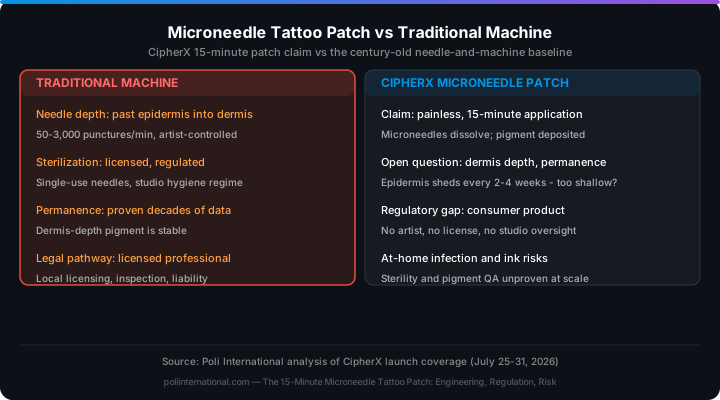
Microneedle tattoo patch vs traditional machine comparison: depth, sterilization, permanence, and regulation
Infographic: Microneedle tattoo patch vs traditional machine comparison: depth, sterilization, permanence, and regulation

The Permanence Question: Dermis Depth Is Everything

Permanence in tattooing is not a marketing word; it is a physics statement about where pigment particles end up. Dermal pigment is phagocytosed by macrophages and held in the skin's extracellular matrix, which is why tattoos survive decades. Epidermal pigment is shed with keratinocytes within weeks.

Microneedle arrays of 500 to 1,500 microns can reach the upper dermis - that is the same range used in intradermal vaccine patches. So the mechanism is physically plausible. But there is a critical difference between delivering a vaccine and delivering a permanent pigment: vaccine patches deliver a soluble payload that disperses; tattoo pigment must be deposited as insoluble particles at sufficient density to remain visible.

The concentration problem is real. A 15-minute passive patch deposits pigment by diffusion and dissolution rather than by mechanical injection. Whether that produces enough pigment density for a visible, permanent result - or a faint, patchy, fading one - is exactly the kind of data a company releases when it has it. No such data appeared in any of the July coverage. [NEEDS CONFIRMATION]

The Regulatory Gap: Consumer Product vs Licensed Profession

This is where the story matters most for the body art industry. Tattoo regulation is built on the assumption that a professional applies the ink: state licensing boards require bloodborne pathogen training, autoclave sterilization, single-use needles, and permitted facilities. Every one of those requirements exists because hepatitis B and C transmission in unregulated tattoo settings is a documented public health problem.

A consumer-applied mail-order patch is a different regulatory animal entirely. If Microdot is classified as a cosmetic, it faces essentially no pre-market safety review for the pigment itself. If it is a medical device, it requires clearance - but device classification depends on the claims the company makes and the jurisdiction. The company has not announced a classification in the US, EU, or UK. [NEEDS CONFIRMATION]

The deeper issue is that the product could legally sidestep every licensing law on the books. A patch bought online and applied at home is not performed by a licensed artist, in a permitted facility, with sterilized equipment - it bypasses the entire regulatory architecture that professional tattooing is built on. Regulators have not yet spoken, and they are behind the technology.

Infection Risk: Sterilization and the At-Home Factor

Infection control in professional tattooing is not optional: it is the difference between a body art industry and a hepatitis vector. The question for any microneedle patch is whether the array is sterile at the point of application and whether the user applies it to clean skin.

Microneedle patches can be manufactured sterile and sealed - that is standard practice for drug-delivery patches, and it is the one part of the product that is technically straightforward. But at-home application removes the professional infection-control layer: no pre-application skin prep, no aftercare guidance from a trained artist, no observation of the healing site by someone who knows what an infected tattoo looks like. Sterile manufacturing helps; it does not eliminate user error.

CipherX has not published sterilization standards, packaging validation, or microbial safety data for the pigment. For a product designed to be self-administered in an uncontrolled environment, that is a significant omission. [NEEDS CONFIRMATION]

What the Industry Should Do

First, the professional body art community should treat this as an opportunity, not just a threat. The microneedle delivery mechanism has genuine merit for low-pain applications - and the industry that ignores a viable delivery technology will lose the narrative to the startup that owns it.

Second, industry bodies should push for transparency: pigment composition, heavy metal content, needle depth data, and clinical validation. Every claim CipherX has not published is a question regulators, journalists, and the APP and APT should be asking in writing.

Third, regulators need to close the classification gap before the first mail-order patch ships. If the product delivers pigment to the dermis, it is doing what a tattoo machine does - and it should carry the same pigment-safety and labeling obligations, starting with the EU REACH restrictions on tattoo inks that took effect in 2022 and the FDA's pigment safety work. A patch is not a license to skip ink chemistry.

Fourth, consumers should be skeptical of the permanence claim until depth data exists. A permanent tattoo that fades after a year is not a tattoo; it is a marketing failure with a 15-minute application time.

The CipherX Microdot is a genuinely interesting piece of body art engineering - the first credible challenge to the century-old needle-and-machine model. But interesting is not verified. Until CipherX publishes pigment depth, ink composition, sterilization data, and a regulatory classification, the responsible read is: plausible mechanism, unproven permanence, and a regulatory gap that the industry should close before the first patch hits a mailbox.


FAQ


How does a microneedle tattoo patch deposit pigment without needles?


Microneedle arrays use microscopic projections—typically 150 to 1,500 microns long—that painlessly breach the stratum corneum and dissolve in the skin, releasing their payload. For a permanent tattoo, the pigment payload must be engineered as insoluble particles that reach the dermis (at least 500 microns deep) where macrophages and the extracellular matrix hold them for decades, unlike soluble vaccine payloads that disperse. CipherX has not published needle length, dissolution kinetics, or pigment particle size, so the exact mechanism of their "Microdot" system remains unverified.


Will a microneedle tattoo patch be truly permanent or will it fade?


Permanence depends entirely on deposition depth: pigment lodged in the epidermis will shed with keratinocytes within 2 to 4 weeks, while dermal pigment is phagocytosed and held for decades. The 500-to-1,500-micron range used in intradermal vaccine patches can reach the upper dermis, but a passive 15-minute patch relies on diffusion rather than mechanical injection, raising doubts about pigment density. No published data currently demonstrates visible, permanent results—only faint, patchy, or fading outcomes have been publicly discussed.


Is a microneedle tattoo patch regulated as a medical device or a cosmetic?


The regulatory classification is currently unresolved: the patch could fall under cosmetic regulation, medical device oversight, or state tattoo licensing laws depending on how the FDA and state boards interpret "intradermal pigment delivery." Traditional tattoo parlors require bloodborne pathogen training, autoclave sterilization, and single-use needles—none of which apply to a consumer-applied mail-order patch. Until CipherX files for clearances or state boards issue guidance, there is a regulatory gap where hepatitis B and C transmission risks fall outside existing enforcement structures.


Can a microneedle tattoo patch really be painless?


The pain-free claim is technically plausible because microneedles shorter than 1,500 microns generally do not reach the nerve endings in the reticular dermis that traditional tattoo needles stimulate 50 to 150 times per second. Vaccine patch studies have demonstrated that arrays at this length produce minimal or no pain sensation in human trials. However, the lack of published needle length or dissolution kinetics from CipherX means the claim remains speculative until peer-reviewed data is released.


What infections or risks come with a mail-order microneedle tattoo patch?


The primary risks mirror those of unregulated tattooing: hepatitis B and C transmission, bacterial infection, and allergic reactions to insoluble pigment particles—all of which are normally mitigated by professional autoclave sterilization and single-use needles. A mail-order patch eliminates the licensed professional but introduces new concerns: unknown sterility during shipping, improper storage degrading the microneedle tips, and the user's inability to assess skin conditions like keloid scarring or dermatitis. No sterilization validation or stability data has been released by the manufacturer.


FAQ

Q: How does the CipherX Microdot tattoo patch work?

The system is a microneedle patch applied to the skin like a plaster. The microneedle array dissolves over roughly 15 minutes, reportedly depositing pigment into the skin. Whether that pigment reaches the dermis - which determines true permanence - has not been publicly documented.

Q: Is the CipherX Microdot tattoo actually permanent?

Unconfirmed. Permanent tattoos require pigment in the dermis, the deeper skin layer. If the microneedles deposit pigment only in the epidermis, the tattoo will fade as skin cells shed. CipherX has not published depth measurements. [NEEDS CONFIRMATION]

Q: Is the Microdot regulated by the FDA or CE?

No regulatory classification has been announced. A microneedle device delivering pigment could be classified as a medical device, a cosmetic, or remain unregulated depending on jurisdiction and claims. [NEEDS CONFIRMATION]

Q: Does a mail-order tattoo patch bypass state licensing laws?

Potentially, and that is the central regulatory question. Traditional tattoo regulation requires licensed artists, permitted facilities, and sterilization oversight. A consumer-applied patch may sit outside those frameworks entirely - a gap public health regulators have not yet addressed.

Q: Is the pain-free claim clinically validated?

No published clinical trial data was found in the July 2026 coverage. The painless claim is the company's marketing position. Microneedle arrays are generally less painful than reciprocating needles, but no comparative clinical evidence was cited. [NEEDS CONFIRMATION]

1. Aging With Body Art: What the Next Twenty Years Will Do to Your Tattoos and Piercings
2. AI Boyfriends, Sedation Tattoos, and “Cringe Ink”: Why the Latest Viral Tattoo Panic Gets the Science Wrong


Mind map · The 15-Minute Microneedle Tattoo Patch: Engineering, Regulation, and the Questions Nobody Has Answered

  • Microneedle Tattoo Engineering
    • Dissolving Patch Technology

      The CipherX Microdot Tattoo Patch deposits pigment permanently through microscopic dissolvable needles in fifteen minutes with minimal discomfort.

      • Gamma Irradiation
      • Handheld Applicator
    • Dermal Ink Permanence

      Permanent tattooing requires depositing insoluble pigment into the dermal skin layer to prevent it from shedding during normal epidermal outer cell turnover.

      • Target Depth
        • Dermis Layer
      • Depth Mistakes
        • Too Shallow Fading
        • Too Deep Blowout
    • State Tattoo Licensing

      Florida Department of Health regulations require tattoo artists to hold active licenses, obtain biomedical waste permits, and operate within registered establishments.

      • Establishment Licensure
      • Waste Permits
      • Bloodborne Pathogens
    • Medical Alert Uses

      Microneedle tattoos provide painless options for medical alerts communicating severe conditions like diabetes, epilepsy, and allergies or marking radiation therapy zones.

      • Alerting Conditions
      • Radiation Marking
      • Animal Identification
StructureProcessMaterialHazard

4 branches, 0 sources. Each branch cites the article it came from; the labels beneath it are names, not claims.

Tattoo Mechanics Quiz

  1. 1. How does the mechanical delivery mechanism of a traditional tattoo machine differ from that of the proposed CipherX Microdot patch?

    • ✓ Traditional machines use reciprocating needles driven 50 to 150 times per second to inject ink, whereas the Microdot patch relies on passive diffusion and dissolution over approximately 15 minutes. — Traditional tattooing relies on high-speed mechanical needle punctures to drive ink into the skin, while the patch deposits pigment passively as its microneedle array dissolves.
    • • Traditional machines deposit ink exclusively into the stratum corneum, whereas the Microdot patch uses high-pressure liquid jets to breach the dermis. — Traditional tattooing must penetrate past the stratum corneum into the dermis to achieve permanence, and the Microdot uses dissolving solid microneedles rather than liquid jets.
    • • Traditional machines depend on thermal capillary action without skin penetration, whereas the Microdot uses rapid mechanical vibration. — Traditional tattoo machines actively puncture the skin rather than relying on capillary heat, whereas microneedle patches function passively without mechanical drive.
    • • Traditional machines release soluble pigment that disperses across tissues, whereas the Microdot patch injects non-dissolving metallic bars. — Traditional tattoo inks consist of insoluble pigment particles that must stay localized, and the patch utilizes dissolving microneedle projection arrays rather than metallic bars.
  2. 2. Why is depositing pigment into the dermal layer, rather than the epidermal layer, mandatory for achieving a permanent tattoo?

    • ✓ Epidermal cells shed every 2 to 4 weeks along with any pigment, whereas dermal pigment is phagocytosed by macrophages and retained in the extracellular matrix. — Permanence relies on biological retention, as skin cell turnover rapidly sheds epidermal ink while macrophages hold dermal pigment in place for decades.
    • • The epidermis completely lacks a structural extracellular matrix, forcing all liquid pigments to drain into blood vessels immediately. — Epidermal shedding, not vascular drainage, is the primary reason ink lost in the outer skin layer fails to produce a lasting tattoo.
    • • Dermal tissue chemically neutralizes organic ink toxicity, whereas epidermal tissue causes immediate thermal degradation of pigments. — Depth dictates permanence due to cellular turnover rates, not because of thermal degradation or dermal neutralization of ink components.
    • • Pain receptors in the dermis physically anchor pigment particles to prevent them from migrating through skin tissue. — Nerve fibers that detect pain do not physically anchor ink particles; retention is maintained by macrophages and matrix structures.
  3. 3. What microneedle length range is typically required to successfully breach the stratum corneum and reach the upper dermis?

    • ✓ 500 to 1,500 microns — Microneedle projections within this micrometer range are long enough to pass through the outer barrier into the upper dermal layer where intradermal delivery occurs.
    • • 50 to 150 microns — This range matches the frequency of needle punctures per second in traditional tattoo machines, not the microneedle length necessary to reach the dermis.
    • • 2 to 4 millimeters — This depth exceeds microneedle dimensions and corresponds numerically to the 2 to 4 week timeline of epidermal cell turnover.
    • • 15 to 31 microns — These numbers reflect calendar dates from July press announcements rather than physical depth measurements needed for dermal penetration.
  4. 4. What key distinction exists between delivering a soluble vaccine payload via a microneedle patch and delivering permanent tattoo pigment?

    • ✓ Vaccine patches deliver a soluble payload intended to disperse, whereas tattoo patches must deposit dense, insoluble particles that remain localized and visible. — Vaccines succeed when active compounds dissolve and spread, but tattoo patches must leave behind dense clusters of insoluble pigment to create lasting visual marks.
    • • Vaccine patches target the subcutaneous fat layer, whereas tattoo patches must deposit pigment exclusively within the shedding epidermis. — Intradermal vaccine patches target the upper dermis rather than fat, and permanent tattoo pigments must avoid the shedding epidermis.
    • • Vaccine patches require reciprocating mechanical power, whereas tattoo patches depend entirely on bloodborne pathogen transport. — Vaccine patches operate passively without reciprocating motors, and tattoo pigment retention does not rely on bloodborne movement.
    • • Vaccine patches rely on heavy metal pigments to activate immune responses, whereas tattoo patches must use non-particulate soluble fluids. — Vaccine payloads do not rely on heavy metal pigments, and effective permanent tattoos require particulate insoluble pigment rather than soluble fluid.
  5. 5. Which documented public health risk originally prompted regulatory bodies to enforce strict facility permits, autoclave sterilization, and practitioner licensing for tattooing?

    • ✓ The transmission of hepatitis B and C in unregulated environments. — Infection control infrastructure was explicitly designed to prevent the spread of bloodborne viral infections like hepatitis B and C.
    • • Widespread systemic heavy metal toxicity caused by cosmetic dyes. — While heavy metal content is a safety concern, licensing laws were primarily established to prevent bloodborne pathogen transmission.
    • • Allergic reactions stemming from non-dissolving adhesive backing materials. — Traditional studio regulations predated adhesive delivery systems and focused on needle hygiene and bloodborne disease prevention.
    • • Severe skin burns caused by continuous high-frequency needle friction. — Studio safety requirements target biological contamination and pathogen transfer rather than mechanical friction burns.
  6. 6. If a mail-order tattoo patch is legally classified strictly as a cosmetic, what key regulatory safety oversight is missing?

    • ✓ It faces essentially no pre-market safety review for the pigment payload itself. — Cosmetics bypass the rigorous pre-market clearance required for medical devices, leaving pigment safety unreviewed prior to public sale.
    • • It becomes subject to mandatory clinical trial oversight by trade associations. — Trade associations do not hold legal authority to conduct or mandate clinical trial clearances for consumer goods.
    • • It must be administered exclusively inside a facility equipped with an autoclave. — Cosmetic classification enables direct consumer sale, bypassing facility permit requirements and shop equipment rules.
    • • It automatically enforces compliance with state bloodborne pathogen training requirements. — Cosmetic home products bypass professional application, removing practitioner training requirements entirely.
  7. 7. Even if a microneedle tattoo patch is manufactured and sealed in a sterile environment, why does consumer at-home application retain infection risks?

    • ✓ It eliminates professional skin preparation, trained aftercare guidance, and expert evaluation of the healing application site. — Sterile production cannot prevent user error or contamination occurring from improper skin cleansing and unguided home aftercare.
    • • Dissolving microneedles react with room air to form hazardous heavy metal compounds. — Infection risks at home stem from environmental contamination and user application error, not chemical reactions between sterile needles and air.
    • • Sterile packaging prevents pigment particles from reaching the required dermal depth. — Packaging sterility impacts pathogen presence, not the mechanical penetration depth achieved by the array.
    • • Self-application forces skin cells to shed within 15 minutes, leaving exposed subcutaneous tissue. — Application time does not accelerate epidermal cell turnover to minutes or expose underlying fat layers.
  8. 8. Which regulatory framework established targeted chemical restrictions on tattoo ink components in 2022?

    • ✓ EU REACH restrictions — European Union REACH regulations specifically took effect in 2022 to govern tattoo ink chemistry and hazardous substance limits.
    • • FDA Medical Device Clearance section 510(k) — FDA device clearances govern specific equipment claims rather than the 2022 European chemical restrictions on tattoo ink components.
    • • OSHA Bloodborne Pathogens Standard — OSHA standards regulate workplace safety and occupational exposure, not chemical ingredient restrictions on tattoo inks.
    • • ASTM International Microneedle Manufacturing Codes — ASTM creates technical material standards rather than the 2022 European chemical limitations applied to ink chemistry.
  9. 9. Which specific technical dataset has CipherX failed to publish regarding its Microdot tattoo patch?

    • ✓ Pigment deposition depth and needle length measurements — CipherX has omitted crucial data showing the precise needle lengths used and whether pigment reaches the dermal layer.
    • • The frequency range of traditional reciprocating needle motors — Reciprocating motor speeds reflect standard traditional tattooing mechanics rather than missing startup product data.
    • • The typical 2 to 4 week shedding cycle of human keratinocytes — Epidermal cell turnover schedules are established biological facts rather than proprietary technical data withheld by the company.
    • • The historical origin of needle-and-machine tattooing equipment — The century-old history of tattoo machinery is well documented and not missing technical data.
  10. 10. What role do industry trade groups, such as the Association of Professional Piercers (APP), fill when evaluating emerging body art technologies?

    • ✓ They act as educational and advocacy bodies that can push for technical transparency and clinical validation rather than issuing government regulations. — Trade associations represent professional interests and encourage transparency, but they are not regulatory agencies that write or enforce state laws.
    • • They serve as legal regulatory agencies with the power to license mail-order medical devices. — Trade groups lack regulatory jurisdiction to issue legally binding medical device clearances or state commercial licenses.
    • • They hold exclusive jurisdiction over enforcing state health codes in non-commercial private residences. — State and local public health departments enforce health codes, whereas trade associations have no statutory enforcement power.
    • • They conduct mandatory pre-market safety reviews for cosmetic pigment imports. — Pre-market safety evaluations fall under governmental regulatory frameworks, not private trade association operations.

Extended Reference Table

7 of 7 rows

Extended reference table generated from the article and its verified research sources. Bracketed numbers jump to the matching entry in the Technical References below.

SafetyItem, Material, or Practice Description Application Method Target Skin Depth Regulatory or Compliance Standard Source
✅ASTM F136 Titanium ELI (Grade 23)Medical-grade Ti-6Al-4V ELI titanium alloy with extra-low interstitials, forming a self-healing TiO₂ passivation layer.Implantation for initial piercings and orthopedic applications.Subcutaneous/Dermal (through-and-through piercing channel)ASTM F136
✅316LVM Surgical SteelA stainless steel alloy containing 12–14% nickel with a Cr₂O₃ layer vulnerable to chloride attack.Insertion into healed or healing piercings.Dermal (Piercing channel)EU Nickel Directive (REACH Annex XVII Entry 27)
✅Microdot / Microneedle Tattoo PatchSingle-use patch containing microscopic structures (smaller than a grain of sand) made of tattoo ink encased in a dissolvable, biodegradable matrix for painless tattooing.Applied using a handheld applicator or manual pressure for 5–15 minutes until needles dissolve.Superficial layers (less than 1mm; 500 to 1,500 microns)Australian industrial-chemicals framework[10], [11]
✅Traditional Tattoo Machine (Coil or Rotary)Conventional equipment using reciprocating metal needles to deposit pigment through high-frequency oscillation (50–3,000 punctures per minute).Mechanical injection by a professional; needle protrusion adjusted via tube vice or dial.Dermis (1.5mm – 2.5mm; deeper than 1mm)State licensing boards; Skin-penetration laws[10], [11], [12]
✅BioFlex® (PP-R)A flexible polypropylene random copolymer used as a non-metal alternative for body jewelry to reduce mechanical stress.Injection-molded jewelry for initial piercings, sports, and MRI-safe retainers.Dermal fistulaISO 10993
✅Tattoo Establishment / Artist LicenseProfessional credential and facility permit required to legally operate a tattooing business.Submission of Application DH-4147, health department inspection, and fee submission.Not applicableFlorida Statutes 381.00771-381.00791; Rule 64E-28.006, F.A.C.
✅Microblading and Permanent CosmeticsTechniques using pigments, dyes, or ink for semi-permanent brow enhancement or simulated makeup.Manual or machine-assisted tattooing of skin with pigment.Dermal layerFlorida Administrative Code Chapter 64E-28

Free Body Art Wall Posters

Print-ready reference posters for your studio or your own wall. Free to download and display, embed on your own site with attribution. Click any poster to preview it full size before downloading.

Choose and download all 40 posters

Technical_References_Archive

  • [1]The Verge, This tattoo is permanent, pain-free, and might soon come in the mail, July 31, 2026 theverge.com
  • [2]Gizmodo, A London Startup Is Selling Permanent Stick-On Tattoos - and It Wants to Do Mail Order, July 31, 2026 gizmodo.com
  • [3]Man of Many, After A Painless Tattoo? London Startup CipherX Says It Has The Answer, July 31, 2026 manofmany.com
  • [4]Dezeen, CipherX launches world's first painless tattoo, July 24, 2026 dezeen.com
  • [5]Hypebeast, CipherX Unveils 'World's First Painless Tattoo', July 2026 hypebeast.com
  • [6]Yanko Design, Permanent Tattoos Now Come in a 15-Minute Dissolving Patch, July 25, 2026 yankodesign.com/2026/07/25/permanent-tattoos-now-...
  • [7]Time Out London, The World's First Painless Tattoo Has Been Invented in London, August 14, 2026 timeout.com
  • [8]PMID 34916571, Sawutdeechaikul et al. Detachable dissolvable microneedles: intra-epidermal and intradermal diffusion, effect on skin surface, and application in hyperpigmentation treatment.. Sci Rep. 2021;11(1):24114. [PMID 34916571](https://pubmed.ncbi.nlm.nih.gov/34916571/)
  • [9]PMID 38266945, Roussel et al. Leveraging novel innovative thermoresponsive polymers in microneedles for targeted intradermal deposition.. Int J Pharm. 2024;652():123847. [PMID 38266945](https://pubmed.ncbi.nlm.nih.gov/38266945/)
  • [10]Body Art Engineering Journal | Poli International: poliinternational.com/blog
  • [11]Microblading, Permanent Cosmetics, and Micro-needling Using Pigments, Dye, or Ink - Florida Department of Health: www.floridahealth.gov/licensing-regulations/regulated-profes
  • [12]Researchers Develop Painless Tattoos That Can Be Self-Administered: www.chbe.gatech.edu/news/2022/09/researchers-develop-painles

About the Author

PP

Patrick Poli

Chief Engineer, Poli International · Creator of BioFlex® body jewelry

Patrick has spent 25+ years manufacturing body jewellery and studio equipment, and is the creator of BioFlex® body jewelry. He created the push-fit system so jewellery separates on impact instead of tearing the piercing. He also ran 10 to 25 minute consultations before piercing, and treats aftercare as a standing invitation rather than a leaflet.

More about Patrick →

Last reviewed: 2026-10-13 · Published: 2026-08-01

Related Tools & Reading

Continue Reading