Executive Summary
Three REACH restriction proposals sit in ECHA's opinion-making process in 2026: the universal PFAS restriction, chromium(VI) oxides, oxyacids and salts, and octocrylene in cosmetics. The Commission's revised REACH Restrictions Roadmap, presented on 2 July 2026, confirms all three and adds an entry that matters more here: nickel in skin-contact applications is now on the assessment list for possible restriction.
None of it is law, which is why it belongs in a procurement plan. A restriction is a schedule, and the schedule assumes you can requalify a substitute inside a transition period these files typically set at 18 months. If you are working out your fluoropolymer content in the year the Annex XVII entry lands, you are already late.
» The PFAS restriction covers an estimated 14,000 substances and sets a 50 ppm total-PFAS threshold for articles. PTFE is a PFAS, and so is the fluoropolymer tape on machine fittings.
» Chromium(VI): 13 compounds would move from Annex XIV authorisation to Annex XVII restriction, with RAC proposing a 0.1 µg/m³ worker exposure limit against a current EU limit of 5 µg/m³.
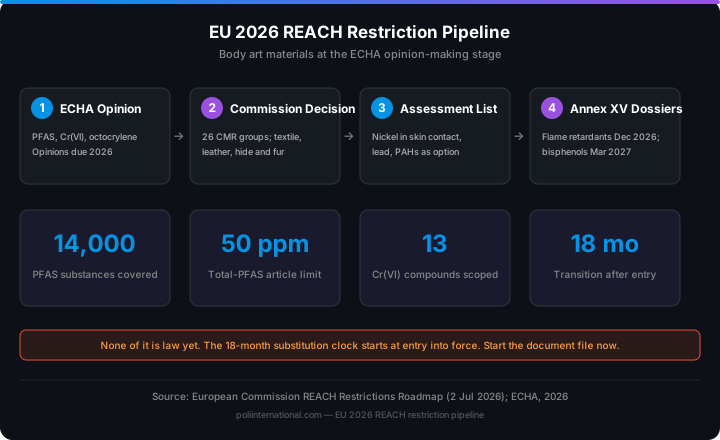
What the 2026 roadmap stages
| Stage | Entries relevant to body art |
|---|---|
| ECHA opinion-making, opinions due 2026 | Universal PFAS restriction; chromium(VI) oxides, oxyacids and salts; octocrylene in cosmetics |
| Commission decision-making | 26 newly classified CMR 1A/1B substance groups; skin-sensitising, irritating or corrosive substances in textile, leather, hide and fur articles |
| Assessment list, restriction as an option | Nickel in skin-contact applications; lead in consumer products; polycyclic aromatic hydrocarbons |
| Annex XV dossiers announced | Non-polymeric aromatic brominated flame retardants, December 2026; endocrine-disrupting bisphenols, March 2027 |
Two rows matter most. The leather and textile entry covers the couch, the chair, the belt and the glove. The nickel entry would sit alongside Entry 27's 0.5 µg/cm²/week migration limit for post assemblies, but written for skin contact rather than piercing jewelry specifically.
PFAS: the 50 ppm figure and the PTFE question
The proposal was submitted to ECHA in January 2023 by five European authorities. RAC adopted its final opinion on 3 March 2026; ECHA published it with SEAC's draft opinion on 26 March 2026, opening a consultation that closed on 25 May. SEAC's final opinion is expected by the end of 2026.
| Threshold | Limit | Note |
|---|---|---|
| Individual PFAS | 25 ppb | Targeted analysis |
| Sum of PFAS | 250 ppb | Prior degradation of precursors is now required, not optional |
| Total PFAS in articles | 50 ppm | Includes polymeric PFAS |
The third row is where fluoropolymers sit. PTFE is a perfluorinated polymer: it does not contain a trace of fluorinated impurity, it is the fluorinated material. A 50 ppm limit on articles does not distinguish PFAS as process contaminant from PFAS as product. Both committees support restriction with targeted, time-limited derogations rather than a blanket ban, so the essential-use argument for medical-grade fluoropolymers is the open question.
The sequencing is decided, though. The restriction would apply 18 months after entry into force, with draft Commission text expected in 2027. A dermal-contact polymer is not requalified in 18 months, because biocompatibility work and extractables testing are sequential. If PTFE jewelry is not derogated, the compliance clock starts at publication. The requalification clock started earlier.
Chromium(VI): authorisation becomes restriction
The Annex XV dossier was submitted in April 2025. RAC adopted its opinion on 1 June 2026; SEAC agreed its draft opinion on 10 June and consulted from 17 June to 17 August, with its final opinion planned for late 2026.
Thirteen chromium(VI) compounds, most currently on the Annex XIV authorisation list, would move to Annex XVII. That changes who carries the obligation: authorisation is a site-by-site permit, while a restriction is a market-wide limit that reaches importers and downstream users. Scope covers formulation of mixtures, electroplating on metal and plastic, primers and slurry coatings, other surface treatments, and functional additives and process aids.
RAC proposes a worker exposure limit of 0.1 µg/m³, far below the current EU occupational limit of 5 µg/m³, plus emission limits of 0.25 kg per year to air and 0.15 kg per year to water. SEAC favours a less stringent option and states that the restriction is unlikely to produce automatic substitution, because companies will invest in risk management measures instead. A restriction whose own socio-economic opinion doubts that it will drive substitution leaves downstream buyers holding the technical problem.
How a CMR classification becomes an ink deadline
The 26 newly classified CMR 1A/1B substance groups are a mechanism, not a list. The working example is the January 2026 amendment to Annex XVII, which reclassified silver as CMR Category 2 and expanded the CMR categories, capturing Pigment Blue 15:3 and Pigment Green 7 with a six-week transition.
That is the sequence: a harmonised classification under CLP is adopted, the tattoo ink restriction under Entry 75 points at CMR substances, and a reformulation deadline follows from a decision most studios never see. Regulation (EU) 2026/859 shows the other half, adding 2,4-dinitrotoluene as Entry 83 and restricting it at 0.1 per cent by weight in articles from 10 May 2027. Controls once aimed at substances in mixtures are being extended to imported articles, and body jewelry, coated hardware and studio equipment are articles.
What to build before 2027
1. A material declaration file per product line. Polymer identity, fluoropolymer content, total fluorine where a supplier can provide it, and a written scope statement for the PFAS restriction.
2. Chromium(VI) statements for metal and leather. For leather in skin contact, Entry 47 already sets a 3 mg/kg limit. Ask for the test report, not the assurance.
3. Nickel release data, not material claims. Entry 27 sets 0.5 µg/cm²/week for post assemblies, and products outside that definition may be asked for the same evidence.
4. A substitution timeline that runs ahead of the regulation. Identify the fluoropolymer item, pigment family and coated component you cannot replace quickly, and qualify replacements now.
FAQ
Q: Does the EU PFAS restriction ban PTFE body jewelry?
No decision exists, and a blanket ban is not what is on the table. The proposal covers PFAS as a group, sets a 50 ppm total-PFAS limit for articles, and provides for time-limited derogations. PTFE falls inside the substance definition, so the operative question is whether an essential-use derogation covers it.
Q: Entry into force may not arrive before 2028, so why act in 2026?
Because the 18-month transition starts at entry into force while substitution takes longer. The January 2026 silver and phthalocyanine amendment allowed six weeks, and requalifying a dermal-contact polymer cannot be scheduled against a publication date you do not control.
Q: Is chromium(VI) a tattoo ink problem or an equipment problem?
The proposal is scoped to industrial uses: formulation of mixtures, electroplating, primers and slurry coatings, other surface treatments, and functional additives. Ink formulators sit under the formulation category, while for studios the practical exposure is coated hardware and any chromium-finished component in the supply chain.
Conclusion
The pipeline is not a threat to body art. It is a documentation deadline with a long fuse. Two of the three live files reach materials in a working studio, and the nickel entry reaches this category directly. The answer is a material declaration file, built before anyone asks for it.