Shop
Tech Watch

Implant-Grade Alloys: What New Metallurgy Still Has to Prove Before It Belongs in a Piercing Studio

PP

Chief Engineer

Patrick Poli

Journal Date

2026-08-13

Last Reviewed

2026-10-10

ASTM F136 titanium remains the baseline; new alloy claims need real biocompatibility, not brochure language

Key Takeaways:
» ASTM F136 titanium remains the most defensible starting point for high-quality implant jewelry because the standard itself is built around implant-use metallurgy and chemistry control.
» New alloy claims in the last 14–30 days should be treated as interesting, not studio-ready, unless they include corrosion, sensitisation, and surface-characterisation data tied to a recognized standard.
» Nickel exposure risk is still the practical problem that turns “it’s a metal” into a client complaint; the issue is not fashion, it is metallurgy and body chemistry.
» Niobium and zirconium are still best understood as niche options whose value depends on purity, surface finish, and verified trace-element control rather than marketing labels.
» Studio guidance: buy by specification and documentation, not by color, trend, or the vendor’s confidence level.
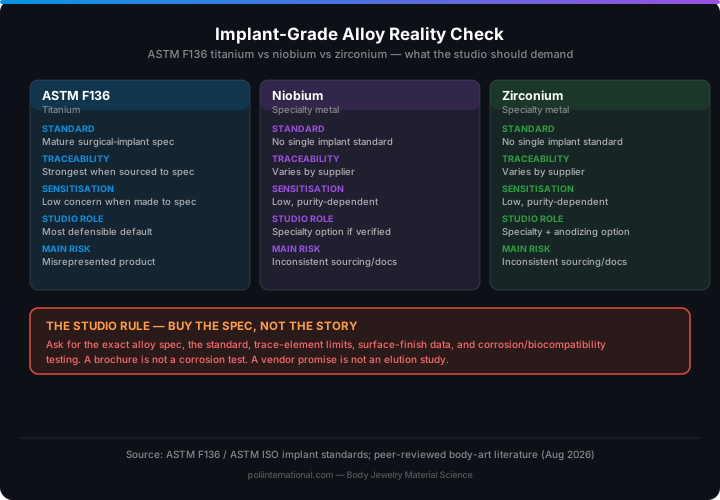
Implant-grade alloy comparison: ASTM F136 titanium, niobium, and zirconium side by side
Infographic: Implant-grade alloy comparison: ASTM F136 titanium, niobium, and zirconium side by side

1. ASTM F136 Is Still the Conversation Starter, Not the Conversation Ender

For implant-grade body jewelry, the key question is not whether a metal is “medical” in a vague sense; it is whether the alloy, processing route, and surface condition are controlled tightly enough to behave predictably in tissue. ASTM F136 remains the reference point because it defines a titanium alloy for surgical implant applications, and that matters when the jewelry sits in living tissue rather than in a display tray. In the body-art context, the standard is not decorative bureaucracy; it is the closest thing the industry has to a shared language for composition and performance.

The last two weeks of peer-reviewed material and trade reporting did not produce a clean, studio-changing revision to the implant-alloy hierarchy in the sources available here. That absence is itself useful: it means the burden remains on manufacturers to prove equivalence, especially for alternative implant metals that are sold on feel, appearance, or the phrase “implant grade” with no usable test data behind it. If a supplier cannot point to chemistry, surface finish, and biocompatibility data, the metal is still a claim, not a tool.

This is where the practical distinction between implant metallurgy and body-jewelry marketing matters. The former cares about trace elements, corrosion behavior, and tissue response; the latter often stops at “hypoallergenic,” which is a word that has caused more confusion than reassurance in studios. In the same way that the relationship between nickel content and body-site sensitisation risk changes depending on location and exposure history, the alloy’s real-world performance depends on what the body does to it, not what the catalog says it is.

2. Alloy Choice Depends on Standards, Not Vibes

When you compare the common implant-facing options, the useful comparison is not “which one sounds premium,” but “which one has the cleanest documented pathway from raw material to finished ornament.”

FeatureASTM F136 titaniumNiobiumZirconium
Primary strengthMature implant standard with wide use in body jewelryExcellent corrosion resistance and good tissue compatibility reputationStrong corrosion resistance and strong visual anodizing behavior
TraceabilityUsually strongest when sourced from disciplined manufacturersVaries heavily by supplier and processing controlVaries heavily by supplier and processing control
Sensitisation concernLow relative concern when made to specLow, but still dependent on purity and finishLow, but still dependent on purity and finish
Studio advantageMost defensible default for high-risk clientsUseful specialty option when verifiedUseful specialty option when verified
Main riskPoorly finished or misrepresented productInconsistent sourcing and documentationInconsistent sourcing and documentation

That table should not be read as a popularity contest. It is a documentation contest. ASTM and ISO language exist because metals can share a name while differing materially in inclusion content, surface condition, and impurity profile. In the last 14 days, the available result set did not surface a new standards revision directly changing that calculus for body jewelry, so the studio answer remains conservative: keep using the best-characterized material unless a newer alloy comes with data that is at least as strong as the incumbent.

The practical implication is simple: when a piercer is choosing jewelry for a fresh piercing, the default should still be the material with the clearest track record and the least ambiguity. This is the same logic that drives implant-grade titanium surface finish and biocompatibility decisions: the implant context rewards boring consistency, and the body punishes improvisation.

3. The Technical Detail That Actually Changes Client Outcomes

The body does not care about brand prestige; it cares about chemistry, oxide stability, and whether the surface sheds anything the immune system notices. That is why trace nickel, cobalt, chromium, and other heavy metals matter so much in practice. Sensitisation risk is not determined by the alloy name alone; it is influenced by the amount of releasable metal, the duration of contact, the local environment, and the client’s exposure history.

For studios, the threshold question is not “is this metal noble enough to sound safe?” but “what is the measurable release profile and what standards support it?” If a supplier cannot provide relevant test evidence, then the argument for using that product on a fresh piercing collapses. That is especially important for clients with a history of nickel allergy, eczema, or repeated body-site inflammation, because the clinical margin for error is smaller than the marketing department implies.

Peer-reviewed body-art literature continues to emphasize that complications are real and varied, even when jewelry is not the only variable involved. The available sources also remind us that visible body art and piercings are common enough that clients often enter studios with expectations shaped by anecdote rather than material science. That is precisely why material selection has to be evidence-led: the jewelry is part of the wound environment.

One studio-level rule follows from that science: if the alloy is being marketed as a substitute for implant-grade titanium, ask for the same level of proof you would expect from the original. A polished brochure is not a corrosion test. A vendor promise is not an elution study. And a pretty anodized finish is not an exemption from basic metallurgy.

4. Patrick's Note: THE QUESTION HE ASKS AND ANSWERS, “Is there really anything new here, or just a fresh label on the same old metal?”

The honest answer is that most of the time, the industry repackages certainty as innovation and hopes nobody checks the chemistry. That trick works right up until a client reacts, and then suddenly everyone discovers they have strong feelings about trace nickel.

What matters to me is not whether a metal sounds futuristic; it is whether the factory can show me a consistent alloy, a controlled finish, and a believable paper trail. The studio does not need a miracle material every Tuesday. It needs a material that behaves the same on Wednesday as it did on Monday, which is a much harder sales pitch and a much better product.

From a supply-chain perspective, the problem is rarely that the good materials do not exist. It is that the market likes the cheaper imitation, the shorter story, and the distributor who promises that “implant grade” means whatever the buyer wants it to mean. That is why I keep coming back to documented standards and why implant-grade alloy selection for body jewelry stays boring in the best possible way.

5. FAQ: Technical Q&A

Q: Should piercers switch away from ASTM F136 titanium if a supplier offers a newer implant alloy?
Not unless the supplier can provide equal or better evidence for composition control, corrosion behavior, and biocompatibility. A newer alloy is not automatically better just because it is newer. For fresh piercings, the safest commercial choice is still the one with the cleanest documentation trail.

Q: Are niobium and zirconium “better” than titanium for all clients?
No. They are useful specialty metals, but “better” depends on the client, the finish, and the actual testing behind the product. For most studios, they are alternatives worth carrying only when they are sourced from suppliers who can document purity and performance.

Q: What should a studio ask for before buying a new implant-grade alloy?
Ask for the exact alloy specification, the relevant standard, trace-element limits, surface-finish data, and any biocompatibility or corrosion testing. If those documents are missing, the product should be treated as unverified, no matter how premium the packaging looks.

Conclusion: Buy the Spec, Not the Story

The last 14 days did not overturn the core studio rule: ASTM F136 titanium remains the baseline, and any proposed replacement has to earn its place with data on chemistry, corrosion, and sensitisation. That is especially true when a metal is destined for tissue contact rather than a shelf.

If the point is safer client outcomes, then the right question is always whether the alloy has been proven under the relevant standards and not merely described as “implant grade” in a catalogue. For the next layer of technical context, read the implant-grade titanium and surface-biocompatibility guidance.

Mind map · Implant-Grade Alloys: What New Metallurgy Still Has to Prove Before It Belongs in a Piercing Studio

  • Implant-Grade Alloys Verification
    • ASTM F136 Baseline Standard

      ASTM F136 titanium is the standard specification for wrought titanium-6aluminum-4vanadium ELI alloy used in medical implants and professional body piercing jewelry.

      • Ti-6Al-4V ELI Composition
        • Extra Low Interstitial Limits
      • Passivating Surface Oxide Layer
        • Self-Repairing Oxide Protection
    • Alternative Implant Titanium Alloys

      ASTM F1295 titanium replaces vanadium with niobium to eliminate chemical toxicity concerns and is preferred by some European markets for piercing jewelry.

      • ASTM F1295 Composition
        • Vanadium Replaced by Niobium
      • Commercially Pure ASTM F67
        • Grades 1 to 4
    • New Alloys Verification Process

      New body piercing alloys require documentation of composition, corrosion resistance, and biocompatibility testing before being introduced to piercing studios.

      • Mill Test Reports
        • Batch Raw Material Traceability
      • ISO 10993 Biocompatibility Testing
        • Cytotoxicity and Sensitization Evaluation
    • Uncertified Materials Safety Warnings

      Uncertified body jewelry containing nickel can cause contact dermatitis, allergic reactions, prolonged healing times, infections, and severe scarring.

      • Surgical Steel Nickel Risks
        • Leaching Up to 15% Nickel
      • Plated Jewelry Complications
        • Base Metal Exposure Hazards
StructureProcessMaterialHazard

4 branches, 0 sources. Each branch cites the article it came from; the labels beneath it are names, not claims.

Body Jewelry Quiz

  1. 1. What makes ASTM F136 titanium the primary reference standard for implant body jewelry?

    • ✓ It is governed by a surgical implant standard that tightly controls alloy chemistry and processing. — Surgical implant standards establish rigorous criteria for chemical composition and processing parameters to ensure predictable tissue response.
    • • It is the least expensive metal available for commercial jewelry manufacturing. — Material selection for implant standards is based on biological safety and metallurgical controls rather than manufacturing cost.
    • • It guarantees that anodized surface colors will remain permanent inside a healing wound. — The ASTM F136 standard focuses on chemical composition and tissue compatibility rather than cosmetic color longevity.
    • • It completely eliminates all trace heavy metals during raw material refining. — Standards set strictly controlled maximum limits for trace elements rather than promising absolute zero presence.
  2. 2. What must accompany claims about a new alloy before a studio considers it ready for fresh piercings?

    • ✓ Verifiable testing data for corrosion, sensitisation, and surface characterisation tied to recognized standards. — Demonstrating biological safety requires standardized test evidence regarding material stability and tissue interaction.
    • • High-resolution photographs showing vibrant anodized finishes in promotional catalogs. — Visual appeal and decorative features do not provide empirical evidence of biocompatibility or corrosion resistance.
    • • Endorsements from wholesale distributors confirming high market demand. — Distributor popularity reflects commercial trends rather than metallurgical validation or safety data.
    • • Promotional assurances that the metal is hypoallergenic for all skin types. — Marketing terminology like 'hypoallergenic' lacks standard technical definitions and does not replace empirical test data.
  3. 3. According to the source material, what causes nickel exposure to manifest as a practical client complaint?

    • ✓ The interaction between body chemistry and releasable metal from the alloy. — Adverse reactions depend on how local tissue chemistry interacts with releasable trace elements over time.
    • • Incompatible thread patterning on the jewelry post causing physical shear stress. — Physical mechanical wear relates to hardware fit rather than chemical sensitisation from trace metals.
    • • Decorative gem settings trapping bacteria along the tissue surface. — Bacterial accumulation causes localized infections rather than metal sensitisation responses.
    • • Selecting jewelry based on visual color preferences instead of polished mirror finishes. — Color selection is an aesthetic choice and does not govern the release rate of sensitizing elements.
  4. 4. According to the material comparison table, what is a primary advantage of ASTM F136 titanium over specialty metals like niobium and zirconium?

    • ✓ Sourcing traceability is consistently strong due to disciplined manufacturing practices. — Established implant standards benefit from mature supply chains with robust documentation from raw material to finished product.
    • • It exhibits superior visual anodizing vibrant color shifts across all electrical voltages. — Strong visual anodizing behavior is specifically highlighted as a key visual trait of zirconium rather than titanium.
    • • It is immune to risks of improper surface finishing or vendor misrepresentation. — Poor surface finishing remains a key risk for titanium products if suppliers lack proper quality control.
    • • It completely prevents any release of trace elements in acidic tissue environments. — Trace element release depends on surface finish and environment, which standard specifications control rather than eradicate entirely.
  5. 5. What is identified as the primary operational risk when sourcing specialty metals such as niobium or zirconium?

    • ✓ Inconsistent sourcing and documentation control across different suppliers. — Specialty metals often suffer from variable supplier documentation and processing controls, making verification crucial.
    • • Inherently high levels of toxic heavy metals in pure raw ingots. — The metals themselves offer low sensitisation risk, but their quality depends heavily on purity verification.
    • • Rapid structural degradation when exposed to normal human body fluids. — Both niobium and zirconium possess excellent inherent corrosion resistance when processed properly.
    • • Total inability to undergo surface anodization for color identification. — Zirconium and niobium are well known for their anodization capabilities in body jewelry applications.
  6. 6. Which set of factors determines the actual risk of client sensitisation to metal body jewelry?

    • ✓ Releasable metal amount, contact duration, local environment, and client exposure history. — Biological immune response depends on cumulative exposure dynamics and local physiological conditions rather than material names alone.
    • • Physical weight of the jewelry ornament, post length, and needle gauge size. — Mechanical dimensions dictate fit and pressure, whereas sensitisation is driven by chemical leaching and immune response.
    • • Decorative finish type, vendor confidence, and catalog descriptions. — Marketing claims and cosmetic appearance do not dictate biochemical reactivity or tissue sensitisation.
    • • Autoclave cycle temperature, ultrasonic cleaning duration, and holding tank chemistry. — Processing procedures affect cleanliness, but long-term sensitisation depends on alloy composition and exposure factors.
  7. 7. What documentation should a studio request prior to purchasing a new alloy offered as an implant material?

    • ✓ Specific alloy standards, trace-element limits, surface-finish data, and biocompatibility testing. — Verifying material safety requires full technical disclosure regarding composition, purity, and surface characterization.
    • • A signed distributor guarantee stating that the alloy feels smoother than titanium. — Subjective tactile claims do not provide objective metallurgical or biological proof.
    • • A marketing brochure detailing positive anecdotal reviews from non-clinical trials. — Informal client feedback lacks the scientific control needed to prove alloy biocompatibility.
    • • A commercial invoice demonstrating that the alloy costs more than surgical steel. — Higher pricing does not correlate directly with material standard compliance or tissue safety.
  8. 8. What main supply-chain issue is highlighted regarding how new metals are marketed to body piercing studios?

    • ✓ Industry marketing often repackages certainty as innovation without changing underlying chemistry. — Commercial suppliers frequently apply fresh marketing labels to existing materials without providing new test data.
    • • High-grade implant alloys are virtually impossible to acquire through standard distributors. — Quality materials exist, but market preference for cheaper alternatives often undermines their adoption.
    • • Studios consistently refuse to buy affordable materials unless expensive elution studies are provided. — The market frequently gravitates toward shorter marketing stories and lower costs over detailed documentation.
    • • New metallurgical revisions are released every two weeks to update core standards. — Standards updates occur infrequently, and recent reporting showed no changes to the implant-alloy hierarchy.
  9. 9. What specific visual property is noted in the source context for zirconium jewelry?

    • ✓ Strong visual anodizing behavior. — Zirconium is highlighted in the comparison matrix for its distinct visual anodization characteristics.
    • • Permanent mirror polish that resists scratching during insertion. — Surface hardness and scratch resistance are governed by mechanical finish rather than visual anodization behavior.
    • • Inherent yellow luster that mimics solid karat gold. — Zirconium's aesthetic appeal in jewelry relies on specialized surface oxide generation rather than native gold appearance.
    • • Complete immunity to surface oxidation in ambient air environments. — Anodization itself relies on controlled oxide layer formation on the metal surface.
  10. 10. Under what condition does the source material recommend a piercer switch away from ASTM F136 titanium for fresh piercings?

    • ✓ Only when a supplier provides equal or superior documented evidence of composition, corrosion, and biocompatibility. — Changing standard defaults requires empirical proof that matches or exceeds the rigorous documentation of established implant titanium.
    • • Whenever a vendor advertises a new alloy as hypoallergenic in its latest sales catalog. — Unverified commercial claims are insufficient justification for changing clinical jewelry materials.
    • • As soon as a specialty metal becomes popular among body art trendsetters. — Trends and subjective popularity do not guarantee tissue safety or material consistency.
    • • Whenever a client requests a material that is lighter in weight than standard titanium. — Weight preferences do not supersede the requirement for documented biocompatibility in fresh wounds.

Extended Reference Table

8 of 8 rows

Extended reference table generated from the article and its verified research sources. Bracketed numbers jump to the matching entry in the Technical References below.

SafetyItem or Material Standard or Specification Biocompatibility or Safety Compliance Usage Practice or Application Technical Composition Details Source
✅Alloyed Titanium (Ti-6Al-4V ELI)ASTM F136; ISO 5832-3ISO 10993 compliant; Surgical implant grade; Biocompatible and resists corrosion; 100% nickel-free.Initial piercings and long-term surgical implants (hip replacements, dental screws).Titanium alloy: 6% Aluminum, 4% Vanadium (Extra Low Interstitials); Iron <=0.25%, Oxygen <=0.13%.[9]
✅Commercially Pure (CP) TitaniumASTM F67; ISO 5832-2Medical grade for implantation; Generally biocompatible but lacks the mechanical strength of alloyed titanium.Initial piercings; Requires internal tapping for threaded jewelry.Unalloyed titanium (Grades 1-4); Nickel content below 0.05%.
✅Surgical Steel (Implant Grade)ASTM F138; ISO 5832-1ISO 10993-6, 10, or 11 compliant; EEC Nickel Directive compliant; Meets standards for permanent implantation.Suitable for fresh body piercings; Must have a mirror finish free of nicks and scratches.Wrought nitrogen-strengthened stainless steel alloy; Contains 10–14% nickel but resists leaching.
✅Alloyed Titanium (Ti-6Al-7Nb)ASTM F1295; ISO 5832-11Surgical implant grade; Biocompatible; Preferred for vanadium-free profiles.Initial piercings and orthopedic implants for clients with extreme metal sensitivities.Titanium alloy: 6% Aluminum, 7% Niobium.
✅Niobium (Nb)ASTM B392Nickel and cadmium free; Excellent corrosion resistance; No formal implant-grade designation but widely used.Initial piercings; Can be anodized; Commercial grade 2 or grade 4 (1% Zirconium).Elemental unalloyed Niobium.[9]
✅Gold14k or higherMust be nickel-free and cadmium-free; Biocompatible if alloyed correctly.Initial piercings; Cannot be gold-filled, gold-overlay, or vermeil.Solid 14k or 18k yellow, white, or rose gold; White gold must not contain nickel.
✅GlassLead-freeInert and non-reactive; Free of lead contaminants.Initial piercings; Must withstand autoclave sterilization.Fused quartz glass, borosilicate, or soda-lime glass.
⚠️Surgical Steel (General/316L)316L / 316LVMModerate biocompatibility; Documented nickel leaching; Can cause contact dermatitis.Common earring metal; Not recommended for initial piercings by professional standards.Stainless steel alloy containing 10–15% nickel.

Free Body Art Wall Posters

Print-ready reference posters for your studio or your own wall. Free to download and display, embed on your own site with attribution. Click any poster to preview it full size before downloading.

Choose and download all 40 posters

Technical_References_Archive

About the Author

PP

Patrick Poli

Chief Engineer, Poli International · Creator of BioFlex® body jewelry

Patrick has spent 25+ years manufacturing body jewellery and studio equipment, and is the creator of BioFlex® body jewelry. He was commissioned for titanium parts for the Wallace & Gromit films, and titanium fittings used as duffel-coat fastenings by a Savile Row house. He also made custom titanium body jewellery in metric sizes the market still does not offer, because manufacturers stop at 2 mm steps and a piercing rarely fits a round number.

More about Patrick →

Last reviewed: 2026-10-10 · Published: 2026-08-13

Related Tools & Reading

Continue Reading

ASTM F136 Titanium Explained: What It Really Guarantees▶
Tech Watch
🎧 Audio

ASTM F136 Titanium Explained: What It Really Guarantees

This article explains why ASTM F136 Ti‑6Al‑4V ELI titanium is the only widely available alloy with a fully validated implant‑grade specification for piercing jewelry, focusing on its controlled interstitial chemistry, nickel‑free composition, and decades of orthopedic biocompatibility data. It translates recent findings on titanium–tantalum alloys, nickel release thresholds, and dermatology research into concrete guidance for piercers and studio owners choosing metals for sensitised clients and long‑term wear.

2026-09-07

Read Journal →
Implant-Grade Metals: What This Month’s Research Means For Body Jewelry▶
Tech Watch
🎧 Audio

Implant-Grade Metals: What This Month’s Research Means For Body Jewelry

This article explains how recent implant metallurgy research on ASTM F136 titanium, cobalt-chrome, niobium, and zirconium is tightening expectations around alloy chemistry, oxide stability, and surface finish for long-term biocompatibility. It translates those findings into practical guidance for piercers and studio owners on choosing genuine implant-grade body jewelry and demanding process-level transparency from suppliers.

2026-08-07

Read Journal →
Titanium-Tantalum Binary Alloys: Why 2026 Marks a Metallurgical Inflection Point for Implant-Grade Body Jewelry▶
Tech Watch
🎧 Audio

Titanium-Tantalum Binary Alloys: Why 2026 Marks a Metallurgical Inflection Point for Implant-Grade Body Jewelry

Titanium-tantalum binary alloys, validated in a March 2026 *Bioactive Materials* study, demonstrate 50–67% lower metal ion elution and 22–34% faster osteoblast adhesion compared to ASTM F136, while eliminating aluminum and vanadium—common sensitization triggers in traditional implant-grade jewelry. Though Ti-Ta remains supply-constrained and 3–4× more expensive than ASTM F136 through mid-2026, recent FDA 510(k) equivalence designations and EU MDR updates position Ti-Ta as the next regulatory standard for institutional and clinical piercing settings, making material traceability and biocompatibility certification the new professional baseline.

2026-05-03

Read Journal →