Choose jewellery by measured nickel release, not by appearance or vague “hypoallergenic” claims
Key Takeaways:
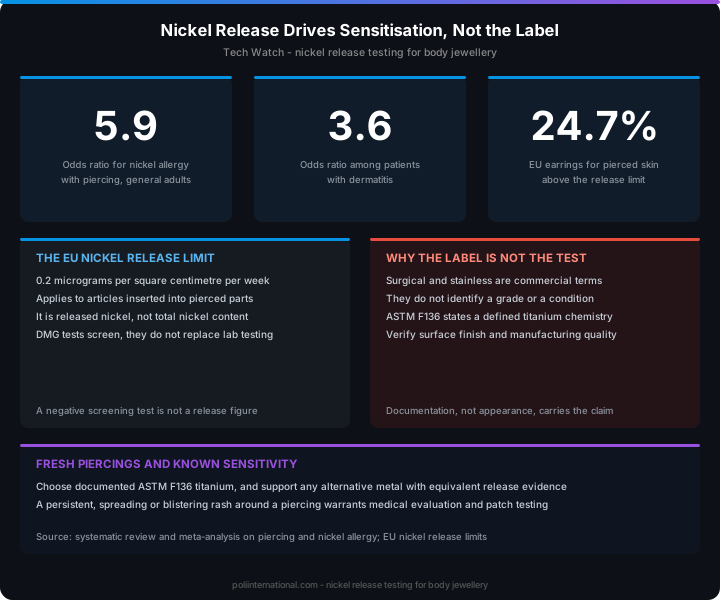
» Piercing is strongly associated with nickel allergy, with a recent meta-analysis reporting an odds ratio of 5.9 in the general adult population.
» In the same review, 24.7% of European earrings intended for direct insertion into pierced skin exceeded the EU nickel-release limit.
» A “stainless steel” or “surgical steel” label does not prove that finished jewellery meets a safe nickel-release threshold.
» ASTM F136 titanium is a strong default for fresh piercings, but documentation, surface finish, and manufacturing quality still matter.
» Studios should record the exact material specification and supplier documentation rather than relying on colour, price, or generic catalogue language.
1. Piercing changes the nickel-exposure problem
Nickel allergy is not simply a matter of whether a piece of jewellery contains nickel. The practical question is whether nickel ions can leave the finished surface and contact skin or healing tissue at a meaningful rate. A nickel-containing alloy can perform acceptably when release is tightly controlled; a poorly made or unsuitable item can create unnecessary exposure even when its product description sounds reassuring.
A recent systematic review and meta-analysis found a significant association between piercing and nickel allergy: the odds ratio was 5.9 in the general population and 3.6 among patients with dermatitis. The review analysed 5,333 people from the general adult population and 20,330 adults with dermatitis, making it more useful than isolated anecdotes or online claims about one particular alloy. The results are reported in the PubMed systematic review of nickel allergy and piercings.
The same review found that 24.7% of European earrings intended for direct insertion into pierced skin exceeded EU nickel-release limits. That figure is not a reason to reject every metal item; it is a reason to stop treating jewellery terminology as a substitute for testing. The distinction is similar to the one explained in what ASTM F136 actually guarantees for piercing jewellery: a material designation matters only when it is supported by the correct specification and traceability.
Nickel sensitisation can develop after repeated or prolonged exposure. A fresh piercing is especially relevant because the channel is healing, the barrier is disrupted, and the jewellery remains in contact with tissue continuously. A client who tolerates a cheap earring in a healed lobe may still react to an unsuitable item in a new cartilage, nostril, navel, or oral piercing.
2. Nickel release is the useful comparison
For professional decision-making, release rate is more informative than total nickel content. Regulations focus on how much nickel migrates from an article under defined test conditions, because allergy is driven by exposure to available nickel ions rather than the mere presence of nickel atoms inside an alloy.
| Feature | ASTM F136 titanium | Generic stainless or “surgical steel” |
|---|---|---|
| Primary advantage | Low concern for nickel exposure when genuine and correctly processed | Can be mechanically suitable, but performance varies by grade and finish |
| Nickel status | Titanium alloy specification does not rely on nickel for corrosion resistance | Many grades contain nickel as an intentional alloying element |
| What the label proves | ASTM F136 identifies a defined titanium alloy chemistry and condition when documentation is genuine | “Surgical” and “stainless” are broad commercial terms, not sufficient grade identification |
| Main studio risk | Counterfeit or misrepresented material; poor finishing or contamination | Unknown grade, uncontrolled nickel release, damaged passivation, or mixed components |
| Documentation to request | Mill certificate or equivalent material certification, lot traceability, and supplier declaration | Exact grade, nickel-release evidence where relevant, component-by-component traceability |
| Best use decision | Strong default for many fresh piercings when properly manufactured | Only when the exact grade, finish, and release performance are documented |
European rules commonly cited for jewellery distinguish between items intended for prolonged skin contact and items intended for insertion into pierced skin. The review reported that 10.2% of European earrings intended for prolonged skin contact and 24.7% of those intended for direct insertion exceeded the relevant limits. These are population-level findings, not a test result for every supplier, but they show why purchasing from an established professional manufacturer matters.
A dimethylglyoxime, or DMG, test can screen for readily available nickel on some surfaces, but it is not a complete substitute for quantitative laboratory release testing. The recent review reported critical nickel release by DMG screening in 11.3% of European earrings, compared with 34.5% from Asia and 31.1% from North America in the samples assessed. DMG is useful as a warning signal; it cannot establish that an item meets every applicable regulatory condition.
3. What the numbers mean for studios
The EU nickel restriction is commonly expressed through a release limit of 0.2 micrograms per square centimetre per week for articles intended to be inserted into pierced parts of the body. For other articles in prolonged direct contact with skin, the commonly cited limit is 0.5 micrograms per square centimetre per week. The distinction matters: a healed bracelet and a fresh labret are not the same exposure scenario.
Release testing is performed under controlled conditions intended to simulate contact over time. The test does not reproduce every individual’s sweat chemistry, friction, cleaning routine, inflammation, or healing behaviour. It does, however, provide a consistent regulatory benchmark. Studio purchasing should therefore treat a test report as evidence about a defined product or material lot—not as a universal promise that every item sold under a similar name behaves identically.
Surface condition is central. Scratches, poor polishing, crevices, exposed solder or brazing, mixed-metal components, and damaged protective oxide layers can all alter local corrosion and ion release. Threaded jewellery deserves particular attention because the post, end, and threading may not have identical materials or finishes. A certificate for the bar does not automatically certify the decorative end, hinge, pin, or coating.
For clients with a known nickel allergy, the practical response is not to diagnose the rash from across the counter. Use jewellery with a clearly documented nickel profile, avoid unknown alloys, and refer persistent, spreading, blistering, or recurrent dermatitis for medical assessment and patch testing. Nickel allergy is a clinical diagnosis; a red piercing can also reflect mechanical irritation, pressure, cleaning trauma, infection, or another allergen.
Studios should retain:
- The exact alloy designation, such as ASTM F136 titanium where applicable.
- Supplier and manufacturer identity.
- Lot or batch information.
- Material certification or certificate of conformity.
- Evidence that all components—not only the main post—match the stated specification.
- Records of sterilisation and any processing that could affect the finished surface.
- A clear replacement and adverse-reaction procedure.
The phrase “hypoallergenic” should be treated as marketing language unless it is supported by a defined material specification and relevant test evidence. The recent review’s findings show why a polished appearance and a familiar sales label are poor substitutes for controlled release data.
4. Patrick's Note: The Label Is Not the Test
A client arrives with a rash around a new piercing and is often told that the jewellery is “surgical steel,” as if the adjective has been sterilised, tested, and appointed to public office. It has not. When the material is vague, the client carries the uncertainty inside a healing channel, while the supplier keeps the comfortable label.
The useful question is simple: what exact material is in contact with the tissue, and what evidence supports its nickel-release performance? I have put the practical evidence and regulatory context together in the nickel allergy and piercing EU regulation data guide, because clients deserve an answer more precise than “it should be fine.” A good piercer should not have to reverse-engineer a catalogue description while someone else’s immune system conducts the audit.
5. FAQ: Technical Q&A
Q: Is all stainless steel unsafe for a person with nickel allergy?
No. “Stainless steel” covers multiple grades, finishes, and manufacturing conditions, so the phrase alone cannot determine nickel-release performance. For a client with confirmed nickel allergy, use a precisely identified, documented material with an appropriate release profile rather than relying on a generic steel label.
Q: Does ASTM F136 titanium contain nickel?
ASTM F136 titanium is not a nickel-based alloy and is widely selected to reduce concern about nickel exposure in body jewellery. The studio must still verify that the item is genuinely made to the claimed specification and that decorative ends, pins, hinges, and other components are not made from an undisclosed different material.
Q: Can a client become allergic to nickel after years of wearing earrings?
Yes. Sensitisation can develop after repeated exposure, so previous tolerance does not prove permanent tolerance. If dermatitis recurs, remove the exposure only with appropriate professional guidance, assess the jewellery material, and refer the client for medical evaluation or patch testing when symptoms persist.
Conclusion: Make Release Evidence the Standard
Nickel sensitisation prevention begins with a purchasing decision: identify the exact alloy, verify the documentation, and consider how the finished jewellery will contact healing tissue. The recent evidence shows that a substantial minority of tested earrings exceeded applicable EU nickel-release limits, so “surgical,” “stainless,” and “hypoallergenic” are not adequate technical specifications.
For fresh piercings and clients with known sensitivity, documented ASTM F136 titanium is a strong option, while any alternative metal should be supported by equivalent material and release evidence. The technical guide to implant-grade metals for body jewellery explains how studios can turn that principle into a consistent selection and documentation process.