Turning “Free Tattoos For Jobs” Into A Clinical Lesson In Consent And Risk
Key Takeaways:
» Treat any “tattoo for opportunity” event as a high‑risk consent situation, not a fun brand activation.
» On‑the‑spot corporate flash pieces belong in low‑risk body zones, with conservative pigment choices and strict screening.
» Artists must slow consent down: written forms, cooling‑off windows, and clear regret pathways beat hype every time.
» Studios should hard‑ban visible corporate logos on faces, hands, and necks at branded events.
» If you’re the artist, your name is what survives the news cycle—design your risk policy accordingly.
---
1. The Story: Free Tattoos, Viral Backlash, And A Very Old Problem In New Clothing
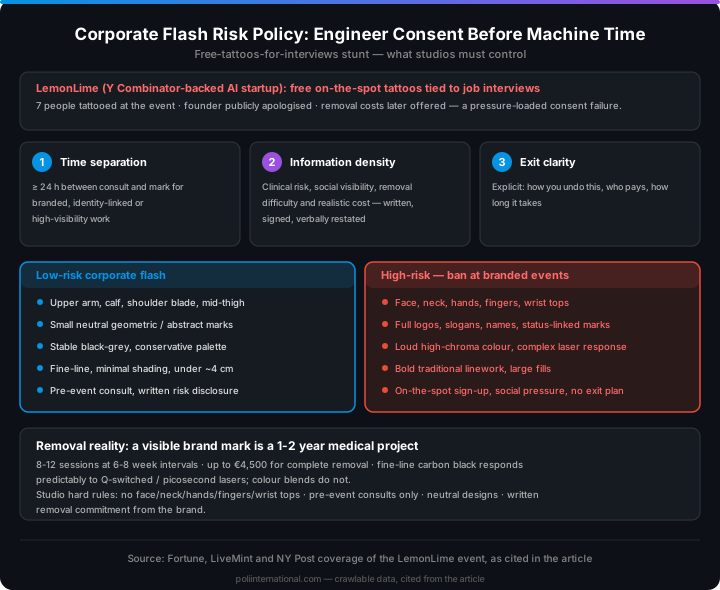
An AI startup, LemonLime, backed by Y Combinator, ran an event where attendees were offered free tattoos on the spot, tied to job interviews and brand hype. Multiple reports describe a live tattooer set up at the gathering; seven people accepted and got tattooed during the event, and the story promptly blew up as an ethics and consent nightmare in the tech press and on social media, forcing the founder into a public apology for “messing up” and scrambling to clarify that interviews were available to everyone, tattooed or not.[^fortune-ll]
Strip away the AI buzzwords and venture logos and the pattern is painfully familiar to anyone who’s worked in this trade: pressure‑loaded consent wrapped in “fun”, permanent marks traded for perceived opportunity, and a client base who are excited, socially exposed, and in no state to run a proper risk/benefit calculation. The same dynamic fuels “free flash for followers” nights that quietly turn into regret factories and emergency cover‑up sessions six months later.
There’s a reason experienced studios treat context as seriously as needle hygiene. A tattoo at 2 p.m. in a quiet shop after a proper consult is not the same as a tattoo at a loud startup event where people are half‑networking, half‑trying not to miss out. The difference in clinical risk looks small on paper—same pigment, same liners—but the difference in psychological risk, long‑term satisfaction, and litigation exposure is massive. It’s the same logic that sits behind the engineering of tapered needle geometry to minimise dermal trauma: the mark itself is only half the story; the conditions you create around it decide how the tissue, and the client, live with it.
---
2. Where The Real Risk Is: Anatomy, Visibility, And Power Dynamics
Here’s the technical bit nobody in the tech press bothers to ask: not all tattoos are equal from a clinical and social risk standpoint. If a startup waves around “free tattoos” as a perk, the questions for a responsible artist aren’t “Is this cool?” but:
- Where on the body?
- What pigments?
- What line weight?
- What’s the psychological load of this mark in five years?
Let’s break that down in a way you can use when you’re actually behind a machine or running a studio.
| Feature | Low‑Risk Corporate Flash (Acceptable Event Zone) | High‑Risk Corporate Flash (Ban For Branded Events) |
|---|---|---|
| Body location | Upper arm, calf, shoulder blade, mid‑thigh (easy to cover, low friction) | Face, neck, hands, fingers, wrist tops (high visibility, social cost) |
| Design type | Small geometric mark, abstract logo derivative, neutral text | Full logo, slogans, names, political or identity statements |
| Pigment choice | Stable black/grey, conservative colour palette | Loud high‑chroma colour where laser response is complex |
| Line weight / scale | Fine‑line, minimal shading, under ~4 cm | Bold traditional linework, large fills, high coverage |
| Context of consent | Booked slot, pre‑event consult, written risk disclosure | On‑the‑spot sign‑up, social pressure, “perk” tied to opportunity |
| Exit strategy | Clear removal funding promise, design easy to cover‑up | No removal plan, hard‑to‑mask placement, complex cover shapes |
The engineering logic here is the same logic behind initial piercing jewelry selection: you don’t put a heavy, high‑moment barbell in cartilage for a first pass if you care about healing, just like you don’t drop a brand’s logo on a forehead at a hype event if you care about consent. The way initial jewelry gauge and length influence tissue stress and hypertrophic scarring is the piercing version of the same rule—small technical decisions that either amplify or dampen the long‑term cost of a moment’s excitement.
From the studio side, the power gradient matters more than the art. At a corporate event, attendees are not “just clients”; they are job applicants, networkers, people trying to impress a gatekeeper. That is a built‑in coercive context even if nobody says the word “must”. If you’re the artist, you’re not neutral: your presence certifies the stunt as safe, legitimate, and “normal”.
When the company later offers to pay for removal, as LemonLime reportedly did for the seven people they tattooed, they’re admitting something practical: they knew regret was likely, and they knew the mark was a liability. That’s exactly why your risk policy should be written before anyone sets up a portable bed under a neon sign.
---
3. Technical Deep Dive: Consent Engineering, Laser Reality, And Policy That Actually Protects People
Let’s talk numbers and mechanics, because that’s where this stuff gets real.
Laser removal cost and sessions. The press around these stories loves quoting “up to €4,500” or similar numbers for complete removal of a moderately sized black tattoo on the face or forehead. That’s not arbitrary. Full clearance can take 8–12 sessions at roughly 6–8 week intervals, and aggressive treatments flirt with hypo‑ or hyperpigmentation, textural change, and incomplete ghosting. Experienced removal practitioners know that high‑contrast black on pale facial skin can be one of the most unforgiving combinations.
If you allow a brand mark on a visible area at an event, you’re effectively committing someone to a one‑to‑two‑year medical project if they change their mind, even if the company foots the bill. That’s not “fun”; that’s a continuous clinical relationship under a spotlight they never properly agreed to.
Pigment and particle size. Event flash often leans into “fine‑line” minimal black work. Clinically, that’s the best version of a bad idea: carbon black with small particle sizes responds predictably to Q‑switched and picosecond lasers; it fragments cleanly, macrophages can clear the debris relatively efficiently, and the risk profile is easier to manage. Start pouring opaque white, reds with azo dyes, or heavily layered colour blends into a logo and the laser profile gets messy fast. Different wavelengths hit different chromophores; you’re now talking multi‑platform removal and more sessions, not less. The same material science that drives the choice of low‑trauma pigments and controlled deposition depth in single‑needle facial tattooing applies here—only nobody in the event deck is thinking that far ahead.
Consent structure as engineering. True informed consent has three engineered components:
1. Time separation. The decision to be marked and the moment of marking cannot be the same moment. In practice: consult and booking at least 24 hours apart for anything branded, identity‑linked, or high‑visibility.
2. Information density. Plain‑language explanation of clinical risk, social visibility risk, removal difficulty, and realistic cost. Written, signed, and verbally restated.
3. Exit clarity. Specific statement of “here’s how you undo this, here’s who pays, here’s how long it takes”.
Treat it like a mechanical design: if any one of those three components is missing, the consent structure is under‑engineered and will fail under load—usually when the client’s life changes and the tattoo stops lining up with their identity.
Studio policy implications. For studios being asked to staff corporate events:
- Hard rules on placement. No face, neck, hands, fingers, or wrist tops. Period. If the brand insists, decline the job.
- Pre‑event consult requirement. Every attendee must pre‑book and sign forms off‑site; event itself is for execution only.
- Minimum design neutrality. No corporate slogans, political references, or marks tied to professional status. Geometric or symbolic only.
- Written removal commitment. If the brand wants their logo in skin, they sign a contract covering removal costs and transport for X years.
These aren’t “nice to have”. They’re the difference between your studio being the professional adults in the room and being a prop in someone else’s PR disaster.
---
4. Patrick’s Note: The Question He Asks And Answers
Here’s the question I ask every time a brand wants skin in their marketing deck: “Who carries the mark when the campaign is over?” Because the posters come down, the founder’s apology gets buried under the next news cycle, and the only thing still walking into job interviews is the client’s body.
What the data doesn’t tell you is how many people quietly sit in removal clinics, sleeves rolled up, explaining that they got a piece “for a brand thing” and it stopped being funny somewhere around session five. From a materials perspective, the irony is brutal: artists can fully control trauma, pigment choice, needle geometry, and aftercare—everything needed to make that piece heal beautifully. The part nobody engineers is the life cycle of the meaning. That’s how you end up with extremely well‑executed tattoos that are clinically perfect and psychologically disastrous.
I wrote in the Poli Journal before about how initial jewelry gauge mis‑selection silently drives hypertrophic scarring rates in helix and nostril piercings; this is the same story in different clothing. The industry obsesses over technical skill and pretends social context is “not our department”. It is. The needle is ours. Where and why it goes in is ours. If a five‑person startup wants to rent your credibility for a night, charge them for the risk policy, not for the machine time.
---
5. FAQ: Technical Q&A
Q: If a studio is asked to do free tattoos at a corporate event, what’s the minimum safe setup?
Run it like a pop‑up extension of your shop, not a party trick. Require pre‑event consults and consent forms, limit designs to small neutral symbols on easily covered areas (upper arm, calf), and standardise pigment choices to stable black work that is straightforward to remove if needed. No alcohol, no walk‑up “spur‑of‑the‑moment” slots, and no ties between getting tattooed and getting hired.
Q: How should artists handle clients who feel pressured because tattoos are framed as a “perk” tied to jobs or status?
Make the pressure explicit and then cut it out. Tell them clearly that tattooing will not affect their standing with the company, that they can walk away without explanation, and that your clinical concern is their long‑term wellbeing, not the brand’s marketing plan. Offer a cooling‑off period and a non‑tattoo alternative (merch, prints) so walking away doesn’t feel like missing out.
Q: Are these event tattoos more likely to be regretted and removed than standard studio pieces?
Yes. Anything done under social pressure, brand hype, or perceived professional advantage has a higher regret rate, regardless of technical quality. Clinically, that means planning as if removal is likely: conservative placement, predictable pigments, and designs that can be covered or incorporated later. Treat every brand‑linked tattoo as a potential future removal case and design with that endpoint in mind.
---
Conclusion: Write The Policy Before You Plug In The Machine
Corporate tattoo stunts feel new because they’re wrapped in venture money and AI jargon, but the underlying problem hasn’t changed: permanent marks traded under temporary pressure. If you’re running a studio, your job isn’t to decide whether the brand’s idea is cute; your job is to ensure that the person walking out of the event has a mark they can live with in the real world, not just in a one‑day highlight reel.
When you build your risk policy for branded work, treat it with the same seriousness you’d use for designing low‑trauma single‑needle facial tattoos with controlled pigment depth. You already know how to engineer for tissue. Now engineer for regret. The campaign ends; the tattoo doesn’t. Act accordingly.